

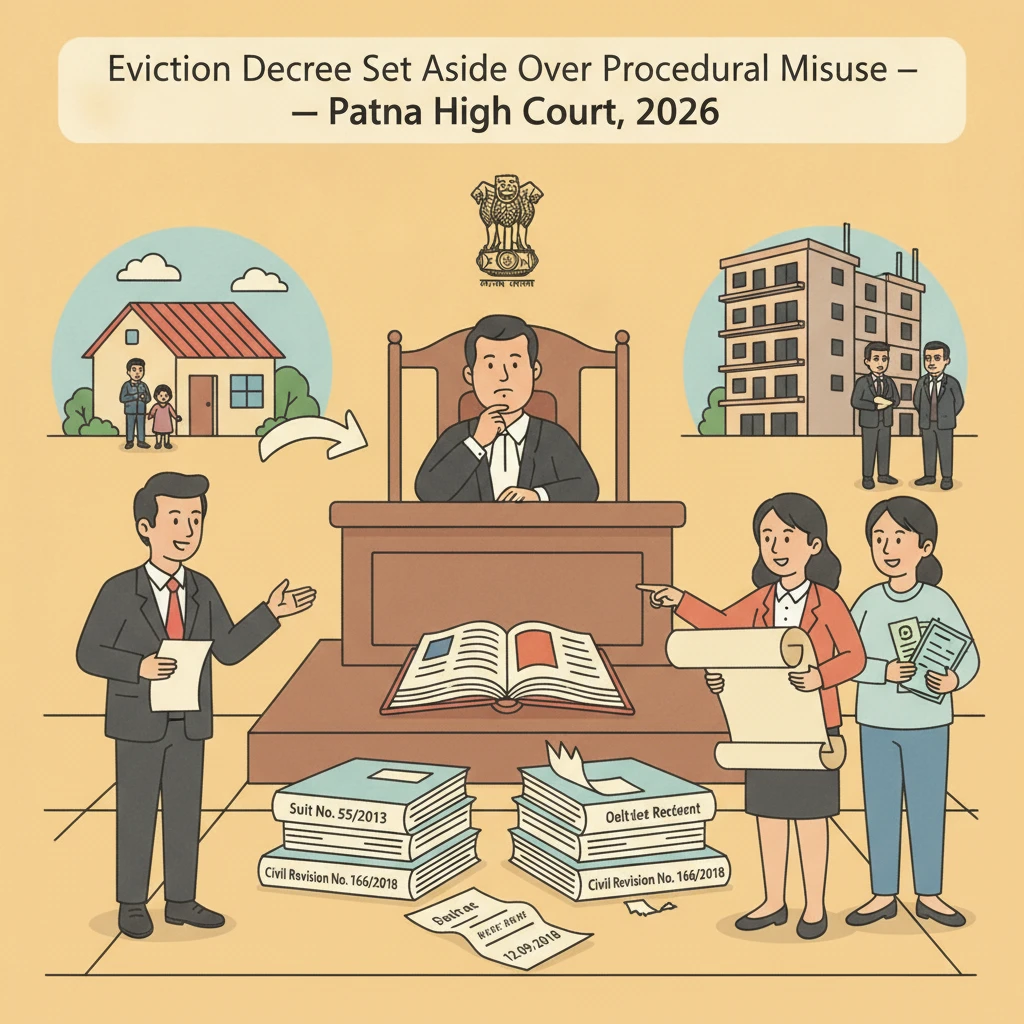
Case Background
The dispute began when the plaintiff filed Title Eviction Suit No. 55 of 2013 before the Court of Sub Judge-IX, Patna. He claimed to be the landlord of a house property and said that the defendant was a tenant on a monthly rent of Rs. 1,500.
He sought eviction on the ground of his personal requirement. At the same time, he invoked the special summary procedure under Section 14 of the Bihar Buildings (Lease, Rent and Eviction) Control Act (BBC Act). This special procedure is meant for quick disposal of landlord’s suits based on bona fide personal need.
The defendant, a woman, entered appearance and filed her written statement on 02.12.2013. She contested the claim completely. She said the suit was not maintainable on various technical grounds like limitation, estoppel, waiver and misjoinder or non-joinder of parties.
More importantly, she firmly denied that she was a tenant. Instead, she claimed to be the absolute owner in possession of the disputed land and house.
According to her pleadings, she had purchased the land by a registered sale deed dated 13.10.2003 (in another place mentioned as 16.12.2003) executed by one Md. Jawed, who is the real brother of the plaintiff. She also pointed out that the plaintiff himself had signed that sale deed as an attesting witness.
After purchase, she stated that she built a pucca house, got mutation done in her name in government records, and regularly paid rent, holding tax and electricity charges. She also obtained a possession certificate from the competent authority.
The defendant further stated that the plaintiff’s land lies to the north of her land and remains vacant, while she lives with her family in her own house. She alleged that the plaintiff, in collusion with a builder constructing an apartment nearby, filed the eviction suit to grab her property and to force her to sell.
On this basis, she argued that the BBC Act did not apply at all because there was no landlord-tenant relationship and the plaintiff had no cause of action.
What the Court Examined and Decided
The trial court focused on the special procedure under Section 14 of the BBC Act. It noted that the defendant had filed her written statement, but had not filed a separate affidavit seeking leave to contest the suit as required under Section 14(4).
Under Section 14(4), a tenant who receives summons in such a summary eviction case cannot contest unless he files an affidavit stating the grounds of defence and obtains leave from the court. If he does not appear or does not obtain such leave, the statements made by the landlord in the suit are deemed to be admitted, and the landlord becomes entitled to an eviction order.
Relying solely on this provision, the trial court held that, as no affidavit for leave to contest had been filed, the defendant could not be allowed to contest. It treated the statements in the plaint as deemed to be admitted and decreed the suit. The trial court directed the defendant to vacate the premises and hand over peaceful and vacant possession within two months, failing which the plaintiff could take steps for eviction through process of law.
Aggrieved by the eviction order dated 12.09.2018, the defendant filed Civil Revision No. 166 of 2018 before the Patna High Court under Section 14(8) of the BBC Act.
Before the High Court, the defendant’s counsel argued that the trial court had acted mechanically and in a summary manner, without properly considering the pleadings and materials. They pointed out that the written statement was already on record, and the case was at the stage of settlement of issues. Yet the trial court decreed the suit only on the technical ground of non-filing of the affidavit.
They emphasised that the very foundation of the eviction suit—existence of a landlord-tenant relationship—was in serious dispute. The defendant claimed ownership based on a registered sale deed from the plaintiff’s brother, with the plaintiff as an attesting witness. She had also pleaded mutation, possession certificate, payment of taxes and electricity charges, and construction of a pucca house.
On these facts, counsel argued that the BBC Act presupposes a tenancy, and when tenancy is denied and title is claimed, such an eviction suit under the BBC Act is itself doubtful. They further submitted that the plaintiff had not produced any rent receipt, lease deed or other evidence, nor had he examined himself as a witness to prove his case.
They relied on the principle that pleadings are not proof, and even in a Section 14 proceeding, the court must examine the genuineness and bona fides of the claim. Reliance was placed on the coordinate Bench judgment in Abhimanyu Prasad Sah v. Murlidhar Bhawsinghka, 1998 (1) PLJR.
On the other hand, counsel for the plaintiff supported the trial court’s order. They argued that the suit was rightly filed on the ground of personal necessity under Section 11(1)(c) read with Section 14 of the BBC Act. They stressed that the defendant had admittedly failed to file the affidavit under Section 14(4), and therefore the trial court had no option but to treat the plaint averments as admitted and pass the eviction order.
They argued that Section 14 of the BBC Act creates a special, summary procedure to prevent delay caused by frivolous defences from tenants. Once the defendant fails to file the required affidavit and obtain leave to contest, the court is not required to look into the written statement or record evidence. They cited earlier decisions such as Abdul Salam v. Mohammad Junai (Civil Revision No. 2327 of 2006) and Sardar Singh Karla v. Mahesh Kumar Lohani (Civil Revision No. 2211 of 2001), where it was held that without leave, the written statement cannot be considered and the plaintiff need not adduce evidence.
The Patna High Court first noted the limited scope of revisional jurisdiction under Section 14(8) of the BBC Act. A revisional court does not re-appreciate evidence like an appellate court. It only checks whether the lower court’s order suffers from jurisdictional error, illegality, material irregularity or perversity. For this principle, the Court referred to the Constitution Bench judgment of the Supreme Court in Hindustan Petroleum Corporation Ltd. v. Dilbahar Singh, (2014) 9 SCC 78.
The High Court then examined the facts closely. It was undisputed that the suit was filed under Section 14 and that the defendant had entered appearance and filed her written statement in time, but had not filed a separate affidavit under Section 14(4).
However, the Court highlighted an important aspect: for Section 14(4) to apply, the tenancy must be undisputed and the landlord-tenant relationship must be established. In this case, tenancy was clearly denied. Both parties had pleaded that their respective lands form part of the same Plot No. 752, Khata No. 52, Thana No. 38. The plaintiff claimed to have purchased the disputed land by a registered sale deed dated 28.07.1986, and in paragraph 3 of the plaint he himself admitted that the defendant had purchased the adjacent part of the suit premises on the west side by a registered sale deed dated 13.10.2003 from his elder brother Md. Jawed. The defendant also pleaded this fact in paragraph 5 of her written statement.
Taking these pleadings together, the High Court noted that there was at least a possibility that the disputed property had been purchased by the plaintiff, but at the same time the defendant was claiming independent ownership. In any case, the relationship of landlord and tenant was neither admitted nor established. Therefore, the strict requirement of Section 14(4) could not be applied in these facts.
The Court held that the trial court had proceeded only on the technical aspect of Section 14(4), ignoring the core dispute about title and tenancy. When foundational facts such as landlord-tenant relationship and tenancy are seriously in dispute, the deeming provision of Section 14(4) cannot be used to grant eviction merely because no affidavit for leave to contest was filed.
The High Court also stressed that even in a summary proceeding under Section 14, the court must be satisfied about essential ingredients: the existence of landlord-tenant relationship and the bona fide requirement of the landlord. In this case, there was no documentary evidence like rent receipts or lease agreement, and no oral evidence by the plaintiff, to support the plea of tenancy or personal necessity.
The Court then highlighted a broader principle of procedural law. It cited the Supreme Court’s decision in M/s Anvita Auto Tech Works Pvt. Ltd. v. M/s Aroush Motors, reported in 2025 INSC 1202. The Supreme Court in that case had emphasised that procedural rules are meant to advance justice, not to thwart it; that rigid adherence to technicalities should not cause injustice; and that substantial justice must not be sacrificed at the altar of procedural rigidity.
Applying this principle, the High Court held that the trial court should have adopted a pragmatic and justice-oriented approach. It should have examined whether the plaintiff had laid even minimal material to show tenancy and bona fide requirement, especially when the defendant was claiming ownership with supporting documents.
By decreeing the suit only due to non-filing of the affidavit, without verifying whether the basic ingredients for eviction were made out, the trial court failed to exercise its jurisdiction properly. This mechanical approach amounted to material irregularity.
Therefore, the Patna High Court set aside the impugned eviction order dated 12.09.2018 passed by Sub Judge-IX, Patna in Title Eviction Suit No. 55 of 2013. The matter was remitted back to the trial court for fresh adjudication in accordance with law.
The High Court directed that the defendant should be given adequate opportunity to contest the suit, and that the trial court should proceed expeditiously, settle issues, and decide the suit on its own merits, uninfluenced by any observations made in the revisional order. The Civil Revision was accordingly disposed of, and any interim order stood vacated.
Why This Judgment Matters
This judgment is important for tenants and occupants in Bihar who are facing eviction cases under the BBC Act, especially under the special summary procedure of Section 14.
It makes clear that the special rule requiring an affidavit for leave to contest cannot be used blindly in every case. Where the very existence of a landlord-tenant relationship is denied and ownership is claimed, courts cannot pass eviction orders only on the basis of non-filing of such an affidavit.
The Patna High Court has also emphasised that procedural rules are tools for justice, not weapons to dispossess people without proper inquiry. Even in summary cases, courts must check whether basic facts like tenancy and landlord’s bona fide need are supported by some evidence.
For ordinary people, this means that if they genuinely claim ownership and can show documents like sale deeds, mutation, tax receipts or possession certificates, courts should first look into these claims. They should not lose their homes only because of a technical lapse like not filing a particular affidavit, especially where the law itself presupposes a clear landlord-tenant relationship.
Legal Issues and Answers
Issue: Can a tenant (or alleged tenant) be evicted under Section 14(4) of the BBC Act solely for not filing an affidavit seeking leave to contest, when the landlord-tenant relationship itself is in serious dispute?
Answer: No. The Patna High Court held that Section 14(4) applies only where tenancy is undisputed and landlord-tenant relationship is established. When tenancy is denied and foundational facts are contested, courts cannot decree eviction merely on the technical ground of non-filing of the affidavit.
Issue: What is the duty of the trial court while using the special summary procedure under Section 14 of the BBC Act?
Answer: Even in summary proceedings, the court must satisfy itself about essential ingredients such as existence of landlord-tenant relationship and bona fide requirement. It cannot rely only on pleadings or procedural defaults without minimal judicial scrutiny of the claim.
Issue: When can the High Court interfere in revision under Section 14(8) of the BBC Act?
Answer: The High Court may interfere when the trial court’s order suffers from jurisdictional error, illegality or material irregularity, such as mechanically applying Section 14(4) without examining foundational facts, as happened in this case.
Cases Cited by the Court
- Hindustan Petroleum Corporation Ltd. v. Dilbahar Singh, (2014) 9 SCC 78 – Constitution Bench decision on the scope of revisional jurisdiction and limits on re-appreciation of evidence.
- M/s Anvita Auto Tech Works Pvt. Ltd. v. M/s Aroush Motors, 2025 INSC 1202 – Supreme Court decision emphasising that procedural rules must advance justice and cannot be applied with rigid technicality when substantial justice is at stake.
- Abhimanyu Prasad Sah v. Murlidhar Bhawsinghka, 1998 (1) PLJR – Coordinate Bench decision of the Patna High Court referred to by the petitioner regarding the need for judicial scrutiny even in Section 14 proceedings.
- Abdul Salam v. Mohammad Junai, Civil Revision No. 2327 of 2006 – Patna High Court decision relied upon by the opposite party, holding that without leave to contest, written statement cannot be considered.
- Sardar Singh Karla v. Mahesh Kumar Lohani, Civil Revision No. 2211 of 2001 – Patna High Court decision, cited by the opposite party, stating that if leave is not obtained and facts are deemed admitted, the plaintiff need not lead evidence.
Case Details
Case Number: Civil Revision No. 166 of 2018
Case Title: Raushan Praveen v. Md. Firoz
Coram: Hon’ble Mr. Justice Ramesh Chand Malviya
Date of Judgment: 05.05.2026
Citation: 2026 (3) PLJR 387
Advocates:
- For the petitioner: Mr. Uday Prasad, Advocate; Mr. Jitendra Kumar Bharti, Advocate; Mr. Vineet Kumar, Advocate
- For the respondent: Mr. Mukesh Kumar Jha, Advocate; Mr. Ujjwal Kumar, Advocate
Nature of the Case: Civil Revision under Section 14(8) of the Bihar Buildings (Lease, Rent and Eviction) Control Act, challenging an eviction decree passed under the special summary procedure of Section 14(4).
Result: Eviction order dated 12.09.2018 in Title Eviction Suit No. 55 of 2013 set aside; matter remitted to trial court for fresh adjudication on merits; Civil Revision disposed of; interim orders, if any, vacated.
Link to Judgment: Click here to read the full judgment of the Patna High Court
If you found this explanation helpful and wish to stay informed about how legal developments may affect your rights in Bihar, you may consider following Samvida Law Associates for more updates.







