
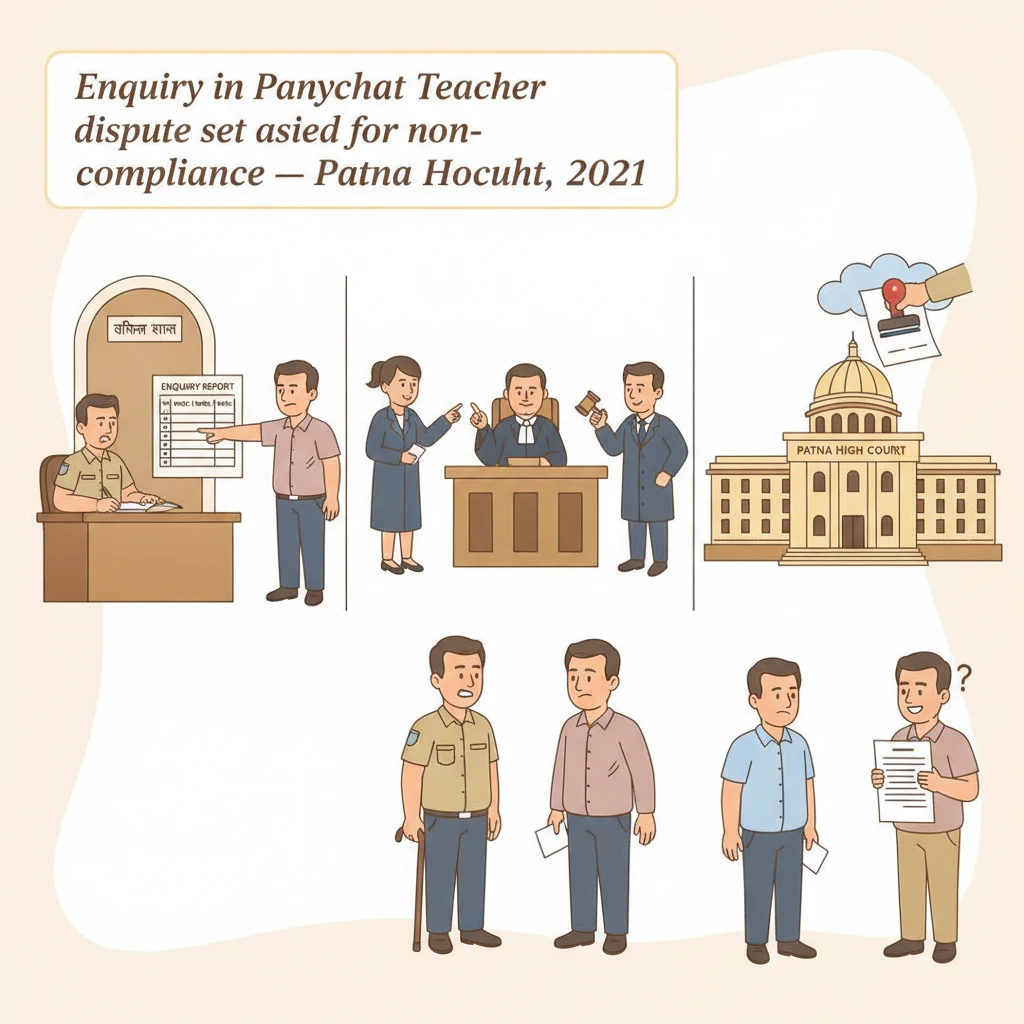
Case Background
The dispute arises from recruitment of Panchayat Teachers in Raj Bisharia Mohim Bujurg Gram Panchayat, Kusheshwar Asthan, District Darbhanga, pursuant to an advertisement issued in 2006.
Both the writ petitioner and respondent no. 11 applied for appointment as Panchayat Teacher. The petitioner applied under the category of physically disabled person and, as recorded by the Court, secured more marks than respondent no. 11.
Despite this, respondent no. 11 was appointed on the post. Feeling aggrieved, the petitioner lodged a complaint before the competent authority. On this complaint, a Two Men Enquiry Committee was constituted to examine the legality of the appointment.
The enquiry culminated in a joint report signed by the Block Education Officer and the Block Development Officer. According to the applicable rules noted in the judgment, only the Block Development Officer was competent to conduct the enquiry. Nevertheless, based on this enquiry report, the petitioner was appointed as Panchayat Teacher in place of respondent no. 11.
Respondent no. 11 then approached the Patna High Court in C.W.J.C. No. 3941 of 2008. He challenged the petitioner’s appointment mainly on the ground that the enquiry report had been finalized before the next scheduled date of enquiry and bore the joint signatures of both the B.D.O. and B.E.O., even though the latter was not authorized to be part of the enquiry.
Relying on this ground and following another petition on a similar issue, the High Court (Single Judge) quashed the appointment of the present writ petitioner and allowed the State to start fresh proceedings, if necessary. The Court also directed that respondent no. 11 be reinstated in service with all consequential benefits.
The present petitioner challenged this order in appeal by filing L.P.A. No. 1756 of 2015. The Appellate Court agreed that respondent no. 11 also had not been properly associated with the original enquiry. It held that, once the appointment of the petitioner was quashed, the Single Judge ought not to have ordered the reinstatement of respondent no. 11 merely because the enquiry was defective.
The Appellate Court therefore modified the Single Judge’s order. It directed that the reinstatement order in favour of respondent no. 11 would not be made effective. Instead, the official respondents were to conduct a fresh enquiry after giving adequate opportunity to the writ applicants and all other affected persons, and then take a decision in accordance with law.
What the Court Examined and Decided
In the present writ petition (C.W.J.C. No. 7307 of 2017), the petitioner complained that the directions issued in L.P.A. No. 1756 of 2015 had been blatantly ignored by the authorities.
According to the petitioner, respondent no. 11 was never removed from service, even though the Appellate Court had made it clear that the earlier reinstatement order was not to be given effect. The petitioner further alleged that the so-called fresh enquiry was conducted behind his back.
To support these allegations, the petitioner relied on the enquiry report and on Annexure-10, being memo no. 63 dated 16.01.2017. Annexure-10 was an information to the general public and, according to the petitioner, confirmed that respondent no. 11 continued to function as Panchayat Teacher during the enquiry period.
The enquiry report, as summarized in the judgment, showed that the committee had largely proceeded by merely perusing the relevant register. On that basis, it concluded that the petitioner’s appointment was bad in law. There was, however, nothing on record to show that the petitioner had been notified about the enquiry or given an opportunity to participate in it.
The petitioner argued that this was in clear violation of the Appellate Court’s directions. The Appellate Court had mandated a fresh enquiry, with adequate opportunity for all writ applicants and affected persons, and had not permitted respondent no. 11 to continue in service as a matter of right.
It was further submitted that, if the petitioner had known that the enquiry was being conducted while respondent no. 11 continued in service, he would have brought these facts to the notice of the Appellate Court earlier.
On the other side, learned counsel for respondent no. 11 raised two main objections.
First, he argued that the petitioner had an alternative statutory remedy. Instead of directly invoking the extraordinary writ jurisdiction of the Patna High Court, the petitioner ought to have approached the State Appellate Authority, which, according to him, was the proper forum to question the enquiry result and related service decisions.
Secondly, respondent no. 11’s counsel defended the enquiry. He submitted that the official respondents carried out the enquiry on the basis of the documents available on record. From the enquiry report, he highlighted two points: there had allegedly been an interpolation of marks, and the petitioner’s application had supposedly not been received for counselling and for appointment as Panchayat Teacher. On this basis, he contended that the conclusion reached by the enquiry committee could not be easily brushed aside.
The State’s counsel took a different stand. He fairly conceded before the Court that the directions of the Appellate Court in L.P.A. No. 1756 of 2015 had not been followed in “its entirety” and in “its letter and spirit”. Specifically, he admitted that respondent no. 11 had been allowed to continue working as Panchayat Teacher and that the enquiry had been completed without giving notice to the writ petitioner.
This admission became crucial for the Patna High Court’s decision. The Court emphasised that once the Appellate Court had laid down a particular course of action, the authorities were bound to comply strictly.
The Appellate Court’s modified order had two key elements:
First, the earlier direction to reinstate respondent no. 11 was not to be made effective. This meant that there was no automatic right for respondent no. 11 to continue in service pending the fresh enquiry.
Second, the authorities were required to carry out a fresh enquiry, giving adequate opportunity to all concerned, including the writ applicants and other affected persons.
The High Court in the present case found that neither of these instructions was followed. Respondent no. 11 continued to serve as Panchayat Teacher. The enquiry was conducted behind the petitioner’s back, without even informing him, let alone giving him an opportunity to participate or to respond to the allegations about marks or counselling.
Because the basic conditions laid down by the Appellate Court were not honoured, the High Court concluded that the enquiry was legally flawed. An enquiry conducted in disregard of the binding directions of a superior bench, and without hearing the affected party, could not stand.
In paragraph 11 of the judgment, the Court clearly stated that, for these reasons—non-compliance with the Appellate Court’s order and conducting the enquiry behind the petitioner’s back—the enquiry report was quashed.
However, the Court did not itself decide who should finally hold the Panchayat Teacher post. Instead, it restored the process directed by the Appellate Court and ensured that it would now be properly implemented.
The Court directed the “concerned authority” to implement the order passed by the Appellate Court “in its entirety”. It ordered that a fresh enquiry be conducted by the same authority, after duly notifying the petitioner, respondent no. 11, and all other affected parties.
The Court set a clear timeline. The enquiry was to commence one week after a copy of the order was produced before the concerned authority. From the date the enquiry actually commenced, the report had to be submitted within 30 days.
Importantly, the Court also protected the fairness of the process going forward. It directed that, until completion of the enquiry, respondent no. 11 “shall not be treated in service” and that “status quo shall be maintained.” This meant respondent no. 11 could not claim the Panchayat Teacher’s post as of right during the fresh enquiry.
Finally, the Court directed that necessary follow-up action be taken by the authorities after they received the new enquiry report. The writ petition was allowed to the extent of quashing the impugned enquiry report and issuing these directions.
Why This Judgment Matters
This judgment is important for people involved in government recruitment disputes, especially Panchayat Teachers and other local appointments in Bihar.
First, it shows that when the Patna High Court or its Appellate Bench sets out how an enquiry must be conducted, government officers cannot pick and choose which parts to follow. Non-compliance can lead to the entire enquiry being thrown out.
Second, the case highlights a basic rule of fairness: if your appointment or job is under enquiry, you must be informed and given a chance to be heard. An enquiry done behind your back is likely to be struck down.
Third, the Court’s direction that respondent no. 11 will not be treated in service during the fresh enquiry means that no candidate should enjoy an unfair advantage when the very legality of their appointment is under examination.
For candidates who feel cheated in recruitment processes, this decision illustrates that the High Court can intervene when authorities ignore binding court orders or conduct one-sided enquiries. At the same time, the Court reminded litigants that statutory appeal mechanisms exist, even though in this particular case it proceeded to grant relief.
Legal Issues and Answers
Issue: Whether the fresh enquiry into the Panchayat Teacher appointment, allegedly conducted pursuant to L.P.A. No. 1756 of 2015, was valid when respondent no. 11 continued in service and the petitioner was not given notice.
Answer: No. The Patna High Court held that the enquiry violated the Appellate Court’s directions and principles of fairness, and therefore quashed the enquiry report.
Issue: What directions should govern the resolution of the competing claims to the Panchayat Teacher post after quashing the enquiry report.
Answer: The Court directed the concerned authority to strictly implement the Appellate Court’s order by holding a fresh enquiry, after notifying the petitioner, respondent no. 11 and all affected parties, to be completed within 30 days of commencement. Until then, respondent no. 11 shall not be treated in service and status quo shall be maintained.
Issue: Whether the existence of a State Appellate Authority barred the present writ petition.
Answer: The Court did not dismiss the petition on this ground and instead proceeded to examine and quash the defective enquiry, in view of admitted non-compliance with the Appellate Court’s binding directions.
Cases Cited by the Court
- The judgment refers to earlier proceedings in C.W.J.C. No. 3941 of 2008 and L.P.A. No. 1756 of 2015, arising from the same recruitment dispute. No separate external precedents or reported cases are cited in the extracted text.
Case Details
Case Number: Civil Writ Jurisdiction Case No. 7307 of 2017
Case Title: Brahmdeo Yadav v. The State of Bihar & Ors.
Citation: 2022(1) PLJR 130
Court: High Court of Judicature at Patna
Coram: Hon’ble Mr. Justice Ashutosh Kumar
Date of Judgment: 29-11-2021
For the Petitioner: Mr. Raju Giri, Advocate; Mr. Santosh Kumar Gupta, Advocate; Mr. Ranjeet Kumar Yadav, Advocate
For the State/Official Respondents (Respondent nos. 2 to 10): Mr. Amit Bhushan, Advocate
For Respondent no. 11: Mr. Sanjay Kumar, Advocate
Nature of the Case: Writ petition under civil writ jurisdiction challenging the validity of a departmental enquiry and consequential actions regarding appointment to the post of Panchayat Teacher.
Link to Full Judgment: Patna High Court Judgment in CWJC No. 7307 of 2017
If you found this explanation helpful and wish to stay informed about
how legal developments may affect your rights in Bihar,
you may consider following Samvida Law Associates for more updates.







