
Case Background
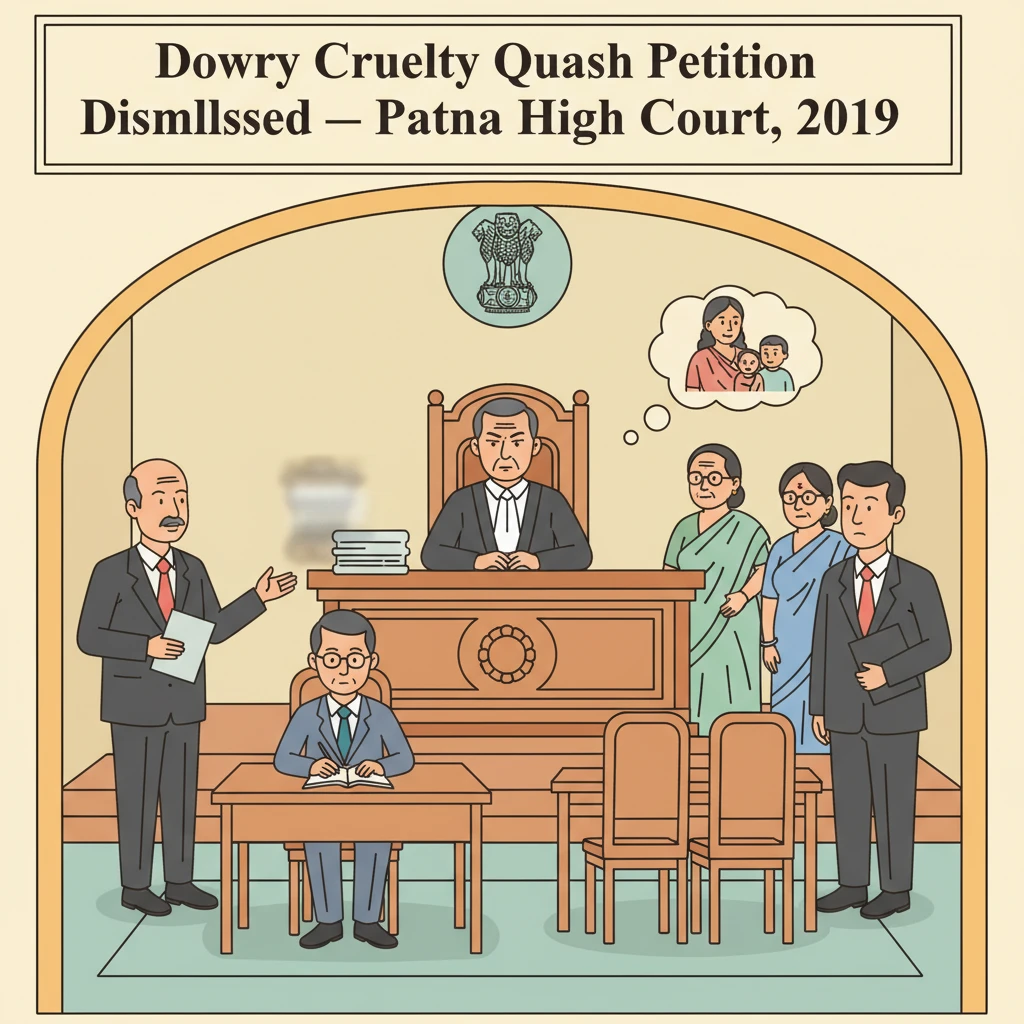
The case began with a complaint filed in 2014 before the Judicial Magistrate 1st Class, Patna City. The complainant is the wife of petitioner no. 1. She alleged cruelty, dowry demand, assault, and that her minor son was forcibly taken away from her custody by her husband and in-laws.
The complaint was registered as Complaint Case No. 1554 of 2014 (Patna). During enquiry, the Magistrate examined the complainant and her witnesses. After considering the materials, the Magistrate took cognizance of the offence under Section 498A of the Indian Penal Code only against three accused: the husband, his father, and his mother. Cognizance was taken by order dated 18.03.2015.
Unhappy with this order, the three accused approached the Patna High Court. They filed Criminal Miscellaneous No. 17273 of 2015 under Section 482 of the Code of Criminal Procedure, 1973. They asked the High Court to use its inherent powers to quash (cancel) the Magistrate’s order taking cognizance under Section 498A.
The matter came up before Hon’ble Mr. Justice Ahsanuddin Amanullah. The State of Bihar was arrayed as opposite party no. 1, and the wife as opposite party no. 2. Though the wife had entered appearance and filed a counter affidavit, and her lawyer’s name was printed in the cause list, nobody appeared for her when the case was heard. The Court therefore heard learned counsel for the petitioners and the learned Additional Public Prosecutor (A.P.P.) for the State and proceeded to decide the matter on the basis of the record.
What the Court Examined and Decided
The petitioners’ core request was to quash the criminal proceedings at the very threshold. They argued that even if the complaint was read as it is, no criminal offence under Section 498A IPC was made out against them.
The petitioners pointed to the complaint allegation that Rs. 8,00,000/- was demanded by the accused “for doing business”. According to them, this kind of money demand was not “dowry” within the meaning of Section 498A read with the Dowry Prohibition Act. On this basis, they claimed the entire complaint was outside the scope of dowry cruelty and should be closed.
To support this argument, learned counsel for the petitioners relied on two Supreme Court decisions. First, Appasaheb v. State of Maharashtra, (2007) 9 Supreme Court Cases 721. In that case, the Supreme Court had held that demands to meet urgent domestic expenses or to purchase manure could not be treated as demands for dowry. It was argued that, in the same way, a demand of money for business cannot be considered dowry.
Second, they relied on State of Karnataka v. Dattaraj, (2016) 12 Supreme Court Cases 331. In that case, the Supreme Court discussed the requirement under Section 304B of the Indian Penal Code that the woman should have been subjected to dowry harassment “soon before her death”. The petitioners highlighted paragraphs 19, 20 and 21 of that judgment, where the Court treated a particular demand as too remote in time from the death to qualify as “soon before” her death.
On the other side, the learned A.P.P. for the State supported the Magistrate’s order. He submitted that the Magistrate had conducted an enquiry, considered the complaint materials and witness statements, and then applied his judicial mind. Significantly, the Magistrate chose to take cognizance only against three of the five named accused, which, according to the State, itself showed careful scrutiny and not a mechanical order. Therefore, the State argued, there was no legal flaw in the cognizance order that would justify interference under Section 482 CrPC.
The High Court first examined whether there was any apparent absence of criminal offence from the complaint and enquiry materials. It noted that the allegation of demand of Rs. 8,00,000/- as dowry had been supported by the witnesses during the enquiry before the Magistrate. Thus, the demand was not a bare statement; it was backed by preliminary evidence recorded in the lower court.
The Court then carefully considered the petitioners’ reliance on Appasaheb. In that Supreme Court case, the accused had been convicted under Section 304B read with Section 34 IPC. While discussing the facts there, the Supreme Court had held that demands to meet urgent domestic expenses and for purchasing manure could not be treated as dowry.
However, the Patna High Court highlighted paragraph 11 of Appasaheb, which defines “dowry” and clarifies its legal scope. The Supreme Court had explained that “dowry” covers any property or valuable security given, or agreed to be given, directly or indirectly, at, before, or any time after the marriage, “in connection with” the marriage of the parties. The crucial requirement is a connection between the giving or taking of property or valuable security and the marriage.
From this, the Patna High Court concluded that Appasaheb does not simply rule out all money demands as non-dowry. Rather, the test is whether there is a nexus between the demand and the marriage. In the present case, according to the complaint, the husband’s family allegedly demanded Rs. 8,00,000/- and threatened that the complainant-wife would not be kept in her matrimonial home, and that the husband would remarry if the money was not paid.
These threats – to drive the wife out and to arrange a second marriage – were clearly tied to her status as wife and to the continuation of the marriage. Therefore, the Court held, there was a “direct nexus between the demand of dowry and marriage” in the present case. On this reasoning, the Court found Appasaheb actually supported, rather than undermined, the complainant’s case, because it confirmed that a money demand linked to the marital relationship can be treated as dowry.
Next, the Court considered the judgment in Dattaraj. In that case, at paragraph 19, the Supreme Court had discussed a demand of Rs. 20,000/- for purchase of agricultural land. The demand had allegedly been made by the husband’s father when he left the wife at her maternal home, while the husband himself was in Dubai. The husband returned to India eight to ten months later. A female child was born about one year after his return, and the wife stayed at her maternal home for four to five months after the birth.
On these facts, even assuming the demand of Rs. 20,000/- was true, the Supreme Court found that it was made about two years prior to the wife’s death. This was held to be too remote to meet the requirement of “soon before her death” under Section 304B(1) IPC. The conviction under dowry death could not be sustained on such a remote demand.
The Patna High Court pointed out that the Supreme Court in Dattaraj did not say that a demand for money to purchase land was not dowry. The problem in Dattaraj was the long time gap between the demand and the death, which failed the special requirement under Section 304B. In the present case, there was no such issue of proximity to death, because the case here was under Section 498A IPC, dealing with cruelty, not dowry death. Therefore, the reasoning in Dattaraj on “soon before death” did not assist the petitioners’ attempt to quash a Section 498A prosecution.
The Court then added another important aspect. Apart from the dowry demand, the complaint specifically alleged that the petitioners had taken away the minor son from the custody of the complainant-wife. The High Court treated this act as independently serious. It held that taking a minor child away from the mother, in the circumstances alleged, “by itself is sufficient to constitute cruelty”. The Court stated in clear terms that taking away a minor son from his mother “is nothing short of cruelty”.
This observation is significant because it indicates that, for the purpose of Section 498A IPC, cruelty is not confined only to physical assault or direct dowry harassment. Acts that deeply harm the emotional and parental bond of a mother, such as forcibly removing a minor child from her care, can also amount to cruelty.
Considering all these points together, the Patna High Court found “no merit” in the petition. The complaint and the enquiry evidence prima facie disclosed a demand for dowry linked to the marriage, supported by threats about the matrimonial home and a second marriage. Additionally, the alleged forcible taking of the minor son from the mother’s custody independently pointed to cruelty.
In such circumstances, this was not a case where the extraordinary power under Section 482 CrPC should be used to shut down the criminal proceedings at the outset. Interference at this stage would prevent a proper trial on serious allegations of dowry harassment and cruelty.
Accordingly, by its oral judgment dated 05.04.2019, the Patna High Court dismissed Criminal Miscellaneous No. 17273 of 2015. The Magistrate’s order dated 18.03.2015, taking cognizance under Section 498A IPC in Complaint Case No. 1554 of 2014, remains in force, and the trial before the Magistrate will proceed in accordance with law.
Why This Judgment Matters
This judgment is important for married women who face pressure for money from their husbands’ families. It shows that a demand for a large sum of money can be treated as dowry if it is connected with the marriage and backed by threats about the wife’s place in the matrimonial home or the husband remarrying.
The decision also highlights that cruelty under Section 498A is not limited to beating or verbal abuse. Taking a minor child away from the mother, as alleged here, can itself be treated as cruelty. This recognition is practically significant for mothers who suffer emotional harassment through control over children.
For accused persons, the judgment makes clear that the Patna High Court will not lightly quash criminal cases under Section 482 CrPC when there are specific allegations supported by witnesses and when the Magistrate has already applied his mind. Attempts to rely on Supreme Court judgments without matching facts are unlikely to succeed.
Legal Issues and Answers
Issue: Whether the Magistrate’s order taking cognizance under Section 498A IPC for an alleged Rs. 8,00,000/- demand and related acts was so defective that it should be quashed under Section 482 CrPC.
Answer: No. The Patna High Court held that the allegations and enquiry evidence showed a dowry demand directly linked to the marriage and acts of cruelty, so the cognizance order was valid and should not be quashed.
Issue: Whether, on the basis of Appasaheb and Dattaraj, a money demand for business or land purchase can never amount to dowry under criminal law.
Answer: No. The Court held that these Supreme Court cases do not rule out such demands as dowry. What matters is the nexus with marriage and, in dowry death cases, the timing “soon before death”. Those conditions are satisfied here at the stage of taking cognizance.
Issue: Whether taking away a minor son from the mother’s custody, as alleged, can amount to cruelty under Section 498A IPC.
Answer: Yes. The Court stated that taking a minor son away from his mother is, by itself, sufficient to constitute cruelty.
Cases Cited by the Court
- Appasaheb v. State of Maharashtra, (2007) 9 Supreme Court Cases 721.
- State of Karnataka v. Dattaraj, (2016) 12 Supreme Court Cases 331.
Case Details
Case Number: Criminal Miscellaneous No. 17273 of 2015, arising out of Complaint Case No. 1554 of 2014, Patna.
Case Title: Vivek Gupta & Ors. v. The State of Bihar & Anr.
Coram: Hon’ble Mr. Justice Ahsanuddin Amanullah.
Citation: 2019 (3) PLJR 182.
Advocates: For the petitioners: Mr. D.K. Sinha, Senior Advocate with Mr. Abhinav Raj, Advocate. For the State: Mr. Jharkhandi Upadhyay, A.P.P. Appearance for opposite party no. 2 is recorded, but no one was present at the time of hearing.
Nature of the Case: Petition under Section 482 of the Code of Criminal Procedure, 1973 seeking quashing of an order taking cognizance under Section 498A of the Indian Penal Code.
Link to Judgment: Patna High Court Judgment – CR. MISC. No. 17273 of 2015
If you found this explanation helpful and wish to stay informed about
how legal developments may affect your rights in Bihar,
you may consider following Samvida Law Associates for more updates.







