

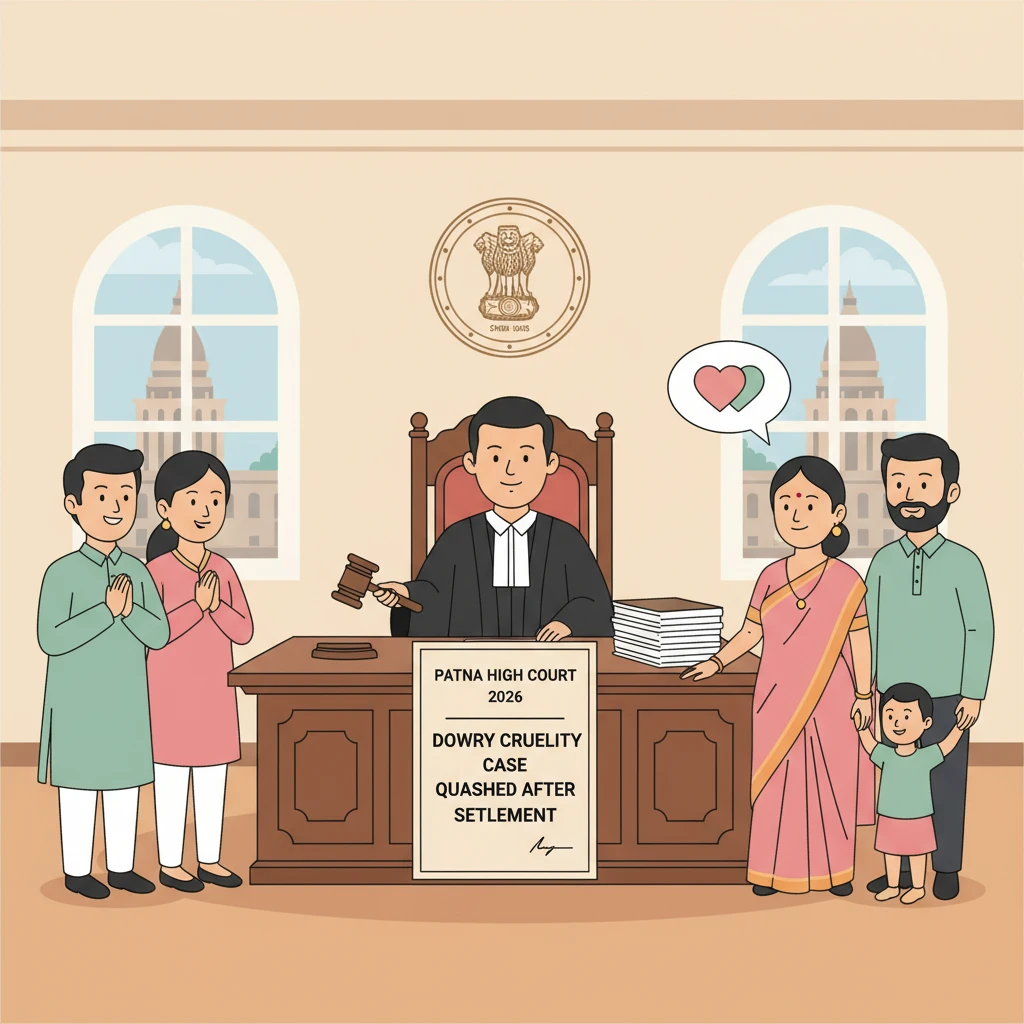
Case Background
A complaint case was filed in 2005 at West Champaran (Complaint Case No. 712(C) of 2005, S.Tr. No. 423 of 2018). The complainant, the wife, alleged that her in-laws subjected her to cruelty and demanded dowry. On this basis, the learned Sub-Divisional Judicial Magistrate (S.D.J.M.), West Champaran at Bettiah, took cognizance under Section 498A of the Indian Penal Code (IPC).
By order dated 06.02.2006, the S.D.J.M. issued summons against several accused persons, including the present petitioners. The petitioners are the sister-in-law and two brothers-in-law of the complainant’s husband.
Over time, the relationship between the parties changed. On 31.07.2019, a joint compromise petition was filed before the S.D.J.M., West Champaran at Bettiah. In that document, both sides informed the Magistrate that, with the interference of well‑wishers, they had amicably settled their dispute. They stated that the compromise was voluntary, without any threat or coercion, and that the complainant did not want to pursue the case further.
The compromise was later reaffirmed before the Patna High Court. Opposite party no. 2 (the complainant) filed a counter affidavit specifically stating in paragraphs 4 and 5 that all issues between the parties had been resolved, that she had signed the compromise petition on 31.07.2019, and that she no longer wished to continue the criminal case.
It was further indicated that, after the settlement, the complainant and her husband’s family were living together peacefully in the joint family house. In this background, the sister-in-law and brothers-in-law approached the Patna High Court by filing Criminal Miscellaneous No. 35893 of 2021, seeking quashing of the 06.02.2006 cognizance order and the criminal proceedings arising from Complaint Case No. 712(C) of 2005.
What the Court Examined and Decided
The matter was heard by Hon’ble Justice Smt. Soni Shrivastava on 13.01.2026. The Court heard Mr. Rajesh Mohan, learned counsel for the petitioners, the learned APP for the State of Bihar, and Mr. Sanjan Kumar Sharan, learned counsel for opposite party no. 2.
The petitioners’ counsel stressed that the dispute which had led to the complaint had already been settled. He relied on the joint compromise petition dated 31.07.2019 filed before the S.D.J.M. and on the complainant’s stand that she did not wish to proceed with the case. He argued that, in such circumstances, continuing the criminal case against the in‑laws under Section 498A IPC would be meaningless and would only prolong bitterness.
The learned counsel for opposite party no. 2 supported this position. In her counter affidavit, opposite party no. 2 confirmed that she had signed the compromise on 31.07.2019 and that the parties were now living peacefully in the joint family house. She clearly stated that, in the changed situation, there was no good ground to continue the criminal case against the petitioners.
The Court first noted that the petitioners were not the husband, but his close relatives: the sister‑in‑law and two brothers‑in‑law of the complainant. The allegations in the complaint related to demand of dowry and cruelty under Section 498A IPC against them along with other accused persons.
The key question for the Patna High Court was whether, despite the offences being non‑compoundable, it should use its inherent powers under Section 482 of the Code of Criminal Procedure (Cr.P.C.) to quash the proceedings, when the parties themselves had amicably settled their matrimonial dispute and wished to move on.
The Court observed that in cases under Section 498A IPC involving relatives of the husband, if the parties have compromised and are living together peacefully, continuation of the criminal prosecution may not serve any useful purpose. The Court emphasised that there are several judicial pronouncements where even non‑compoundable offences have been quashed, when it is clear that the complainant does not want to pursue the case and the dispute is essentially personal and has been settled.
To support this, the Court relied on recent and earlier decisions of the Hon’ble Supreme Court. It referred to the case of Mange Ram Vs. State of Madhya Pradesh and Anr. [2025 INSC 962]. In that case, the Supreme Court discussed the tendency of roping in multiple family members of the husband in matrimonial disputes and held that, where a compromise has been reached in such matters, continuation of criminal proceedings in non‑compoundable offences would be an exercise in futility. Justice demands that when parties have resolved their differences, the criminal dispute should come to an end and peace should be restored.
The Patna High Court also cited Gian Singh Vs. State of Punjab, reported in (2012) 10 SCC 303. In that landmark judgment, the Supreme Court held that High Courts, exercising their inherent powers under Section 482 Cr.P.C., can quash criminal proceedings if, in view of a genuine settlement, there is hardly any likelihood of conviction and if continuing the case would defeat the ends of justice.
Further, the Court relied on Naushey Ali vs. State of U.P., reported in (2025) 4 SCC 78. In that case, the Supreme Court clearly observed that when parties have amicably resolved their dispute, carrying on with the criminal trial would be futile. The ends of justice require that such settlements be respected by quashing the proceedings; otherwise, it would amount to a grave abuse of the process of the court.
Applying these principles, the Patna High Court examined the specific facts before it. It noted:
- The case arose out of a matrimonial dispute relating to dowry and cruelty under Section 498A IPC.
- The petitioners were family members of the husband (sister‑in‑law and brothers‑in‑law), not the principal accused husband himself.
- A joint compromise petition had been filed as far back as 31.07.2019 before the S.D.J.M., stating that the settlement was voluntary and that the complainant no longer wished to proceed.
- Opposite party no. 2, through her counsel and counter affidavit, reaffirmed that position before the High Court and disclosed that the parties were living together peacefully in a joint family.
- There were no specific allegations brought to the Court’s notice which would justify continuing the criminal case against the petitioners despite the settlement.
In this backdrop, the Court found that keeping the criminal case alive against the husband’s relatives would not serve any legitimate purpose. Instead, it would merely prolong bitterness between the parties and unnecessarily burden the justice system, especially when the disputes were no longer “live”.
The Court stressed that, in matters of personal disputes that have been genuinely settled, it is the duty of the High Court to bring quietus, that is, to bring an end to the litigation. Using its inherent powers under Section 482 Cr.P.C., the Court concluded that continuation of the criminal proceedings in such a settled matrimonial matter would amount to abuse of the process of the Court.
Accordingly, the Patna High Court quashed the impugned order dated 06.02.2006 passed by the S.D.J.M., West Champaran at Bettiah in Complaint Case No. 712(C) of 2005 (S.Tr. No. 423 of 2018), insofar as it related to the petitioners. It also quashed the criminal prosecution arising out of that complaint case against the petitioners. The criminal miscellaneous application was allowed.
Why This Judgment Matters
This judgment is important for people involved in matrimonial disputes, especially those where multiple in‑laws are named in a dowry‑cruelty case under Section 498A IPC.
The Patna High Court has clearly shown that when the husband’s family and the complainant wife genuinely settle their differences and resume peaceful cohabitation, the Court can step in to stop criminal cases against relatives, even if the offence is technically non‑compoundable.
For families in Bihar and elsewhere, this decision reinforces that criminal law is not meant to keep old quarrels alive when both sides have chosen to move on. It also confirms that the High Court will look carefully at whether the case is still serving any purpose, or only causing unnecessary harassment and pressure on the parties and the justice system.
Legal Issues and Answers
-
Issue: Can the Patna High Court quash a pending Section 498A IPC case against the husband’s relatives when the parties have amicably settled their matrimonial dispute and are living together, even though the offence is non‑compoundable?
Answer: Yes. Exercising its inherent powers under Section 482 Cr.P.C., the Court held that in a settled matrimonial dispute involving husband’s relatives, continuing the criminal proceedings would be futile and an abuse of process, and therefore quashed the cognizance order and prosecution against the petitioners.
Cases Cited by the Court
- Mange Ram Vs. State of Madhya Pradesh and Anr., 2025 INSC 962
- Gian Singh Vs. State of Punjab, (2012) 10 SCC 303
- Naushey Ali vs. State of U.P., (2025) 4 SCC 78
Case Details
Case Number: Criminal Miscellaneous No. 35893 of 2021
Arising out of: Complaint Case No. 712(C) of 2005 (S.Tr. No. 423 of 2018), P.S. Case No. 712 of 2005, Thana West Champaran Complaint, District West Champaran
Case Title: Baby Naz & Ors. vs. The State of Bihar & Anr.
Citation: 2026(2) PLJR 184
Coram: Hon’ble Justice Smt. Soni Shrivastava
Advocates:
- For the Petitioners: Mr. Rajesh Mohan, Advocate
- For the State: Mrs. Usha Kumari, APP
- For Opposite Party No. 2: Mr. Sanjan Kumar Sharan, Advocate
Nature of the Case: Petition under Section 482 Cr.P.C. seeking quashing of cognizance order and criminal proceedings under Section 498A IPC arising out of a matrimonial dispute based on compromise.
Date of Judgment: 13.01.2026
Court: High Court of Judicature at Patna
Link to the Judgment: View original judgment on Patna High Court website
If you found this explanation helpful and wish to stay informed about
how legal developments may affect your rights in Bihar,
you may consider following Samvida Law Associates for more updates.







