
Case Background
This case arose from a matrimonial dispute between a wife and her husband, with allegations of dowry cruelty against the husband and his two younger brothers.
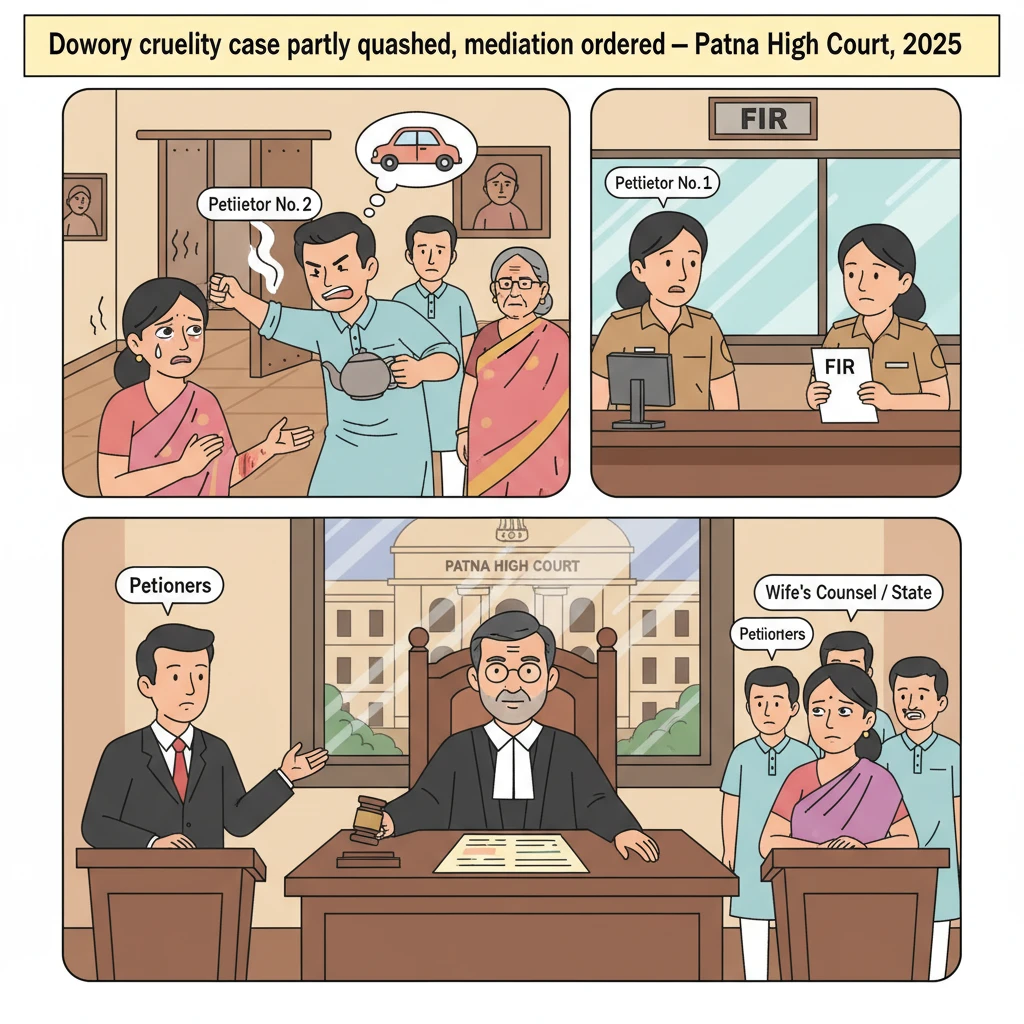
The wife lodged an FIR at Mahila Police Station, Bhagalpur, registered as P.S. Case No. 58 of 2017. She stated that she had married petitioner no. 1, her husband, on 01.12.2014 according to Hindu rites and customs.
According to the FIR, soon after the marriage, the husband and his family members began torturing her mentally and physically. The alleged demand was for a four-wheeler as dowry. There was a specific allegation that petitioner no. 2, one of the younger brothers, threw hot tea on her body, causing burn injuries.
On these allegations, the police registered the case under Sections 498A, 341, 323, 379, 504 and 506 read with Section 34 of the Indian Penal Code. After investigation, the case proceeded before the court of the learned Sub-Divisional Judicial Magistrate (S.D.J.M.), Bhagalpur, as G.R. Case No. 4105 of 2017.
During the proceedings, the three accused brothers filed an application under Section 262(1) of the Bharatiya Nagarik Suraksha Sanhita (BNSS), seeking discharge from the case. They argued that no sufficient material existed to continue the charges.
On 16.05.2025, the S.D.J.M., Bhagalpur, rejected their discharge application, holding that there was a prima facie case to proceed. Aggrieved by that order, the three brothers filed the present Criminal Miscellaneous No. 44166 of 2025 before the Patna High Court under Section 528 BNSS, seeking quashing of the 16.05.2025 order and the related criminal proceedings.
What the Court Examined and Decided
The matter came up before Hon’ble Mr. Justice Purnendu Singh on 24.11.2025. The Court heard the learned counsel for the petitioners, the learned counsel for Opposite Party No. 2 (the wife), and the learned APP for the State of Bihar.
On behalf of the petitioners, it was argued that the allegations arose out of a dispute between husband and wife, and were not offences against society at large. Counsel submitted that petitioner no. 1 is the husband, while petitioners nos. 2 and 3 are his younger brothers. It was contended that what began as “little matrimonial skirmish” had turned into hatred, but such disputes are often later resolved amicably outside court. Implicit in this argument was that the criminal process should not be used harshly against all family members in such circumstances.
On the other side, counsel for the wife and the learned APP argued that Opposite Party No. 2 was being harassed by the petitioners, and therefore the quashing application deserved to be dismissed. At the same time, they accepted that an opportunity should be given to both sides to settle the dispute amicably.
After hearing the parties, the Patna High Court noted the settled legal position regarding matrimonial disputes. The Court observed that while cruelty for dowry is a serious allegation, the Supreme Court has repeatedly cautioned that the husband’s entire family should not be unnecessarily dragged into criminal cases.
The Court recorded that in society it is commonly seen that all family members and relatives are made accused along with the husband. The Supreme Court has drawn a line and guided how such complaints should be entertained by district courts.
Looking at the FIR, the High Court found that there was no specific allegation against petitioner no. 3, the younger brother of the husband. The only accusation against him was general and omnibus in nature. There was no clear act of cruelty or specific incident attributed to him.
The Court then referred to important Supreme Court judgments on matrimonial disputes. In B.S. Joshi v. State of Haryana, (2003) 4 SCC 675, the Supreme Court stressed that in matrimonial matters the courts should encourage genuine settlements of disputes. That judgment recognised that marriage is a sacred ceremony and that small disputes often get blown out of proportion, dragging elders into criminal cases and consuming the “young days” of the parties in court battles.
The Patna High Court also cited the decision in Navneesh Aggarwal & Ors. v. State of Haryana & Anr., 2025 INSC 963, where the Supreme Court reiterated that the family members of a husband should not be compelled to face a vexatious criminal trial when there are no clear allegations against them.
Relying on these authorities and examining the FIR, the High Court held that no case under Section 498A and other allied sections of the IPC was made out against petitioner no. 3. Therefore, the Court quashed the entire criminal proceedings, along with the order dated 16.05.2025, to the extent they related to petitioner no. 3.
Regarding petitioner no. 2, however, the Court took a different view. The FIR contained a specific allegation that he had thrown hot tea on the body of the wife, causing burn injuries. The Court held that in the face of this concrete accusation, the prosecution against petitioner no. 2 could not be interfered with at this stage. Thus, the trial against him would continue.
For petitioner no. 1, the husband, the Court considered not only the allegations but also the possibility of reconciliation. The Court discussed the recent Supreme Court decision in Mange Ram v. State of Madhya Pradesh & Another, Special Leave Petition (Criminal) No. 10817 of 2024. In that case, particularly in paragraphs 25 and 31, the Supreme Court emphasised two points:
First, following Dara Lakshmi Narayana v. State of Telangana, (2025) 3 SCC 735, the Court reiterated that criminal law should not be used to harass every member of the husband’s family when allegations lack specific details or when relatives live separately. Courts must guard against misuse of criminal law in matrimonial discord.
Second, drawing from Gian Singh v. State of Punjab, (2012) 10 SCC 303, the Supreme Court held that High Courts can quash criminal proceedings arising out of matrimonial disputes, even for non-compoundable offences, if the parties have genuinely settled their disputes and there is little likelihood of conviction. The guiding factor is securing the ends of justice and restoring peace.
The Patna High Court further referred to Naushey Ali & Ors. v. State of Uttar Pradesh & Anr., (2025) 4 SCC 78. There, the Supreme Court discussed misuse of Section 498 IPC in matrimonial dowry disputes and held that offences arising out of such disputes, where the wrong is primarily to the victim, can be settled amicably between the parties.
Applying these principles, the High Court observed that although a prima facie case existed against the petitioners, strictly following the usual criminal procedure in the present facts would not serve the interest of justice or the parties. The Court recorded that petitioner no. 1, the husband, had agreed to settle the dispute with his wife outside court and had willingly expressed his desire to appear before the District Court.
In these circumstances, the Court crafted a hybrid order: part quashing, part mediation direction, and part protection order.
First, the Court directed that petitioner no. 1 shall appear before the learned District Court on 17.12.2025 at 10:30 AM. The District Court was instructed to issue necessary notices to both sides and, after their appearance, refer the matter to the learned Mediator of the District Mediation Centre by fixing a date for mediation.
Secondly, the Mediator was directed to make best efforts to settle the dispute amicably between the parties. A time limit of six months was fixed for the mediation process. Until the mediation process is completed and the mediator’s report is submitted to the District Court, no coercive action shall be taken against petitioner no. 1 in the case.
Thirdly, the Court clarified what should happen after mediation. If the parties resolve their dispute amicably or reach a mutual agreement, then, in the light of the Supreme Court judgments cited, the criminal proceeding would be required to be dropped.
However, the Court also made it clear that if petitioner no. 1 fails to appear before the District Court on 17.12.2025 or on any date fixed by the Mediator without any reason, the interim protection against coercive action will automatically lapse.
Similarly, if it is found that the husband is deliberately avoiding reconciliation, the District Court shall proceed with the trial in the normal course. On the other hand, if it appears that Opposite Party No. 2 is deliberately avoiding reconciliation, then the interim protection in favour of petitioner no. 1 will continue, and the trial will proceed in accordance with law.
In conclusion, the Patna High Court modified the order dated 16.05.2025 to this extent. The criminal miscellaneous application was disposed of with the quashing of proceedings against petitioner no. 3, continuation against petitioner no. 2, and conditional protection and mediation for petitioner no. 1.
Why This Judgment Matters
This judgment has practical importance for families facing dowry and cruelty cases in Bihar and beyond.
First, it confirms that courts will not blindly allow the entire family of a husband to be prosecuted when there are no specific allegations. Mere general or omnibus accusations against relatives may not be enough to drag them through a long criminal trial.
Second, the decision shows that the Patna High Court is willing to promote mediation in matrimonial disputes, especially in dowry-related cases, when both sides are open to settlement. This can save years of litigation and emotional stress for both spouses.
Third, the judgment makes it clear that genuine, specific allegations of cruelty, such as the alleged incident of throwing hot tea and causing burns, will still be taken seriously. The court refused to interfere with such charges at the initial stage.
Finally, the order provides a balanced approach: protection from arrest for the husband while mediation is tried, but with clear consequences if he or the wife misuses this opportunity. This signals that the Patna High Court expects both sides to act in good faith when the court opens a door for settlement.
Legal Issues and Answers
- Issue: Should the criminal proceedings in a dowry-cruelty case be quashed against all three accused brothers when one has only general allegations against him?
Answer: The Patna High Court quashed the proceedings only for petitioner no. 3, finding no specific allegation against him, but allowed the case to continue against the husband and petitioner no. 2. - Issue: Can the High Court direct mediation and grant interim protection in a pending 498A-type case based on willingness of the parties to settle?
Answer: Yes. Relying on Supreme Court precedents, the Court referred the matter to the District Mediation Centre, granted interim protection to the husband, and laid down conditions under which proceedings may later be dropped or continued.
Cases Cited by the Court
- B.S. Joshi v. State of Haryana, (2003) 4 SCC 675
- G.V. Rao v. L.H.V. Prasad, (2000) 3 SCC 693 : 2000 SCC (Cri) 733 (referred within B.S. Joshi extract)
- Navneesh Aggarwal & Ors. v. State of Haryana & Anr., 2025 INSC 963
- Mange Ram v. State of Madhya Pradesh & Another, Special Leave Petition (Criminal) No.10817 of 2024
- Dara Lakshmi Narayana v. State of Telangana, (2025) 3 SCC 735 (as referred in Mange Ram)
- Gian Singh v. State of Punjab, (2012) 10 SCC 303
- Naushey Ali & Ors. v. State of Uttar Pradesh & Anr., (2025) 4 SCC 78
Case Details
Case Number: Criminal Miscellaneous No. 44166 of 2025; arising out of P.S. Case No. 58 of 2017, Mahila P.S., District Bhagalpur; G.R. Case No. 4105 of 2017
Case Title: Tripurari Kumar Yadav @ Tripurari Kumar & Ors. v. The State of Bihar & Anr.
Coram: Hon’ble Mr. Justice Purnendu Singh
Date of Judgment: 24.11.2025
Citation: 2026 (1) PLJR 51
Advocates: Mr. Bachan Jee Ojha, Advocate for the petitioners; Mr. Vikram Singh, Advocate for Opposite Party No. 2; Mr. Uday Pratap Singh, A.P.P. for the State
Nature of the Case: Criminal miscellaneous application under Section 528 BNSS seeking quashing of order rejecting discharge under Section 262(1) BNSS in a dowry-cruelty and allied offences case under Sections 498A, 341, 323, 379, 504, 506/34 IPC
Link to Judgment: Click here to view the full judgment on the Patna High Court website
If you found this explanation helpful and wish to stay informed about how legal developments may affect your rights in Bihar, you may consider following Samvida Law Associates for more updates.







