
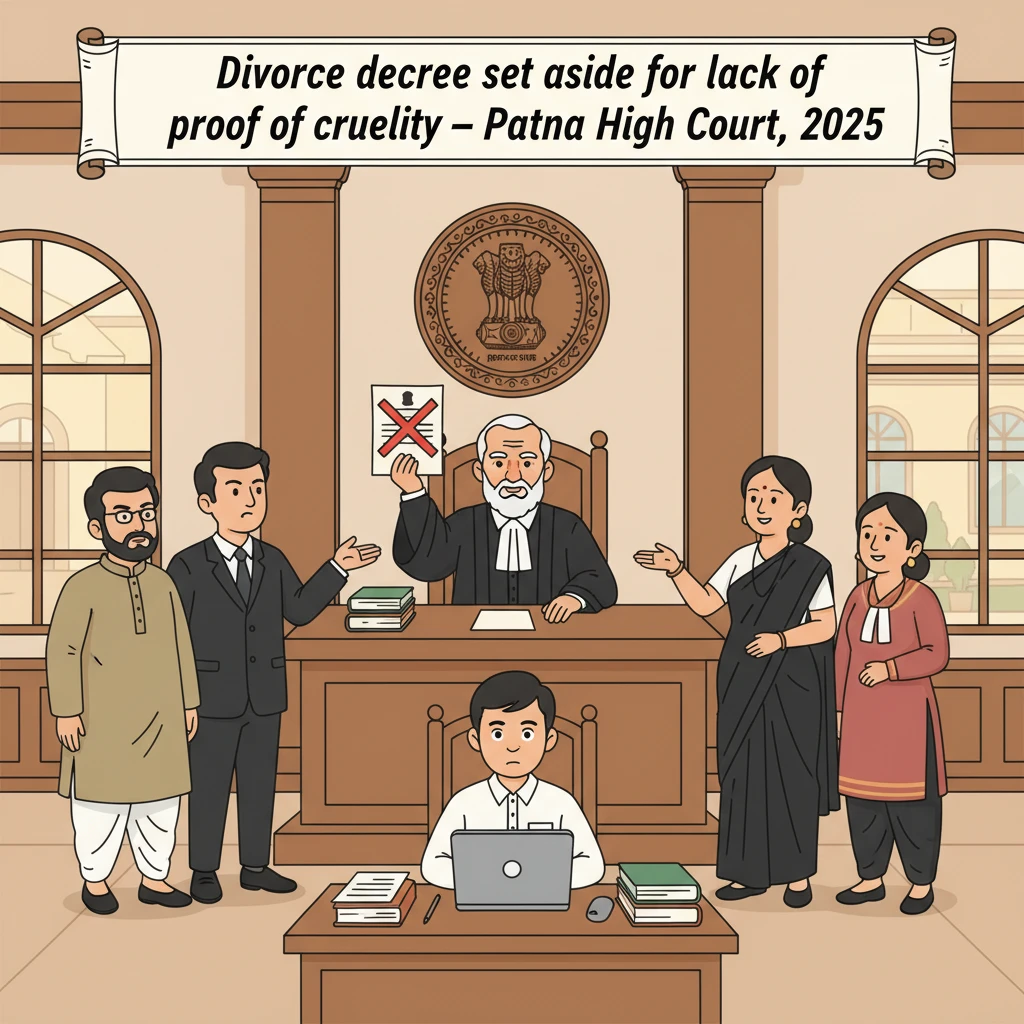
Case Background
This case arises out of a matrimonial dispute between a husband and wife married in May 2005 according to Hindu rites and customs. After marriage, the wife went to live in her matrimonial home.
The husband’s case before the Family Court was that the wife stayed in the matrimonial house for a few months, then went to her parents’ house and did not return, despite several efforts by him and his father. He alleged that in June 2006 he went to his in-laws’ house with relatives, but the wife refused to come back.
According to the husband, he later came to know that the wife had an illicit relationship with another man (arrayed as respondent no. 2) who frequently visited her parental home. He also claimed that she became pregnant, gave birth to a female child who died soon after birth, and that the spouses never cohabited after marriage. On this basis, he said the wife had deserted him and their marriage had broken down.
The wife presented a very different background. In her written statement before the Family Court, she alleged that after around 3–4 months of marriage, the husband and his family began demanding dowry, including a motorcycle and colour TV, and subjected her to cruelty. She claimed she conceived and gave birth to a female child who later died, and that on 20.04.2009 she was assaulted and thrown out of her matrimonial home.
The wife then filed Complaint Case No. 2761 of 2009, which led to Bhore P.S. Case No. 2 of 2010 under Sections 498A, 406 and 34 of the Indian Penal Code. She alleged that the husband and his father were in jail for 6–7 months. Later, with the intervention of relatives, a compromise was entered into and she returned to the matrimonial house.
The record shows that earlier the husband had also filed M.M. Case No. 62 of 2009 for divorce, which ended in compromise, and he was directed to keep the wife with dignity and honour. According to the wife, even after this compromise, torture for dowry continued, and the husband took a job in Dubai. She claimed that despite the compromise, he again filed a divorce case on the same allegations, which became M.M. Case No. 176 of 2011.
On the rival pleadings, the Principal Judge, Family Court, Gopalganj framed issues, led evidence from both sides, and by judgment and decree dated 25.02.2019 allowed the husband’s divorce petition in M.M. Case No. 176 of 2011. The Family Court granted divorce on grounds of cruelty and desertion, subject to payment of Rs. 2,50,000/- as permanent alimony for life support of the wife.
Aggrieved, the wife filed Miscellaneous Appeal No. 247 of 2019 under Section 19(1) of the Family Courts Act, 1984 before the Patna High Court.
What the Court Examined and Decided
The Patna High Court, comprising Hon’ble the Acting Chief Justice and Hon’ble Mr. Justice S. B. Pd. Singh (author of the judgment), heard both sides. The Court focused on two main questions: whether the wife (appellant) was entitled to relief in appeal, and whether the Family Court’s divorce decree was legally sustainable.
The husband examined himself as P.W.1 and his father as P.W.2. P.W.1 stated that after marriage the wife came to the matrimonial home, but later went to her parents’ house and did not return despite repeated attempts. He claimed she had an illicit relationship with respondent no. 2, was not willing to live with him, and therefore he sought divorce.
P.W.2, the husband’s father, supported the broad timeline of marriage in 2005, the wife staying for about 3–4 months and then shifting to her parents’ house, and the husband’s attempts to bring her back. He denied that the wife was ever ousted from her matrimonial home. He also confirmed that earlier M.M. Case No. 62 of 2009 for divorce had been compromised and, on that basis, the wife had returned to her matrimonial home.
On the other hand, the wife examined herself as O.P.W.1 and her father as O.P.W.2. The wife deposed that after 3–4 months of marriage, the husband and in-laws started demanding motorcycle and colour TV in dowry. She claimed that for non-fulfilment of these demands, she was tortured and ultimately ousted from the matrimonial house, and since September 2005 she had been living at her parents’ house. She denied any misbehaviour towards her in-laws.
Her father, O.P.W.2, stated that his daughter was tortured for dowry “few days” after marriage and was finally ousted on 20.04.2009. He supported the dowry-cruelty and ouster allegations.
The Family Court had earlier concluded that the husband had proved cruelty and desertion by the wife and granted divorce on both grounds. The High Court, therefore, closely checked whether the evidence actually supported such a finding.
The High Court noted that the husband’s allegation of the wife “always” quarrelling with him and his family members was vague. No specific incident with any particular date, time or detailed description was mentioned either in the plaint or in his evidence. There was no concrete instance of serious misbehaviour that could be tested by the Court.
Further, the husband admitted in his evidence that before filing this second divorce case, there had been no relationship between him and the wife. Yet he had not filed any petition under Section 9 of the Hindu Marriage Act for restitution of conjugal rights, which could have shown real intention to resume marital life. The Court treated this as a relevant factor against his plea that he genuinely wanted to live with her but she deserted him.
On the allegation of adultery, the High Court found that the husband had brought no proof to show that the wife was in an illicit relationship with respondent no. 2, or that they were “living in adultery.” The Court emphasised that he had not produced any cogent or reliable evidence. The allegation appeared to have been made merely to create a legal ground for divorce.
The Court then discussed the legal standard for “cruelty” under Section 13(1)(ia) of the Hindu Marriage Act, 1955. Though cruelty is not precisely defined in the Act, the Court reiterated that it must be of such character and conduct as to cause in the mind of the other spouse a reasonable apprehension that it is harmful or injurious to live with the other.
Relying on the Supreme Court’s decision in Samar Ghose vs. Jaya Ghose, 2007 (4) SCC 511, the High Court recalled that sustained unjustifiable conduct affecting physical and mental health, and grave and substantial treatment, are required. Ordinary wear and tear, trivial irritations and normal quarrels of married life are not enough for mental cruelty.
The Court also quoted at length from the Supreme Court judgment in Narain Ganesh Dastane vs. Sucheta Narain Dastane, AIR 1975 1534, stressing that what matters is the effect of the conduct on the particular spouse, not on a hypothetical “reasonable person,” and that courts deal with real individuals, not ideal husbands and wives.
Applying these principles, the High Court held that the husband failed to discharge his burden of proving cruelty. Not a single specific incident with date was pleaded or proved. The evidence lacked the necessary detail and seriousness to meet the statutory threshold for cruelty. It observed that occasional harsh words, minor threats or retaliatory acts, which may occur in day-to-day conjugal life, cannot by themselves justify divorce.
The Court also noted that the wife was still ready to live with the husband. It stressed that austerity of temper, petulance, or harsh language can vary from person to person, depending on background, education and social status, and do not automatically amount to legal cruelty.
On the adultery ground, the Court clarified that adultery involves (i) an act of sexual intercourse outside marriage and (ii) that such intercourse must be voluntary. No evidence was produced to show any act of sexual intercourse between the wife and respondent no. 2. Hence, adultery was not proved at all.
In the end, the High Court concluded that the Family Court’s findings on cruelty and adultery were unsustainable. The husband had not proven either ground with cogent, relevant and reliable evidence, even though the burden lay squarely on him.
Accordingly, by judgment dated 01.09.2025, the Court set aside the Family Court’s judgment and decree dated 25.02.2019 in M.M. Case No. 176 of 2011. The divorce case itself was dismissed. As a result, the marriage was not dissolved by the Court, and the permanent alimony of Rs. 2,50,000/- awarded by the Family Court also fell with the decree.
The Miscellaneous Appeal No. 247 of 2019 was allowed, and all pending interlocutory applications were disposed of.
Why This Judgment Matters
This Patna High Court judgment is important for spouses, especially women, facing divorce cases based on vague accusations of cruelty or adultery.
First, it makes clear that a husband cannot secure divorce simply by alleging that his wife quarrels or that she has an illicit relationship, without strong supporting evidence. Serious grounds like cruelty, desertion and adultery must be proved with specific facts and reliable material.
Second, the decision shows that courts will look closely at the behaviour of both spouses and the exact evidence produced. General allegations, without dates, incidents or independent proof, are not enough to break a marriage in law.
Third, the judgment reinforces the idea that normal marital disagreements, occasional harsh words or minor quarrels do not amount to “cruelty” in the legal sense. This protects spouses, often wives, from being divorced on weak and exaggerated claims.
Finally, the ruling sends a message that making unproven charges of adultery to obtain divorce will not be tolerated. Without concrete proof of voluntary sexual intercourse outside marriage, such allegations cannot stand in court.
Legal Issues and Answers
- Issue: Did the husband prove that the wife treated him with such cruelty that it was harmful or injurious for him to live with her, justifying divorce under Section 13(1)(ia) of the Hindu Marriage Act?
Answer: No. The Patna High Court held that the husband failed to lead cogent, reliable and specific evidence of cruelty. Vague allegations and ordinary marital discord were insufficient to grant divorce. - Issue: Did the husband establish that the wife was living in adultery with respondent no. 2, so as to entitle him to divorce on that ground?
Answer: No. The Court found that no evidence was produced to prove any act of voluntary sexual intercourse outside marriage between the wife and respondent no. 2. The adultery allegation was held to be baseless. - Issue: Was the divorce decree dated 25.02.2019 passed by the Principal Judge, Family Court, Gopalganj in M.M. Case No. 176 of 2011 legally sustainable?
Answer: No. Since neither cruelty nor adultery was proved, the High Court set aside the decree and dismissed the husband’s divorce case, allowing the wife’s appeal.
Cases Cited by the Court
- Samar Ghose vs. Jaya Ghose, 2007 (4) SCC 511
- Narain Ganesh Dastane vs. Sucheta Narain Dastane, AIR 1975 1534
Case Details
Case Number: Miscellaneous Appeal No. 247 of 2019
Trial Court Case Number: M.M. Case No. 176 of 2011 (Family Court, Gopalganj)
Earlier Divorce Case Mentioned: M.M. Case No. 62 of 2009 (compromised)
Case Title: Kiran Devi vs. Akhilesh Mishra & Anr.
Coram: Hon’ble the Acting Chief Justice and Hon’ble Mr. Justice S. B. Pd. Singh
Citation: 2025 (4) PLJR 457
Advocates:
For the Appellant (wife): Mr. Sanjay Kumar Pandey No. 5, Advocate
For the Respondents (husband and respondent no. 2): Mr. Ranjan Kumar Dubey, Advocate; Mr. Kumar Gaurav, Advocate; Mr. Shanshank Kashyap, Advocate; Ms. Sheshadri Kumari, Advocate
Nature of the Case: Miscellaneous Appeal under Section 19(1) of the Family Courts Act, 1984 against a decree of divorce passed by the Family Court
Date of Patna High Court Judgment: 01.09.2025
CAV Date: 10.07.2025
Link to Judgment: Patna High Court official judgment link
If you found this explanation helpful and wish to stay informed about
how legal developments may affect your rights in Bihar,
you may consider following Samvida Law Associates for more updates.







