
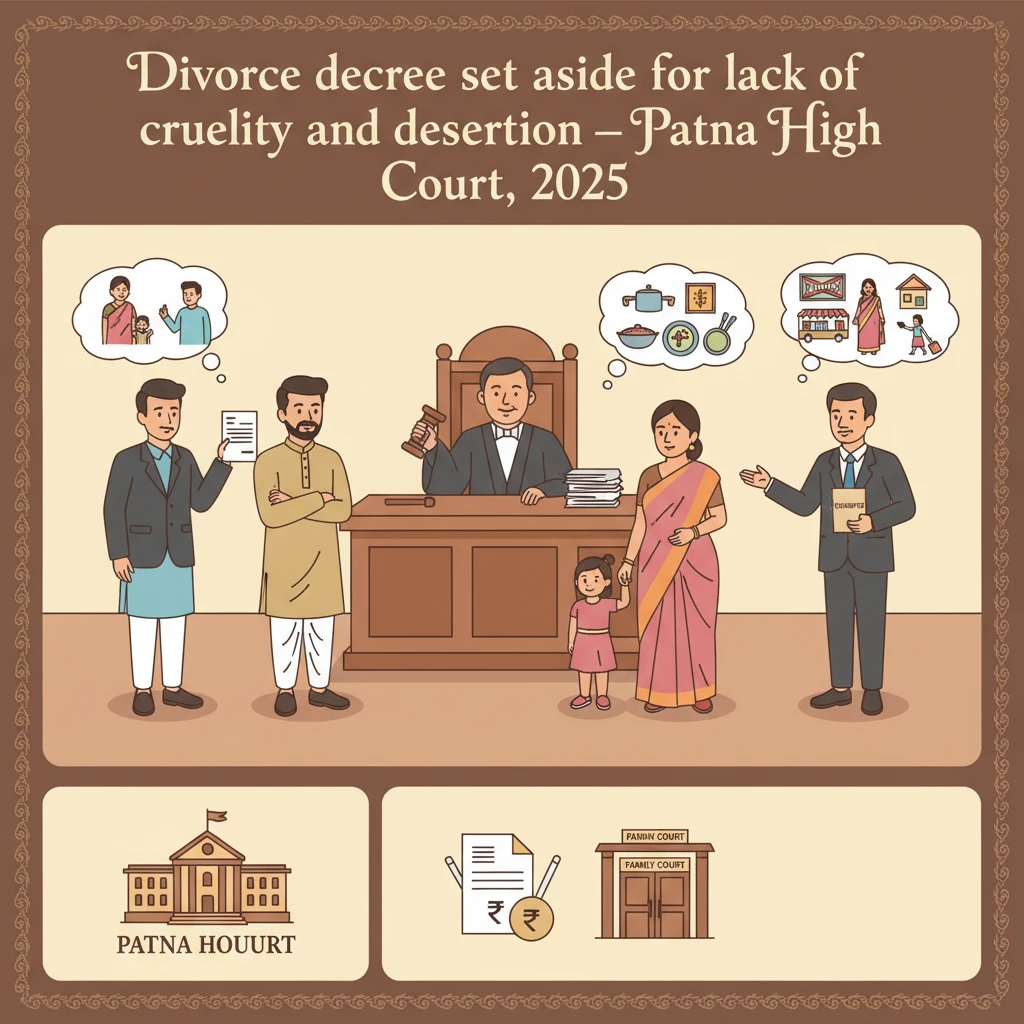
Case Background
This case arose from a matrimonial dispute between a husband and wife married under Hindu law. Their marriage was solemnised on 20.11.2011 according to Hindu rites and customs. Out of this marriage, a female child was born on 03.11.2012.
Some time after the marriage, the relationship started deteriorating. The husband later filed Divorce Case No. 247 of 2013 before the Principal Judge, Family Court, Vaishali at Hajipur, seeking dissolution of the marriage under Section 13 of the Hindu Marriage Act, 1955.
By judgment and decree dated 20.02.2018, the Family Court allowed the husband’s petition. It dissolved the marriage on the grounds of cruelty and desertion attributed to the wife.
Aggrieved, the wife filed Miscellaneous Appeal No. 331 of 2018 before the Patna High Court. She challenged the Family Court’s findings on both cruelty and desertion and also raised issues regarding lack of reconciliation efforts and absence of permanent alimony.
What the Court Examined and Decided
The Patna High Court, comprising Hon’ble the Acting Chief Justice and Hon’ble Mr. Justice S. B. Pd. Singh (authoring the judgment), heard the appeal and examined the entire record of the Family Court. The core questions were whether the husband had legally proved cruelty and desertion by the wife so as to justify a decree of divorce under Section 13(1) of the Hindu Marriage Act, 1955.
Allegations by the Husband
In his divorce petition, the husband alleged that soon after marriage, the wife started pressurising him to live separately from his old parents. According to him, she abused her in-laws in filthy language and behaved cruelly with him, attempting to malign the prestige of his family.
He further alleged that the wife did not take responsibility as a wife. Instead, his aged mother continued to cook for the family. The husband claimed that the wife used to throw away the cooked food outside the house, forcing him and other family members to remain hungry on many occasions.
The husband also described the wife as a “lady of free mind,” alleging that she frequently went to movies and markets with other male persons. When he objected, she allegedly became furious. He stated that she used to visit her parental home (Maike) frequently without his permission.
According to him, the wife left his company and went to her Maike on 19.08.2013. He claimed that the matrimonial relationship had irretrievably broken down and that there was no chance of restoration, so he filed the divorce petition on the ground of cruelty and desertion.
Defence by the Wife
The wife entered appearance in the Family Court and filed a written statement. She denied all allegations regarding misbehaviour, cruelty, and neglect of responsibilities. She asserted that she used to cook food in her matrimonial home and, after bathing and praying to God, she used to have her meal.
She alleged instead that the husband and his family demanded Rs. 2 lakh as dowry. On non-fulfilment of this demand, she was allegedly ousted from the matrimonial house along with her daughter. She also alleged that the husband had an illicit relationship with his sister-in-law (Bhabhi).
The wife further stated that she had filed Complaint Case No. 2526 of 2014 against the husband and his family members under Section 498A of the Indian Penal Code and Section 3/4 of the Dowry Prohibition Act. She claimed that the divorce petition was based on false and concocted grounds only to remove her from the husband’s life.
She also pointed out that she had filed Maintenance Case No. 31 of 2016 under Section 125 of the Code of Criminal Procedure before the Principal Judge, Family Court, Vaishali at Hajipur, in which she was getting Rs. 3,000 per month as interim maintenance.
Evidence Before the Family Court
On behalf of the husband, five witnesses were examined:
- P.W. 1: Sunil Patel (neighbour)
- P.W. 2: Manoj Kumar
- P.W. 3: Kumar Shankar Patel
- P.W. 4: Shailendra Kumar Patel
- P.W. 5: Sanjay Kumar (the husband himself)
Additionally, the husband produced certain documents:
- Ext. 1: Certified copy of orders from 05.08.2014 to 09.05.2014 in Complaint Case No. C1 2526/2014, Trial No. 28/2015
- Ext. 2: Certified copy of Complaint Case No. 2526/2014
- Ext. 3 and 3/a: Certified copies of depositions of witnesses under Section 202 Cr.P.C. in the complaint case filed by the wife
The wife also examined five witnesses:
- O.P.W. 1: Nilo Kumari (wife)
- O.P.W. 2: Mina Devi
- O.P.W. 3: Maheshwar Sah
- O.P.W. 4: Mukesh Sah
- O.P.W. 5: Ram Babu Singh
High Court’s View on Cruelty
The High Court first addressed the ground of cruelty. It noted that “cruelty” is not specifically defined in the Hindu Marriage Act, 1955. However, the settled legal position is that cruelty must be of such nature and conduct as to cause in the mind of the other spouse a reasonable apprehension that it will be harmful or injurious to live with the other party.
The Court referred to the Supreme Court’s decision in Samar Ghose v. Jaya Ghose, 2007 (4) SCC 511, which explains that sustained and unjustifiable conduct affecting the physical and mental health of the other spouse, and which is grave, substantial and weighty, may amount to mental cruelty. Ordinary wear and tear of married life or trivial quarrels are not enough.
The Court also cited the classic observations of the Supreme Court in Narain Ganesh Dastane v. Sucheta Narain Dastane, AIR 1975 1534, emphasising that cruelty must be judged in relation to the particular spouses and circumstances, and that courts deal with real couples, not ideal ones.
Applying these principles, the High Court closely examined the husband’s evidence. It observed that P.W. 5, the husband himself, had not stated any specific incident of cruelty. His evidence was described as “vague” on the point of cruelty.
The Court noted that in the divorce petition itself, no single incident of alleged cruelty with a specific date was pleaded. The allegations remained general and unsupported by precise particulars.
The Court further held that certain flimsy acts or omissions, or occasional harsh words between spouses, can occur in day-to-day married life. Such trifling utterances, remarks or threats in retaliation cannot automatically be treated as legal cruelty for granting divorce. The harshness of language or temper can vary from person to person, according to family background, education and social status.
After considering the evidence from both sides, the High Court concluded that the husband had failed to prove any legally sufficient cruelty by the wife under Section 13(1) of the Hindu Marriage Act. Therefore, the Family Court’s finding of cruelty was unsustainable.
High Court’s View on Desertion
The Court then examined the ground of desertion. The husband’s case was that the wife deserted him on 19.08.2013 by going to her Maike and that despite his efforts, she refused to return. He filed the divorce petition on 23.12.2013.
The High Court reproduced the relevant part of Section 13(1)(ib) of the Hindu Marriage Act, which requires that the other spouse must have “deserted the petitioner for a continuous period of not less than two years immediately preceding the presentation of the petition.”
From the dates on record, the Court found that the petition had been filed just four months after the alleged desertion. This was much shorter than the statutory period of two years. The Court held that the divorce petition was therefore premature.
The short time gap also indicated to the Court that the husband did not make sufficient, reasonable efforts to resolve the dispute and bring the wife back before resorting to divorce. The Court noted that the Family Court had failed to properly consider this mandatory two-year period and still granted divorce on desertion.
Lack of Reconciliation and Alimony
The wife had argued that no real attempt was made by the Family Court to reconcile the parties. The High Court endorsed this criticism, observing that the Family Court did not “take a pain to reconcile” the dispute between husband and wife before dissolving the marriage.
The Court further noted that while allowing the divorce petition, the Family Court did not decide any permanent alimony in favour of the wife and her dependent daughter. The High Court described permanent alimony as the “legal rights of a deserted wife and her dependent-daughter,” highlighting another serious lapse in the Family Court’s approach.
Final Decision
After reviewing the full record and arguments, the Patna High Court held that:
- The husband failed to prove cruelty by cogent, relevant and reliable evidence.
- The requirement of two years’ continuous desertion under Section 13(1)(ib) was not met, since the petition was filed only four months after the alleged separation.
- The divorce petition was premature and reflected a hurried approach rather than efforts at settlement.
- The Family Court erred in allowing the petition without proper reconciliation attempts and without deciding permanent alimony.
Accordingly, the High Court set aside the judgment and decree dated 20.02.2018 passed in Divorce Case No. 247 of 2013 by the Principal Judge, Family Court, Vaishali at Hajipur. The Miscellaneous Appeal No. 331 of 2018 was allowed. Any pending interlocutory applications were disposed of.
Why This Judgment Matters
This Patna High Court judgment sends a clear message to both spouses and trial courts in Bihar and beyond.
First, it reinforces that divorce on grounds of cruelty cannot be granted on vague or general allegations. The spouse seeking divorce must bring clear, specific and reliable evidence of conduct that truly makes it harmful or unsafe to live together. Normal quarrels and friction in marriage are not enough.
Second, the decision stresses that the statutory requirement of “two years’ desertion” under the Hindu Marriage Act is mandatory. A spouse cannot file for divorce immediately after separation and claim desertion. Courts must carefully count this period before granting relief.
Third, the judgment criticises Family Courts for not making sufficient efforts to reconcile couples before dissolving marriages. For many families, especially where a child is involved, reconciliation efforts are crucial.
Finally, the Court’s observation that permanent alimony is a legal right of a deserted wife and her dependent daughter highlights the protection available to financially weaker spouses. Even where divorce is granted, a woman and her child should not be left without support.
For ordinary readers in Bihar, this case shows that false, exaggerated or weak claims of cruelty or desertion will not automatically result in divorce. It also shows that higher courts are willing to correct mistakes made by Family Courts when legal requirements are not properly followed.
Legal Issues and Answers
-
Issue: Did the husband prove that the wife treated him with such mental cruelty as to justify divorce under Section 13(1)(ia) of the Hindu Marriage Act, 1955?
Answer: No. The Patna High Court held that the husband failed to prove specific, grave acts of cruelty by cogent and reliable evidence. General and vague allegations, without specific incidents and dates, were insufficient in law. -
Issue: Could the husband claim divorce on the ground of desertion under Section 13(1)(ib) when the petition was filed within four months of the alleged separation?
Answer: No. The Court held that Section 13(1)(ib) requires desertion for a continuous period of not less than two years immediately preceding the petition. Filing the petition after only four months made it premature and legally unsustainable. -
Issue: Was the Family Court justified in granting divorce without reconciliation efforts and without deciding permanent alimony?
Answer: No. The High Court found that the Family Court did not make adequate attempts to reconcile the parties and failed to decide permanent alimony for the wife and daughter, which was a serious lapse.
Cases Cited by the Court
- Samar Ghose v. Jaya Ghose, 2007 (4) SCC 511 – cited for the test of mental cruelty and the requirement that the conduct be grave, substantial and beyond normal wear and tear of married life.
- Narain Ganesh Dastane v. Sucheta Narain Dastane, AIR 1975 1534 – cited for principles on assessing cruelty in matrimonial relations, focusing on the impact on the particular spouse rather than an abstract “reasonable person.”
Case Details
Case Number: Miscellaneous Appeal No. 331 of 2018
Case Title: Nilu Kumari v. Sanjay Kumar
Citation: 2025(4) PLJR 258
Court: High Court of Judicature at Patna
Bench/Coram: Hon’ble the Acting Chief Justice and Hon’ble Mr. Justice S. B. Pd. Singh (CAV Judgment per S. B. Pd. Singh, J.)
Date of High Court Judgment: 02.09.2025
Impugned Order: Judgment and decree dated 20.02.2018 passed by the Principal Judge, Family Court, Vaishali at Hajipur in Divorce Case No. 247 of 2013
Parties’ Roles: Appellant – wife; Respondent – husband
Advocates:
- For the appellant (wife): Mr. Kaushal Kishor
- For the respondent (husband): Mr. Anirudh Kumar Sinha
Nature of the Case: Miscellaneous Appeal (matrimonial) challenging a decree of divorce passed by the Family Court under Section 13 of the Hindu Marriage Act, 1955.
Relevant Statutes/Sections:
- Section 13(1)(ia) and 13(1)(ib), Hindu Marriage Act, 1955
- Section 125, Code of Criminal Procedure, 1973 (Maintenance Case No. 31 of 2016 – interim maintenance)
- Section 498A, Indian Penal Code (Complaint Case No. 2526 of 2014 – as pleaded by wife)
- Section 3/4, Dowry Prohibition Act (Complaint Case No. 2526 of 2014 – as pleaded by wife)
Link to Full Judgment: Click here to read the full judgment on the Patna High Court website
If you found this explanation helpful and wish to stay informed about
how legal developments may affect your rights in Bihar,
you may consider following Samvida Law Associates for more updates.







