

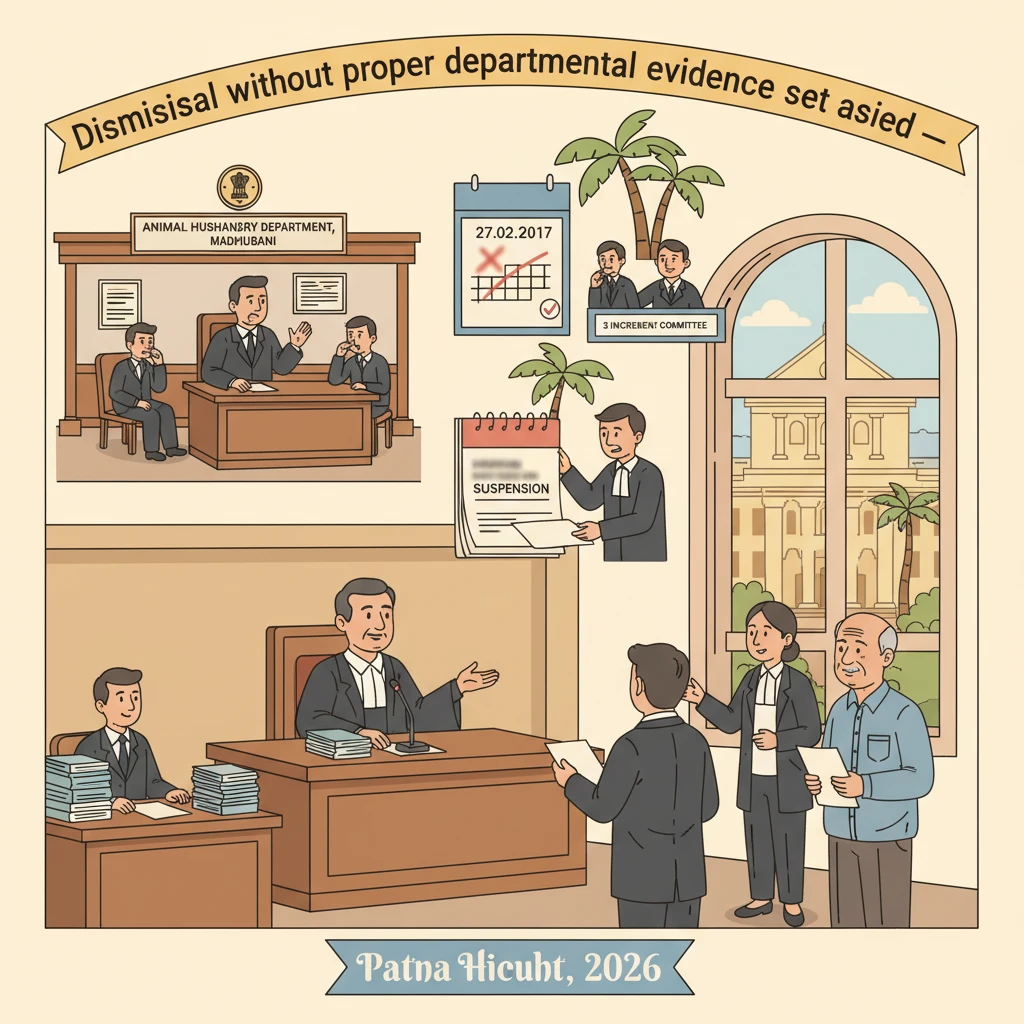
Case Background
The petitioner was appointed on 12.5.1983 as a Touring Veterinary Officer and was first posted at Sonva in West Singhbhum. In 2009, he was promoted and posted as District Animal Husbandry Officer, Madhubani, under the Animal Husbandry and Fisheries Department, Government of Bihar.
Between 22.4.2010 and 3.5.2010, an audit inspection was carried out in the office of the District Animal Husbandry Officer, Madhubani. The audit covered the period from March, 2008-09 to March, 2009-10. Various objections were raised for the period prior to 31.7.2009, which was the date on which the petitioner had joined the post at Madhubani.
Separately, one Meenakshi Pandey made a complaint to the Principal Secretary, Animal Husbandry and Fisheries Department, making 14 allegations against employees posted in the Madhubani office. A Three Men Committee was constituted under the Chairmanship of the Regional Director, Animal Husbandry, Muzaffarpur. This committee conducted an enquiry and submitted a report dated 9.8.2011, which did not contain any adverse finding against the petitioner.
On 23.9.2011, the department sought an explanation from the petitioner regarding the audit objections. He replied on 16.1.2012. The Regional Director, Animal Husbandry, Darbhanga thereafter submitted a compliance report on 17.2.2012 along with his recommendation to the Accountant General.
By order dated 31.3.2012, the Director, Animal Husbandry, Bihar initiated departmental proceedings against the Head Assistant and an Accountant in the Madhubani office. They were punished with stoppage of three increments.
On 27.4.2012, the Special Secretary to the Animal Husbandry Department placed the petitioner under suspension in contemplation of a departmental enquiry under the Bihar Government Servants (Classification, Control and Appeal) Rules, 2005 (the CCA Rules). An explanation on a memo of charge in Form-ka was sought on 25.6.2012, and the petitioner replied on 16.8.2012.
On 5.12.2012, an Enquiry Officer and Presenting Officer were appointed and the petitioner was served with a copy of the memo of charge. The enquiry commenced on 19.12.2012, when the petitioner filed his defence statement. The Enquiry Officer submitted his report on 29.2.2016 to the Principal Secretary, Animal Husbandry and Fisheries Department.
The petitioner was served with a copy of the enquiry report on 15.3.2016 and was asked to file a second written statement of defence. He submitted his reply on 7.4.2016.
On 27.2.2017, under the orders of the Governor of Bihar and the signature of the Under Secretary, Animal Husbandry and Fisheries Department, memo no.56 was issued dismissing the petitioner from service. This order came just one day before his scheduled date of superannuation on 28.2.2017. The petitioner then filed the present writ application before the Patna High Court challenging the dismissal order.
What the Court Examined and Decided
The petitioner attacked the dismissal mainly on the ground that the departmental enquiry was conducted in violation of Rule 17(14) of the CCA Rules and the principles of natural justice. He argued that the articles of charge did not mention any witnesses who would be examined during the enquiry. In fact, according to him, no witness was examined at all.
He further submitted that no document was formally marked as an exhibit and the contents of the documents were never proved through oral evidence. In spite of this, the Enquiry Officer relied on those documents to hold that a part of the charge was proved. On this basis, counsel for the petitioner contended that the proceeding was one of “no evidence” and could not lawfully result in dismissal from service.
To support this argument, the petitioner relied on the judgment of the Supreme Court in State of Uttar Pradesh & Ors. vs. Saroj Kumar Sinha; (2010) 2 SCC 772, where the Supreme Court emphasised that an enquiry officer must act as an independent adjudicator, that documents must be proved by evidence, and that holding a government servant guilty without examining witnesses or affording proper opportunity violates natural justice.
The State opposed the writ petition. Learned counsel for the respondents submitted that the enquiry had been conducted in accordance with Rule 17 of the CCA Rules, and that the petitioner had been given full opportunity to defend himself, including personal hearing and the chance to file written statements. It was argued that several documents were produced during enquiry, their details were reflected in the enquiry report, and on the basis of these documents the charges were found proved.
The State’s counsel also pointed out that the charges were serious, relating to financial irregularities and misappropriation of government money. The department stressed that the petitioner had not challenged the findings of the Enquiry Officer in the writ petition, which, according to them, meant that he had accepted the enquiry report. They also highlighted that the petitioner had been given opportunity to file a second show cause after receipt of the enquiry report, which he did on 7.4.2016. Only after considering this reply, the department claimed, was the punishment of dismissal imposed.
The Patna High Court carefully examined the material on record. It noted that the petitioner, as District Animal Husbandry Officer, Madhubani, had faced charges based on an inspection for the period April 2008 to March 2010. According to the charge, there were allegations of:
- payment of Rs. 19.04 lakhs to irregularly retained employees,
- difference of Rs. 28.32 lakhs between the accounts register and bank accounts,
- loss to the State exchequer of Rs. 3.46 lakhs,
- irregular withdrawal of Rs. 1.82 lakhs,
- and other items, making total objections of Rs. 207.32 lakhs.
These allegations were linked to the audit and subsequent enquiries, including the complaint of Smt. Meenakshi Pandey and reports by the Regional Director, Animal Husbandry, Darbhanga dated 25.3.2011, as well as a Three Member Committee report dated 9.8.2011 and communications from the District Magistrate.
The Enquiry Officer, in his report dated 29.2.2016, held charge no.1 as partly proved, while giving the benefit of doubt on charge no.2 and treating it as not proved.
The Court then turned to the core question: whether there was any legally admissible evidence in the departmental enquiry to support even this partial finding of guilt.
The Court examined the memo of charge in Form-ka (Annexure-11 to the writ petition). It observed that the charges were sought to be proved by 11 documents listed in the fourth column of Prapatra-ka under the heading “evidence”. Significantly, the Court noted that there was no mention of any witness proposed to be examined in support of the charges.
On reading the enquiry report, the Court found that the Enquiry Officer had indeed relied upon those 11 documents, and additionally referred to three more documents. However, from the entire report it was clear that not a single witness had been examined in the enquiry proceedings.
As a result, none of the documents relied upon by the Enquiry Officer had been marked as exhibits, and more importantly, their contents were never proved through oral evidence. This meant that the documents were merely on record but not proved in the way required in a quasi-judicial enquiry.
To test the legality of such an enquiry, the Court referred to the Supreme Court decision in Roop Singh Negi vs. Punjab National Bank & Ors.; (2009) 2 SCC 570. The Supreme Court in that case held that departmental proceedings are quasi-judicial and the enquiry officer must base findings only on materials properly brought on record. Documents collected during investigation cannot be treated as evidence unless proved through witnesses; mere tendering of documents without proving their contents is not enough.
The Court then again referred to State of Uttar Pradesh & Ors. vs. Saroj Kr. Sinha; (2010) 2 SCC 772. In that decision, the Supreme Court explained that an enquiry officer is like an independent judge. Even if the charged employee is absent, the officer must examine whether the unrebutted evidence is sufficient to prove the charges. Where no oral evidence is recorded and documents are not proved, the charges cannot be said to be established. The Supreme Court further emphasised that Article 311(2) and the rules of natural justice require that a government servant be given a reasonable opportunity of being heard in any proceeding that might lead to punishment, especially dismissal or removal.
Applying these principles, the Patna High Court held that in the present case the basic procedure mandated in these Supreme Court decisions had not been followed. In the departmental enquiry against the petitioner, no witness was examined at all. None of the 11 documents mentioned as evidence in Prapatra-ka, or the three additional documents cited by the Enquiry Officer, had been duly exhibited or proved by any oral testimony.
In such a situation, the Court held that the case squarely fell in the category of “no evidence”. Without any legally acceptable evidence, the finding that charge no.1 was partly proved could not stand.
Consequently, the Court concluded that the order of punishment contained in memo no.56 dated 27.2.2017, dismissing the petitioner from service under the signature of the Under Secretary, Animal Husbandry and Fisheries Department, Government of Bihar, could not be sustained in law.
The Patna High Court therefore set aside the dismissal order. The writ application was allowed with all consequential benefits to the petitioner. Although the judgment does not spell out each consequential benefit, this generally includes restoration of service-related benefits in accordance with law, especially as the order was passed just a day before his scheduled retirement.
Why This Judgment Matters
This judgment is important for government employees facing departmental proceedings, especially in Bihar under the CCA Rules. The Patna High Court clearly states that the department cannot dismiss an employee only on the basis of unproved documents or audit objections.
For many officers, especially those dealing with accounts and funds, audits often raise serious objections. This decision shows that, even where large financial figures are involved, dismissal is not automatic. The department must hold a fair enquiry, produce witnesses, and prove documents properly.
The decision also protects employees close to retirement. In this case, the dismissal order was passed just one day before the officer’s superannuation. By setting aside the order and granting consequential benefits, the Court ensured that a faulty enquiry could not be used to strip an employee of his terminal dues.
For departments, the judgment is a reminder that compliance with Rule 17 of the CCA Rules and the principles of natural justice is not a mere formality. If basic steps like examining witnesses and proving documents are skipped, the entire enquiry can be struck down as a “no evidence” proceeding.
Legal Issues and Answers
- Issue: Whether a government servant can be dismissed from service on the basis of a departmental enquiry in which no witnesses were examined and documents were not proved.
Answer: No. The Patna High Court held that such an enquiry amounts to a “no evidence” proceeding, and the dismissal order based on it cannot be sustained. - Issue: Whether reliance only on unproved documents and audit reports without oral evidence satisfies Rule 17 of the CCA Rules and the principles laid down by the Supreme Court in Roop Singh Negi and Saroj Kumar Sinha.
Answer: No. The Court applied these Supreme Court rulings and held that in the absence of oral evidence proving the documents, the charges cannot be said to be proved.
Cases Cited by the Court
- Roop Singh Negi vs. Punjab National Bank & Ors.; (2009) 2 SCC 570.
- State of Uttar Pradesh & Ors. vs. Saroj Kumar Sinha; (2010) 2 SCC 772.
Case Details
Case Number: Civil Writ Jurisdiction Case No. 6227 of 2017
Case Title: Dr. Ashok Kumar Das vs. The State of Bihar & Ors.
Citation: 2024(2) PLJR 346
Coram: Hon’ble Mr. Justice Partha Sarthy
Date of Judgment: 29.01.2026
Advocates:
- For the petitioner: Mr. Suraj Narain Yadav, Advocate
- For the respondents: Mr. Saurabh Kumar, AC to SC-19
Nature of the Case: Writ petition challenging departmental dismissal order of a government servant.
Impugned Order: Memo no.56 dated 27.2.2017 issued under the signature of the Under Secretary, Animal Husbandry and Fisheries Department, Government of Bihar, dismissing the petitioner from service.
Link to the Judgment: Click here to read the full judgment of the Patna High Court
If you found this explanation helpful and wish to stay informed about how legal developments may affect your rights in Bihar, you may consider following Samvida Law Associates for more updates.







