
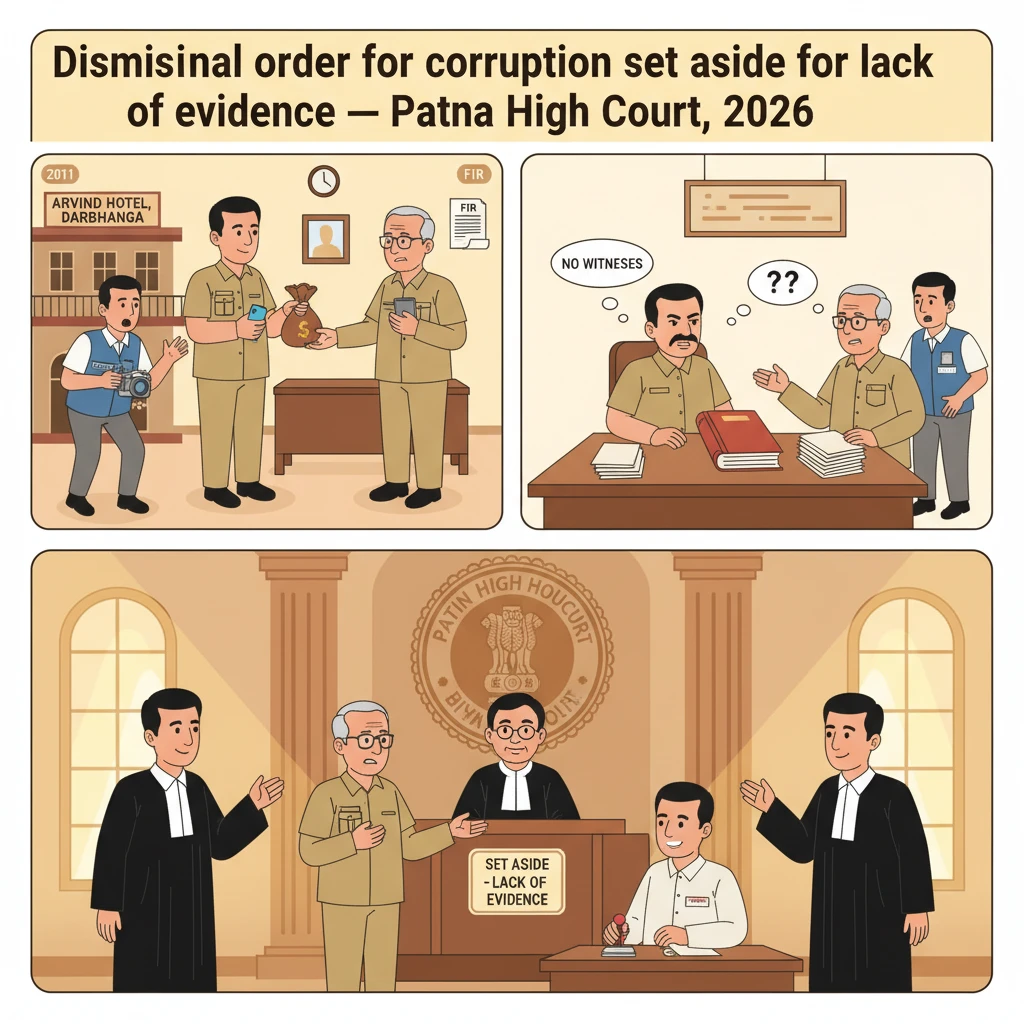
Case Background
The petitioner was appointed as a Junior Statistical Assistant in 1978 in the Agriculture Department of Bihar. After serving for about three decades, he was promoted as District Planning and Evaluation Officer, Darbhanga, under the District Agriculture Office.
In 2010, he was given additional charge as Junior Plant Protection Officer (JPPO), Darbhanga. While working in this capacity, a vigilance raid took place in Room No. 104 of Arvind Hotel, Darbhanga. Some officials were allegedly caught there while accepting bribe.
A memo of charge dated 16.05.2011 was issued to the petitioner. The allegation against him was that he was present in the hotel room along with those officials and that a mobile phone and a Sony camera were recovered from his possession. On this basis, his presence was treated as involvement in corruption. There was no specific allegation that he personally demanded or accepted any bribe or that any bribe money was recovered from him.
An FIR under the Prevention of Corruption Act was lodged as Town (Darbhanga) P.S. Case No. 86 of 2011/Special Case No. 8 of 2011. The criminal case is still pending. The petitioner was suspended and departmental proceedings were initiated under the Bihar Government Servants (Classification, Control and Appeal) Rules, 2005, commonly known as the Bihar CCA Rules, 2005.
The Enquiry Officer submitted his report on 11.01.2013. Later, a second show cause notice dated 19.03.2014 was served on the petitioner. Ultimately, by Notification No. 411 dated 06.11.2014, issued by the Deputy Secretary, Department of Agriculture, the petitioner was dismissed from service under Rule 14(xi) of the Bihar CCA Rules, 2005. According to the State, the dismissal was approved by the Cabinet.
The petitioner retired from service on 31.01.2016, but by then he stood dismissed. He challenged the dismissal by filing CWJC No. 5278 of 2015 before the Patna High Court. He also filed a review application under Rule 24(2) of the Bihar CCA Rules, 2005.
On 27.08.2018, the High Court disposed of CWJC No. 5278 of 2015, directing the competent authority to decide the review application on its own merits. Pursuant to this order, the petitioner was given personal hearing on 11.12.2018 and 08.01.2019. However, by Notification No. 129 dated 08.03.2021, the Secretary, Agriculture Department, rejected the review petition and affirmed the dismissal.
The petitioner then filed the present writ petition, CWJC No. 1430 of 2022, challenging both the punishment order dated 06.11.2014 and the review order dated 08.03.2021, and seeking consequential benefits after retirement.
What the Court Examined and Decided
Hon’ble Mr. Justice Dr. Anshuman of the Patna High Court heard both sides. The petitioner attacked the dismissal and review orders on multiple grounds: lack of evidence, violation of Bihar CCA Rules, 2005, and denial of natural justice.
The petitioner’s counsel emphasised that the core allegation in the charge memo was only his presence in the hotel room where others were caught taking bribe. There was no allegation of demand or acceptance of bribe by him and no recovery of money from his possession. Only a mobile and an official Sony camera were seized from him.
According to the petitioner, the Enquiry Officer’s own findings supported this. The enquiry report stated clearly that no bribe money was recovered from him. The recovery of the official camera supported his explanation that he had gone to the hotel to show his superior officers how government programmes were being implemented.
The Enquiry Officer did note that booking a hotel room on a holiday raised suspicion. Yet he also acknowledged that the petitioner appeared to have acted under the instructions of his superior officers. Despite these findings, the Enquiry Officer oddly concluded that the charge of assisting his superiors in the act of bribery stood proved. This “assisting” role was not even mentioned in the original charge memo.
The petitioner argued that the inquiry was legally defective because no witnesses were examined and no documents were proved by any witness. The Presenting Officer only relied on his own submissions. Thus, there was literally no admissible evidence, even on the standard of “preponderance of probabilities” that applies in departmental inquiries.
The second show cause notice dated 19.03.2014 was also challenged. The petitioner submitted that the notice itself revealed that the Disciplinary Authority had already made up its mind to impose a major penalty, saying that grave charges stood proved. He filed a reply on 12.04.2014, received by the department on 16.04.2014, but the dismissal notification later claimed that he did not respond in time. This, he said, showed bias and non-application of mind.
The petitioner further pointed out that even the Bihar Public Service Commission did not agree with the proposal of dismissal. Yet, after seeking opinion from the General Administration Department and obtaining Cabinet approval, the Department still imposed the extreme penalty of dismissal under Rule 14(xi).
The petitioner relied on several judicial precedents. In Oryx Fisheries Private Limited v. Union of India, the Supreme Court held that a show cause notice in a quasi-judicial proceeding must give a real and fair opportunity to defend. In Brij Bihari Singh v. Bihar State Financial Corporation, the Supreme Court held that a delinquent must know the accusation and the evidence, must be allowed to hear and cross-examine witnesses, and must have a chance to rebut the material. The petitioner also cited a Patna High Court decision in Dr. Janardan Prasad Sukumar v. State of Bihar, which stressed fair opportunity in disciplinary proceedings and held that violation of natural justice vitiates such actions.
On the other side, the State defended the proceedings. The State counsel recited the service history of the petitioner and the seriousness of the allegations. According to the State, a proper departmental enquiry was held under the Bihar CCA Rules, 2005, and the Enquiry Officer gave a detailed report finding the charges proved. A second show cause was issued, and after considering the petitioner’s case, the Disciplinary Authority imposed dismissal, later upheld in review.
The State also said that two other officers, Manoj Kumar and Satya Narayan Mochi, faced similar proceedings and were also punished, showing there was no discrimination. The State therefore argued that the writ petition only sought to reopen a concluded disciplinary case and should be dismissed.
After hearing both sides and examining the records, the Patna High Court focused on a few key aspects.
First, the Court noted that in the charge memo the allegation was only that the petitioner was present with others in the hotel room where bribes were taken, and that a mobile and camera were seized from him. The FIR was registered and the criminal case is still pending. However, in the departmental enquiry, no witness was examined and no documents were properly proved. Yet, the Enquiry Officer concluded that the petitioner had assisted other officials in taking bribes.
The Court highlighted that the enquiry report itself recorded that no bribe money was recovered from the petitioner. The official camera in his possession supported his explanation of being there for official purposes. Suspicion about booking a hotel room on a holiday could not substitute for proof.
Secondly, the Court found a serious mismatch between the charge memo and the punishment order. In the punishment order, the Disciplinary Authority held as if the petitioner was arrested due to acceptance and recovery of bribe by the trap team from his possession. This was plainly incorrect because the charge memo did not allege any recovery from him, and the enquiry report expressly found no such recovery. Therefore, the Disciplinary Authority imposed punishment for a charge that did not exist in the memo.
Thirdly, the Court was “surprised” that no witness, not even the complainant, had been examined to prove the charge. No opportunity of cross-examination was provided to the petitioner. The Court treated this as a gross violation of Rule 19 of the Bihar CCA Rules, 2005, and also of the broader principles of natural justice.
In support, the Court relied on the Supreme Court decision in Roop Singh Negi v. Punjab National Bank, which clarifies that departmental proceedings are quasi-judicial. An Enquiry Officer must base findings on evidence brought on record. Material collected in a criminal investigation, like an FIR, is not automatically evidence in a departmental enquiry unless proved through witnesses. Where there is “no evidence” to support a finding, the Court can interfere under Article 226.
The Court also held that the principle from Brij Bihari Singh applied squarely: a delinquent must know both the accusation and the testimony, must have a fair chance to hear and cross-examine witnesses, and must be allowed to rebut the evidence. Where an enquiry report is based only on ipse dixit, conjectures and surmises, it cannot stand.
Further, the Patna High Court found the ratio of Dr. Janardan Prasad Sukumar applicable, observing that the disciplinary proceeding in this case showed a mala fide design to somehow impose dismissal on the petitioner despite the absence of recovery from him.
The Court distinguished the case of Laxmi Devi Sugar Mills Ltd. because that judgment dealt with the Industrial Employment (Standing Orders) Act, 1946, which had no application here.
Coming to the Bihar CCA Rules, 2005, the Court held that once the Disciplinary Authority decided to hold a regular enquiry in terms of Rule 17(3) to (23), he was bound to strictly follow those procedures and could not fall back upon Rule 19. Accepting the Enquiry Officer’s report while giving reasons contrary to the report and without evidence amounted to a violation of Rule 19 read with Rule 17.
On the argument that two other officers had also been punished, the Court noted from the petitioner’s rejoinder that money had actually been recovered from those officers, one of whom was removed from service and another suffered a 10% pension cut. As no money was recovered from the petitioner and there were serious procedural violations in his enquiry, their cases were held not comparable.
On this analysis, the Patna High Court concluded that there was gross violation of principles of natural justice and the Bihar CCA Rules, 2005, in the petitioner’s case. The findings of guilt had no evidentiary basis.
Accordingly, the Court set aside three things: the enquiry report dated 11.01.2013, the dismissal order issued under Memo No. 411 dated 06.11.2014 by the Deputy Secretary, and the review order under Memo No. 129 dated 08.03.2021 passed by the Secretary, Agriculture Department, Bihar.
The Court then directed the respondent authorities to decide, within three months of receiving a copy of the judgment, on the petitioner’s entitlement to payment and dues arising from the setting aside of the punishment order. With these directions, the writ petition was allowed and any interlocutory applications were disposed of.
Why This Judgment Matters
This judgment is important for government employees in Bihar and beyond, especially those facing departmental proceedings alongside criminal cases.
First, the Patna High Court made it clear that mere presence at a place where corruption occurs cannot, by itself, become a basis for dismissal from service without proper evidence of involvement. Suspicion is not proof.
Second, the Court reaffirmed that departmental enquiries are not a formality. Authorities must examine witnesses, allow cross-examination, and base findings on evidence. FIRs, trap memos and investigation papers cannot be treated as evidence unless proved through witnesses.
Third, the judgment shows that if the punishment order talks about a charge that was never mentioned in the charge memo, such punishment cannot stand. A person must know exactly what he is accused of before he can be punished.
Fourth, even where the government aims to root out corruption, it must still follow due process. The Court emphasised that violation of the Bihar CCA Rules, 2005, and natural justice will invite judicial interference under Article 226.
For retired employees, the judgment also shows that even if dismissal orders are passed before retirement, courts can still quash them and direct the department to reconsider their dues and benefits.
Legal Issues and Answers
Issue: Can a government servant be dismissed from service for alleged involvement in a bribery incident when no bribe is recovered from him and no witness is examined in the departmental enquiry?
Answer: No. The Patna High Court held that in the absence of any legal evidence, and where the enquiry is conducted in violation of the Bihar CCA Rules, 2005 and principles of natural justice, such dismissal is unsustainable and must be set aside.
Issue: Is a punishment order valid if it proceeds on a charge different from what was stated in the charge memo?
Answer: No. The Court found that imposing punishment on the basis of a new or altered allegation, not mentioned in the charge memo, violates natural justice. The punishment order in this case was vitiated because it assumed recovery of bribe from the petitioner, contrary to both the charge memo and enquiry report.
Issue: What is the effect of non-compliance with procedural safeguards under Rules 17 and 19 of the Bihar CCA Rules, 2005 in a departmental enquiry?
Answer: Non-compliance, such as failure to examine witnesses or allow cross-examination after deciding to hold a regular enquiry, amounts to gross violation of the Rules and natural justice. Findings based on such an enquiry are liable to be quashed.
Cases Cited by the Court
- Roop Singh Negi v. Punjab National Bank & Ors., (2009) 2 SCC 570.
- Union of India v. H.C. Goel, AIR 1964 SC 364; (1964) 4 SCR 718 (quoted within Roop Singh Negi).
- Oryx Fisheries Private Limited v. Union of India & Ors., (2010) 13 SCC 427 (considered, partly applied).
- Laxmi Devi Sugar Mills Ltd. v. Nand Kishore Singh, AIR 1957 SC 7 (held not applicable to this case).
- Brij Bihari Singh v. Bihar State Financial Corporation & Ors., (2015) 17 SCC 541.
- Dr. Janardan Prasad Sukumar v. The State of Bihar through the Chief Secretary & Ors., 2025 (1) PLJR 625.
Case Details
Case Number: Civil Writ Jurisdiction Case No. 1430 of 2022
Case Title: Bipin Kumar v. The State of Bihar & Ors.
Court: High Court of Judicature at Patna
Coram: Hon’ble Mr. Justice Dr. Anshuman
Date of Judgment: 06.01.2026
Citation: 2026 (1) PLJR 589
Advocates:
- For the Petitioner: Ms. Surya Nilambari, Advocate
- For the Respondents (State of Bihar and Agriculture Department authorities): Mr. Anant Kr. Singh (SC15)
Nature of the Case: Writ petition under Article 226 of the Constitution of India challenging departmental enquiry report, dismissal order, and dismissal of review petition relating to a government servant in the Agriculture Department.
Key Departmental Orders Challenged:
- Enquiry report dated 11.01.2013.
- Dismissal notification contained in Memo No. 411 dated 06.11.2014 issued by the Deputy Secretary, Department of Agriculture, Bihar under Rule 14(xi) of the Bihar CCA Rules, 2005.
- Review rejection order contained in Memo No. 129 dated 08.03.2021 issued by the Secretary, Department of Agriculture, Bihar.
Final Outcome: Writ petition allowed; enquiry report, dismissal order, and review order set aside; respondents directed to decide petitioner’s entitlement to payment and dues within three months of receipt of the judgment.
Link to Full Judgment: Patna High Court Judgment – CWJC No. 1430 of 2022
If you found this explanation helpful and wish to stay informed about
how legal developments may affect your rights in Bihar,
you may consider following Samvida Law Associates for more updates.







