

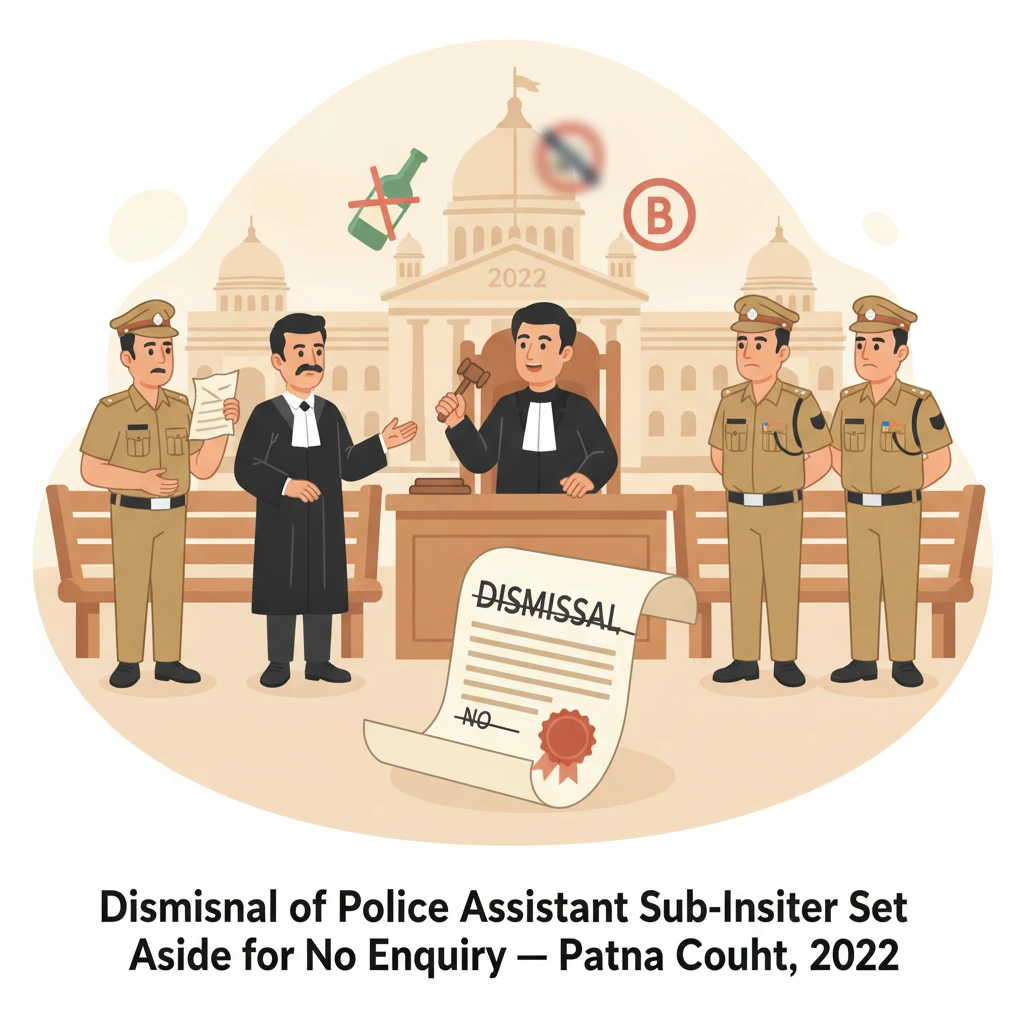
Case Background
The petitioner joined the Bihar Police as a Constable on 22.01.1990. Over time, he was promoted to higher posts and was serving as an Assistant Sub-Inspector when the events of this case took place.
On 16.02.2020, a criminal case was registered against him under Sections 37(B)/37(C) of the Bihar Prohibition & Excise Act, 2018 at Muffasil (Mahadeva Out Post) Police Station, Case No. 76 of 2020. He was arrested and released on bail on 17.02.2020.
On the same date as his bail, i.e. 17.02.2020, the disciplinary authority issued a memo to him arising out of this incident. Within a week, on 24.02.2020, the petitioner was dismissed from service by memo no. 985/Ra.Ka. issued by the Superintendent of Police, Siwan, in the light of Range Order No. 45/2020 memo no. 535/Go dated 22.02.2020 passed by the Deputy Inspector General, Saran Range, Chapra.
Feeling aggrieved, the petitioner filed an appeal before the Appellate Authority on 04.03.2020. On 08.06.2020, the Additional Director General (Law and Order), Bihar, Patna, rejected his appeal vide letter no. Vi. Vaya-Go/Appeal Abhyavedan-12/2020/101. The petitioner was informed of this by memo no. 2814/Ra.Ka. dated 12.07.2020 issued by the Superintendent of Police, Siwan.
The petitioner approached the Patna High Court in Civil Writ Jurisdiction Case No. 10670 of 2020. He sought quashing of the dismissal order, the Range Order, the appellate order and the memo conveying rejection of his appeal. He also sought reinstatement with all consequential benefits.
What the Court Examined and Decided
The writ petition was heard by Hon’ble Mr. Justice P. B. Bajanthri. Counsel for both sides were heard. The core question before the Patna High Court was whether the disciplinary authority was justified in dismissing the petitioner without holding a departmental enquiry, by invoking Article 311 of the Constitution of India.
The petitioner’s counsel argued that he was a permanent employee of the Bihar Police Department. Before imposing a major punishment like dismissal, the authority must, as a rule, hold a departmental enquiry, give him the charges, and provide a reasonable opportunity to defend.
It was submitted that the disciplinary authority had resorted to a “short circuit” method. Instead of following the regular procedure, the authority invoked Article 311 and dismissed him straightaway. This, according to the petitioner, was impermissible because none of the conditions for bypassing an enquiry were recorded or satisfied.
As per the petitioner’s counsel, the allegation against him was that he had consumed alcohol, was under intoxication, and was doing “hulla and hungama,” creating nuisance in public and disturbing the general public. The counsel argued that such an allegation, by itself, did not make it impossible to hold a departmental enquiry.
The key grievance of the petitioner was that the disciplinary authority had not recorded any reasons to show why it was “not reasonably practicable” to hold a regular enquiry. Article 311(2)(b) of the Constitution of India clearly requires that the authority must record such reasons in writing if it wishes to dispense with the enquiry.
It was also argued that the appellate authority did not address this core issue at all. The appellate authority simply confirmed the dismissal without examining whether skipping the departmental enquiry was justified in law. Therefore, both the original dismissal and the appellate order deserved to be set aside.
On the other hand, the State’s counsel defended the orders. The State argued that as a member of the police force, the petitioner was expected to be disciplined and set an example. Instead, he was allegedly found under the influence of alcohol and causing nuisance in public, which, according to the State, seriously damaged the reputation of the police department.
On this basis, the State submitted that there was no infirmity in invoking Article 311 of the Constitution and imposing the punishment of dismissal. It was also argued that the appellate order was proper.
The Court first identified the “crux of the matter”: could the disciplinary authority lawfully dispense with a regular disciplinary proceeding against the petitioner on the ground that he was intoxicated and causing nuisance on 16.02.2020, and then dismiss him without recording reasons regarding impracticability of holding an enquiry?
The Court then reproduced Article 311 of the Constitution of India in detail. It emphasised that, as a general rule, a government servant cannot be dismissed, removed or reduced in rank without an enquiry where he is informed of the charges and given reasonable opportunity of being heard.
The Court discussed the three exceptions contained in the second proviso to Article 311(2):
(a) where the dismissal is based on conduct which has led to conviction on a criminal charge;
(b) where the competent authority is satisfied that it is not reasonably practicable to hold an enquiry, and such reasons are recorded in writing; and
(c) where in the interest of the security of the State, it is not expedient to hold an enquiry.
The Court underlined that these exceptions are narrow and specific. They allow the authority to dispense with an enquiry, but only when clearly justified and when the pre-conditions laid down in the Constitution are meaningfully followed.
Referring particularly to clause (b) of the second proviso to Article 311(2), the Court explained that if the disciplinary authority feels that it is not reasonably practicable to hold an enquiry, the reasons for such satisfaction must be recorded in writing before taking action. Without such written reasons, the protection available to the government servant under Article 311(2) cannot be taken away.
The Court further clarified that although the disciplinary authority has an “absolute power” to dispense with enquiry under certain conditions, this power must be exercised strictly as per the constitutional framework. There must be material to show why holding a regular enquiry is not practical, for example due to threat to witnesses, breakdown of discipline, or similar extreme situations.
In the present case, the allegation was that the petitioner was intoxicated, doing hulla and hungama, and disturbing public peace. The Court noted that nothing in the record showed why these facts made it impossible or impracticable to hold a departmental enquiry in the usual manner.
Importantly, the Court found that the disciplinary authority had not written any reasons to show impracticability of holding the enquiry. The appellate authority also failed to rectify this defect; it did not discuss or cure the lack of reasons. Therefore, the constitutional requirement in Article 311(2)(b) was not complied with.
The Court also discussed that clause (c) of the second proviso to Article 311(2) deals with situations relating to security of the State. For that too, though the clause does not expressly require recording of reasons, there must be cogent material on record. In this case, the Court found that there were no credible and substantial materials justifying invocation of such extraordinary provisions.
On this reasoning, the Court held that the petitioner had made out a clear case of violation of Article 311(2)(b) of the Constitution. As a result, both the disciplinary authority’s dismissal order dated 24.02.2020 and the appellate authority’s order dated 08.06.2020 were set aside.
The Court allowed the writ petition. However, it did not straightaway grant full back wages or close the door on disciplinary action. Instead, it directed the disciplinary authority to regulate the “intervening period” (the period between dismissal and future decision) in light of the judgments of the Supreme Court in Managing Director, ECIL v. B. Karunakar, (1993) 4 SCC 727, and Chairman-cum-Managing Director, Coal India Limited & Ors. v. Ananta Saha & Ors., (2011) 5 SCC 142, paragraphs 46 to 50.
Those Supreme Court decisions, as quoted in detail in the judgment, explain that when a punishment is set aside on technical grounds, the authority can hold a fresh enquiry from the stage where the defect occurred. The employee may be reinstated and placed under suspension, and the question of back wages is left to be decided after the fresh enquiry, applying the principle of “no work – no pay” and other equitable considerations.
Following this line, the Patna High Court gave liberty to the disciplinary authority to initiate disciplinary proceedings afresh against the petitioner and to conclude them within three months from the date of receipt of the High Court’s order. It also directed that the authority must take note of the Supreme Court pronouncements while regulating the intervening period.
Thus, while the immediate dismissal without enquiry was held illegal and set aside, the department was not barred from proceeding afresh against the petitioner in accordance with law and procedure.
Why This Judgment Matters
This judgment is important for government servants, especially members of the police force in Bihar and elsewhere. It makes clear that even when allegations are serious, like drunken behaviour in public, the employer cannot simply throw out an employee without following due process.
The Patna High Court has reinforced that Article 311 of the Constitution is a real protection, not a formality. A departmental enquiry is the rule, and skipping it is permitted only in rare situations where it is genuinely not possible to hold one, and reasons are written down.
For employees, this means that if they are dismissed without any enquiry and without written reasons showing why an enquiry could not be held, they may have a strong ground to challenge such orders in court.
For departments and disciplinary authorities, the judgment is a reminder that powers under Article 311(2)(b) and (c) are “extraordinary” and must be used sparingly and carefully, else their orders will not survive judicial review.
Legal Issues and Answers
-
Issue: Can a police officer be dismissed from service for alleged drunken and disorderly conduct in public without holding a departmental enquiry, by invoking Article 311(2)(b) of the Constitution, when no reasons are recorded showing that an enquiry was not reasonably practicable?
Answer: No. The Patna High Court held that without recording written reasons showing why it was not reasonably practicable to hold an enquiry, the disciplinary authority cannot dispense with the enquiry under Article 311(2)(b). The dismissal and the appellate order were therefore quashed. -
Issue: What is the consequence of setting aside a dismissal order passed in violation of Article 311(2)(b)?
Answer: The Court set aside the dismissal and appellate orders but allowed the disciplinary authority to start fresh disciplinary proceedings and conclude them within three months, and directed regulation of the intervening period in line with Supreme Court decisions in ECIL v. B. Karunakar and Coal India Ltd. v. Ananta Saha.
Cases Cited by the Court
- Managing Director, ECIL v. B. Karunakar, (1993) 4 SCC 727.
- Chairman-cum-Managing Director, Coal India Limited & Ors. v. Ananta Saha & Ors., (2011) 5 SCC 142 (paragraphs 46 to 50 as extracted).
- R. Thiruvirkolam v. Presiding Officer (referred).
- Punjab Dairy Development Corpn. Ltd. v. Kala Singh (referred).
- Graphite India Ltd. v. Durgapur Projects Ltd. (referred).
- U.P. SRTC v. Mitthu Singh (referred).
- Akola Taluka Education Society v. Shivaji (referred).
- Balasaheb Desai Sahakari S.K. Ltd. v. Kashinath Ganapati Kambale (referred).
- Union of India v. Y.S. Sadhu (referred).
Case Details
Case Number: Civil Writ Jurisdiction Case No. 10670 of 2020
Case Title: Lal Babu Manjhi v. The State of Bihar & Ors.
Citation: 2022 (2) PLJR 144
Court: High Court of Judicature at Patna
Coram: Hon’ble Mr. Justice P. B. Bajanthri
Date of Judgment: 09.03.2022
Advocates:
- For the Petitioner: Mr. Ebrahim Kabir, Advocate; Ms. Shruti Sinha, Advocate.
- For the Respondents (State): Mr. N. H. Khan, SC-I; Ms. Babita Kumari, AC to SC-I.
Parties:
- Petitioner: Lal Babu Manjhi, Assistant Sub-Inspector (earlier appointed as Constable on 22.01.1990), resident of Village-Bargachiya, PS-Thawe, District-Gopalganj.
- Respondents: State of Bihar through the Secretary, Government of Bihar, Patna; Director General of Police, Bihar, Patna; Additional Director General (Law and Order), Bihar, Patna; Deputy Inspector General, Saran Range, Chapra; Superintendent of Police, Siwan.
Nature of the Case: Writ petition (civil) challenging dismissal from service and rejection of departmental appeal in a disciplinary matter.
Impugned Orders:
- Dismissal order dated 24.02.2020 (memo no. 985/Ra.Ka.) of the Superintendent of Police, Siwan, based on Range Order No. 45/2020 memo no. 535/Go dated 22.02.2020 issued by DIG, Saran Range, Chapra.
- Appellate order dated 08.06.2020 (letter no. Vi. Vaya-Go/Appeal Abhyavedan-12/2020/101) passed by ADG (Law and Order), Bihar, Patna, communicated through memo no. 2814/Ra.Ka. dated 12.07.2020.
Link to the Judgment: Click here to access the official Patna High Court judgment
If you found this explanation helpful and wish to stay informed about how legal developments may affect your rights in Bihar, you may consider following Samvida Law Associates for more updates.







