

Case Background
The petitioner was appointed on 5 May 1992 as a Maintenance Technician (Lobby Exhibit) in the Bihar Council on Science and Technology (BCST). His appointing authority, as noted in the judgment, was the Executive Committee of the BCST.
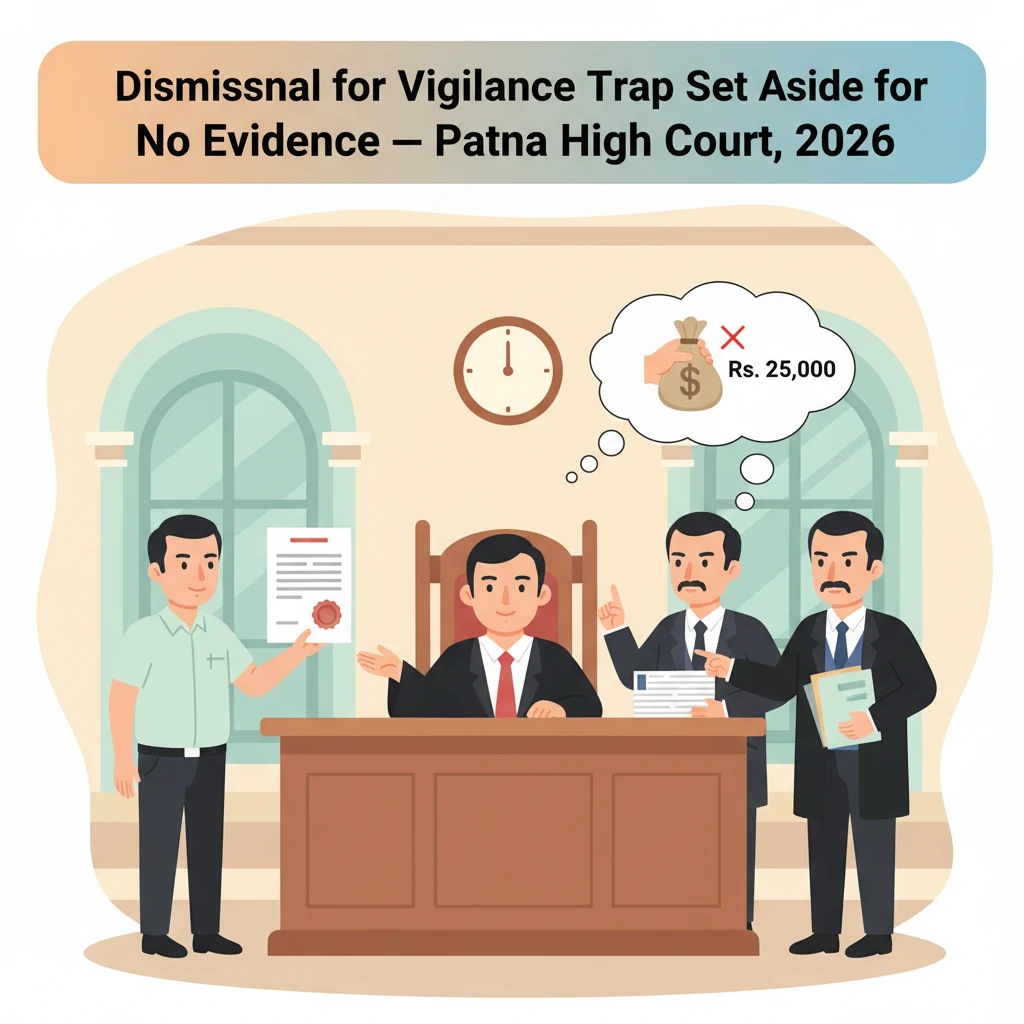
On 30 May 2007, a vigilance trap case was registered as Vigilance P.S. Case No. 69 of 2007. The allegation was that the petitioner was caught taking a bribe of Rs. 25,000. He was taken into custody and, by order dated 22 June 2007, he was placed under suspension.
After he was granted bail by order dated 4 January 2008 in Cr. Misc. No. 51081 of 2007, the petitioner reported back for duty. His joining was accepted on 16 December 2009 and his suspension was vacated with effect from 6 January 2008.
Despite this, the employer initiated departmental proceedings based on the same alleged incident of taking bribe. These proceedings and the way they were handled ultimately led to his dismissal and then to this writ petition before the Patna High Court.
What the Court Examined and Decided
The petitioner approached the Patna High Court under its civil writ jurisdiction to challenge two orders. First, the dismissal order dated 6 June 2014 issued under Memo No. BCST-291 by the Director, Department of Science and Technology-cum-Secretary, BCST (respondent no. 4). Second, the appellate order dated 14 March 2016 passed by the Development Commissioner-cum-Chairman, Executive Committee, BCST (respondent no. 2), by which his departmental appeal was rejected.
He also sought a direction to be reinstated in service with back wages and all consequential benefits.
The charges in the departmental proceeding were all tied to the vigilance trap case. The main accusations were that the petitioner had been caught taking a bribe of Rs. 25,000, that Vigilance P.S. Case No. 69 of 2007 was registered against him, that the vigilance charge-sheet mentioned his demand for the bribe from the complainant, and that he had secured bail in the criminal case.
Initially, a memo of charge was issued by the Project Director. The petitioner replied to this memo. He questioned the competence of the Project Director to issue the charge, pointing out that the Project Director was neither the appointing authority nor the disciplinary authority. He also asked for certain documents to be supplied.
The Project Director rejected his reply and sent the file to the department. On 17 October 2013, another memo of charge was again issued by the Project Director. The substance of the charges remained the same. In this memo, only one document was listed as evidence: the vigilance charge-sheet. No list of witnesses was mentioned.
On the same date, 17 October 2013, the authorities decided to proceed under Rule 17 of the Bihar Government Servants (Classification, Control and Appeal) Rules, 2005 (CCA Rules, 2005). A Conducting Officer and a Presenting Officer were appointed. The petitioner filed his reply to this memo of charge on 22 November 2013.
On 14 February 2014, the petitioner was served with a supplementary memo of charge. The charges again repeated the allegation that he had been caught taking a bribe of Rs. 25,000 and arrested at 3:30 p.m. The memo referred to the post-trap memorandum of the Vigilance Bureau. This time, the memo was signed by the Director, Department of Science and Technology-cum-Secretary, BCST (respondent no. 4).
After the enquiry was conducted, the Conducting Officer submitted his report on 28 April 2014. He held that the charges against the petitioner in the departmental proceeding were proved. A copy of the enquiry report was given to the petitioner, who submitted his response on 24 May 2014.
Thereafter, on 6 June 2014, respondent no. 4 passed the order dismissing the petitioner from service. The petitioner filed an appeal, which was first dealt with by respondent no. 3, the Principal Secretary, Department of Science and Technology-cum-Vice Chairman, Executive Committee, BCST. By order dated 3 September 2015, respondent no. 3 observed that the appeal should be filed before respondent no. 2. The petitioner accordingly filed an appeal before respondent no. 2 on 22 February 2016, but it was rejected by order dated 14 March 2016.
Before the High Court, the petitioner, through learned Senior Counsel, attacked the proceedings mainly on two grounds. First, he contended that the very initiation of the departmental proceeding was illegal as the Project Director, who issued the initial memo of charge, lacked competence under the CCA Rules, 2005. He argued that there was no resolution authorising the Project Director to act as disciplinary authority when his appointing authority was the Executive Committee of BCST.
Second, and more importantly, he argued that there was complete violation of Rule 17(2), (3), (4), 5(a) and 5(c) of the CCA Rules, 2005. The memo of charge did not list witnesses; during the enquiry no witness was examined; and no document, including the vigilance charge-sheet, was proved through evidence. He submitted that mere registration of an FIR could not amount to misconduct and relied on the Supreme Court decisions in Roop Singh Negi v. Punjab National Bank and State of Uttar Pradesh v. Saroj Kumar Sinha, as well as several Patna High Court decisions.
The State, through its counsel, defended the enquiry. It was argued that there was no procedural irregularity and that all necessary documents were already with the petitioner, as they were annexed to his bail application in the criminal case. The State emphasised that acquittal in a criminal case does not automatically invalidate departmental proceedings. It relied on the distinction between the standard of proof in criminal cases (beyond reasonable doubt) and departmental proceedings (preponderance of probability. For this, reliance was placed on State of Uttar Pradesh v. Rajit Singh. The State also requested that if the Court found any procedural fault, the matter should be remanded to the disciplinary authority to conduct a fresh enquiry from the stage of defect.
Justice Partha Sarthy examined the enquiry record closely. The Court noted that the enquiry report itself showed that no witness had been examined in support of the charges. Even the memo of charge did not mention any witness. The only document mentioned was the vigilance charge-sheet, which was never formally proved in the enquiry.
Relying on the Supreme Court’s decision in Roop Singh Negi, the Court reiterated that a departmental proceeding is a quasi-judicial proceeding. An Enquiry Officer must base his findings on evidence properly brought on record. Documents collected during criminal investigation cannot automatically be treated as evidence in a departmental proceeding. They must be proved by examining witnesses. The Supreme Court had clearly held that even an FIR cannot be treated as evidence by itself.
The Court also referred to the Division Bench judgment in Devendra Prasad v. State of Bihar & Ors. In that case, following Roop Singh Negi, the Division Bench held that documents in departmental enquiry must be proved through witnesses, that even FIRs and confessions to police are not enough by themselves, and that the standard of proof requires more than mere suspicion or conjectures.
Applying these principles, the Patna High Court concluded that this was a clear case of “no evidence.” There was neither oral evidence from witnesses nor any properly proved documentary evidence to support the serious charge of bribery. In such a situation, the dismissal order dated 6 June 2014 and the appellate rejection order dated 14 March 2016 could not legally stand.
On the State’s request for remand based on State of Uttar Pradesh v. Rajit Singh, the Court carefully distinguished the facts. In Rajit Singh, the charges had been proved in the enquiry by leading evidence, but the punishment was set aside due to violation of principles of natural justice because the documents referred to in the charge-sheet had not been supplied. Therefore, the Supreme Court had permitted a fresh enquiry from the stage of defect.
In contrast, in the present case no evidence had been led at all. No witness was examined, and no document was proved. The Court also noted that the petitioner had been acquitted in the criminal case. In these circumstances, the High Court held that it was not a fit case to remit the matter for a fresh proceeding.
Ultimately, the Patna High Court allowed the writ petition. It set aside the dismissal order and the appellate order. The Court directed that the petitioner shall be entitled to all consequential benefits, including payment of arrears of salary for the period of suspension and for the period during which he remained dismissed from service.
Why This Judgment Matters
This judgment is important for government employees in Bihar and elsewhere who face departmental proceedings based only on a vigilance FIR or criminal case. The Patna High Court has clearly said that even in departmental enquiries, some basic proof is required. Authorities cannot simply rely on a vigilance charge-sheet or FIR without examining witnesses and proving documents.
For employees, this means that if they are dismissed only on the basis of unproved papers, without any witness examination, they can challenge such action. The Court has also shown that when an enquiry suffers from complete absence of evidence, it may quash the dismissal outright instead of sending the matter back for a fresh enquiry.
For departments, the judgment is a reminder that departmental proceedings are serious, quasi-judicial processes. Officers must follow Rule 17 of the CCA Rules, 2005, prepare proper charge-sheets with witness lists, present evidence, and record findings based on that evidence. Shortcuts can lead to the punishment being overturned many years later, along with liability to pay back wages.
Legal Issues and Answers
- Issue: Can a government employee be dismissed from service in a departmental proceeding based solely on an FIR and vigilance charge-sheet, without examining any witness or formally proving documents?
Answer: No. The Patna High Court held that a departmental enquiry is quasi-judicial and findings must be based on evidence. Where no witness is examined and no document is proved, it is a case of “no evidence” and the dismissal cannot be sustained. - Issue: When an enquiry is vitiated, is the Court bound to remit the matter back for a fresh enquiry?
Answer: Not always. The Court distinguished cases of mere technical defects from situations of complete lack of evidence. In this case, as no evidence was led and the employee was also acquitted in the criminal case, the Court declined to remit the matter and instead quashed the proceedings with full consequential benefits. - Issue: Does acquittal in a criminal case automatically end a departmental proceeding?
Answer: The Court reiterated the general principle that standards of proof are different, but in this case it treated the acquittal as an additional factor. The main reason for quashing the dismissal was the absence of evidence in the departmental enquiry itself.
Cases Cited by the Court
- Roop Singh Negi v. Punjab National Bank; (2009) 2 SCC 570
- State of Uttar Pradesh v. Saroj Kumar Sinha; (2010) 2 SCC 772 (relied upon by petitioner’s counsel, noted by Court)
- Vijendra Prasad v. State of Bihar; order dated 21.10.2019 in CWJC No. 18779 of 2019 (relied upon by petitioner’s counsel)
- Kumari Rita v. State of Bihar; order dated 15.10.2019 in CWJC No. 14412 of 2019 (relied upon by petitioner’s counsel)
- Anil Kumar Singh v. State of Bihar; order dated 3.11.2025 in CWJC No. 13272 of 2013 (relied upon by petitioner’s counsel)
- State of Uttar Pradesh v. Rajit Singh; (2022) 15 SCC 254
- Devendra Prasad v. State of Bihar & Ors.; judgment dated 19.10.2023 in LPA No. 1302 of 2017
Case Details
Case Number: Civil Writ Jurisdiction Case No. 1596 of 2017
Case Title: Ramesh Kumar v. The State of Bihar & Ors.
Citation: 2026 (3) PLJR 287
Coram: Hon’ble Mr. Justice Partha Sarthy
Date of Judgment: 02.04.2026
Court: High Court of Judicature at Patna
Advocates:
- For the Petitioner: Mr. Abhinav Srivastava, Senior Advocate; Mr. Tavseef Waquar, Advocate; Mr. Arun Kumar, Advocate
- For the Respondents: Mr. Ajay, GA-5
Nature of the Case: Writ petition under civil writ jurisdiction challenging departmental dismissal order and appellate order, with prayer for reinstatement and consequential benefits.
Relevant Rules/Statutes: Rule 17 of the Bihar Government Servants (Classification, Control & Appeal) Rules, 2005; principles governing departmental enquiries and standard of proof.
Link to Full Judgment: Click here to read the Patna High Court judgment
If you found this explanation helpful and wish to stay informed about
how legal developments may affect your rights in Bihar,
you may consider following Samvida Law Associates for more updates.







