

Case Background
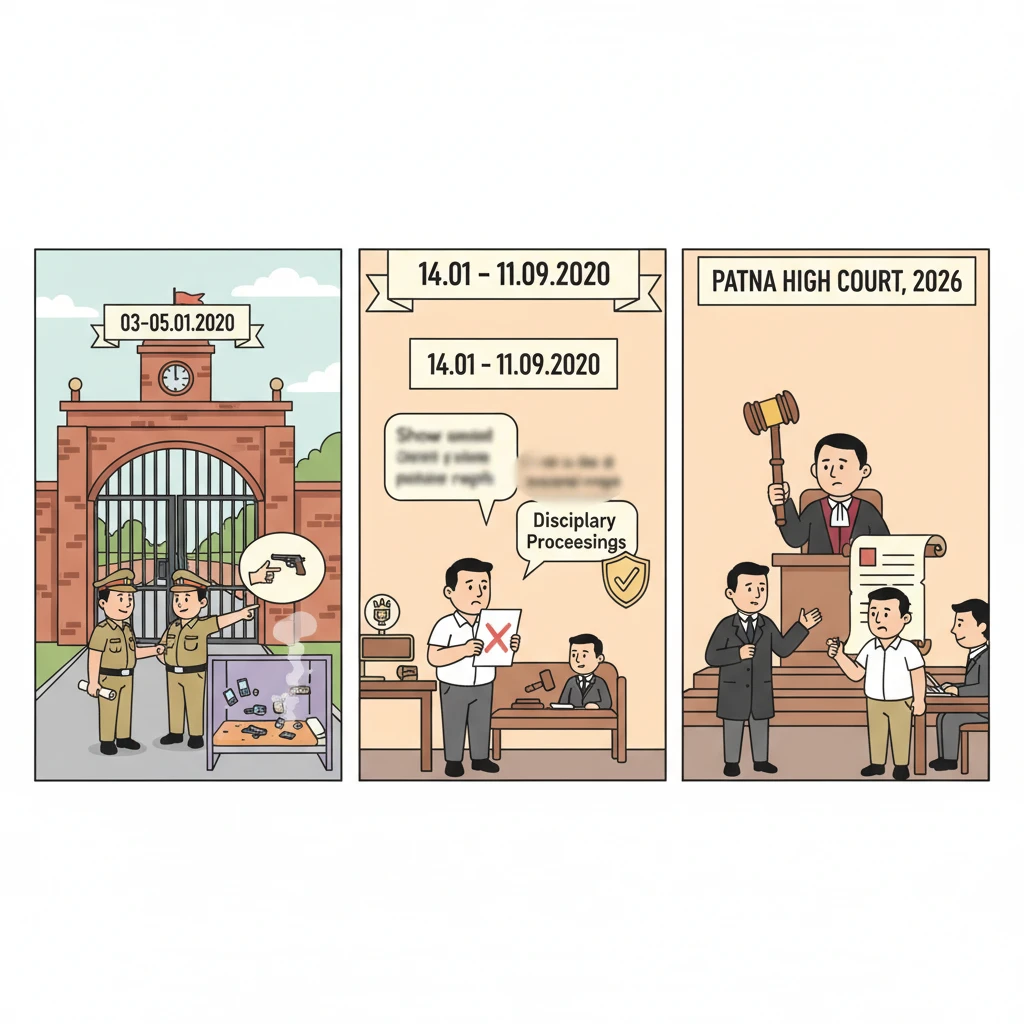
This case arises from a serious incident in District Jail, Hajipur on 03.01.2020. At that time, the petitioner was posted as Jail Superintendent.
On that afternoon, one prisoner, Manish Kumar @ Netaji @ Telia, was shot dead inside the jail by another prisoner, Raja Babu. An enquiry revealed that a jail warder, Raj Kumar, allegedly conspired with prisoner Raja Babu and supplied the firearm used in the shooting.
Immediately after the incident, the District Magistrate, Vaishali and the Superintendent of Police, Vaishali conducted a search inside the jail. They recovered one pistol, two live cartridges, four empty cartridges, six mobile phones, two chargers, two small steel scissors, one clay pipe (chilam), two iron chisels and other prohibited articles.
The District Magistrate and Superintendent of Police prepared a joint report dated 04.01.2020 about the incident and sent it to the Additional Chief Secretary, Home Department, Bihar on 05.01.2020. A copy was also sent to the Inspector General, Prison, Bihar.
On 05.01.2020 itself, acting on directions of the Additional Chief Secretary, a surprise inspection of Hajipur jail was conducted by a team headed by the District Magistrate and the Superintendent of Police. During this inspection, they recovered three mobile phones, one earphone, one USB device and other restricted materials. The inspection team found the petitioner guilty for recovery of prohibited items and noted several lapses in the jail’s infrastructure and security.
Based on this inspection report, the petitioner was suspended in contemplation of disciplinary proceedings vide order dated 14.01.2020. A show cause notice was issued on 18.04.2020, which the petitioner answered on 22.06.2020.
Finding his reply unsatisfactory, the authorities, by resolution dated 11.09.2020, initiated departmental proceedings under the Bihar C.C.A. Rules, 2005 and issued a memo of charge. Five charges were framed, all broadly alleging failure to maintain security, non-monitoring of frisking, lack of control over subordinates and dereliction of duty under the Bihar Prison Manual, 2012 and Bihar Government Servants Conduct Rules, 1976.
After enquiry, the Enquiry Officer submitted his report on 22.11.2021. He held charge no. 1 as proved and the remaining four charges as partially proved. A second show-cause notice enclosing the enquiry report was issued. The petitioner filed his reply, but the disciplinary authority was not satisfied.
On 25.05.2022, the Joint Secretary-cum-Director (Administration) imposed the punishment of withholding five increments with cumulative effect. The petitioner’s review petition was rejected by order dated 01.09.2022.
Thereafter, a fresh show cause notice dated 13.09.2022 was issued asking why the petitioner should not be paid only subsistence allowance for the period of suspension. After considering his reply, an order dated 20.12.2022 was passed directing that he would get nothing except subsistence allowance for the suspension period.
Aggrieved, the petitioner filed Civil Writ Jurisdiction Case No. 8620 of 2024 before the Patna High Court challenging the punishment order dated 25.05.2022, the review order dated 01.09.2022, the show cause dated 13.09.2022, the order dated 20.12.2022, and also seeking quashing of the departmental proceedings initiated through memo no. 6159 dated 11.09.2020 and all consequential benefits.
What the Court Examined and Decided
The Patna High Court, through Hon’ble Mr. Justice Sandeep Kumar, closely examined both the facts and the conduct of the departmental enquiry.
The petitioner’s main defence was that the charges were only about lack of supervision, not any direct act of misconduct. He argued that he was a diligent officer, recipient of the President’s Correctional Service Medal, and had taken several steps to improve jail security.
The petitioner pointed to actions such as writing multiple letters to higher authorities seeking improvement of jail infrastructure, raising the boundary wall, and installing jammers and CCTV cameras. He also relied on a letter dated 19.06.2019 where he had requested replacement of a jail staff who was not working satisfactorily.
On the specific incident of 03.01.2020, the petitioner argued that the shooting was a result of a criminal conspiracy between warder Raj Kumar and prisoner Raja Babu. He claimed he could not be held directly liable for this act, especially when he had rejoined duty only on 02.01.2020 after a long leave of three months.
He further stated that inspection in 2018 by the then District Magistrate, Vaishali had already recorded serious deficiencies in the jail, including the low boundary wall. After that inspection, the petitioner repeatedly wrote to the Executive Engineer, Building Construction Department and the Inspector General, Prisons, seeking improvements and better security measures, including more CCTV coverage and jammers. According to him, these letters showed his active effort, not negligence.
The petitioner also highlighted that he regularly instructed his subordinates, including the Assistant Superintendent and BMP in-charge, to ensure strict frisking of all persons entering the jail and to take action whenever objectionable items were found. Despite this, warder Raj Kumar allegedly smuggled in the firearm.
A crucial part of the petitioner’s challenge related to how the departmental enquiry was conducted. From the memo of charge, it appeared that two oral witnesses were to prove the charges. The Enquiry Officer examined these two witnesses jointly on the basis of a questionnaire.
The petitioner argued that both witnesses said nothing against him. He further pointed out that the Enquiry Officer treated charge no. 1 as proved and the rest as partially proved based mainly on a joint inspection report and the statement of warder Raj Kumar.
However, the authors of the joint report, namely the then District Magistrate, Vaishali and the then Superintendent of Police, Vaishali, were never examined in the enquiry. The petitioner contended that without examining them, the contents of the joint report could not be treated as evidence.
Most importantly, the Enquiry Officer relied heavily on the alleged statement of Raj Kumar, the warder who supposedly supplied the firearm. Raj Kumar was not produced as a witness in the departmental enquiry and the petitioner was never allowed to cross-examine him. The petitioner argued that this violated basic principles of natural justice.
He relied on Supreme Court judgments, especially Roop Singh Negi v. Punjab National Bank, State of U.P. v. Saroj Kumar Sinha, SBI v. S.N. Goyal and other precedents to show that in disciplinary proceedings, especially when a major penalty is proposed, oral evidence has to be led, documents must be proved by their authors, and the charged employee must get a chance to cross-examine witnesses.
The State, in its counter affidavits, stood by the enquiry. It stressed that illegal articles, including a firearm and cash, were recovered in two separate searches in the jail and that this itself indicated gross negligence and lack of control by the petitioner over jail staff.
After hearing both sides, the Court analysed the enquiry record. It noted that immediately after the shooting on 03.01.2020, a preliminary enquiry had found five personnel prima facie responsible for security lapses, but the petitioner was not named nor was any adverse remark made against him at that stage.
Later, a two-man committee inspected the jail and found him responsible for the recovery of prohibited items. On the basis of this inspection report, the disciplinary proceedings were started.
The Court examined the way the Enquiry Officer reached his conclusions. It found that the Enquiry Officer had failed to properly consider the defence evidence led by the petitioner. The joint inspection report had not been proved by examining its authors. Yet, the Enquiry Officer placed “heavy reliance” on it.
The Court also found that the Enquiry Officer relied substantially on the statement of warder Raj Kumar, but Raj Kumar had not been produced as a witness in the enquiry. The petitioner, therefore, had no chance to test his statement through cross-examination.
To decide whether such an enquiry could be sustained, the Court referred to recent Supreme Court law. It quoted in detail the judgment in Satyendra Singh v. State of U.P., 2024 SCC OnLine SC 3325, which in turn relied on Roop Singh Negi and Nirmala J. Jhala.
From these authorities, the Court highlighted three key principles:
First, in a disciplinary proceeding proposing a major punishment, recording of evidence is mandatory. Merely tendering documents is not enough; their contents must be proved through witnesses.
Second, even in an ex parte enquiry, the Inquiry Officer has to examine whether unrebutted evidence is sufficient and must record witness evidence. Documents whose contents are not proved cannot be used to hold charges as proved.
Third, evidence recorded in a preliminary enquiry, where the delinquent officer is not associated and cannot cross-examine, cannot be used in a regular enquiry unless those witnesses and documents are properly introduced and tested before the Enquiry Officer.
The Court also referred to the recent Supreme Court decision in K. Prabhakar Hegde v. Bank of Baroda, Neutral Citation 2025 INSC 997, which summarised the law on the limited use of preliminary enquiry reports. It reiterated that such reports are internal, cannot by themselves be used to reach guilt, and any oral or documentary material used there must be independently produced and proved in the regular enquiry.
Applying these principles, the Patna High Court held that the departmental enquiry against the petitioner was legally flawed. The crucial witness, warder Raj Kumar, was not examined. The joint inspection report was relied upon without its authors being examined. The petitioner was deprived of his right to cross-examine and the enquiry fell short of even the lower standard of proof (preponderance of probabilities) applicable in departmental cases.
The Court also noted a significant factual aspect: the petitioner had rejoined duty only on 02.01.2020 after a three-month leave, and the shooting took place on 03.01.2020. In this background, and in the absence of any specific allegation of direct wrongdoing or incompetence, the Court held that overall systemic lapses of the jail could not be strictly fastened upon him.
The petitioner had also argued that under Rule 800 of the Bihar Prison Manual, 2012, the Deputy Superintendent (Administration & Security) was mainly responsible for search and seizure at the main gate and for preventing entry of prohibited items. The petitioner, as Superintendent, had overall responsibility but depended on that officer for gate security. The Court noted that this contention was not dealt with in the enquiry report and that the concerned Deputy Superintendent was not examined as a witness.
On the basis of all these factors and guided by the Supreme Court decisions, the Patna High Court concluded that the enquiry report and the subsequent punishment and suspension-related orders were vitiated.
It therefore quashed the punishment order dated 25.05.2022, the revisional order (review rejection) dated 01.09.2022 and the order dated 20.12.2022 which denied full salary during suspension. The Court held that the petitioner would be entitled to all consequential benefits in accordance with law. The writ petition was allowed.
Why This Judgment Matters
This judgment is important for government servants, especially those in jail administration and other sensitive posts in Bihar.
First, the Patna High Court has made it clear that even in departmental proceedings, basic fairness must be followed. Authorities cannot punish an employee solely on the basis of unproved reports or statements collected behind his back.
Second, when a serious punishment like withholding increments with cumulative effect is proposed, the department must produce its witnesses, prove documents, and allow cross-examination. Shortcuts in enquiry will not stand judicial scrutiny.
Third, the Court recognised that systemic defects in infrastructure and long-standing security issues cannot automatically be blamed on a newly rejoined officer without specific proof of negligence. This offers protection to officers who are trying to improve difficult systems but are later blamed when something goes wrong.
Finally, on suspension, the judgment shows that once an enquiry is completed and punishment is imposed, further orders affecting salary for the suspension period must also meet legal standards. An unjustified order restricting pay to subsistence allowance can be struck down.
Legal Issues and Answers
- Issue: Whether the departmental enquiry against the Jail Superintendent, Hajipur, was conducted in accordance with law and could validly support a major punishment.
Answer: No. The Court held that the enquiry was vitiated because crucial witnesses were not examined, documents were relied upon without being proved, and evidence from preliminary enquiry was used without giving the petitioner a chance to cross-examine. - Issue: Whether the punishment of withholding five increments with cumulative effect and the denial of full salary during suspension could be sustained.
Answer: No. Since the underlying enquiry itself was invalid, the punishment order dated 25.05.2022, review order dated 01.09.2022 and order dated 20.12.2022 on suspension pay were quashed. The petitioner was held entitled to all consequential benefits. - Issue: Whether general security lapses and recovery of prohibited articles in Hajipur jail could, in the facts of this case, be strictly fastened on the petitioner.
Answer: On the facts considered, the Court held that systemic lapses could not be strictly fastened on the petitioner, especially when he had just rejoined after long leave, there was no specific allegation of wrongdoing, and the Rules placed primary responsibility for gate search on the Deputy Superintendent (Administration & Security).
Cases Cited by the Court
- Satyendra Singh v. State of U.P., 2024 SCC OnLine SC 3325
- Roop Singh Negi v. Punjab National Bank, (2009) 2 SCC 570
- State of U.P. v. Saroj Kumar Sinha, (2010) 2 SCC 772
- Nirmala J. Jhala v. State of Gujarat & Anr., (2013) 4 SCC 301
- Amalendu Ghosh v. North Eastern Railway, AIR 1960 SC 992
- Champaklal Chimanlal Shah v. Union of India, AIR 1964 SC 1854
- Narayan Dattatraya Ramteerthakhar v. State of Maharashtra, (1997) 1 SCC 299
- SBI v. S.N. Goyal, (2008) 8 SCC 92 (relied upon by petitioner’s counsel)
- K. Prabhakar Hegde v. Bank of Baroda, Neutral Citation 2025 INSC 997
Case Details
Case Number: Civil Writ Jurisdiction Case No. 8620 of 2024
Case Title: Ramesh Prasad v. The State of Bihar & Ors.
Court: High Court of Judicature at Patna
Coram: Hon’ble Mr. Justice Sandeep Kumar
Date of Judgment: 13.01.2026
Citation: 2024(2) PLJR 519
Appearance:
For the Petitioner: Mr. Siddhartha Prasad, Advocate
For the Respondents: Mr. Amish Kumar, A.C. to A.G.
Nature of the Case: Writ petition (civil) challenging departmental punishment, review order, suspension pay order and underlying disciplinary proceedings.
Impugned Orders:
Punishment order dated 25.05.2022 (withholding five increments with cumulative effect); review rejection order dated 01.09.2022; show cause notice dated 13.09.2022; order dated 20.12.2022 restricting pay during suspension to subsistence allowance; departmental proceeding initiated via memo no. 6159 dated 11.09.2020.
Link to Judgment: Click here to access the full judgment of the Patna High Court
If you found this explanation helpful and wish to stay informed about
how legal developments may affect your rights in Bihar,
you may consider following Samvida Law Associates for more updates.







