
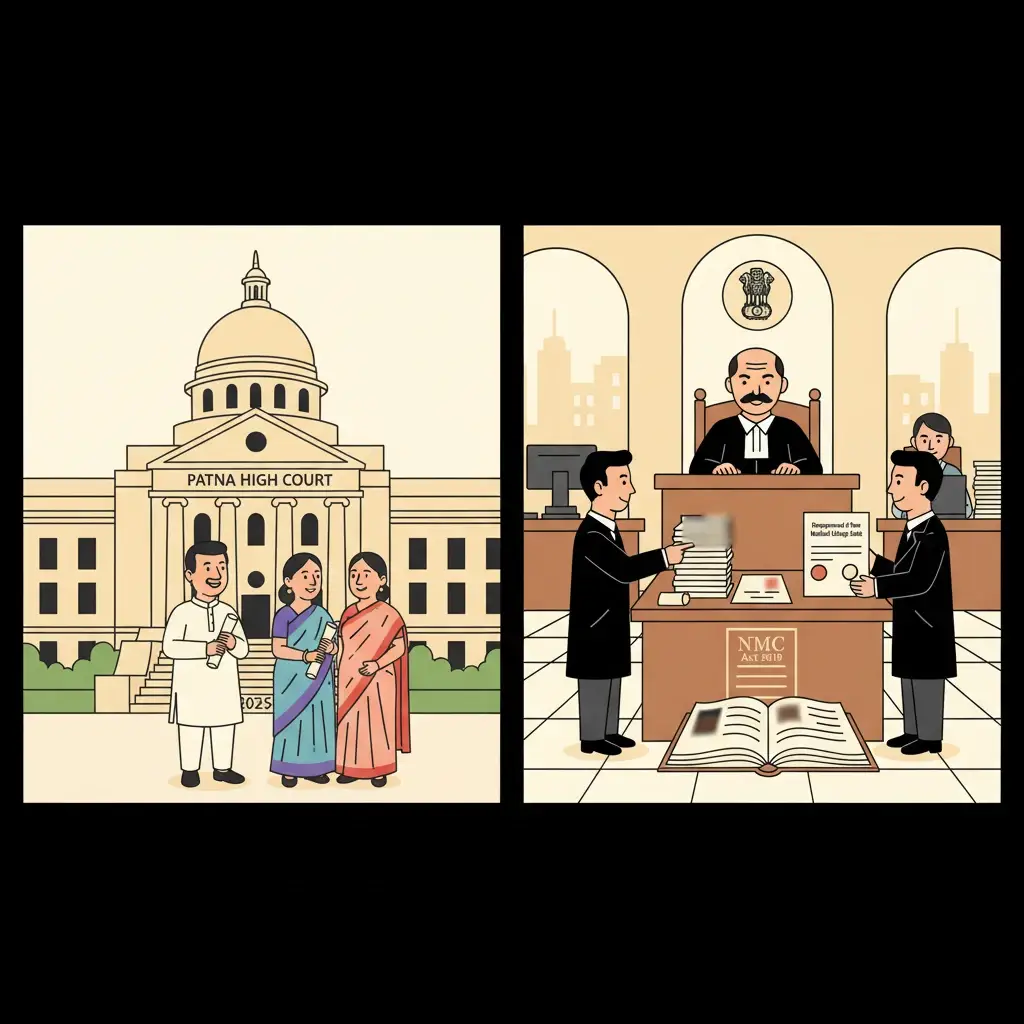
Case Background
A registered trust established a medical college and attached hospital at Khagaria, Bihar, named Shyamlal Chandrashekhar Medical College & SPNM Hospital. The trust applied on 16.09.2023 to the Medical Assessment and Rating Board (MARB) of the National Medical Commission (NMC) for a Letter of Permission to establish a new medical college and admit students in MBBS.
Initially, the application was for 150 MBBS seats for the academic year 2024–25, under Section 28(1) and (2) of the National Medical Commission Act, 2019. After scrutiny of the application, MARB issued a show cause notice dated 04.04.2024 pointing out deficiencies, mainly regarding application fee (including GST), bank guarantee, and bed strength as per the UG-MSR 2023.
The college replied on 09.04.2024, filed the required affidavit, and clearly opted to seek permission for only 100 MBBS seats instead of 150. It requested that further processing and inspection be done as per the norms for 100 seats. MARB then proceeded on that basis.
On 28.06.2024, MARB’s assessment team conducted a physical inspection of the college for 100 seats. A Standard Assessment Form and inspection report were prepared. On 03.07.2024, a virtual hearing was granted by NMC, where representatives of the college appeared, but they could not fully satisfy the committee on the deficiencies flagged in the report.
On 04.07.2024, MARB issued a Letter of Disapproval for the new college. The college filed a first appeal before NMC on 18.07.2024 under Section 28(5), which was dismissed by NMC on 07.08.2024. The college then filed a second appeal before the Union of India under Section 28(6), which was heard on 29.08.2024 and rejected on 30.09.2024.
The college approached the Delhi High Court by way of W.P.(C) No. 14137/2024, but that petition was dismissed on 14.10.2024 for lack of territorial jurisdiction. A petition under Article 32 before the Supreme Court was also dismissed on 21.10.2024, with liberty to approach the jurisdictional High Court. The present writ petition was then filed before the Patna High Court.
What the Court Examined and Decided
The core dispute before the Patna High Court was whether the refusal to grant permission to start the new medical college, for 100 MBBS seats, was legal and fair. The Court closely examined the sequence of notices, inspections, appeals, and the legal requirements under Section 28 of the NMC Act, 2019, along with the UG-MSR 2023.
The Letter of Disapproval dated 04.07.2024 from MARB mentioned these key deficiencies:
- Faculty deficiency of 39%.
- Resident/Tutor deficiency of 39.5%.
- No CT Scan machine available.
- No valid blood bank licence.
- Only one delivery recorded.
On that basis, MARB disapproved establishment of the new medical college. In the first appeal decision dated 07.08.2024, NMC noted “gross deficiency” in faculty and AEBAS data and upheld MARB’s decision. It even recorded that the college requested consideration for 50 seats, but held that it did not qualify even for that.
In the second appeal, the Union of India recorded that:
- Only 39 faculty (7 Professors, 9 Associate Professors, 23 Assistant Professors) and 22 SR/Tutors were found against the required 85 faculty and 65 SR/Tutors for 100 seats.
- There were only 3 deliveries (2 normal, 1 caesarean).
- CT scan and blood bank were not available at the time of inspection.
After considering the material, the Union of India rejected the second appeal on 30.09.2024.
The petitioners argued that the authorities violated Section 28(3) of the NMC Act, which requires MARB to give an opportunity to rectify defects through a show cause notice before disapproving a scheme. They contended that:
- The show cause notice dated 04.04.2024 related only to the initial 150-seat proposal and self-assessment, not to deficiencies found after the 28.06.2024 inspection for 100 seats.
- No show cause notice was issued after the inspection, specifically pointing out the inspection-based deficiencies and giving time to rectify them.
- The Union of India itself recorded in the second appeal order that “no show cause notice was issued by MARB”, but still rejected the appeal.
The petitioners also submitted that as per a 25.01.2023 NMC letter, AEBAS, HMIS, and CCTV data are to be used for decision-making. They pointed out that:
- 149 faculty members of the college were duly registered on the AEBAS portal, which is more than the 85 required under UG-MSR 2023 for 100 seats.
- The deficiency was calculated only on physical presence on the inspection day, even though the college was new and had not yet started its course; there is no rule that all faculty must be physically present on that day.
- The inspection report itself recorded 2 normal deliveries and 1 caesarean, but the disapproval letter incorrectly mentioned only one delivery.
On CT scan and blood bank, the petitioners placed documents to show that:
- A blood centre application was filed on 11.12.2023; inspections were conducted on 06.06.2024 and 16.07.2024; and the licence was granted on 22.08.2024.
- A CT scan machine was installed and functional from 01.08.2024.
The petitioners further alleged discrimination, stating that on the same date, 30.09.2024, the Union of India allowed second appeals of three similarly placed colleges (P.A. Sangma International Medical College, KPC Medical College & Hospital, and School of Medical Sciences, Sri Satya Sai University of Technology & Medical Science) despite major deficiencies, on the strength of their undertakings and affidavits, without compliance inspections.
The respondents argued that:
- Regulations framed under Section 57 of the NMC Act have statutory force and must be strictly followed.
- The college had massive faculty and resident shortages, both as per AEBAS and as per inspection, and lacked a functioning blood bank and CT scan at the time of assessment.
- Court should not sit as an expert body in matters of maintaining medical education standards, relying on decisions like Anand Yadav and Zahoor Ahmed.
- After disapproval for 2024–25, the college should have applied afresh for 2025–26 under the public notice dated 19.12.2024, which it did not do.
The Court first focused on Section 28(3) of the NMC Act. The proviso clearly states that before disapproving a scheme, MARB “shall” give an opportunity to rectify defects. The Court held this requirement to be mandatory. It found that:
- No show cause notice was issued after the 28.06.2024 physical inspection for 100 seats, specifically listing those inspection-based deficiencies.
- The 04.04.2024 notice was tied to the earlier 150-seat application and pre-inspection scrutiny, not to the later 100-seat assessment, and therefore could not be treated as the mandatory notice under Section 28(3).
- The Union of India itself acknowledged in its second appeal order that no show cause notice was issued by MARB, yet failed to give proper weight to that defect and still rejected the appeal.
The Court relied on Supreme Court judgments (including Swamy Devi Dayal Hospital & Dental College and Royal Medical Trust) to underline that where deficiencies are pointed out, an opportunity to report compliance and, if necessary, compliance verification must be provided within the statutory timetable.
On the question of faculty strength, the Court noted:
- UG-MSR 2023 requires 85 faculty for 100 MBBS seats.
- The Assessors’ report confirmed that 149 faculty were registered on AEBAS.
- The NMC itself had previously indicated that AEBAS, HMIS and CCTV data would be used for decision-making.
- There is no specific rule requiring all faculty to be physically present on the inspection day, especially in a new college yet to start courses.
On this basis, the Court accepted the petitioner’s contention that there was no legally sustainable faculty deficiency when viewed in light of AEBAS registration and the applicable regulations.
Regarding CT scan and blood bank, the Court noted that the respondents themselves accepted that these facilities existed and had become operational, and that licences and installation dates were on record. Therefore, these points could not justify outright disapproval, especially without a proper show cause and chance to cure.
The Court also found that the authorities:
- Did not follow the prescribed timelines, causing prejudice to the college, which lost the entire 2024–25 session.
- Acted in a discriminatory manner by allowing second appeals of other colleges with similar or greater deficiencies purely on undertakings and affidavits, but denying similar treatment to the petitioner college.
- Failed to act as a “model litigant”, despite being a State organ expected to act fairly and reasonably.
The Court emphasised the larger public interest: there is an acute shortage of doctors; the college has created infrastructure and appointed approved faculty; if students are not allowed, these resources and teachers will remain idle, which is a waste at a time of healthcare crisis.
At the same time, the Court clarified that it was not questioning expert norms or substituting its views on medical standards. Instead, it was enforcing legal and procedural fairness, including the principles of natural justice (audi alteram partem and nemo debet esse judex in propria causa).
The Court held that the disapproval order of MARB dated 04.07.2024, the NMC first appeal order dated 07.08.2024, and the Union of India second appeal rejection dated 30.09.2024 suffered from “manifest illegality and arbitrariness” and were contrary to mandatory statutory provisions.
Since the 2024–25 academic year had already lapsed, the Court applied the principle that an act of the Court should not harm anyone (actus curiae neminem gravabit). It held that the college’s original application of 16.09.2023 should now be treated as an application for the 2025–26 academic year, to give effective relief.
The Court then issued detailed directions:
- The college’s 16.09.2023 application for 100 MBBS seats must be treated as for academic year 2025–26.
- MARB must accept and process this application within seven days of receiving the Court’s order.
- NMC must conduct a special inspection/physical assessment within twenty days to verify whether all earlier deficiencies have been rectified and whether norms for 2025–26 are met.
- NMC must inform the college in advance of the tentative inspection date.
- The entire process for granting Letter of Permission must be completed by 31.08.2025, before the start of the 2025–26 academic year.
- If any new deficiencies are found in the special inspection, a show cause notice must be issued, granting one month to rectify them, followed by a further inspection.
- If the deficiencies are of a nature that cannot be rectified within one month, NMC/authorities must grant the Letter of Permission for 100 MBBS seats for 2025–26 on the basis of an undertaking/affidavit from the college, in the same manner as done for similarly situated institutions.
- The authorities must strictly follow the NMC Act and applicable guidelines for granting permission.
- The college must fulfil all prerequisites and deposit prescribed fees for 2025–26 as per norms.
With these findings and directions, the writ petition was allowed and all pending applications were disposed of.
Why This Judgment Matters
This judgment is important for all new and proposed medical colleges dealing with the National Medical Commission and MARB. It makes clear that the authorities cannot simply reject applications without strictly following the procedure laid down in Section 28(3) of the NMC Act.
The Patna High Court holds that a proper show cause notice, after inspection and before disapproval, is mandatory. Colleges must be given a fair chance to correct deficiencies. Failure to follow this step can make the disapproval order illegal, even if some shortcomings actually exist.
The judgment also shows that decisions cannot be one-sided or discriminatory. If other colleges are allowed to proceed on the strength of undertakings and documents, similarly placed colleges cannot be denied the same treatment without sound reasons.
For students and families, this case shows that courts are willing to step in where a genuine institution with infrastructure and faculty is kept out due to unfair or delayed decisions. But the Court has also ensured that minimum standards of medical education remain under expert control by ordering fresh inspection and compliance verification instead of blindly ordering admissions.
Legal Issues and Answers
- Issue: Whether MARB/NMC could disapprove the scheme for a new medical college without issuing a mandatory show cause notice under Section 28(3) after inspection for 100 MBBS seats.
Answer: No. The Court held that Section 28(3) is mandatory. No proper show cause notice was issued after the 28.06.2024 inspection for 100 seats, so the disapproval and appellate orders were illegal and liable to be quashed. - Issue: Whether alleged faculty, CT scan, blood bank and delivery deficiencies justified outright rejection without further opportunity to comply.
Answer: No, not in the manner done here. The Court found that 149 faculty were AEBAS-registered against a requirement of 85, CT scan and blood centre had become functional, and no rule required all faculty to be physically present on inspection day. Without a proper show cause and compliance process, these grounds could not sustain disapproval. - Issue: What relief should be granted when the relevant academic year (2024–25) has already lapsed.
Answer: The Court directed that the original application dated 16.09.2023 be treated as for the academic year 2025–26, ordered fresh inspection and compliance steps within strict timelines, and mandated consideration for a Letter of Permission for 100 MBBS seats by 31.08.2025.
Cases Cited by the Court
- Mohinder Singh Gill v. Chief Election Commissioner, (1978) 1 SCC 405.
- Rameshwar Prasad (VI) v. Union of India, (2006) 2 SCC 1.
- Swamy Devi Dayal Hospital & Dental College v. Union of India, 2014 (13) SCC 506.
- Royal Medical Trust v. Union of India, (2015) 10 SCC 19.
- Anand Yadav v. State of Uttar Pradesh, AIR 2020 SC 5383 (cited by respondents).
- Zahoor Ahmed v. Sheikh Imtiyaz Ahmed, (2019) 2 SCC 404 (cited by respondents).
- Judgment of Rajasthan High Court, S.B. Civil Writ Petition No. 16822/2024, dated 16.10.2024 (relied on by petitioners).
Case Details
Case Number: Civil Writ Jurisdiction Case No. 16800 of 2024
Case Title: Madhuri Sewa Nyas & Anr. v. Union of India & Ors.
Court: High Court of Judicature at Patna
Coram: Hon’ble Mr. Justice Anjani Kumar Sharan
Date of Judgment: 20.03.2025
Citation: 2025 (2) PLJR 824
Advocates:
- For the Petitioners: Mr. Chitranjan Sinha, Senior Advocate; Mr. Arun Kumar, Advocate.
- For the Union of India: Mr. K.N. Singh, ASG; Mr. Alok Kumar, CGC.
- For the National Medical Commission and its Boards: Mr. Kumar Priya Ranjan, Senior Standing Counsel; Mr. Sudarshan Bharadwaj, Advocate; Mr. Sandeep Kumar, Advocate.
Nature of the Case: Writ petition under Article 226 of the Constitution challenging disapproval of application for establishment of a new medical college and seeking a mandamus for grant of Letter of Permission for MBBS intake.
Link to Judgment: https://patnahighcourt.gov.in/viewjudgment/MTUjMTY4MDAjMjAyNCMxI04=-LYInMIrBYaw=
If you found this explanation helpful and wish to stay informed about
how legal developments may affect your rights in Bihar,
you may consider following Samvida Law Associates for more updates.







