

Case Background
This case was filed by forty‑one petitioners from different villages of West Champaran district. All of them were working in the education sector under government schemes meant for Mahadalit children and families.
They were engaged as Maha Dalit Shiksha Swayam Sevak in the financial year 2011‑12. Their work was under the Special Trained Non Residential Centre being run by the District Programme Officer, Primary Education and Sarv Shiksha Abhiyan, West Champaran.
The petitioners’ job was to accompany students from the lower strata of society throughout the day. They had to ensure that these children did not run away from school and to make efforts for improving their living standards. Thus, the work was both educational and social in nature.
The engagement was purely contractual. It was for a period of one year with an honorarium of Rs. 2,000 per month. The arrangement also stated that after one year, such workers could be re‑adjusted as Tola Sevaks depending on their performance.
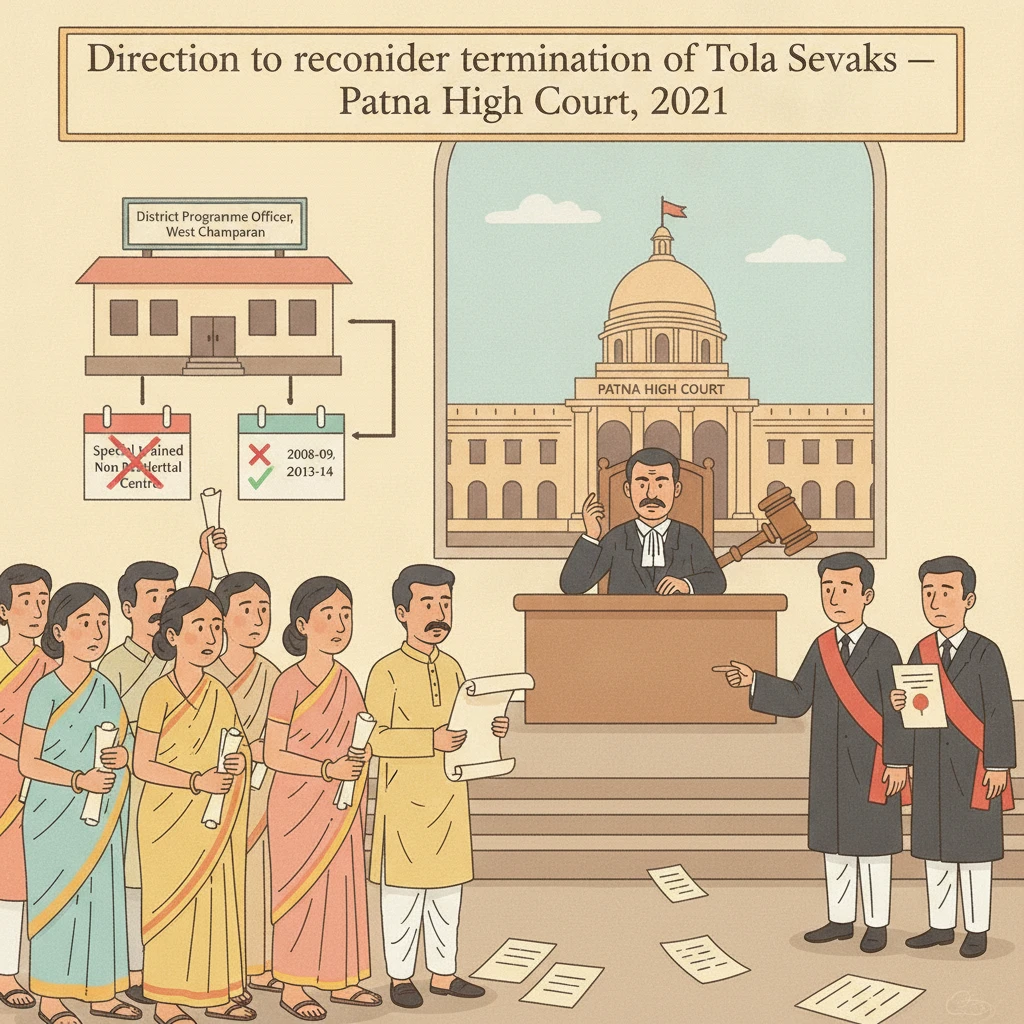
On 01.09.2011, a letter was issued by the District Programme Officer, Primary Education and Sarv Shiksha Abhiyan, West Champaran. By this letter, the Special Trained Non Residential Centre was directed to be closed with immediate effect. As a result, the petitioners lost their place of work and their engagement came to an end.
The petitioners claim that they had been assured they would be absorbed as Tola Swayam Sevak. However, this did not happen. On the contrary, according to them, persons engaged as Tola Sevaks in other years and districts continued in service and continued to receive their honorarium.
Aggrieved by this situation, the petitioners repeatedly represented before different authorities. According to the judgment, these authorities wrote to the Principal Secretary, Department of Education, recommending continuance of the petitioners as Tola Sevaks, but nothing changed on the ground.
Ultimately, the petitioners approached the Patna High Court under its civil writ jurisdiction, challenging the letter of 01.09.2011 and the termination of their engagement.
What the Court Examined and Decided
The matter came up before Hon’ble Mr. Justice Ashutosh Kumar. The Court heard Mr. Radha Mohan Pandey, counsel for the petitioners, and the learned Assistant Counsel to SC‑16 for the State.
The main grievance of the petitioners was directed against the letter dated 01.09.2011 of the District Programme Officer. Through this letter, the Special Trained Non Residential Centre was closed with immediate effect. The petitioners argued that, because of this closure, they were removed from their posts despite earlier assurances that they would be absorbed as Tola Swayam Sevaks.
The Court recorded the factual position that the petitioners were engaged on contract basis as Maha Dalit Shiksha Swayam Sevak in the financial year 2011‑12. They had the responsibility of accompanying children belonging to the lower strata of society throughout the day and helping to uplift their living standards.
The Court also noted that the engagement was for one year on a monthly honorarium of Rs. 2,000. After the period of one year, such Tola Sevaks could be re‑adjusted depending on their performance. This shows that there was no automatic right to continuity, but there was a scheme‑based possibility of re‑adjustment.
On behalf of the petitioners, it was submitted that the Tola Sevak scheme itself had not been discontinued. Counsel pointed out that Tola Sevaks engaged in the years 2008‑09 and 2013‑14 had been allowed to continue and were still being paid their honorarium.
According to the petitioners, it was only in West Champaran district that the Tola Sevaks engaged in the year 2011‑12 saw their services terminated. This selective termination, they argued, was arbitrary and unfair.
The Court took note of the petitioners’ statement that they had been representing before all competent authorities. It also recorded that those authorities had written to the Principal Secretary, Department of Education, for continuance of the petitioners as Tola Sevaks, but without any positive outcome.
The stand of the State, as placed before the Court, was that the engagement of the petitioners as Maha Dalit Shiksha Swayam Sevak was only for a certain period. Therefore, the petitioners could not insist on continuation of such engagement.
The learned counsel for the petitioners argued that this stand of the State was not tenable. He submitted that this argument could have been accepted only if the entire project had been stopped altogether. In reality, the project had not been abandoned, and therefore the State could not rely simply on the temporary nature of the contract.
The Court considered whether the project had completely ended. It observed that the State had not disputed the factual claim that Maha Dalit Shiksha Swayam Sevaks engaged before and after the petitioners had indeed been absorbed as Tola Swayam Sevaks and were still allowed to continue.
The Court also referred to the fact that Tola Sevaks Rules, 2018 had been promulgated for effective functioning of the project. This indicated that the project was alive and that the role of Tola Sevaks continued to exist within the government scheme.
Although the communication concerning closure of the Special Trained Non Residential Centre had been issued in 2012, the Court explained why it was entertaining the writ petition in 2021. It stated that the project had not been abandoned. Many persons engaged as Maha Dalit Shiksha Swayam Sevak in different districts were absorbed as Tola Swayam Sevaks and had been allowed to continue.
The Court found that there did not appear to be any rationale behind picking out the Tola Sevaks of one district only, and that too those appointed in a particular financial year, for termination of their engagement. In other words, while similar persons elsewhere and in other years were retained, these petitioners alone had their services ended.
Instead of directly ordering reinstatement or absorbing the petitioners, the Court chose a more limited but clear course of action. It directed the petitioners to make a detailed representation before the Principal Secretary, Department of Education, Government of Bihar, within four weeks.
The Court further directed that, upon receipt of such representation, the Principal Secretary must pass a reasoned order within eight weeks. This meant that the government officer would have to explain, in writing, the reasons for either accepting or rejecting the petitioners’ request.
The Court then laid down a test for what the Principal Secretary must examine. It said that, in case there was no rationale behind disengaging the petitioners while Tola Sevaks appointed in different districts and in different financial years were allowed to continue, then necessary consequential action must be taken.
The Court pointed out that there was nothing on record to suggest any difference between those Tola Sevaks who were engaged later than the petitioners and were still continuing, and the petitioners themselves. Thus, if there was no valid distinction, the administration would need to correct the situation.
By making these directions, the Court left the final decision on continuance or other relief to the Principal Secretary, but insisted on fairness, uniformity, and a reasoned decision‑making process.
With these observations and directions, the writ petition was disposed of.
Why This Judgment Matters
This judgment is important for contract workers and volunteers engaged under government schemes, especially in the education and welfare sectors in Bihar.
The Patna High Court recognised that, even when an engagement is contractual and for a fixed period, the government cannot act arbitrarily. If a project continues and other similarly placed workers are kept on, authorities must have a proper reason for removing only a specific group.
For Mahadalit Swayam Sevaks and Tola Sevaks, the judgment underlines that they can demand equal treatment across districts and years. When one district alone terminates their services while others continue, the State must justify this difference.
The Court has also insisted that senior officials, such as the Principal Secretary, must give a clear, written, and reasoned order when such grievances are raised. This helps affected workers understand why a decision has been taken and gives them a basis to challenge it further, if needed.
Legal Issues and Answers
- Issue: Can the State terminate the engagement of Maha Dalit Shiksha Swayam Sevaks of one district and one financial year while allowing similarly placed Tola Sevaks in other districts and years to continue, without showing any rational basis?
Answer: The Patna High Court held that such selective disengagement requires a rational basis. It directed the Principal Secretary, Education Department, to reconsider the matter, and if no rationale exists, to take consequential action in favour of the petitioners. - Issue: How should the State respond when affected workers claim discrimination in continuation of a government project that is still running?
Answer: The Court directed that a detailed representation by the affected workers must be decided by the competent authority through a reasoned order within a fixed time frame.
Cases Cited by the Court
- The judgment does not mention or rely on any other decided cases.
Case Details
Case Number: Civil Writ Jurisdiction Case No. 12767 of 2017
Case Title: Radhe Shyam Kumar & Ors. v. The State of Bihar & Ors.
Coram: Hon’ble Mr. Justice Ashutosh Kumar
Citation: 2022 (2) PLJR 313
Date of Judgment: 24.11.2021
Advocates: Mr. Radha Mohan Pandey for the petitioners; Mr. S.C. Mishra, SC‑16 (with AC to SC‑16) for the respondents
Court: High Court of Judicature at Patna
Nature of the Case: Civil writ petition under Article 226 of the Constitution challenging termination arising from closure of a Special Trained Non Residential Centre and seeking continuance/absorption as Tola Swayam Sevaks
Link to Judgment: Click here to read the full judgment of the Patna High Court
If you found this explanation helpful and wish to stay informed about
how legal developments may affect your rights in Bihar,
you may consider following Samvida Law Associates for more updates.







