

Case Background
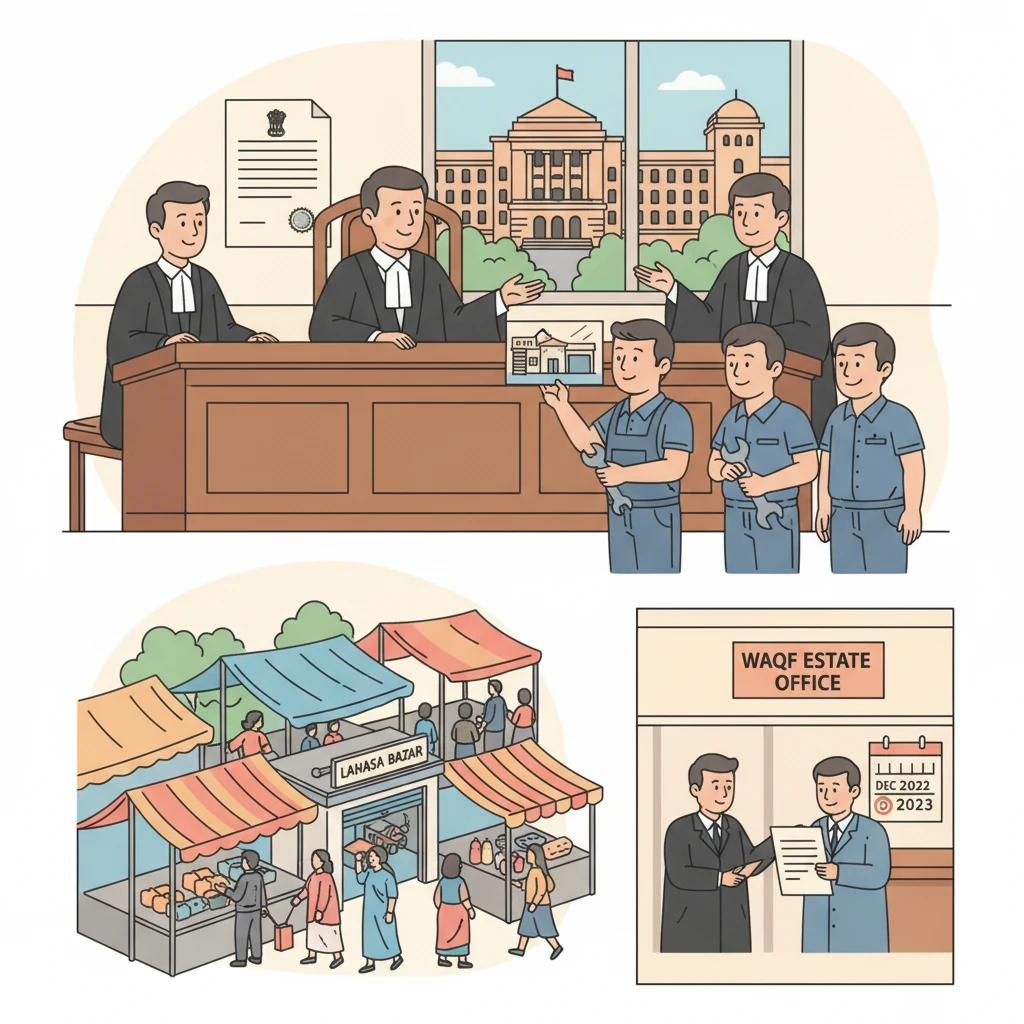
The case arose from Civil Writ Jurisdiction Case No. 17142 of 2022 filed before the Patna High Court. The petitioners work as motor mechanics within the premises of the Patna High Court Mazar Sharif Waqf Estate, identified as Waqf No. 663.
According to the judgment, the petitioners claimed that they had been earning their livelihood from a motor garage located on the Waqf Estate for a long period. They stated that they regularly paid rent to the Managing Committee of the High Court Mazar Sharif Waqf Estate and described themselves as tenants.
Every year, a temporary market called “Lahasa Bazar” is organized on the same premises. This market operates for about two months. For the year in question, a tender had been issued and the right to hold the Lahasa Bazar had already been settled in favour of a private tenderee.
The writ petition was filed on 08.12.2022. By the time the Court heard the matter on 07.12.2023, the relevant Lahasa Bazar period had apparently expired, and no amendment was made to extend the challenge to a later season. Despite this, the core grievance of the petitioners remained: their access to livelihood had been affected by the way Lahasa Bazar was being organized.
What the Court Examined and Decided
The petitioners approached the Patna High Court seeking a direction to the State authorities, the Bihar State Sunni Waqf Board, and the Managing Committee of the High Court Mazar Sharif Waqf Estate. They wanted permission to ply a different trade in Lahasa Bazar during the period when it was operative at the Mazar Sharif premises.
Their main grievance was that when Lahasa Bazar was allowed to operate, the entry of customers to their motor garage was blocked. As a result, their income as motor mechanics was badly affected. They argued that they had a right to continue their business at the place where they had been working for a long time.
To reduce the hardship, the petitioners had requested the Waqf Estate to allot them a temporary shop within Lahasa Bazar. They expressed readiness to pay the requisite amount either to the Waqf Estate or directly to the tender holder so that they could maintain their livelihood and support their families.
The Court recorded that the petitioners did not seek any free benefit. Instead, they wanted an opportunity to participate in the bazar on payment of the usual charges, so that they were not left without work for two months every year.
Earlier, the Court had adjourned the matter. The purpose was to allow counsel for the Waqf Estate to obtain instructions and communicate whether the petitioners could be given temporary shops, so that they were not rendered jobless and their families did not suffer.
On the next hearing, counsel for respondent no. 4 (the Waqf Estate) stated that the Estate had received complaints about the “mischievous character” of the petitioner and that the petitioner was considered an encroacher, not a tenant. It was also informed that an encroachment proceeding had been initiated and was pending against the petitioner.
Thus, there was a clear conflict of stand: the petitioners claimed tenancy and rent payment, while the Waqf Estate treated them as encroachers and had started a formal encroachment case. However, the encroachment proceeding itself was not under challenge before the Court in this writ petition.
The Court heard all parties, including counsel appearing for the State, the Waqf Board, and the Waqf Estate. It then moved to consider the larger constitutional background to the dispute.
The Court referred to Articles 25 and 26 of the Constitution of India, which guarantee freedom of religion and the right to manage religious affairs. It stressed that these rights are subject not only to morality and health but also to public order.
The judgment drew a distinction between two aspects of religion: doctrinal and ritual aspects, which are treated as private purposes, and the administration of property dedicated to the public for religious purposes, which is a public purpose. To explain this, the Court quoted the decision in “Amulya Chandra v. Corporation of Calcutta”, AIR 1922 Cal 333 (O).
In that case, the Privy Council had to decide whether acquiring property to build a Dharmasala for pilgrims visiting a Hindu temple amounted to a “public purpose”. The Privy Council held that such acquisition did serve a public purpose and was not excluded merely because it benefitted pilgrims and religious dignitaries. From this, the Patna High Court reiterated that State control can extend to administration of properties endowed for religious institutions, treating them as public purposes, when the institutions are dedicated to the public.
Coming back to the present matter, the Court noted that just before issuing the tender for Lahasa Bazar, the Waqf Estate had started encroachment proceedings against the petitioner. However, the Court specifically described that issue as “a different subject matter”.
The real concern before the Court was whether a person who had been earning his livelihood as a motor mechanic from premises of the Waqf Estate could be completely prevented from operating his garage during the operation of Lahasa Bazar, especially when there was nothing on record to show that he had disturbed the religious practices or rituals of the Waqf Estate.
The Court observed that there was no material to suggest that the petitioner had meddled with, or interfered in any way with, the doctrinal or ritual aspects of the Waqf Estate. On the contrary, he had expressed willingness to pay the required amount to the Waqf Estate or to the tender holder in order to sustain himself and his family during the Lahasa Bazar season, regardless of any private dispute between him and the Waqf Estate.
On this basis, the Court turned to the constitutional guarantee of the right to life and livelihood under Article 21. It cited the decision of the Hon’ble Supreme Court in State of U.P. v. Charan Singh, Civil Appeal No. 2381 of 2007. In that case, the Supreme Court had reiterated the observations made by a Constitution Bench in Olga Tellis v. Bombay Municipal Corporation, AIR 1986 SC 180.
The key extract quoted in the judgment emphasised the inseparable link between life and livelihood: “That, which alone makes it impossible to live, leave aside what makes life livable, must be deemed to be an integral part of the right to life. Deprive a person from his right to livelihood and you shall have deprived him of his life.”
Applying this principle, the Patna High Court held that a citizen cannot be denied his livelihood. It recorded that the petitioner had been sustaining his expenses from his earnings as a mechanic in a garage situated in the Waqf Estate for a long time.
The Court also took note of the fact that, notwithstanding the pending encroachment proceedings, the respondents accepted the basic factual position that the petitioner was working there and that his survival depended on this occupation. The petitioner remained prepared to pay the requisite amounts either to the Waqf Estate or to the tenderee.
Balancing the rights of the religious institution and the livelihood concerns of the individual, the Court did not grant any blanket right in favour of the petitioner. Instead, it issued a direction of a limited and humane nature.
The Court directed that the Waqf Estate must consider the grievance of the petitioner sympathetically, especially regarding his survival and livelihood during the operation of Lahasa Bazar. It made it clear that this direction was issued in the peculiar facts of this particular writ petition and was not a general rule applicable to all similar disputes.
With these observations and directions, the Court disposed of the writ petition. It did not interfere with the existing tender or with the ongoing encroachment proceedings but ensured that the Waqf Estate would not ignore the livelihood aspect while dealing with the petitioner.
Why This Judgment Matters
This decision is important for small workers and shopkeepers who earn their living on religious or charitable properties, such as Waqf lands. It shows that while such properties are managed for religious purposes, the administrators must still act fairly towards people whose survival depends on businesses running from those lands.
The Patna High Court underlined that even when there are disputes about title or accusations of encroachment, authorities cannot casually cut off a person’s livelihood. The Court relied on the constitutional right to life and livelihood and asked the Waqf Estate to consider the petitioners’ request with sympathy.
For people facing similar situations—where markets, fairs or religious events temporarily block their shops or workspaces—this judgment highlights that courts can insist on humane consideration. At the same time, it shows that the Court may not directly grant a permanent right or cancel tenders but can nudge authorities to act in a way that protects basic survival.
Legal Issues and Answers
- Issue: Can the managing committee of a Waqf Estate, while organizing a temporary market like Lahasa Bazar, completely deny a long-standing mechanic the ability to earn his livelihood from the premises, despite his willingness to pay required charges?
Answer: The Patna High Court held that a citizen cannot be denied livelihood. It directed the Waqf Estate to consider the petitioner’s grievance sympathetically so that his survival is not imperilled, while making it clear that the order is confined to the peculiar facts of this case. - Issue: Does the constitutional protection for religious institutions under Articles 25 and 26 prevent the Court from intervening where the administration of religious property affects livelihood?
Answer: No. The Court clarified that doctrinal and ritual aspects of religion are private, but administration of properties dedicated for public religious purposes is a public purpose and subject to regulation. Protecting livelihood in such contexts falls within this regulatory space.
Cases Cited by the Court
- Amulya Chandra v. Corporation of Calcutta, AIR 1922 Cal 333 (O)
- State of U.P. v. Charan Singh, Civil Appeal No. 2381 of 2007
- Olga Tellis v. Bombay Municipal Corporation, AIR 1986 SC 180
Case Details
Case Number: Civil Writ Jurisdiction Case No. 17142 of 2022
Case Title: Mohammad Abid & Ors. v. The State of Bihar & Ors.
Coram: Hon’ble Mr. Justice Purnendu Singh
Citation: 2024 (1) PLJR 274
Advocates:
- For the petitioners: Mr. Ajit Kumar Ojha, Advocate
- For the State: Mr. Sudhanshu Shekhar, AC to SC-24
- For respondent no. 4 (High Court Mazar Sharif Waqf Estate): Mr. Ashhar Mustafa, Advocate; Mr. Abu Nasar, Advocate
- For respondent no. 2 (Bihar State Sunni Waqf Board): Mr. Helal Ahmad, Advocate
Nature of the Case: Civil writ petition seeking directions regarding livelihood and temporary business rights within Waqf property during operation of Lahasa Bazar
Link to Judgment: Click here to read the full judgment of the Patna High Court
If you found this explanation helpful and wish to stay informed about
how legal developments may affect your rights in Bihar,
you may consider following Samvida Law Associates for more updates.







