
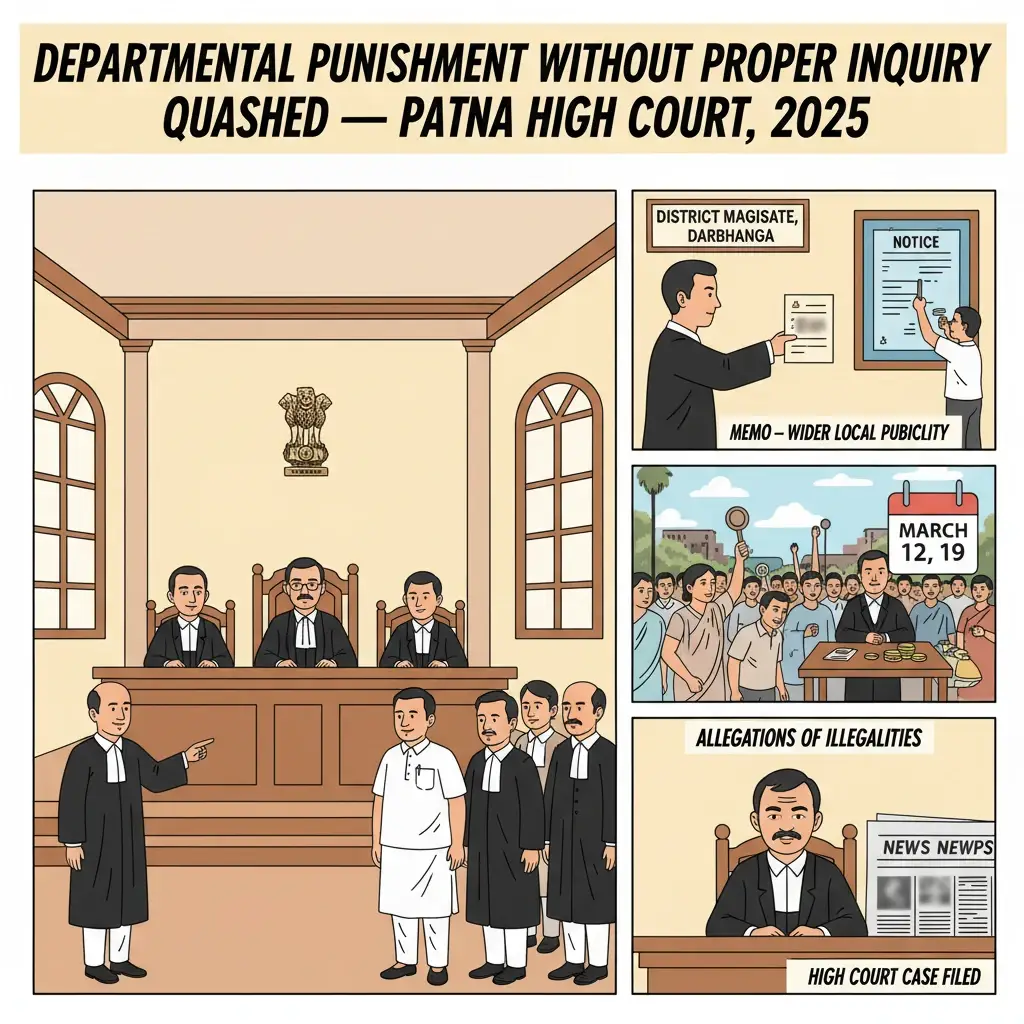
Case Background
The petitioner is a Bihar Administrative Service officer who joined service in 2000. During the financial year 2013-14, he was posted as Deputy Collector Land Reforms (DCLR), Sadar, Darbhanga.
On 26.02.2013, the District Magistrate, Darbhanga issued Memo No. 643. This memo directed the “Settlement of Sairats” (revenue sites like ghats, melas, etc.) for 2013-14 through open tender at district, subdivision and block level. A total of 65 Sairats under three subdivisions — Darbhanga Sadar, Biraul and Benipur — were to be settled.
The petitioner, as DCLR, Darbhanga Sadar, was responsible for settling 24 Sairats falling under his jurisdiction. Out of these, 16 Sairats had a minimum reserved value of Rs. 50,000 or more. The memo also directed that the District Public Relation Officer (DPRO) must get a general public notice published in two daily Hindi newspapers, and that the DCLRs must ensure wide publicity in their own areas and conduct settlement on fixed dates.
Following this, on 01.03.2013, the petitioner issued Letter No. 407, asking all Circle Officers under Darbhanga Sadar to publicise the settlement programme. The public notice was also displayed on the notice board of his office.
On 12.03.2013, seven Sairats were settled through open tender, three of which had minimum value above Rs. 50,000. On 19.03.2013, five more Sairats were settled, and again three of them had minimum value above Rs. 50,000. On 25.03.2013, no bidders turned up, so no Sairat was settled that day. In total, 12 Sairats were settled by the petitioner, five of which had a minimum value of more than Rs. 50,000. The petitioner also informed the District Magistrate about the settlements on the dates of settlement, in line with Memo No. 643.
Later, in July 2013, the petitioner was transferred to Kahalgaon, Bhagalpur.
Subsequently, on 28.12.2013, the Commissioner, Darbhanga Division sent Letter No. 1444 to the Principal Secretary, General Administration Department. It alleged irregularities in settlement of Gausha Ghat Mela Sairat and stated that 20 Sairats, each with minimum value above Rs. 50,000, had been settled without publication of general notice in two daily Hindi newspapers, contrary to departmental guidelines. It also mentioned that this led to filing of CWJC No. 14491 of 2013 (Uma Dhar Yadav v. State of Bihar & Others) in the High Court.
Based on this letter, a show-cause notice (Letter No. 2323 dated 18.02.2014) was issued to the petitioner, asking him to explain. He replied, asserting that no illegality was committed and that responsibility for newspaper publication lay with the DPRO, not with him.
Despite this, on 12.05.2016, he was served with “Prapatra K” (charge memo for major departmental proceeding) vide Letter No. 6749. He submitted a detailed reply on 30.05.2016, denying the charges and pointing out that the allegations were based on incorrect facts.
On 03.07.2017, the disciplinary authority imposed punishment of censure for the year 2012-13 and withholding of one increment without cumulative effect, conveyed through Memo No. 8003 dated 04.07.2017. No regular inquiry under Rule 17 of the Bihar Government Servants (Classification, Control and Appeal) Rules, 2005 was held.
On 19.03.2021, the petitioner filed a review petition under Rule 24(2) of the 2005 Rules against the punishment order. On 09.07.2021, the Under Secretary rejected the review as time-barred. The petitioner then filed this writ petition (CWJC No. 16745 of 2021) before the Patna High Court challenging both orders.
What the Court Examined and Decided
The matter was heard by Hon’ble Mr. Justice Harish Kumar. The Court first noted the petitioner’s challenge to two orders: the original punishment dated 03.07.2017 (Memo No. 8003 dated 04.07.2017) and the review order dated 09.07.2021 rejecting his review on limitation.
The petitioner’s senior counsel argued that the entire departmental proceeding was flawed at its foundation. According to him, the charge memo in “Prapatra K” wrongly alleged that the petitioner, as DCLR Darbhanga Sadar, had settled 16 Sairats having minimum value above Rs. 50,000 without newspaper publication, and also suggested he exceeded his jurisdiction. In reality, he had settled only 12 Sairats, and only five had a minimum value above Rs. 50,000. Thus, the main factual premise of the charge was said to be incorrect.
The petitioner’s counsel relied heavily on Memo No. 643 dated 26.02.2013, which clearly showed that the duty to publish notices in two Hindi newspapers was given to the District Public Relation Officer. The DCLR’s role was to ensure that the settlement programme was publicised locally and conducted on the dates fixed, which the petitioner claimed he had done by issuing Letter No. 407 and putting up the notice on the office notice board.
The petitioner also produced letters obtained under the Right to Information Act, 2005 (Letter No. 70 dated 01.03.2013 and Letter No. 2671 dated 02.12.2013), which indicated that the notice could not be published in newspapers due to procedural delay on the part of the Information and Public Relations Department. This further supported his stand that the failure of newspaper publication was not attributable to him.
A crucial grievance was that although “Prapatra K” indicated initiation of a major departmental proceeding under Rule 17 of the 2005 Rules, no regular inquiry was ever held. The petitioner asserted that:
- No Enquiry Officer was appointed.
- No Presenting Officer was appointed.
- No oral or documentary evidence was produced against him.
- No witness was examined.
- He was not given any opportunity of personal hearing.
Despite these serious procedural gaps, the disciplinary authority proceeded straight from the charge memo and his written reply to imposing punishment. The petitioner argued that once a major penalty proceeding under Rule 17 is initiated, the full procedural safeguards of Rule 17 and the follow-up process under Rule 18 must be followed, even if ultimately only a minor penalty is imposed.
The petitioner also pointed out that the impugned punishment had “cascading effect” on his career. He was denied promotion to the post of Deputy Secretary, while juniors were promoted, and his 1st and 2nd MACP benefits were not granted from the due dates. He therefore submitted that the review application should have been decided on merits, not rejected on limitation alone.
In support of his stand, he relied on Division Bench judgments of the Patna High Court in Ashok Kumar Singh v. State of Bihar (LPA No. 861 of 2019), Manoranjan Singh v. State of Bihar (LPA No. 706 of 2019) and Satyendra Kumar v. State of Bihar (LPA No. 1326 of 2019), which stress the need for proper inquiry and reasoned orders even when imposing minor penalties.
On the other hand, the State opposed the writ petition mainly on the ground of delay and laches. The State’s counsel argued that the punishment order dated 03.07.2017 was challenged only after around four years, and the review petition was filed just as a device to overcome the limitation hurdle. He submitted that such stale claims should not be entertained in writ jurisdiction. He relied on judgments including P. Sadasivaswamy v. State of Tamil Nadu, State of J&K v. R.K. Zalpuri, Surajdeo Lal v. State of Bihar and Nageshwar Singh v. Union of India.
On merits, the State argued that settlement of Sairats with minimum value above Rs. 50,000 was allowed only after publication of notice in two daily Hindi newspapers, as per instructions of the Revenue and Land Reforms Department. Since the petitioner admitted that he settled Sairats with value above Rs. 50,000 without such publication, the charge stood proved. The State also argued that the punishment was minor, so strict adherence to Rule 17 was not required, and that the petitioner was given ample opportunity through show-cause and replies.
The Court first addressed the objection of delay and laches. It referred to several Supreme Court judgments, including City and Industrial Development Corporation v. Dosu Aardeshir Bhiwandiwala, Karnataka Power Corporation Ltd. v. K. Thangappan, Union of India v. Tarsem Singh, and Tukaram Kana Joshi v. Maharashtra Industrial Development Corporation.
From these, the Court summarised that while delay and laches is a relevant factor in writ jurisdiction, it is not an absolute bar. Where there is a continuing wrong causing a continuing source of injury, and no third-party rights are affected, and the situation shocks judicial conscience, the Court may still exercise jurisdiction.
Applying this, the Court noted that the punishment order had directly impacted the petitioner’s promotion and MACP benefits, creating a continuing source of injury. Though there was delay, the Court held that this was a fit case to exercise its writ jurisdiction in the interest of justice, especially as the impugned order appeared to be “manifestly illegal and non est in the eyes of law”.
On merits, the Court carefully examined the record. It found that the charge memo was “completely based upon incorrect facts”, inasmuch as it alleged settlement of 16 Sairats with minimum value above Rs. 50,000 under the petitioner, whereas he had jurisdiction and responsibility only over 12 Sairats, with only five in that category. This factual error went to the root of the proceeding.
The Court emphasised that Memo No. 643 showed that the obligation to publish the general notice in two newspapers rested with the DPRO, not the petitioner. The petitioner’s role was to ensure local publicity and conduct of settlement, which he had performed. RTI documents (Annexure-13 series) confirmed that non-publication in newspapers was due to procedural delay in the Information and Public Relations Department.
The Court then turned to the requirement of following statutory procedure under the 2005 Rules. It quoted Rule 18 in detail, which deals with action on the inquiry report in a major penalty proceeding, including the need to consider the inquiry report, record disagreement with reasons, forward the report and findings to the delinquent officer, seek his representation, and then decide whether to impose minor or major penalty.
The Court held that once a departmental proceeding is initiated by issuing a charge memo that clearly contemplates a “major enquiry” under Rule 17, the authorities cannot bypass the mandatory procedure merely because they ultimately choose to impose a minor penalty. Rule 18(5) specifically deals with the situation where, after a major inquiry, the disciplinary authority decides to impose one of the minor penalties. In other words, the inquiry process cannot be skipped.
In the present case, the Court noted that no Enquiry Officer was appointed, no formal inquiry was conducted and no inquiry report existed. Instead, after the petitioner’s reply to “Prapatra K”, comments were taken from the Divisional Commissioner and, based on those comments, the punishment was imposed. The Court found that this showed lack of independent application of mind by the disciplinary authority.
The Court further examined the punishment order and found it to be cryptic and unreasoned. The order merely stated that the department found that settlement of Sairats took place without publication of notice in newspapers and therefore the petitioner was found guilty. It did not discuss any of the defences raised by the petitioner or explain why his explanations were not acceptable.
Relying on earlier judgments such as Kems Services Pvt. Ltd. v. State of Bihar, Kranti Associates v. Masood Ahmad Khan, Manoranjan Singh, Satyendra Kumar, and The State of Bihar v. Arun Kumar (LPA No. 837 of 2023), the Court reiterated that:
- Any order having civil consequences must follow principles of natural justice.
- Even in cases of minor punishment, when facts are disputed, some form of inquiry and due consideration of defence is necessary.
- Final orders must contain reasons showing that the authority has applied its mind to the show-cause reply.
- Non-speaking, cryptic orders that ignore the defence are vulnerable to being set aside.
Summarising, the Court held that the disciplinary authority was obliged to consider the entire circumstances, the show-cause reply and to apply its mind before deciding the penalty. In this case, no such consideration was evident. The punishment order was therefore unsustainable.
Consequently, the Court set aside the punishment order dated 03.07.2017 (Memo No. 8003 dated 04.07.2017). Since the basis for the review order fell with the original order, the review order dated 09.07.2021 rejecting the review as time-barred was also quashed. The writ petition was allowed, with no order as to costs.
Why This Judgment Matters
This judgment is significant for government servants in Bihar and similar service structures.
First, it reinforces that once a major departmental proceeding is initiated, the authorities cannot bypass the mandatory inquiry procedure, even if they ultimately impose a minor penalty like censure or withholding of increment. The process has to be fair and lawful from the beginning to the end.
Second, the Patna High Court has made it clear that disciplinary authorities cannot base charges on incorrect or exaggerated facts. If the very foundation of the charge is wrong, any punishment arising from it cannot stand.
Third, the Court has stressed the importance of reasoned orders. An order affecting service career cannot simply state “explanation not satisfactory” without dealing with the defence. This protects employees from arbitrary and non-speaking orders.
Fourth, on the delay issue, the Court has recognised that some service wrongs, especially those affecting promotion and MACP, can create a continuing injury. In such cases, even if there is delay, the Court can still intervene where the punishment is clearly illegal.
For officers and employees facing departmental proceedings, this judgment shows that they have a right to:
- Proper framing of charges based on correct facts.
- Due procedure under the relevant service rules, especially where major penalty is invoked.
- A fair consideration of their replies and defences.
- A reasoned decision that can be examined by a court.
For departments, the judgment is a reminder that shortcuts in disciplinary proceedings may not survive judicial scrutiny and may ultimately delay or derail valid administrative action.
Legal Issues and Answers
- Issue: Can the Patna High Court entertain a writ petition challenging a punishment order after several years, when the punishment affects promotion and MACP benefits?
Answer: Yes. The Court held that, despite delay, it can exercise writ jurisdiction where the punishment causes a continuing source of injury and is manifestly illegal, especially when no third-party rights are affected. - Issue: Is a punishment order valid when a major departmental proceeding is initiated under Rule 17 of the 2005 Rules but no regular inquiry is conducted and the order is non-speaking?
Answer: No. The Court held that once a major inquiry is initiated, the procedures under Rules 17 and 18 must be followed, and the disciplinary authority must apply its mind and give reasons. The impugned order, passed without inquiry and without dealing with the defence, was held unsustainable and set aside. - Issue: Can a disciplinary authority rely on charges based on incorrect factual premises to impose penalty?
Answer: No. The Court found that the charge memo was based on incorrect facts about the number and value of Sairats settled by the petitioner. Such a defective foundation vitiated the entire proceeding and could not support any punishment.
Cases Cited by the Court
- City and Industrial Development Corporation v. Dosu Aardeshir Bhiwandiwala and Others, (2009) 1 SCC 168
- Karnataka Power Corporation Ltd. v. K. Thangappan and Another, (2006) 4 SCC 322
- Chennai Metropolitan Water Supply and Sewerage Board and Others v. T.T. Murali Babu, (2014) 4 SCC 108
- Union of India and Others v. Tarsem Singh, (2008) 8 SCC 648
- Tukaram Kana Joshi and Others v. Maharashtra Industrial Development Corporation and Others, (2013) 1 SCC 353
- P. Sadasivaswamy v. State of Tamil Nadu, (1975) 1 SCC 152
- State of Jammu and Kashmir v. R.K. Zalpuri and Others, 2015 (4) PLJR (SC) 480
- Surajdeo Lal v. State of Bihar, 2015 (2) PLJR 793
- Nageshwar Singh v. Union of India, 2015 (4) PLJR 935
- Kems Services Private Limited v. State of Bihar and Others, 2014 (1) PLJR 622
- Kranti Associates and Another v. Masood Ahmad Khan and Others, (2010) 9 SCC 496
- Manoranjan Singh v. State of Bihar and Others, LPA No. 706 of 2019
- Satyendra Kumar v. State of Bihar and Others, LPA No. 1326 of 2019
- The State of Bihar and Others v. Arun Kumar and Another, LPA No. 837 of 2023
Case Details
Case Number: Civil Writ Jurisdiction Case No. 16745 of 2021
Case Title: Ravi Ranjan Kumar Gupta v. The State of Bihar & Others
Citation: 2025 (2) PLJR 397
Coram: Hon’ble Mr. Justice Harish Kumar
Date of Judgment: 03.03.2025 (Uploading Date: 06.03.2025)
Advocates:
- For the Petitioner: Mr. Mrigank Mauli, Senior Advocate; Mr. Rakesh Kumar Singh, Advocate; Mr. Sanket, Advocate
- For the State: Mr. Manoj Kumar, AC to GP-4
Respondents: State of Bihar and officials of the General Administration Department and district administration, Darbhanga
Nature of the Case: Writ petition under Article 226 of the Constitution challenging departmental punishment (censure and withholding of increment) and rejection of review petition under Rule 24(2) of the Bihar Government Servants (Classification, Control and Appeal) Rules, 2005
Link to Judgment: MTUjMTY3NDUjMjAyMSMxI04=-P0CTz9X8JZo=
If you found this explanation helpful and wish to stay informed about
how legal developments may affect your rights in Bihar,
you may consider following Samvida Law Associates for more updates.







