

Case Background
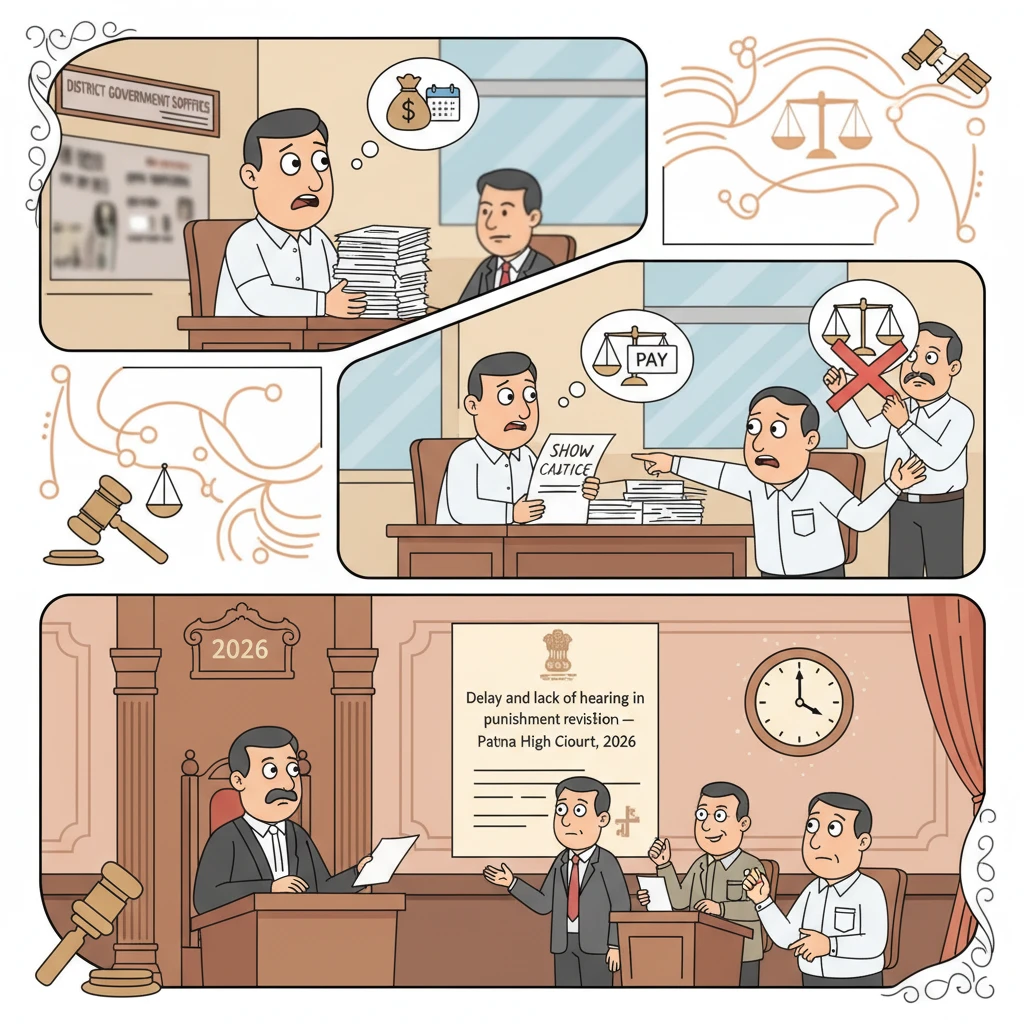
The petitioner is a government servant working as Joint Registrar (Audit), Cooperative Societies, Bhagalpur Division. He was earlier subjected to a departmental proceeding which ended in a punishment order issued through Notification No. 2684 dated 16.10.2020.
Under that order, he was given the punishment of “censure” for the period from 14.07.2014 to 14.01.2017. Along with this, he was denied full salary for his suspension period from 12.10.2018 to 16.10.2020 and was paid only subsistence allowance. According to him, no separate notification was ever issued to specifically deny him full salary for the suspension period.
After this punishment, the petitioner submitted a representation seeking revision of his subsistence allowance for the suspension period. He did not seek enhancement of punishment; rather, he asked for better financial treatment.
However, following this representation, the department invoked Rule 28 of the Bihar CCA Rules, 2005, which deals with revision of disciplinary orders. A show cause notice was issued to him vide Letter No. 1653 dated 29.06.2021. This notice did not specify what punishment was proposed or the purpose of the revision, according to the petitioner.
On the very next day, i.e. 30.06.2021, the department revised and enhanced the punishment through Notification No. 1656 (also referred to by the petitioner in his pleadings as Notification No. 1657 in some places). The earlier punishment of simple censure was thus replaced by a harsher penalty of reduction to a lower stage in the time scale of pay for three years.
The petitioner challenged this revised punishment before the appellate authority on 30.11.2021. His appeal remained pending for around four years without any final decision. Feeling aggrieved by this long pendency and the manner in which his punishment had been enhanced, he approached the Patna High Court in Civil Writ Jurisdiction Case No. 714 of 2026.
What the Court Examined and Decided
The core dispute before the Patna High Court was not about whether the petitioner was guilty in the departmental proceeding. Instead, it focused on whether the State authorities had correctly used their power under Rule 28 of the Bihar CCA Rules, 2005 to revise and enhance his punishment, and whether they had respected the time limit and fair hearing requirements built into that rule.
The petitioner’s senior counsel argued that Rule 28 allows the Government or specified authorities to revise any disciplinary order, but only within six months from the date of the order proposed to be revised. Further, if the authority wishes to enhance the penalty, it must:
- clearly indicate the proposed enhanced punishment, and
- give the employee a reasonable opportunity to respond before passing a final order.
Counsel submitted that in this case:
- the initial punishment order was dated 16.10.2020,
- the show cause notice under Rule 28 was issued on 29.06.2021—beyond six months from 16.10.2020, and
- the enhanced punishment order was passed on 30.06.2021, just one day after the notice.
In his view, this sequence showed two clear violations: first, the revision was initiated after the statutory six‑month limit; second, the time given to reply was so short that it could not be called a “reasonable opportunity”.
The petitioner’s counsel also submitted that the show cause notice did not disclose what enhanced penalty was being proposed. He contended that this went against the first proviso to Rule 28, which requires that, before imposing or enhancing any penalty, the government servant must be given a chance to make a representation against the proposed penalty.
To reinforce the argument that such time limits and jurisdictional conditions are strict and not flexible, he relied on Supreme Court decisions. In Kiran Singh v. Chaman Paswan, (1954) 1 SCC 710, the Supreme Court had held that an order passed in violation of a statutory limit affecting jurisdiction is coram non judice, meaning it is a nullity in law. Similarly, in Jagmittar Sain Bhagat v. Health Services, Haryana, (2013) 10 SCC 136, the Court had clarified that an order without jurisdiction is void and cannot be saved by limitation, waiver, or acquiescence.
He further pointed out that many statutes, such as Section 35‑H(1) of the Central Excise Act, 1944 and Section 127 of the Bihar Electricity Act, 2023, prescribe strict time limits which are treated as mandatory, not extendable. Drawing analogy, he argued that the six‑month limit in Rule 28 should also be treated as absolute. Since this condition went to the root of jurisdiction, the revisional authority had no power to act after six months, and any such order was void.
The State’s counsel, on the other hand, attempted to defend the department’s action by pointing to the overall scheme of the Bihar CCA Rules, 2005. He drew attention to Rule 29, which also talks of a six‑month period, and to Rule 28(3), which says that applications for revision shall be dealt with in the same manner as an appeal under the Rules.
He then referred to Rules 23 to 25, which prescribe 45 days for filing an appeal but allow the appellate authority to condone delay if sufficient cause is shown. Based on this, the State’s counsel argued that, when reading Rule 28 along with the proviso to Rule 25, one could infer that the six‑month period for revision is not rigid. According to him, the authority could entertain a revision even beyond six months by adopting a liberal interpretation, similar to delay‑condonation in appeals.
The State’s counsel also submitted that the Supreme Court judgments cited by the petitioner were not directly applicable, because the Bihar CCA Rules themselves allowed a more flexible reading, and the statutory scheme was clear in that regard.
After hearing both sides, the Patna High Court considered it necessary to reproduce Rule 28 of the Bihar CCA Rules, 2005 in full. The Rule, in simple terms, empowers:
- the Government,
- the head of department,
- the appellate authority, and
- any other specially authorised authority,
to revise a disciplinary order within six months of the date of that order. In such revision, the authority may confirm, modify, set aside, or enhance the penalty, or even impose a fresh penalty, subject to certain safeguards.
Critically, the first proviso to Rule 28 states that no order imposing or enhancing any penalty can be made unless the concerned employee is given a reasonable opportunity of making a representation against the proposed penalty. Where a major penalty under Rule 14 (clauses vi to x) is proposed, an inquiry under Rule 17 is required, and the employee must be given a chance to show cause against the proposed penalty based on the evidence.
The second proviso restricts the head of department’s power of revision in certain appellate situations. Sub‑rule (2) of Rule 28 says that no revision proceeding shall begin until the limitation period for appeal has expired, or the appeal, if filed, has been disposed of. Sub‑rule (3) says that an application for revision will be dealt with like an appeal.
Having closely read Rule 28, the Court drew two clear conclusions. First, four categories of authorities can exercise revisional power, but they must do so “within six months of the date of the order proposed to be revised”. Second, when they propose to impose or enhance a penalty, they must ensure a reasonable opportunity of representation.
Applying these principles to the facts of this case, the Court recorded the following undisputed aspects:
- The final punishment order against the petitioner was passed on 16.10.2020.
- The show cause notice under Rule 28 was issued on 29.06.2021, i.e. after six months from 16.10.2020.
- The revisional (enhanced punishment) order was passed on 30.06.2021, one day after the show cause notice.
From this, the Court held that there were “gross violations” of Rule 28 of the Bihar CCA Rules, 2005. The initiation of revision after the expiry of six months went against the clear wording of the Rule. Further, passing the revisional order the very next day did not satisfy the requirement of giving a “reasonable opportunity” to the employee to make his representation against the proposed enhanced penalty.
At the same time, the Court noted that an appeal against the final order was already pending before the appellate authority, and both sides accepted this position. Therefore, instead of itself quashing the revised punishment, the Court chose to clarify the legal position and send the matter back to the appellate authority to decide.
The Court directed the appellate authority to pass a reasoned and speaking order within 60 days from the date of receipt or production of a copy of the High Court’s judgment. It further directed that, while deciding the appeal, the appellate authority must take into account the legal position as determined by the Court, including its findings on the violation of Rule 28.
The petitioner was given liberty to file additional written submissions or notes in support of his appeal. The Court clarified that the 60‑day period would be counted from the date on which such additional notes are filed, if the petitioner chooses to submit them.
With these observations and directions, the writ petition was disposed of. The core outcome is that the legality of the enhanced punishment will now be freshly examined by the appellate authority, but that authority must respect the time limit and hearing requirements under Rule 28 as clarified by the Patna High Court.
Why This Judgment Matters
This judgment is important for all government employees in Bihar who face departmental proceedings under the Bihar CCA Rules, 2005. It underlines that the Government cannot indefinitely reopen and enhance punishments; it must act within six months of the original order.
The decision also stresses that even when authorities have power to revise or enhance punishment, they must give a real and fair chance to the employee to reply. Issuing a show cause notice one day and passing the final order the next day does not meet the test of “reasonable opportunity”.
For employees, this judgment offers a clear ground to challenge any revisional action that is started after six months or carried out without proper notice and time to respond. For departments, it is a reminder to strictly follow Rule 28 and to decide pending appeals promptly.
Legal Issues and Answers
- Issue: Can the disciplinary authority revise and enhance a punishment order under Rule 28 of the Bihar CCA Rules, 2005 after six months from the date of the original order?
Answer: The Court held that Rule 28 allows revision only “within six months” of the order proposed to be revised, and in this case the decision to undertake revision after six months amounted to a gross violation of the Rule. - Issue: Does issuing a show cause notice one day and passing the revisional order the very next day satisfy the requirement of reasonable opportunity under Rule 28?
Answer: No. The Court found that passing the revisional order the next day, without granting adequate time for representation, breached the mandate of giving a reasonable opportunity to the government servant. - Issue: What course should be followed when an appeal against the revised punishment is already pending?
Answer: The Court clarified the legal position under Rule 28 and directed the appellate authority, where the appeal was pending, to decide it within 60 days by a reasoned order, keeping the Court’s findings in mind.
Cases Cited by the Court
- The petitioner relied upon Kiran Singh v. Chaman Paswan, (1954) 1 SCC 710.
- The petitioner also relied upon Jagmittar Sain Bhagat v. Health Services, Haryana, (2013) 10 SCC 136.
- No other case law is recorded as having been relied upon or discussed in the judgment.
Case Details
Case Number: Civil Writ Jurisdiction Case No. 714 of 2026
Case Title: Mukesh Kumar v. The State of Bihar & Ors.
Coram: Hon’ble Mr. Justice Dr. Anshuman
Citation: 2024(2) PLJR 350
Advocates: For the petitioner – Mr. Ashok Kumar Karna, Advocate. For the respondents – Mr. Saurav Kumar, AC to GA‑5.
Nature of the Case: Writ petition under civil writ jurisdiction challenging a show cause notice and revisional punishment order passed in a departmental proceeding under the Bihar CCA Rules, 2005, and seeking directions regarding salary for suspension period and disposal of pending appeal.
Link to the Judgment: Click here to access the full Patna High Court judgment
If you found this explanation helpful and wish to stay informed about
how legal developments may affect your rights in Bihar,
you may consider following Samvida Law Associates for more updates.







