

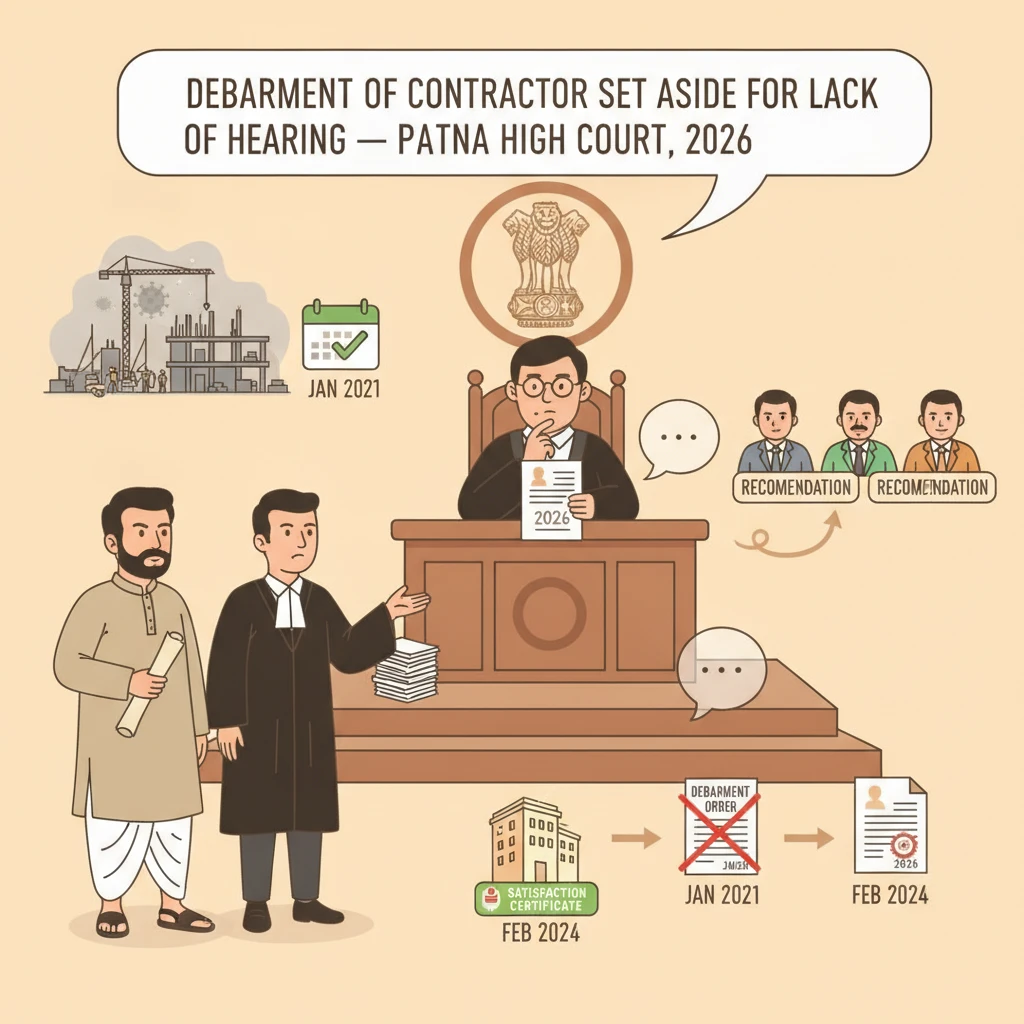
Case Background
The petitioner, a registered contractor under the Public Health Engineering Department (PHED), Bihar, held Registration No. 1646 of 2019. Under this registration, the contractor was awarded two works under Agreement Nos. 169 MBD/2019-20 and 170 MBD/2019-20, both dated 16.10.2019.
These works were originally to be completed within six months. During this period, the COVID-19 pandemic broke out and affected progress. Because of this, the contractor asked for extra time to complete the works.
The competent authority, namely the Chief Engineer, considered this request and, by Memo No. 67 dated 12.01.2021, extended the time for completion up to 31.01.2021. This meant that the contract remained alive till that date and the delay till then stood condoned.
Within this extended period, the contractor claims to have completed the works on 19.01.2021 and 25.01.2021. Completion reports were issued by the department acknowledging this fact.
However, during the subsistence of this extended period, the Executive Engineer, Public Health Department, Division, Supaul, passed Order No. 4 dated 07.01.2021. By this order, the contractor’s firm was debarred from taking part in upcoming contracts “till further order”.
The contractor later came to know of this debarment. On 19.01.2024, it submitted an application seeking revocation of the order. This application triggered a series of recommendations within the department.
The Executive Engineer issued Letter No. 537 dated 22.01.2024 recommending removal of the debarment, noting that the work had been completed. The Superintending Engineer, Public Health Engineering Circle, Saharsa, followed with Letter No. 59 dated 23.01.2024 to the same effect. The Chief Engineer, Purnea Region, then issued Letter No. 71 dated 31.01.2024, again supporting removal of the debarment.
A satisfaction certificate was also issued on 09.02.2024 confirming that the work had been completed to the satisfaction of the department.
Despite these internal recommendations, the Principal Secretary of the Public Health Engineering Department, acting as appellate authority, rejected the contractor’s appeal against the debarment order by order dated 05.03.2024. This led the contractor to file Civil Writ Jurisdiction Case No. 1435 of 2025 before the Patna High Court.
What the Court Examined and Decided
The Division Bench of the Patna High Court, comprising Hon’ble Mr. Justice Sudhir Singh and Hon’ble Mr. Justice Shailendra Singh, heard the matter and framed two specific issues.
The first issue was whether the debarment order dated 07.01.2021 was premature and legally unsustainable because it was passed during the extended period for completing the work and despite completion within that time.
The second issue was whether the debarment order was void due to violation of principles of natural justice, particularly the failure to issue a show cause notice or provide an opportunity of hearing, even though debarment carries serious civil consequences.
On behalf of the contractor, it was argued that the debarment order was passed without any prior notice or hearing. It was also said that the order was issued before the extended deadline of 31.01.2021, even though the department itself had granted this extension and the works were completed within that time. The contractor highlighted that after completion of the work, all three layers of departmental officers (Executive Engineer, Superintending Engineer, and Chief Engineer of the region) recommended lifting the debarment and a satisfaction certificate was issued on 09.02.2024. Yet, the appellate order dated 05.03.2024 ignored these facts.
The State, on the other hand, defended the debarment on the basis that there was delay and unsatisfactory performance, and that the order was passed according to the contract terms. It stressed the importance of timely execution of public works and claimed that the department had power to take such action.
While examining Issue No. 1, the Court carefully looked at the records. It found that the extension of time up to 31.01.2021 was granted by Memo No. 67 dated 12.01.2021. Grant of this extension clearly showed that the State had condoned the delay and was willing to allow completion within the extended period.
Despite this, the debarment order was passed on 07.01.2021, before even the extended period expired. The Court noted that the record showed completion of work on 19.01.2021 and 25.01.2021, within the extended timeline. Completion reports and the satisfaction certificate dated 09.02.2024 confirmed this.
In addition, the Court took note of the letters of the Executive Engineer (Letter No. 537 dated 22.01.2024), the Superintending Engineer (Letter No. 59 dated 23.01.2024) and the Chief Engineer, Purnea Region (Letter No. 71 dated 31.01.2024), all recommending removal of debarment after considering the completion of work.
However, while rejecting the appeal on 05.03.2024, the Principal Secretary did not consider the effect of the extension of time, the fact of completion within that period, or the consistent recommendations of the departmental officers. The order did not explain how debarment could continue once the delay had been condoned and the work had been completed to the satisfaction of the department.
To test the legality of this administrative decision, the Court referred to the Supreme Court’s decision in Tata Cellular v. Union of India, (1994) 6 SCC 651. That judgment lays down that while courts do not sit as appellate bodies over administrative decisions, they can interfere where decisions suffer from arbitrariness or non-application of mind. The Patna High Court applied these principles and found that the continuation of debarment and rejection of the appeal were unsupported by reasons and inconsistent with administrative fairness.
The Court also referred to State of Karnataka v. All India Manufacturers Organization, (2006) 4 SCC 683, where the Supreme Court held that State actions in contractual matters must still meet standards of reasonableness under Article 14 of the Constitution. When State conduct is tainted with extreme arbitrariness or mala fides, constitutional courts can interfere.
On this basis, the Court concluded that the debarment order dated 07.01.2021, which remained in force despite completion of work within the extended time, was premature, arbitrary and unsustainable in law.
On Issue No. 2, the Court turned to the question of natural justice. The impugned debarment order referred to a letter dated 02.01.2021, through which the Executive Engineer was said to have recommended calling for an explanation from the contractor. But the order itself was completely silent about whether any such show cause notice was actually issued or served, or whether the contractor was given an opportunity to explain.
The contractor had taken a categorical stand in paragraphs 9 and 10 of the writ petition that no show cause notice was issued and no hearing was granted before the debarment. In response, although the State filed a counter affidavit, it did not specifically deny this claim. No document was produced to show any notice, service report or even the letter dated 02.01.2021 which was mentioned in the debarment order.
Given this, the Court held that the contractor’s assertion that no opportunity of hearing was provided remained unrebutted and unshaken. There was no reason to disbelieve it.
The Court then examined Rule 11(c) of the Bihar Contractor Registration Rules. This rule requires that any action of blacklisting or debarment must be preceded by a show cause notice and consideration of the reply. The Court treated this requirement as mandatory, because blacklisting and debarment cause serious civil and commercial consequences for a contractor. Failure to follow this procedure, the Court held, makes the action contrary to the statutory framework itself.
Beyond the rules, the Court relied on the broader principles of natural justice. It emphasised the audi alteram partem rule, which means no person should be condemned unheard. Debarment or blacklisting, which excludes a person from future public contracts and affects both reputation and business, clearly has grave civil consequences.
The Court cited several Supreme Court decisions. In Erusian Equipment & Chemicals Ltd. v. State of West Bengal, (1975) 1 SCC 70, the Supreme Court held that blacklisting deprives a person of equality of opportunity in public contracts and cannot be ordered without giving an opportunity of hearing. In Gorkha Security Services v. Government (NCT of Delhi), (2014) 9 SCC 105, it was held that a valid show cause notice for blacklisting must clearly indicate the allegations and the proposed action, so the affected party can respond properly. The Court described blacklisting as a kind of “civil death”.
The High Court also relied on Kulja Industries Ltd. v. Chief General Manager, BSNL, (2014) 14 SCC 731, where the Supreme Court recognised the inherent power to blacklist but made it subject to principles of natural justice and proportionality. A fair hearing is an essential precondition, and the decision must be reasonable, fair and proportionate.
Applying these rulings, the Patna High Court held that in the present case, the absence of show cause notice and hearing amounted to violation of both the Bihar Contractor Registration Rules and Article 14’s guarantee of fairness. The later appellate order dated 05.03.2024 could not cure this fundamental defect because the original decision was void at its very start.
Ultimately, the Court held that the debarment order dated 07.01.2021, being both premature and passed in breach of natural justice, was unsustainable. For the same reasons, the appellate order dated 05.03.2024, which ignored relevant materials and the procedural illegality, also could not stand. Both orders were set aside and the writ petition was allowed.
Why This Judgment Matters
This judgment is significant for contractors working with government departments in Bihar and beyond. It clearly states that a contractor cannot be debarred or blacklisted without prior notice and a real chance to explain.
The Court’s reasoning also protects contractors where work has been delayed but the department itself has later extended time and accepted the work. In such cases, the department cannot continue to punish the contractor for earlier delay that has effectively been condoned.
For ordinary business people, the decision shows that courts will step in when government authorities act arbitrarily, ignore their own rules, or fail to apply their mind to important facts such as completion certificates and internal recommendations.
Legal Issues and Answers
Issue: Was the debarment order dated 07.01.2021 valid when time for completing the work had been extended and the work was completed within that extension?
Answer: No. The Patna High Court held that the order was premature, arbitrary and unsustainable because it was passed during the extended period and continued despite completion of the work to the department’s satisfaction.
Issue: Could the contractor be debarred without receiving a show cause notice or opportunity of hearing, especially when the rules required such notice?
Answer: No. The Court held that the debarment violated Rule 11(c) of the Bihar Contractor Registration Rules and the principles of natural justice under Article 14, and therefore had to be set aside.
Issue: Was the appellate order dated 05.03.2024 legally sustainable?
Answer: No. The Court found that the appellate authority failed to consider the extension of time, completion of work, recommendations for lifting debarment, and the initial procedural illegality, so the order was also quashed.
Cases Cited by the Court
- Tata Cellular v. Union of India, (1994) 6 SCC 651.
- State of Karnataka v. All India Manufacturers Organization, (2006) 4 SCC 683.
- Erusian Equipment & Chemicals Ltd. v. State of West Bengal, (1975) 1 SCC 70.
- Gorkha Security Services v. Government (NCT of Delhi), (2014) 9 SCC 105.
- Kulja Industries Ltd. v. Chief General Manager, BSNL, (2014) 14 SCC 731.
Case Details
Case Number: Civil Writ Jurisdiction Case No. 1435 of 2025
Case Title: Jai Hanuman Enterprises through its Proprietor Girish Kumar Singh v. The State of Bihar & Ors.
Coram: Hon’ble Mr. Justice Sudhir Singh and Hon’ble Mr. Justice Shailendra Singh
Citation: 2026 (3) PLJR 523
Date of Judgment: 30.04.2026
Advocates: Mr. Dhananjay Kumar, Advocate for the petitioner; Mr. Saroj Kumar Sharma, AC to AAG-3 for the respondents
Nature of the case: Writ petition under civil writ jurisdiction challenging debarment order and rejection of appeal
Link to full judgment: Click here to read the full judgment of the Patna High Court
If you found this explanation helpful and wish to stay informed about
how legal developments may affect your rights in Bihar,
you may consider following Samvida Law Associates for more updates.







