

Case Background
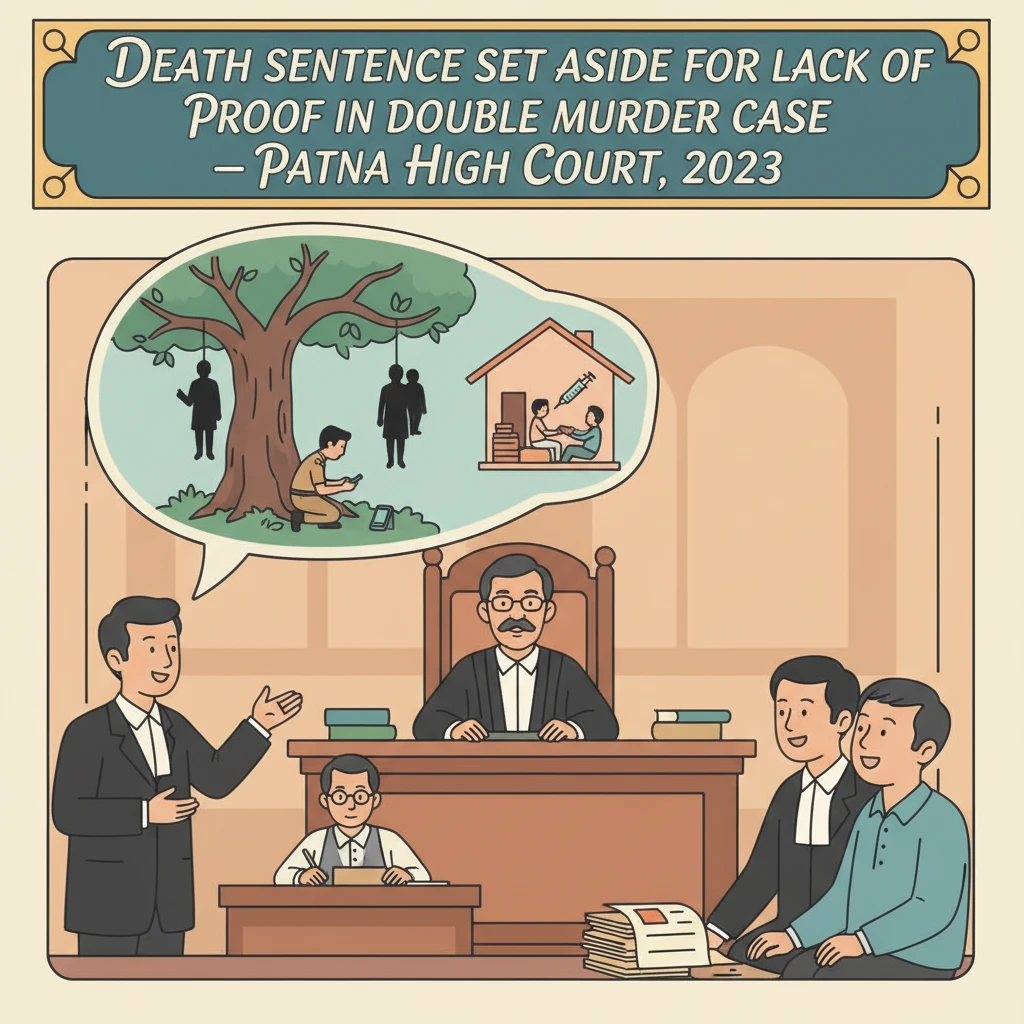
The case started with Bibhutipur P.S. Case No. 223 of 2015 in District Samastipur. On 6.11.2015, early in the morning, the village chowkidar, examined in court as PW-5, learnt that the dead bodies of a boy and a girl were hanging from a banyan tree at Kapan Chaur.
He went to the spot and saw both bodies hanging from a branch of the tree. A mobile phone was lying near the root of the tree. After he spread the information, many villagers gathered and identified the bodies.
The girl was the niece of two of the later accused, Sudhir Kumar Singh and Deva Nand Singh. The chowkidar suspected that it was actually a case of murder and that the bodies had been hung to hide evidence. His fardbeyan was recorded on the spot at about 7:30 a.m. by the Station House Officer, Chaturvedi Sudhir Kumar (PW-9).
On this basis, FIR was registered against unknown persons. Inquest reports were prepared and the police seized a Nokia mobile phone with two SIM cards from the place under a seizure list. The bodies were sent for post-mortem examination.
The post-mortem reports, proved by doctors PW-11, PW-12 and PW-13, showed suspected poisoning in both deceased. Both had post-mortem ligature marks on the neck but no external injuries or bruising under the ligature. Viscera were preserved and sent for Forensic Science Laboratory (FSL) examination.
During investigation, the police picked up a suspect, Rajiv Kumar, who was later found to be a juvenile. While in police custody, his statement (marked Exhibit-8) was recorded. This statement, treated by the prosecution as a confession, was used to name the appellants and build the story of a planned “honour killing” inside the house of appellant Deva Nand Singh.
On 16.03.2016 the police filed charge-sheet against Rajiv Kumar and appellant Gauri Kant Mahto. On 23.08.2017 another charge-sheet was submitted against appellant Sudhir Kumar Singh, and on 17.02.2018 yet another charge-sheet against appellant Deva Nand Singh for offences under Sections 302, 201 and 120B of the Indian Penal Code.
Because Rajiv Kumar claimed juvenility, his case was sent to the Juvenile Justice Board and separated. For the others, three separate sessions trials were registered: Sessions Trial No. 261 of 2016 (against Rajiv Kumar and Gauri Kant Mahto), Sessions Trial No. 227 of 2018 (against Sudhir Kumar Singh) and Sessions Trial No. 388 of 2018 (against Deva Nand Singh). On 07.08.2019, the Additional Sessions Judge-I, Rosera amalgamated these three trials as against the adult accused.
After trial, by judgment dated 22.02.2022 and order of sentence dated 28.02.2022, the trial court convicted all three appellants. Deva Nand Singh was sentenced to death under Section 302/120B IPC and three years’ rigorous imprisonment under Section 201 IPC. The other two appellants, Sudhir Kumar Singh and Gauri Kant Mahto, were sentenced to life imprisonment under Sections 302/34 and 302/120B IPC, and to three years’ rigorous imprisonment under Section 201/34 IPC, with fines.
Because of the death sentence, the trial court made a reference to the Patna High Court under Section 366 of the Code of Criminal Procedure, registered as Death Reference No. 2 of 2022. All three convicted persons also filed criminal appeals under Section 374(2) CrPC, leading to Criminal Appeal (DB) Nos. 241, 278 and 279 of 2022. The High Court heard the death reference and the appeals together.
What the Court Examined and Decided
The Patna High Court, speaking through Hon’ble Mr. Justice Chakradhari Sharan Singh with Hon’ble Mrs. Justice G. Anupama Chakravarthy concurring, closely re-examined the entire evidence.
The prosecution’s central story was that the two deceased were in love, that the girl’s family strongly opposed this relationship, and that her uncles (two of the appellants) and their associate had killed the couple inside the house of appellant Deva Nand Singh. According to the prosecution, the bodies were later hung from a banyan tree to make it look like suicide.
However, the Court noted at the outset that there was no eye-witness produced at the trial to the actual killing. The only person said to have seen the alleged murders was Rajiv Kumar, whose statement to the police (Exhibit-8) the prosecution treated as a “confession” and the main link in the chain of circumstances.
The Court carefully examined Exhibit-8. It recorded that Rajiv described how he knew the deceased girl, how she used to visit his jewellery shop to alter silver anklets, and how she was in love with the deceased boy Deepak. Rajiv stated that the girl had also befriended him, that her uncle objected to their interaction, and that later, appellant Deva Nand Singh asked Rajiv to keep track of Deepak’s movements and share information for money.
According to this statement, on 05.11.2015 Rajiv had a long phone conversation with the girl. She gave an indication she would speak to Deepak. Rajiv then went to Deva Nand’s house to share this. He claimed that Deepak came that night to meet the girl and, as soon as he entered the house, all the appellants and some unknown associates caught both young persons and killed them by injecting poison. Rajiv further claimed that the girl was killed when she threatened to disclose the murder of Deepak. He also claimed that Deva Nand had paid him Rs.10,000 for providing information about Deepak.
The High Court first asked whether Exhibit-8 was legally a “confession” at all. It held that it was not. Relying on principles stated by the Privy Council in Narayan Swami v. Emperor and by the Supreme Court in State (NCT of Delhi) v. Navjot Sandhu, the Court emphasised that:
For a statement to be a confession, it must admit the offence in terms or at least all the main facts constituting the offence. A mere admission of gravely incriminating facts, without admitting guilt, is not a confession.
Confessions made to a police officer, or by an accused in police custody, are generally inadmissible under the Evidence Act, except to the limited extent permitted by Section 27 for discovery of new facts.
On reading Exhibit-8, the Court found that Rajiv nowhere admitted that he himself participated in the killing or conspiracy. He only said that he passed on information and then allegedly saw the murder being committed. There was no statement that his role was part of any plan to kill. There was also no indication that any portion of this statement led the police to discover a new fact or material object.
Therefore, the Court held that Exhibit-8 was neither a valid confession nor admissible under Section 27 of the Evidence Act. Rajiv Kumar was not examined as a witness at trial, and his case had gone to the Juvenile Justice Board, so his police statement could not be used as substantive evidence against the appellants.
The Court then turned to the other evidence. The prosecution had examined 15 witnesses, including the doctors, investigating officers, and several relatives of the deceased boy. But the Court found that PW-1, PW-2, PW-4, PW-5, PW-14 and PW-15 were all hearsay witnesses. They only repeated what they had heard from others and were not present at the time of the alleged killing.
PW-3 was projected as an independent witness of conspiracy, but his evidence only showed that the two deceased were in love and that the girl’s family was opposed. His statement about seeing conspiracy being hatched was not backed by solid details or corroboration. The High Court found it insufficient to prove a clear agreement to kill.
The Court also examined the physical and medical evidence. It noted that the prosecution theory, based on Rajiv’s version, was that poison had been injected into the deceased in the house of Deva Nand Singh.
However, the post-mortem reports and FSL findings did not support this version. The doctors (PW-11, PW-12 and PW-13) deposed that the deaths were due to “suspected poisoning like celphos”. They found no bruising or haematoma below the ligature marks and no external injury consistent with injection on the body parts examined.
The viscera examination by the FSL (Exhibit-7 and 7/1) showed the presence of Endosulfan, an organochloro pesticide commonly used in agriculture, in the heart, lungs, liver, spleen, kidney, loop of small intestine and stomach contents. Nothing in this report indicated poisoning by injection. The High Court found that this clearly contradicted the prosecution’s story of murder by injected poison.
Another serious gap related to the place of occurrence. The prosecution claimed that the killings happened inside Deva Nand’s house and that the bodies were then moved about half a kilometre to the banyan tree at Kapan Chaur. But the investigating agency did not properly prove the house as a place of occurrence.
No evidence showed how the dead bodies were transported from the house to the tree. The Court also noted that the earth around the tree’s root was muddy and no footprints were visible, creating further doubt about the alleged hanging after transport.
The seized mobile phone at the tree also weakened the prosecution story. If the couple had been killed inside the house as claimed, the Court observed, there was no logical explanation from the prosecution as to how the deceased’s phone reached the tree site.
After assessing all these aspects, the High Court concluded that the case rested purely on circumstantial evidence and that the chain of circumstances was incomplete. Key links — such as a reliable confession, a proven place of murder, and a clear path from alleged murder spot to hanging site — were missing.
In criminal law, where the case is based on circumstances, each circumstance must be firmly proved and all of them together must lead only to one conclusion: that the accused are guilty. If another reasonable explanation is possible, or if important links are missing, the accused get the benefit of doubt.
Here, even the basic question of whether it was homicide or suicide remained uncertain. The defence had argued that the presence of agricultural poison and the way the bodies were found suggested a possibility of suicide by consuming poison, rather than homicide. While the Court did not expressly decide the exact manner of death, it held that the prosecution had failed to rule out other possibilities and had not proved murder beyond reasonable doubt.
Because of these doubts, the Court held it unsafe to uphold the convictions for murder, conspiracy and destruction of evidence. It set aside the trial court’s judgment of conviction and the sentences dated 22.02.2022 and 28.02.2022.
As a result, appellant Deva Nand Singh was acquitted of offences under Sections 302/120B and 201 IPC. Appellants Gauri Kant Mahto and Sudhir Kumar Singh were acquitted of offences under Sections 302/34, 302/120B and 201/34 IPC. The connected death reference was answered accordingly, and the High Court directed that all appellants be released from jail forthwith, if not wanted in any other case.
Why This Judgment Matters
This judgment is important for anyone facing serious criminal charges, especially in cases built mainly on suspicion and village talk. The Patna High Court shows that even in emotionally charged situations, like alleged “honour killings”, courts cannot convict unless evidence is strong and lawful.
The Court refused to rely on a statement given to the police by a co-accused juvenile that was not a true confession and did not lead to discovery of any fact. It also treated hearsay evidence and loose talk of conspiracy with great caution.
For families and accused persons in Bihar, this decision underlines that:
Police must properly prove the place of occurrence and all links in a circumstantial chain.
Medical and forensic reports can overturn a story, if they do not support the alleged manner of death.
Even a death sentence will not be confirmed if the prosecution’s case leaves room for reasonable doubt.
Legal Issues and Answers
-
Issue: Could the appellants be convicted for murder and conspiracy on the basis of the circumstantial evidence and the statement of co-accused Rajiv Kumar to the police?
Answer: No. The Court held that Rajiv’s statement was neither a valid confession nor admissible under Section 27 of the Evidence Act, and the remaining evidence failed to establish a complete chain of circumstances proving guilt beyond reasonable doubt. -
Issue: Was the prosecution able to prove that the alleged killings occurred in the house of appellant Deva Nand Singh and that the bodies were later hung from the banyan tree to destroy evidence?
Answer: No. The prosecution did not prove the house as the place of occurrence, nor did it establish how the bodies were moved to the banyan tree. The medical and forensic evidence also did not support the theory of murder by injection.
Cases Cited by the Court
- The Court referred to Narayan Swami v. Emperor, AIR 1939 PC 47, on what constitutes a confession.
- The Court relied on State (NCT of Delhi) v. Navjot Sandhu, (2005) 11 SCC 600, regarding admissibility of confessions and statements to police under the Evidence Act and Section 162 CrPC.
Case Details
Case Number: Death Reference No. 2 of 2022 with Criminal Appeal (DB) Nos. 241, 278 and 279 of 2022; arising out of Bibhutipur P.S. Case No. 223 of 2015; Sessions Trial Nos. 261 of 2016, 227 of 2018 and 388 of 2018; CIS Nos. 97 of 2016, 946 of 2017 and 353 of 2018.
Case Title: The State of Bihar v. Deva Nand Singh (Death Reference No. 2 of 2022) with connected Criminal Appeal (DB) No. 241 of 2022 (Gauri Kant Mahto v. The State of Bihar), Criminal Appeal (DB) No. 278 of 2022 (Sudhir Kumar Singh @ Sudhir Singh @ Sudhir Kumar v. The State of Bihar) and Criminal Appeal (DB) No. 279 of 2022 (Deva Nand Singh v. The State of Bihar).
Coram: Hon’ble Mr. Justice Chakradhari Sharan Singh and Hon’ble Mrs. Justice G. Anupama Chakravarthy.
Citation: 2024(1) PLJR 612.
Advocates:
- For the State in Death Reference No. 2 of 2022 and in Criminal Appeal (DB) No. 278 of 2022: Ms. Shashi Bala Verma, APP.
- For the respondent in Death Reference No. 2 of 2022 and for appellants in Criminal Appeal (DB) Nos. 278 and 279 of 2022: Mr. Baxi S.R.P. Sinha, Senior Advocate, with Mr. Randhir Kumar No.1, Advocate.
- For appellant in Criminal Appeal (DB) No. 241 of 2022: Mr. Alok Kumar, Advocate, with Mr. Birendra Kumar Singh, Mr. Raghwendra Pratap Singh and Mr. Sujit Kumar, Advocates.
- For the State/respondent in Criminal Appeal (DB) No. 241 of 2022 and for respondent in Criminal Appeal (DB) No. 279 of 2022: Mr. Ajay Mishra, Advocate.
Nature of the Case: Death reference under Section 366 CrPC and criminal appeals under Section 374(2) CrPC against conviction for offences under Sections 302, 201 and 120B IPC, arising from alleged double murder; decision resulting in acquittal.
Link to the Judgment: Read full judgment on Patna High Court website
If you found this explanation helpful and wish to stay informed about
how legal developments may affect your rights in Bihar,
you may consider following Samvida Law Associates for more updates.







