
Case Background
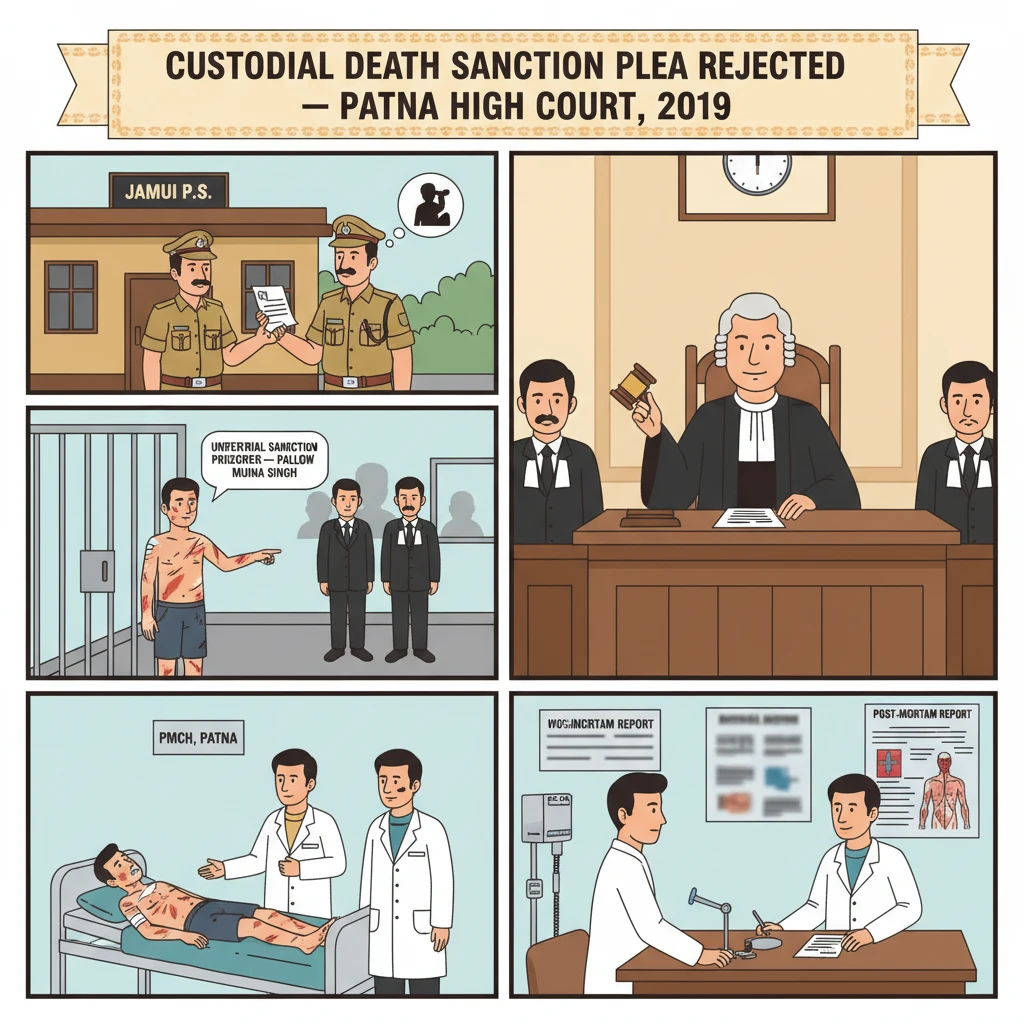
The matter arose from Jamui P.S. Case No. 154 of 2013, registered on 01.07.2013 on the basis of a written report by the Superintendent of Jail, Jamui. He complained to the Superintendent of Police, Jamui, that an undertrial prisoner, Munna Singh, lodged in Jamui Jail in connection with Jamui P.S. Case No. 95 of 2013, had died after being badly assaulted by two police officers.
According to the written report, the assault was committed on 23.06.2013 by the Officer-in-Charge of Jamui Police Station and another Sub-Inspector posted at Giddhaur Police Station. The deceased allegedly narrated this assault to his fellow inmates in the jail.
On this report, an FIR was lodged under Section 302 read with 34 of the Indian Penal Code. After investigation, charge-sheet No. 26 of 2014 dated 31.05.2014 was submitted against the two police officers for the offence of murder with common intention. At the time of submission of charge-sheet, both accused were absconding.
Later, the co-accused appeared and the case proceeded against him separately. The present petitioner surrendered before the court on 24.10.2016 and was remanded to judicial custody. The charge under Section 302/34 IPC was explained to him, and he pleaded not guilty. Trial commenced, twelve prosecution witnesses were examined, the petitioner’s statement was recorded under Section 313 Cr.P.C., and two defence witnesses were also examined.
Only at this late stage, on 19.12.2018, the petitioner filed an application before the trial court claiming that, as he was a public servant at the time of the incident, his alleged acts were in discharge of official duty and the entire prosecution was void for want of sanction under Section 197 Cr.P.C. The Additional Sessions Judge-I, Jamui, rejected this application by order dated 20.12.2018, holding that the assault was not an act in discharge of official duty and no sanction was needed.
The petitioner then approached the Patna High Court under Section 482 Cr.P.C. to quash the cognizance order dated 09.04.2015 in Sessions Trial No. 280 of 2016 and all subsequent proceedings, again relying on absence of sanction. An earlier Bench had dismissed his petition without giving detailed reasons. On appeal, the Supreme Court, by judgment dated 10.05.2019 in Criminal Appeal No. 3502 of 2019, set aside that order and remanded the matter to the High Court for a fresh, reasoned decision. After some roster changes, the case came before Hon’ble Mr. Justice Ashwani Kumar Singh, who has now delivered this detailed oral judgment dated 21.10.2019.
What the Court Examined and Decided
The Patna High Court first noted the two core questions it had to decide: whether the alleged offence was committed by the petitioner while acting or purporting to act in discharge of his official duty, and whether he was entitled to raise the sanction objection at the very end of the trial.
On the second question, the Court accepted the legal position laid down by the Supreme Court in earlier decisions, particularly P.K. Pradhan v. State of Sikkim and Om Prakash v. State of Jharkhand. These cases clarify that the issue of sanction under Section 197 Cr.P.C. can be raised at any stage after cognizance, including at the conclusion of trial or even after conviction. Whether sanction is necessary may have to be decided from stage to stage as facts come on record.
Therefore, the Court held that the mere fact that the petitioner raised the plea of sanction at a late stage did not, by itself, make his application untenable. The High Court proceeded to examine whether, on the facts of this case, sanction was in fact required.
For this purpose, the Court carefully reviewed the factual chain. Munna Singh, the deceased, had surrendered before the Chief Judicial Magistrate, Jamui on 12.06.2013 in Jamui P.S. Case No. 95 of 2013 and was remanded to judicial custody. On 17.06.2013, the Investigating Officer applied for police remand. The Chief Judicial Magistrate allowed police remand for two days on 19.06.2013.
Pursuant to this order, Munna Singh was taken out of jail on police remand on 20.06.2013 and returned to jail on 22.06.2013. On 23.06.2013, he was found with multiple injuries and shifted from jail to a local hospital, then referred to Patna Medical College and Hospital, where he died on 01.07.2013 during treatment.
A Board of Doctors at PMCH conducted a post-mortem under orders of the District Magistrate. The report described extensive ante-mortem injuries: bluish swollen lips with underlying blood clots, large bruises and swellings on both thighs, hips, back of the lower abdomen, groin regions, and both soles, with extravasated blood on incision. The Board concluded that death was due to shock and haemorrhage from these injuries, caused by hard blunt force impact within 24 hours.
The High Court noted that the father of the deceased had testified in trial as an eye-witness to the assault allegedly committed by the petitioner and another police officer. Although the petitioner claimed there were contradictions and that some witnesses had turned hostile, the Court chose not to assess the credibility of evidence at this stage. That task, it stressed, belonged to the trial court when deciding guilt.
The crucial question for the High Court was whether the alleged beatings, which occurred while Munna Singh was in police remand, could be considered acts done “while acting or purporting to act in the discharge of official duty” so as to attract the bar of Section 197 Cr.P.C.
The petitioner argued that he was the Officer-in-Charge of Jamui Police Station and that taking an accused on remand and interrogating him formed part of his official duty. He relied strongly on the Supreme Court decision in Sankaran Moitra v. Sadhna Das, where the Court had quashed a prosecution for want of sanction, holding that even killing in the course of duty or in purported performance of duty could attract Section 197.
The State and the counsel for the deceased’s father strongly opposed this plea. They submitted that causing custodial death by assault could never be treated as part of official duty. It was argued that it is no part of police duty to kill or brutally beat an accused in custody in the name of interrogation. They also accused the petitioner of raising the issue belatedly only to delay the trial, after all prosecution witnesses had been examined.
To resolve this dispute, the Patna High Court reviewed a long line of Supreme Court decisions on the scope of Section 197 Cr.P.C., including:
Matajog Dobey v. H.C. Bhari, Om Prakash v. State of Jharkhand, P.K. Pradhan v. State of Sikkim, Parkash Singh Badal v. State of Punjab, K. Kalimuthu v. State, and Devinder Singh v. State of Punjab. These cases set out the test that there must be a reasonable and direct connection between the act complained of and the public servant’s official duty. If the official status merely gives an opportunity to commit the offence, then sanction is not needed.
The Court also referred to D.K. Basu v. State of West Bengal and Munshi Singh Gautam v. State of M.P., in which the Supreme Court strongly condemned custodial torture and emphasised that the law does not permit use of third-degree methods to extract information. These cases affirm that torture and custodial violence are in clear violation of Article 21 of the Constitution and cannot be justified as part of lawful investigation.
Relying on these authorities, the Patna High Court held that to receive protection under Section 197, the public servant’s act must be within the scope and range of his official duty, and the alleged offence must not be disconnected from that duty. If the act complained of is itself prohibited and constitutes a criminal offence, it does not get protected merely because it occurred during the period of official duty.
Applying this principle to the present case, the Court emphasised that taking an accused in police custody and mercilessly assaulting him with hands and blunt objects inside a police lock-up, in the name of custodial interrogation, could not by any stretch of imagination be treated as an act done in discharge or purported discharge of official duty.
The Court noted that the post-mortem report showed serious injuries all over the lower body and soles, consistent with beating by hard blunt objects, and that the father’s eye-witness account supported the allegation of custodial violence. Such brutal assault, if proved, would amount to serious criminal conduct, not protected investigation activity.
The High Court distinguished the facts of this case from those in Sankaran Moitra, observing that the circumstances here, involving alleged torture of an undertrial in police remand, were quite different and did not justify application of that precedent.
Consequently, the Court concluded that there was no “reasonable connection” between the alleged assault and the lawful performance of police duty. Therefore, Section 197(1) Cr.P.C. did not apply, and no prior sanction was required to prosecute the petitioner for the offence of murder.
On this basis, the Court found no illegality in the order dated 09.04.2015 by the Additional Sessions Judge-I, Jamui, rejecting the petitioner’s claim of vitiation for want of sanction. The application under Section 482 Cr.P.C. was dismissed. At the same time, the Court clarified that its observations on facts were only for deciding the sanction issue and should not influence the trial court’s final decision on guilt.
Finally, the High Court directed the trial court to proceed with the trial and conclude it as early as possible.
Why This Judgment Matters
This judgment is important for families of victims of custodial violence, as well as for human rights defenders and police officers themselves. The Patna High Court clearly states that beating an accused in custody, leading to his death, is not part of official police duty. It cannot be shielded behind the legal protection meant for honest public servants.
In many custodial death cases, accused officers argue that they were only doing their job and therefore cannot be prosecuted without government sanction. This decision explains that such protection applies only when the act is reasonably connected to lawful duty, not when it is itself a criminal act like torture or murder.
The ruling also reassures the public that courts will not allow technical objections to block serious trials, especially after evidence has been fully recorded. At the same time, it respects the principle from the Supreme Court that the question of sanction can be raised at any stage, but it must be examined carefully against the facts.
For police personnel, the judgment is a reminder that they are answerable to the law and cannot treat the shield of Section 197 Cr.P.C. as a licence for excesses in custody. Genuine actions in good faith during investigation may still be protected, but brutal violence cannot be camouflaged as official duty.
Legal Issues and Answers
Issue: Does an alleged custodial assault by a police officer, resulting in the death of an undertrial, amount to an act done in discharge or purported discharge of official duty so as to require prior sanction under Section 197(1) Cr.P.C.?
Answer: No. The High Court held that mercilessly assaulting an accused in police custody in the name of interrogation is not part of official duty, nor even purported official duty. There is no reasonable connection between such brutal violence and lawful investigation, so sanction is not required.
Issue: Can the requirement of sanction under Section 197 Cr.P.C. be raised at a late stage of the trial, after evidence has been completed?
Answer: Yes in law, but it does not help the petitioner here. Relying on Supreme Court precedents, the Court accepted that the sanction question can arise at any stage, even at the end of trial. However, on the facts of this case, Section 197 did not apply at all, so the late-stage plea failed.
Issue: Should the criminal proceedings and cognizance order in Sessions Trial No. 280 of 2016 be quashed under Section 482 Cr.P.C. for want of sanction?
Answer: No. The Court found no illegality in the trial court’s refusal to drop proceedings and held that the prosecution was validly instituted without sanction. The application under Section 482 Cr.P.C. was dismissed and the trial was directed to proceed expeditiously.
Cases Cited by the Court
- Matajog Dobey v. H.C. Bhari, AIR 1956 SC 44
- Hori Ram Singh (Dr.) v. Emperor, AIR 1939 FC 43
- Sankaran Moitra v. Sadhna Das & Anr., (2006) 4 SCC 584
- P.K. Pradhan v. State of Sikkim, (2001) 6 SCC 704
- Om Prakash v. State of Jharkhand, (2012) 12 SCC 72
- D.K. Basu v. State of West Bengal, (1997) 1 SCC 416
- Munshi Singh Gautam (Dead) & Ors. v. State of M.P., (2005) 9 SCC 631
- Parkash Singh Badal v. State of Punjab, (2007) 1 SCC 1
- K. Kalimuthu v. State, (2005) 4 SCC 512
- Devinder Singh v. State of Punjab, (2016) 12 SCC 87
Case Details
Case Number: Criminal Miscellaneous No. 5293 of 2019 (arising out of Jamui P.S. Case No. 154 of 2013; Sessions Trial No. 280 of 2016)
Case Title: Jitendra Kumar @ Jitendra Singh Shyam Sundar Singh v. The State of Bihar
Citation: 2019 (2) PLJR 1189
Coram: Hon’ble Mr. Justice Ashwani Kumar Singh
Advocates:
For the Petitioner: Mr. Patanjali Rishi, Advocate
For the State: Mr. Uday Chand Prasad, Additional Public Prosecutor
For father of deceased: Mr. Ram Binay Prasad Singh, Advocate
Date of Judgment: 21.10.2019
Nature of the Case: Application under Section 482 Cr.P.C. seeking quashing of cognizance order and entire criminal prosecution for offence under Section 302/34 IPC on the ground of absence of sanction under Section 197 Cr.P.C.
Link to Full Judgment: Patna High Court Judgment
If you found this explanation helpful and wish to stay informed about
how legal developments may affect your rights in Bihar,
you may consider following Samvida Law Associates for more updates.







