
Case Background
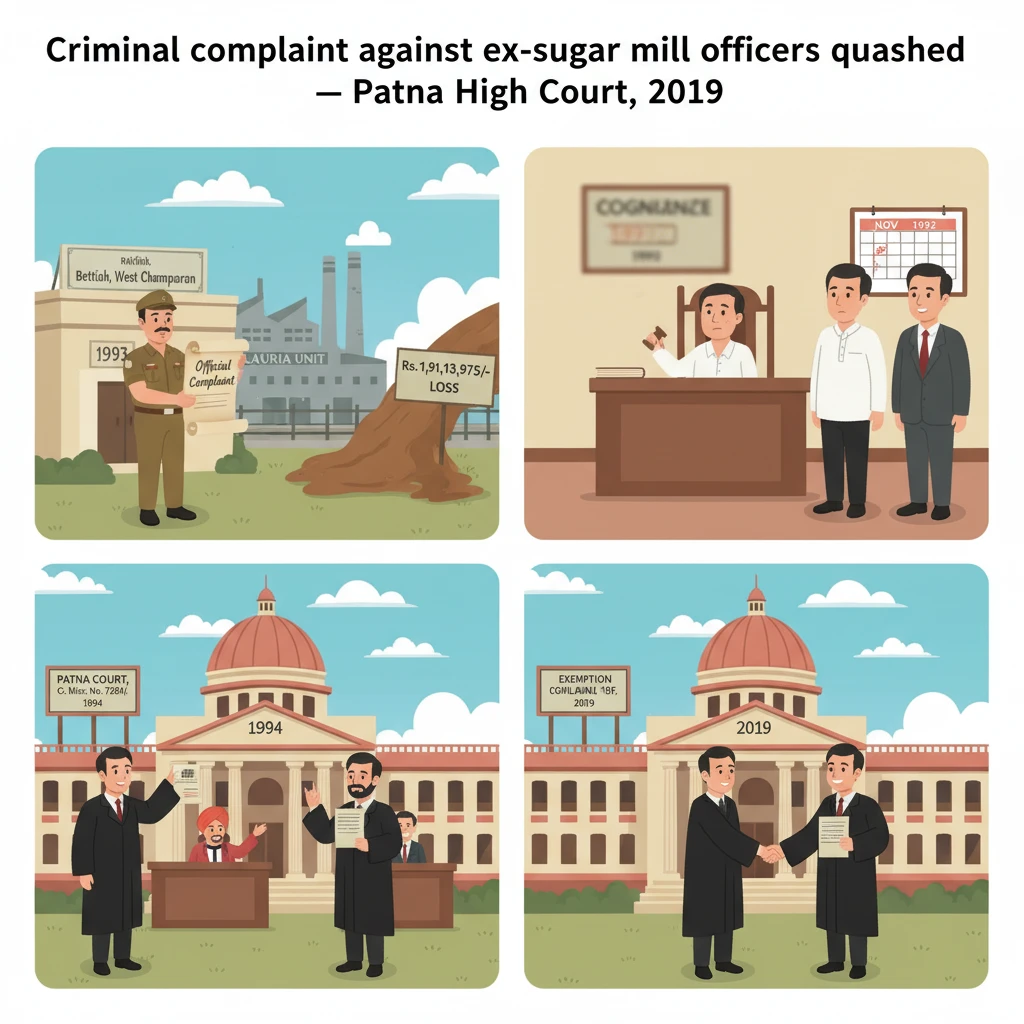
An Official Complaint Case No. 22 (O.C.) of 1993 was filed on 19.04.1993 before the Chief Judicial Magistrate, Bettiah, West Champaran by the Excise Superintendent, Bettiah, West Champaran. The complaint was filed against Bihar State Sugar Corporation Limited and certain officers of its Lauria Unit in West Champaran.
According to the complaint, the Accountant General’s audit report for the year 1991–92 showed wastage of molasses at the Lauria sugar unit. Because of this wastage, there was alleged loss of government revenue of Rs. 1,91,13,975/-. On this basis, the Corporation and the designated officers of the Lauria Unit were held liable.
The officers were not named by personal names in the complaint. The accused were described by posts: Bihar State Sugar Corporation Limited through Managing Director; General Manager, Lauria Unit; Assistant General Manager, Lauria Unit; and Cane Manager, Lauria Unit.
On 24.04.1993, the Magistrate took cognizance of the offences under Sections 403, 409, 413, 421, 420, 437, 467, 471 and 120B of the Indian Penal Code. Cognizance was taken only against two accused: the Managing Director of Bihar State Sugar Corporation Limited (accused no. 1) and the General Manager of the Lauria Unit (accused no. 2).
By that time, the posts were held by Mr. Girish Shankar as Managing Director and the present petitioner as General Manager. Both had joined in November 1992, several months after the period covered by the audit report (1st April 1991 to 31st March 1992).
These two officers moved an application under Section 205 of the Code of Criminal Procedure, 1973, before the Magistrate seeking exemption from personal appearance and permission to appear through counsel. The Magistrate rejected this request on 13.04.1994.
Aggrieved by this, they approached the Patna High Court in Cr. Misc. No. 7581 of 1994. On 15.09.1999, a coordinate Bench allowed their petition. The High Court dispensed with their personal appearance and permitted them to be represented through counsel till further orders of the trial court.
Despite this order, later the Judicial Magistrate, 1st Class, Bettiah, by order dated 25.01.2013, issued non-bailable warrants of arrest against both the petitioner and Mr. Girish Shankar. This led them to file separate criminal revisions before the Sessions Judge, West Champaran, Bettiah: Cr. Revision No. 32 of 2013 by Mr. Girish Shankar and Cr. Revision No. 42 of 2013 by the present petitioner.
On 09.05.2013, the Sessions Judge allowed the revisions and set aside the non-bailable warrants. However, in paragraph 19 of the same order, the Sessions Judge directed the petitioner and the other officer to appear before the Magistrate “without any further delay” and to cooperate in the disposal of the case, ignoring their plea about non-compliance of Sections 63 and 305 Cr.P.C.
Challenging this part of the Sessions Judge’s order, and also the very continuation of the criminal case, the petitioner filed Criminal Miscellaneous No. 15384 of 2015 before the Patna High Court under Section 482 Cr.P.C.
What the Court Examined and Decided
The petition was heard by Hon’ble Mr. Justice Ahsanuddin Amanullah. The petitioner argued that he could not be held criminally liable for alleged offences relating to a period when he was not in charge of the Lauria Unit. He also pointed out that the complaint itself covered only the financial year 1991–92, while he joined as General Manager on 02.11.1992, after that period had ended.
The State of Bihar, through the Secretary, Excise and Prohibition Department, was made opposite party. Despite service of copy of the application on 10.03.2015, no counter affidavit was filed on behalf of the State even after more than four years. The Court therefore accepted the factual statements made in the application, especially as they were also supported by annexed documents, including earlier court orders.
On the basis of the complaint and the undisputed documents, the Court recorded certain admitted facts:
First, the complaint related specifically to wastage of molasses during the period from 1st April 1991 to 31st March 1992, resulting in alleged loss of excise revenue.
Second, the complaint originally treated the accused not as individuals but as offices: Bihar State Sugar Corporation Limited; and the General Manager, Assistant General Manager, and Cane Manager of its Lauria Unit in West Champaran.
Third, the Magistrate’s order dated 24.04.1993 taking cognizance was actually directed only against the then Managing Director of the Corporation and the then General Manager of the Lauria Unit, under various sections of the Indian Penal Code including criminal breach of trust, cheating, forgery and conspiracy.
Fourth, the coordinate Bench of the Patna High Court had already recorded, in its order dated 15.09.1999 in Cr. Misc. No. 7581 of 1994, that Mr. Girish Shankar took charge as Managing Director on 03.11.1992 and the petitioner took charge as General Manager, Lauria Unit on 02.11.1992.
Putting these facts together, the Court reached a clear conclusion: neither of the two officers against whom cognizance had been taken were in charge of the Bihar State Sugar Corporation or its Lauria Unit during the period 1st April 1991 to 31st March 1992, when the alleged offences occurred. They came into office months later in November 1992.
On this basis, the Court held that the petitioner and his co-accused could not be held accountable for any act or omission committed by their predecessors. No criminal liability could be fastened on them for a period when they did not occupy the relevant posts.
The Court then examined its power under Section 482 Cr.P.C. to interfere in such a case. It referred in detail to its own recent judgment in Ashutosh Mukherjee v. The State of Bihar (Cr. Misc. No. 47012 of 2014, judgment dated 18-04-2019). There, the Court had discussed earlier decisions on the inherent powers of the High Court, including:
- State of Uttar Pradesh v. Mohammad Naim, AIR 1964 SC 703
- State v. Navjot Sandhu, (2003) 6 SCC 641
- Jitendra Raghuvanshi v. Babita Raghuvanshi, (2013) 4 SCC 58
- Parbatbhai Aahir v. State of Gujarat, (2017) 9 SCC 641
- Rupesh Kumar v. The State of Bihar, Cr. Misc. No. 30470 of 2016
From these authorities, the Court reiterated that Section 482 does not create new powers but preserves the High Court’s inherent powers to prevent abuse of court process and to secure the ends of justice. The High Court, as a constitutional court, has a duty to act whenever continuation of a proceeding would cause injustice or harassment.
The Court then relied on the landmark Supreme Court judgment in State of Haryana v. Bhajan Lal, 1992 Supp (1) SCC 335. Paragraph 102 of that judgment lists illustrative categories of cases where criminal proceedings can be quashed under Section 482 Cr.P.C. These include situations where:
- even if allegations are taken as true, they do not make out any offence;
- uncontroverted allegations and supporting materials do not disclose any offence; and
- the criminal proceeding is manifestly attended with mala fide or is maliciously instituted to harass the accused.
After examining the nature of allegations and the admitted facts, the Court held that the present case clearly fell under categories 1, 3 and 7 of Bhajan Lal. The allegations, even if accepted as true, related to a period when the petitioner was not in charge and hence did not prima facie constitute any offence against him. The materials did not show any omission or commission by him. Allowing the case to continue would amount to misuse of criminal law to target officers who simply inherited posts.
The Court further relied on State of Karnataka v. L. Muniswamy, (1977) 2 SCC 699, where the Supreme Court held that High Courts must use their inherent powers to prevent criminal proceedings from turning into instruments of harassment or persecution. If the material shows that continuing the case would be an abuse of the court’s process, the High Court is entitled to quash it.
Applying these principles, the Patna High Court concluded that the prosecution of the petitioner was “totally untenable in the eyes of law”. It was both an abuse of process and contrary to the ends of justice.
The Court also noted that the case of the petitioner and that of Mr. Girish Shankar stood on identical facts for the purpose of deciding this application. Both had joined their posts in November 1992, after the relevant period. Therefore, the Court found it proper to extend the benefit of its order to Mr. Girish Shankar as well, even though he was not the moving petitioner in this particular application.
Ultimately, exercising its inherent powers under Section 482 Cr.P.C., the Court allowed the application. It quashed the entire criminal proceeding in Official Complaint Case No. 22 (O.C.) of 1993 pending in the Bettiah court, West Champaran, including all orders already passed by the courts below in that case.
Why This Judgment Matters
This judgment is important for government officers, public sector managers and company officials who take charge of posts after earlier management has left. It underlines that they cannot automatically be dragged into criminal trials for alleged offences committed before they assumed office, unless there is clear material showing their own involvement.
For complainants and investigating agencies, the ruling from the Patna High Court serves as a reminder to carefully identify the correct accused and the correct time period of alleged offences. Simply naming the current office-holders may not be enough when the allegation concerns past conduct.
The judgment also shows that the High Court will intervene under Section 482 Cr.P.C. when a prosecution appears to be baseless or oppressive, especially where the facts are undisputed and clearly show that no offence is made out against the person being prosecuted.
Legal Issues and Answers
-
Issue: Can criminal proceedings continue against officers who took charge after the period during which the alleged offences occurred, when there is no allegation of their own wrongful act?
Answer: No. The Patna High Court held that such officers cannot be made liable for acts of their predecessors, and prosecution against them is untenable and liable to be quashed under Section 482 Cr.P.C. -
Issue: When can the High Court use its inherent powers under Section 482 Cr.P.C. to quash a complaint case?
Answer: The Court can intervene to prevent abuse of the process of any court or to secure the ends of justice, especially where the undisputed facts show that even if allegations are taken at face value, no offence is made out against the accused, as explained in Bhajan Lal and L. Muniswamy.
Cases Cited by the Court
- State of Uttar Pradesh v. Mohammad Naim, AIR 1964 SC 703
- Jairam Das v. Emperor, AIR 1945 PC 94
- Emperor v. Nazir Ahmad, AIR 1945 PC 18
- State v. Navjot Sandhu, (2003) 6 SCC 641
- Jitendra Raghuvanshi v. Babita Raghuvanshi, (2013) 4 SCC 58
- Parbatbhai Aahir v. State of Gujarat, (2017) 9 SCC 641
- Rupesh Kumar v. The State of Bihar, Cr. Misc. No. 30470 of 2016, order dated 21.02.2019
- State of Haryana v. Bhajan Lal, 1992 Supp (1) SCC 335
- State of Karnataka v. L. Muniswamy, (1977) 2 SCC 699
- Ashutosh Mukherjee v. The State of Bihar, Cr. Misc. No. 47012 of 2014, judgment dated 18-04-2019
Case Details
Case Number: Criminal Miscellaneous No. 15384 of 2015 (arising out of Official Complaint Case No. 22 (O.C.) of 1993, P.S. Case No. 22 (O.C.) of 1993)
Case Title: Baidyanath Mishra v. The State of Bihar through The Secretary, Excise and Prohibition Department, Government of Bihar
Citation: 2019 (3) PLJR 84
Court: High Court of Judicature at Patna
Coram: Hon’ble Mr. Justice Ahsanuddin Amanullah
Date of Judgment: 14-05-2019
Advocates:
- For the Petitioner: Mr. Binod Kumar Singh with Ms. Vagisha, Advocates
- For the State: Mr. Jharkhandi Upadhyay, APP
Nature of the Case: Petition under Section 482 of the Code of Criminal Procedure, 1973 seeking quashing of part of revisional order and consequential criminal proceedings in an official complaint case alleging loss of government excise revenue.
Link to Judgment: Patna High Court official judgment link
If you found this explanation helpful and wish to stay informed about
how legal developments may affect your rights in Bihar,
you may consider following Samvida Law Associates for more updates.







