
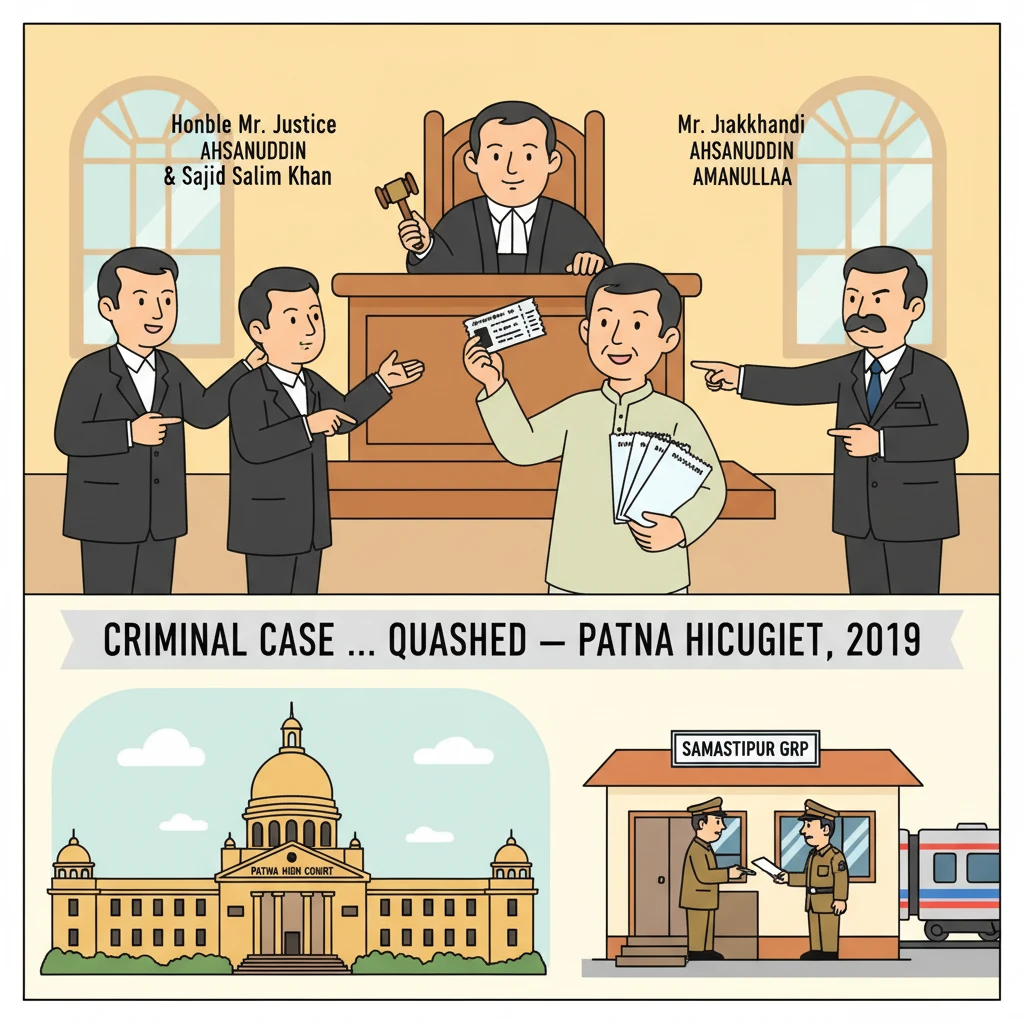
Case Background
The matter arose from Samastipur, where a case was registered as R.P.F. (S.M.I.) 43 of 2010, later numbered as T.R. No. 809 of 2011, before the Railway Judicial Magistrate, Samastipur.
The allegation against the petitioner and another accused was that they were involved in black marketing of railway tickets. Acting on prior information, the authorities allegedly identified the petitioner and confronted him.
From the petitioner’s possession, one railway ticket in his own name and five blank reservation slips were recovered. Based on this, a complaint was lodged and, on 03.01.2011, the Railway Judicial Magistrate, Samastipur took cognizance of an offence under Section 143 of the Railway Act, 1989 against the petitioner.
Feeling aggrieved, the petitioner moved the Patna High Court under Section 482 of the Code of Criminal Procedure, 1973, seeking quashing of the cognizance order dated 03.01.2011 and the entire criminal proceeding as far as it related to him.
What the Court Examined and Decided
The Patna High Court, through Hon’ble Mr. Justice Ahsanuddin Amanullah, heard learned counsel for the petitioner, the learned APP for the State, and learned counsel for the Railways.
The core relief sought by the petitioner under Section 482 of the Code was to quash the cognizance order under Section 143 of the Railway Act, 1989. Section 482 gives the High Court inherent powers to prevent abuse of the process of any court or to secure the ends of justice.
The petitioner’s counsel argued that the accusation of black marketing of railway tickets was based only on suspicion. The specific allegation was that he used to buy railway tickets in his own name but by showing a different age, and then allegedly sold those tickets in the black market.
Counsel for the petitioner highlighted that the only ticket actually recovered from his possession was in his own name and showed his date of birth exactly as recorded in his Election Photo Identity Card. That identity card was also recovered from him. Thus, the ticket matched the petitioner’s real details.
On this basis, the petitioner’s side argued that there was no material to support the suspicion that he used to buy tickets by showing a different age. The prosecution case was not backed by any concrete document or instance of a ticket with a wrong age, nor any evidence of sale in black market.
They further submitted that mere possession of five blank reservation slips cannot be made the basis of a criminal prosecution. Ordinary passengers can hold reservation slips, and no misuse had been demonstrated from these slips.
On the other side, the learned APP for the State and learned counsel for the Railways maintained that the petitioner was suspected of black marketing tickets. They argued that, due to this suspicion, he must face trial and that the cognizance order of the Magistrate was justified.
However, the High Court directly asked the State and Railways’ counsel a pointed question: what material showed that the petitioner used to buy tickets by showing a different age? The record showed that only one ticket in his name, with his correct age, and five blank reservation slips were recovered. The counsel were unable to answer this satisfactorily or point to any supporting material.
After considering the facts and submissions, the Court found that a case for interference had been made out. The Court carefully examined what was actually recovered from the petitioner and what was merely alleged.
The Court noted that the only material recovered was one railway ticket in the petitioner’s own name and that this ticket showed his correct age, based on his Election Photo Identity Card. There was no ticket showing any different age or identity. There were also five blank reservation slips, but no evidence of their misuse or sale.
In the Court’s considered opinion, this material could not justify launching a criminal prosecution. The allegation that the petitioner used to sell railway tickets in the black market by buying them in his own name with different ages was described as “too tenuous a ground” to justify criminal action, especially when the actual recovery contradicted that suspicion.
The Court emphasised that starting a criminal case against any person has serious penal consequences. Such proceedings cannot be initiated lightly, and there must be some substantial material, not just bare suspicion or uncorroborated allegation.
The Court observed that, in this case, what was recovered from the petitioner “absolutely does not constitute or can be a basis for any criminal prosecution.” A mere bald statement that the petitioner used to deal in black marketing of railway tickets, without supporting material, was held to be an abuse of the process of the Court.
To support its reasoning, the Patna High Court relied on the Supreme Court decision in State of Haryana v. Bhajan Lal, reported as 1992 Suppl (1) SCC 335. In paragraph 102 of that judgment, the Supreme Court had laid down illustrative categories of cases where High Courts can use their powers under Section 482 of the Code to quash criminal proceedings.
The Court reproduced those categories, which include situations where, even if all the allegations in the FIR or complaint are taken at face value, they do not constitute any offence; where the allegations are so absurd and improbable that no prudent person could conclude there is ground for proceeding; and where proceedings are attended with mala fide motives or are maliciously instituted for harassment.
After referring to these principles, the Patna High Court held that the present case fell within categories (1) and (7) of paragraph 102 of Bhajan Lal. In other words, even accepting the allegations as stated, no offence was made out against the petitioner, and the case appeared to be a misuse of the criminal process to harass him.
The Court also relied on another Supreme Court judgment, State of Karnataka v. L. Muniswamy, reported as (1977) 2 Supreme Court Cases 699, particularly paragraph 7. The Supreme Court there had recognised that High Courts can quash a criminal proceeding if continuing it would be an abuse of the process of the Court, or where the ends of justice demand that the proceeding be stopped.
That judgment further explained that the inherent powers of the High Court are meant to ensure that court proceedings do not become a weapon of harassment or persecution. Where the nature of the material that supports a prosecution is weak or “lame,” the High Court is justified in quashing such proceedings.
Applying these principles to the facts, the Patna High Court found that the criminal proceeding against the petitioner was “absolutely unsustainable” and had been filed only to harass him. The Court concluded that it was clearly an abuse of the process of the Court.
Therefore, the Court allowed the application under Section 482 of the Code. It quashed the entire criminal proceeding arising out of R.P.F. (S.M.I.) 43 of 2010, T.R. No. 809 of 2011, including the cognizance order dated 03.01.2011 passed by the Railway Judicial Magistrate, Samastipur, as far as it related to the petitioner.
Why This Judgment Matters
This judgment of the Patna High Court is significant for ordinary citizens, especially railway passengers, who may fear being dragged into criminal cases on thin or doubtful grounds.
The Court has clearly stated that a person cannot be prosecuted just on suspicion, without real supporting material. Simply possessing one genuine ticket in one’s own name and a few blank reservation slips is not enough to start a criminal trial for black marketing of tickets.
The decision reinforces that criminal law is a serious matter. Authorities must gather concrete evidence before accusing someone of offences like black marketing. Otherwise, such cases can and will be quashed by the High Court using its powers under Section 482 Cr.P.C.
For those who feel they are being falsely implicated, the judgment shows that the Patna High Court is willing to step in where the prosecution appears to be an abuse of the process of the Court.
Legal Issues and Answers
-
Issue: Whether the materials recovered from the petitioner (one railway ticket in his own name showing correct age and five blank reservation slips) were sufficient to justify cognizance and continuation of a criminal case under Section 143 of the Railway Act, 1989 for alleged black marketing of tickets.
Answer: No. The Patna High Court held that these materials did not constitute a basis for any criminal prosecution. The allegation of black marketing based on supposed purchase of tickets with different ages was unsupported, making the proceeding an abuse of the process of the Court, and the Court quashed the entire case against the petitioner under Section 482 Cr.P.C. -
Issue: When can the High Court use its inherent powers under Section 482 Cr.P.C. to quash criminal proceedings?
Answer: Relying on State of Haryana v. Bhajan Lal and State of Karnataka v. L. Muniswamy, the Court reaffirmed that these powers can be used where allegations, even if taken at face value, do not make out any offence, or where the proceedings are mala fide or constitute harassment and an abuse of the process of the Court. The present case was found to fall within such categories.
Cases Cited by the Court
- State of Haryana v. Bhajan Lal, 1992 Suppl (1) SCC 335
- State of Karnataka v. L. Muniswamy, (1977) 2 Supreme Court Cases 699
Case Details
Case Number: Criminal Miscellaneous No. 4337 of 2015; arising out of R.P.F. (S.M.I.) 43 of 2010, T.R. No. 809 of 2011; arising out of P.S. Case No. 43 of 2010, Samastipur GRP Case, District Samastipur
Case Title: Md. Zakaullah v. The State of Bihar & Anr.
Citation: 2019(3) PLJR 96
Coram: Hon’ble Mr. Justice Ahsanuddin Amanullah
Advocates: Mr. Rajesh Ranjan with Mr. Sajid Salim Khan, Advocates, for the petitioner; Mr. Jharkhandi Upadhyay, APP for the State; learned counsel for the Railways also appeared (name not specified)
Nature of the Case: Petition under Section 482 of the Code of Criminal Procedure, 1973 seeking quashing of cognizance order and criminal proceedings under Section 143 of the Railway Act, 1989.
Link to the Judgment: Click here to read the full judgment of the Patna High Court
If you found this explanation helpful and wish to stay informed about
how legal developments may affect your rights in Bihar,
you may consider following Samvida Law Associates for more updates.







