

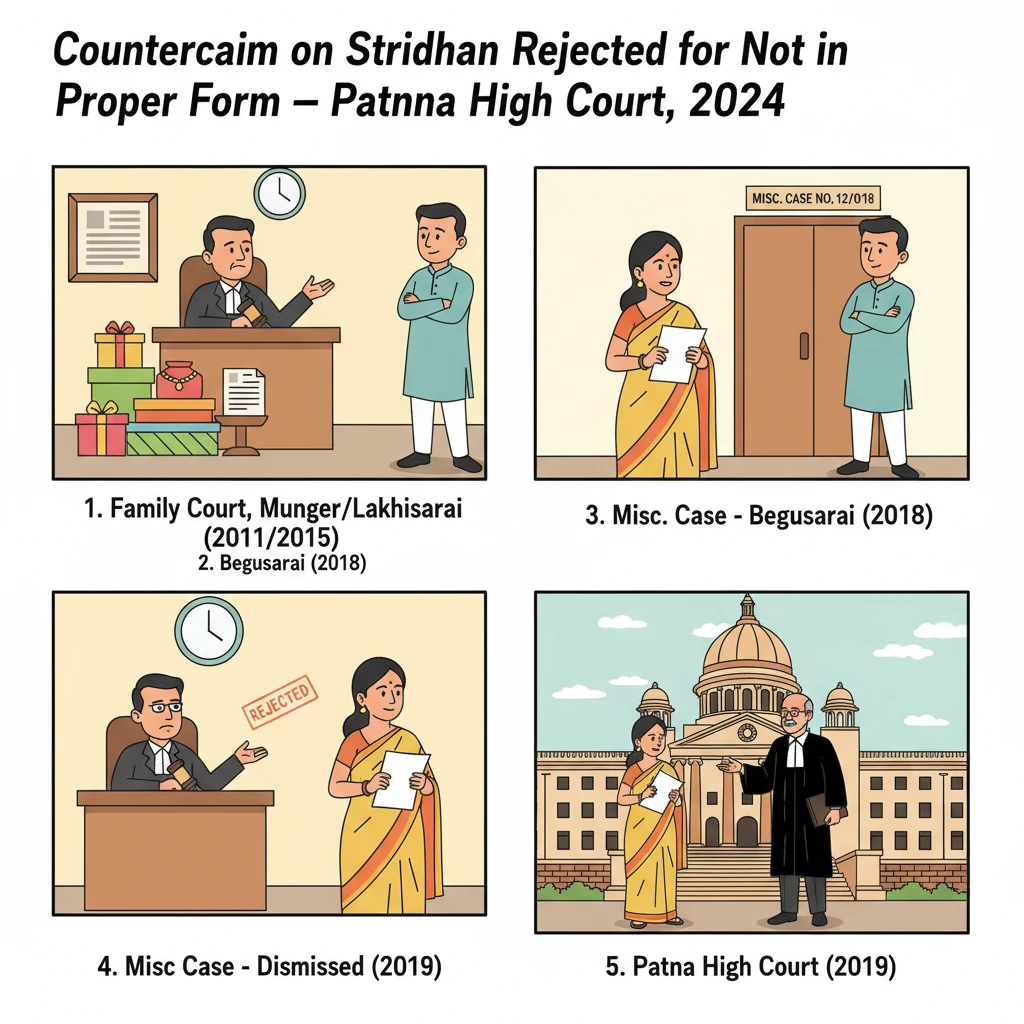
She had tried to treat a line in her written statement as a counterclaim for return of gifts given at marriage.
The Court held this was not a valid counterclaim under law and upheld dismissal of her miscellaneous case.
She is still free to file a proper case before the competent court.
Case Background
The dispute started when the husband filed a matrimonial case for dissolution of marriage against his wife. This case was registered as Matrimonial Case No. 18 of 2011/11 of 2015 in the court of the learned District Judge, Munger/Lakhisarai and was later transferred to the Family Court at Begusarai.
The wife appeared in that case and filed her written statement. In it, she alleged that the husband had wrongly kept her stridhan and other belongings. She also mentioned that gifts worth Rs. 8,35,000/- had been given to the husband at the time of marriage, and she asked that these gifts be returned to her.
According to her, this prayer in the written statement should be treated as a “counterclaim” against the husband. A counterclaim is like a separate suit that a defendant can file within the same case, asking for his or her own reliefs against the plaintiff.
On 16.04.2018, the learned Principal Judge, Family Court, Begusarai dismissed the husband’s matrimonial case. However, while dismissing that case, the Family Court did not separately deal with what the wife claimed to be her counterclaim for return of gifts and stridhan.
Feeling that her claim had been left undecided, the wife then filed Miscellaneous Case No. 12 of 2018 before the same Family Court. In this miscellaneous case, she requested the court to consider and decide her alleged counterclaim on merits.
On 29.06.2019, at the admission stage itself, the learned Principal Judge, Family Court, Begusarai dismissed Miscellaneous Case No. 12 of 2018. The Family Court held that there was in fact no counterclaim before it and that the miscellaneous case was not maintainable.
Aggrieved, the wife approached the Patna High Court by filing Civil Miscellaneous No. 1131 of 2019 under Article 227 of the Constitution of India. She asked the High Court to set aside the Family Court’s order dated 29.06.2019 and to direct consideration of her alleged counterclaim.
What the Court Examined and Decided
The Patna High Court, through Hon’ble Mr. Justice Arun Kumar Jha, examined a narrow but important question: could the wife’s prayer in her written statement, seeking return of gifts and stridhan, be treated in law as a valid counterclaim?
Senior counsel for the wife argued that the Family Court had completely misunderstood the law on counterclaims under Order VIII Rule 6A to 6D of the Code of Civil Procedure, 1908 (the Code). He said that the wife had clearly made a counterclaim in her written statement and that the court below was wrong in holding that no counterclaim existed.
He further submitted that once a counterclaim is made under Order VIII Rule 6A, it must be treated as a plaint and decided like a separate suit. According to him, dismissal of the husband’s matrimonial case could not wipe out the wife’s counterclaim, which had to be decided on its own merits.
He also contended that there are different modes of making a counterclaim and that it should not be rejected merely because it was not put in a particular format or not filed as a separate petition. He drew the Court’s attention to paragraph 16 and the last paragraph of the relief portion of the written statement, where the wife had prayed that the husband be directed to return all gifts given by her parents.
Relying on Section 23A of the Hindu Marriage Act, 1955 (HMA), he argued that in proceedings for divorce, judicial separation or restitution of conjugal rights, a respondent can make a counterclaim for any relief under the Act. He relied on a judgment of the Kerala High Court in Anil Kumar v. Sunil Kumar and Anr., 2023 SCC OnLine Ker 8218, to say that any omission in form and content of a counterclaim is a curable defect. He also referred to Section 20 of the Family Courts Act, 1984 (FC Act) to submit that provisions of the FC Act override other laws and therefore the counterclaim filed by the wife should have been considered.
On the other side, counsel for the husband strongly opposed the petition. He submitted that the Family Court’s order was legal and needed no interference. According to him, a counterclaim must be specifically pleaded so that the Court and the opposite party clearly know that an independent claim is being made.
He relied on the Supreme Court decision in Nitaben Dinesh Patel v. Dinesh Dahyabhai Patel, (2021) 20 SCC 210. He further argued that under Order VIII Rule 6B of the Code, a counterclaim has to be in the nature of a plaint following Order VII of the Code. That means it must contain all particulars required in a plaint, such as details of cause of action, jurisdiction, valuation and reliefs claimed.
He again relied on the Kerala High Court judgment in Anil Kumar v. Sunil Kumar and Anr. to support the need for proper particulars in a counterclaim. As the wife had not filed any such properly detailed counterclaim, the Family Court was right in holding that the miscellaneous case was not maintainable.
The husband’s counsel also placed reliance on a Madras High Court judgment in Ramani Ammal v. Susilammal, AIR 1991 Madras 163. That decision emphasised that a trial court must specifically note and treat a defendant’s counterclaim as such. Merely treating it as ordinary pleading and framing issues is not enough. If the trial court does not treat the pleading as a counterclaim, that is the end of the matter.
The Patna High Court then turned to the legal provisions.
First, it reproduced Order VIII Rule 6A of the Code, which allows a defendant to set up a counterclaim against the plaintiff in respect of a cause of action that has accrued before filing the defence. The Rule states that such counterclaim has the same effect as a cross-suit and shall be treated as a plaint, governed by rules applicable to plaints.
Next, the Court reproduced Order VII Rule 1 of the Code, which lists the particulars a plaint must contain: name of the court, names and addresses of parties, facts constituting cause of action and when it arose, facts showing jurisdiction, the relief claimed, and valuation for court fee and jurisdiction, among others.
From a combined reading of these provisions, the Court held that a counterclaim must contain all particulars prescribed in Order VII Rule 1. In other words, it must be a self-contained pleading that can stand as a separate suit.
The Court then examined the FC Act. Section 7 describes the jurisdiction of Family Courts, including suits and proceedings between parties to a marriage regarding the property of the parties or either of them. Explanation (c) to Section 7 was noted as relevant, since the wife had prayed for return of gifts given at the time of marriage.
Section 20 of the FC Act gives the Act overriding effect where it is inconsistent with any other law. Section 10 provides that, subject to the Act and rules, provisions of the Code of Civil Procedure apply to suits and proceedings before a Family Court, except proceedings under Chapter IX of the Criminal Procedure Code. It also allows Family Courts to lay down their own procedure for settlement or to discover the truth of facts.
The Court then turned to Section 23A of the HMA, which allows a respondent in proceedings for divorce, judicial separation or restitution of conjugal rights to not only oppose the petitioner’s claim but also make a counterclaim for any relief under the HMA on the grounds of adultery, cruelty or desertion. If such grounds are proved, the court may grant the respondent any relief under the Act as if he or she had filed a separate petition.
After examining the admitted facts, the Court noted two key points:
(i) The husband had filed a petition for dissolution of marriage. The wife filed a written statement denying his allegations.
(ii) The wife claimed that gift articles worth Rs. 8,35,000/- had been given to the husband and, in the relief portion of her written statement, she asked for their return.
The Court observed that the FC Act does not itself provide for filing counterclaims. Section 23A of the HMA does, but the HMA is silent on the form and particulars to be contained in a counterclaim. Because both the HMA and FC Act are silent on format, one must fall back on Section 10 of the FC Act, which mandates that procedure is governed by the Code. Therefore, any counterclaim before a Family Court must still satisfy Order VIII Rule 6A and Order VII Rule 1 of the Code.
Applying this to the wife’s pleadings, the Court held that her claim for return of gifts was not in the format prescribed. It was simply a prayer line in her written statement, not a structured counterclaim containing all necessary particulars.
The Court acknowledged that procedural law is often described as the handmaiden of justice and should further the cause of justice. But it stressed that procedure cannot be sacrificed merely on a notion of doing justice at any cost to one side, especially when it may cause injustice to the other.
By insisting on a particular format for counterclaims, the law ensures that the plaintiff is clearly told about the claim against him and is given an opportunity to file a written statement in answer to that counterclaim. If a simple assertion in a written statement is treated as a counterclaim, the plaintiff may be deprived of this statutory right, which could not have been intended by the legislature.
The Court then considered an important, but till then unaddressed, issue: whether a claim for return of gift articles can be sought as a counterclaim under the HMA or FC Act.
It noted that property disputes between spouses can be dealt with under the FC Act, but the FC Act does not provide for counterclaims. Under the HMA, Section 23A does provide for counterclaims, but the Supreme Court, in Nitaben Dinesh Patel (supra), had limited the scope of such counterclaims.
In paragraph 43 of Nitaben Dinesh Patel, the Supreme Court held that by way of counterclaim under Section 23A, only certain reliefs under the HMA can be prayed for or granted: Section 9 (restitution of conjugal rights), Section 10 (judicial separation), Sections 11 and 12 (nullity and annulment of marriage), and Section 13 (divorce). Respondents can seek only these reliefs by way of counterclaim in such proceedings.
The Patna High Court concluded that this authority makes it clear that a counterclaim under Section 23A of the HMA cannot be used to seek return of gift articles. While the FC Act gives jurisdiction to Family Courts over property disputes between spouses, it remains silent on counterclaims. Reading the FC Act and HMA together, the Court held that counterclaims under the HMA are confined to reliefs under Sections 9 to 13 only, and not to property claims like return of gifts.
Finally, the Court summed up its conclusions. No counterclaim, except those specifically allowed under Section 23A of the HMA (relating to Sections 9–13), can be filed in HMA proceedings. Even when a counterclaim is permissible, it must be filed in compliance with Order VIII Rule 6A and Order VII Rule 1 of the Code. A mere statement or prayer in the written statement is not enough. The pleading must clearly state that it is a counterclaim and contain all necessary particulars.
On this basis, the Court held that the Family Court, Begusarai had committed no error or jurisdictional violation in rejecting Miscellaneous Case No. 12 of 2018. It therefore affirmed the order dated 29.06.2019 and dismissed Civil Miscellaneous No. 1131 of 2019 as devoid of merit.
At the same time, the Court left an important door open. It clarified that the wife is at liberty to take recourse to law and assert her rights before the court of competent jurisdiction, if so advised. In simple terms, she may file a proper, independent case for her claimed gifts and stridhan before the appropriate forum.
Why This Judgment Matters
This judgment is significant for spouses, especially women, who wish to claim their stridhan or gifts while fighting matrimonial cases in Family Courts.
First, the Patna High Court has made it clear that just adding a prayer at the end of a written statement is not enough to create a legal counterclaim. If someone wants a separate relief, especially about property or gifts, they must file a proper counterclaim in the required format or bring a separate suit or proceeding in the competent court.
Second, the judgment explains that counterclaims under the Hindu Marriage Act can be used only for certain marriage-related reliefs: restitution of conjugal rights, judicial separation, nullity or annulment, and divorce. Claims for return of stridhan or gifts do not fall in this list. These must be raised under other provisions and in proper proceedings.
Third, the decision underlines that procedure is not a mere technicality. Proper format of counterclaim protects both sides: it informs the opposite party clearly and gives them a chance to reply. This is important for fairness.
For parties in Bihar and elsewhere, the ruling signals that if property or gift disputes are involved in a marriage case, they should seek legal advice on the correct kind of case to file, rather than assuming that a simple line in a written statement will be treated as a counterclaim.
Legal Issues and Answers
- Issue: Can a prayer in the written statement for return of gifts and stridhan be treated as a valid counterclaim in a matrimonial proceeding under the Hindu Marriage Act before the Family Court?
Answer: No. A counterclaim must be in the format and with particulars required under Order VIII Rule 6A read with Order VII Rule 1 CPC, and the person must clearly state that a counterclaim is being raised. A mere prayer in the written statement is insufficient. - Issue: What is the permissible scope of counterclaims under Section 23A of the Hindu Marriage Act?
Answer: Following the Supreme Court in Nitaben Dinesh Patel, counterclaims under Section 23A can seek only reliefs under Sections 9, 10, 11, 12 and 13 of the Hindu Marriage Act (restitution of conjugal rights, judicial separation, nullity/annulment and divorce), not property or gift-related reliefs. - Issue: Did the Family Court commit any jurisdictional error in dismissing Miscellaneous Case No. 12 of 2018 at the admission stage?
Answer: No. The Patna High Court found no infirmity or jurisdictional error and affirmed the order dated 29.06.2019, while leaving the petitioner free to approach the competent court separately.
Cases Cited by the Court
- Nitaben Dinesh Patel v. Dinesh Dahyabhai Patel, (2021) 20 SCC 210.
- Anil Kumar v. Sunil Kumar and Anr., 2023 SCC OnLine Ker 8218.
- Ramani Ammal v. Susilammal, AIR 1991 Madras 163.
Case Details
Case Number: Civil Miscellaneous Jurisdiction No. 1131 of 2019
Case Title: Sima Devi @ Sima Kumari v. Manoranjan Singh
Court: High Court of Judicature at Patna
Coram: Hon’ble Mr. Justice Arun Kumar Jha
Date of Judgment: 03.04.2024
Citation: 2024 (2) PLJR 552
Advocates:
For the Petitioner (wife): Mr. J. S. Arora, Senior Advocate; Mr. Manoj Kumar, Advocate
For the Respondent (husband): Mr. Om Prakash Maharaj, Advocate
Nature of the Case: Civil miscellaneous petition under Article 227 of the Constitution of India challenging an order of the Principal Judge, Family Court, Begusarai in Miscellaneous Case No. 12 of 2018 arising out of Matrimonial Case No. 18 of 2011/11 of 2015.
Impugned Order: Order dated 29.06.2019 of the learned Principal Judge, Family Court, Begusarai dismissing Miscellaneous Case No. 12 of 2018 at the admission stage.
Link to Judgment (official): Patna High Court Judgment – C.Misc. No. 1131 of 2019
If you found this explanation helpful and wish to stay informed about
how legal developments may affect your rights in Bihar,
you may consider following Samvida Law Associates for more updates.







