

Case Background
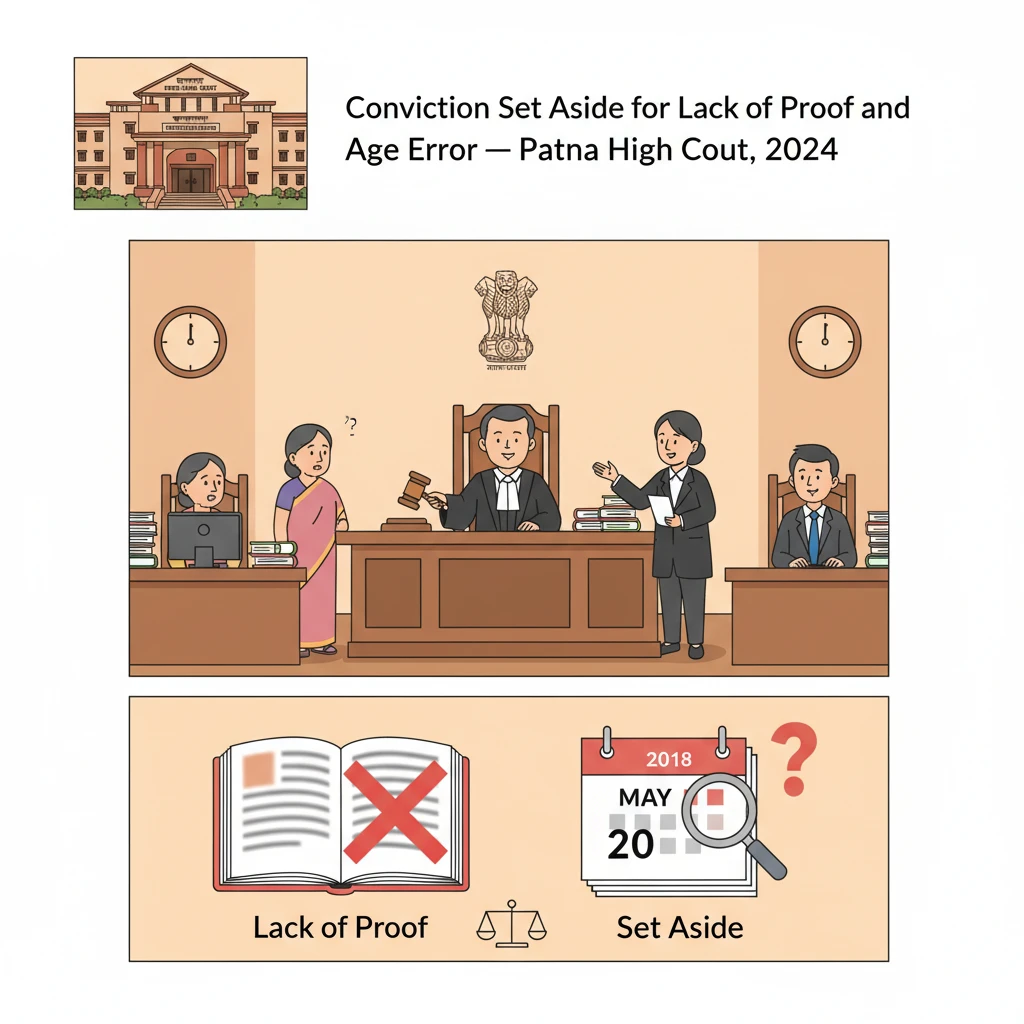
This criminal appeal was filed against the judgment of conviction dated 11.01.2023 and order of sentence dated 18.01.2023 passed by the Additional District and Sessions Judge-VII-cum-Special Judge, POCSO Act, West Champaran at Bettiah, in POCSO Case No. 201 of 2018, S.G.R. No. 62 of 2018, arising out of Balthar P.S. Case No. 66 of 2018.
The trial court had held the sole appellant guilty under Section 376(1) of the Indian Penal Code and Section 4 of the Protection of Children from Sexual Offences (POCSO) Act. He was sentenced to ten years’ rigorous imprisonment on each count, along with a fine of Rs. 20,000/-, payable to the victim, and three months’ simple imprisonment in default of payment. The court also directed the District Legal Services Authority, Bettiah, to pay Rs. 3,00,000/- as compensation to the victim.
The FIR, Balthar P.S. Case No. 66 of 2018, was lodged on 28.05.2018 at 5:15 P.M. on the written report of the victim. It was registered under Sections 376, 323, 504, 506, 341 read with Section 34 of the IPC, Section 4 of the POCSO Act and Sections 66(E)/67 of the Information Technology Act against four persons, including the appellant and his family members.
After investigation, the police submitted charge-sheet No. 84 of 2018 dated 20.07.2018 only against the appellant under Sections 376 and 506 IPC, Section 4 of the POCSO Act and Sections 36(E)/37 of the IT Act, exonerating the other named accused. Cognizance was taken, and the Special POCSO Court framed charges under Sections 376 and 506 IPC, Section 6 POCSO Act and Sections 66E and 67 of the IT Act. The appellant pleaded not guilty and faced trial.
The prosecution examined four witnesses: the victim, her mother, her paternal aunt (bua), and the doctor who conducted medical examination. Several documents, including the written report, Section 164 Cr.P.C. statement, and medical report, were exhibited. After closure of prosecution evidence, the appellant was examined under Section 313 Cr.P.C., where he denied the allegations and claimed innocence. He also led defence evidence by examining the principal teacher of the local school to prove the victim’s age.
What the Court Examined and Decided
Justice Jitendra Kumar, sitting singly in the Patna High Court, heard arguments from the appellant’s counsel, the Additional Public Prosecutor for the State, and counsel for the informant.
The appellant’s core attack on the trial court’s decision was two-fold: first, that the prosecution failed to establish that the victim was below 18 years on the date of occurrence, making POCSO provisions inapplicable; and second, that the allegation of rape itself was not proved beyond reasonable doubt in light of contradictions and medical evidence.
On age, the defence submitted that the victim had studied in Bairagya State Upgraded Middle School, and the age determination under Section 94 of the Juvenile Justice (Care and Protection of Children) Act, 2015 prioritises school records. The prosecution had not produced any school certificate and relied only on a medical assessment, which put the victim’s age in the range of 17–19 years.
The defence, however, produced D.W.-1, the Pradhan Shikshak (principal teacher) of Vairagya State Upgraded Middle School, along with the school admission register. She deposed that as per Serial No. 42 of the register, the victim was admitted to Class III on 25.05.2008 and her date of birth recorded there was 29.05.1997, entered by the then Headmaster. On this basis, the defence argued that on the date of the alleged occurrence, 20.05.2018, the victim was about 20 years and 11 months old and hence not a “child” under the POCSO Act.
The State and informant’s counsel supported the trial court’s finding that the victim was 16 years old at the time and that the conviction was justified.
Before examining the facts, the High Court discussed Sections 29 and 30 of the POCSO Act. These provisions create a presumption against the accused once prosecution establishes basic facts. However, relying on decisions of the Supreme Court and various High Courts, the Court emphasised that:
- The presumption of innocence remains a human right; statutory presumptions must be reasonable and cannot override Articles 14 and 21.
- Presumptions under Sections 29 and 30 arise only after the prosecution proves “foundational facts” such as minority of the victim and occurrence of sexual assault.
- The prosecution still bears the initial burden to prove guilt beyond reasonable doubt; the presumption only shifts the burden after that stage.
The Court further revisited the meaning of “proof beyond reasonable doubt” by citing several Supreme Court decisions. It noted that such proof does not mean perfect or mathematical certainty, but such a degree of probability that a prudent person would believe in the existence of the facts in issue. The accused is entitled to the benefit of reasonable doubts, not every trivial doubt or suspicion.
Turning to the evidence, the Court analysed the testimonies in detail.
The victim (P.W.-3) supported the prosecution version in her examination-in-chief, largely repeating her written report: that at about 6:00 A.M. on 20.05.2018, when she went near the qabristan to answer nature’s call, the appellant came from behind, held her, threatened her with a country-made pistol, removed her salwar and forcibly had sexual intercourse with her. She also spoke about nude photographs allegedly taken by the appellant and threats to make them viral on mobile if she disclosed the incident.
However, the Court noted an important change in her version. In the written report she had said the appellant pushed her to the ground and raped her there. In court, she deposed that the appellant took her to a nearby sugarcane field, then pushed her down on the ground and raped her. In cross-examination she admitted that sugarcane of about five feet height was standing in the field and that she did not suffer any scratch or abrasion even after being pushed on the ground. She also stated that her clothes had no bloodstains and that she had never studied in Bairagiya School.
The victim’s mother (P.W.-2) was not an eye-witness. She deposed that after the incident, the victim narrated it to her, and then she, along with others, went to the appellant’s house to complain, and later to the police station. She said their house and the appellant’s house were adjacent and denied any land dispute or litigation. She stated that at the time of occurrence the victim was wearing a green salwar and pink samij; the salwar was torn in front but there was no bloodstain. These clothes, she said, were handed to the police. She also admitted that there was no scratch or abrasion on the victim’s body and that, according to her, the victim was not examined by a doctor. She further stated that no naked photographs of her daughter appeared on her mobile.
The bua of the victim (P.W.-1) was also not an eye-witness. She said that the victim had been a student of Bairagiya Urdu School but had left much before the occurrence. She denied any land dispute. She said that sugarcane at the place of occurrence was broken in an area of “five hands”, and that the string of the pajama was broken and the salwar was torn.
The medical evidence came from P.W.-4, Dr. Ankasha, who examined the victim on 30.05.2018. She found that the hymen was ruptured with old tags present. She did not find any internal or external injury on the private parts and noted no signs of recent sexual assault. Vaginal swab examination by the pathologist did not show spermatozoa. She also found no signs of violence anywhere on the body. Radiological tests assessed the victim’s age as 17–19 years.
On the crucial question of age, the Court read Section 34(2) of the POCSO Act with Section 94 of the Juvenile Justice Act, 2015, and followed the Supreme Court’s rulings in Jarnail Singh v. State of Haryana and P. Yuvaprakash v. State. It held that when there is a dispute about age, the court must first look at:
- school date of birth certificate or matriculation/equivalent certificate;
- if unavailable, birth certificate from municipal body or panchayat; and
- only in their absence, medical/ossification tests.
The Court noted that P.W.-1 clearly acknowledged that the victim had been a student of Bairagiya Urdu School. Yet, the prosecution did not produce any school certificate regarding age. The High Court held that this withholding of documentary proof justified an adverse inference against the prosecution on age, especially as the initial burden lay with the prosecution to prove that the victim was below 18 years, a foundational requirement to invoke the POCSO Act.
In contrast, the defence produced D.W.-1 with the admission register, which recorded the victim’s date of birth as 29.05.1997. Accepting this evidence, the Court calculated that on 20.05.2018 the victim was over 20 years and therefore not a “child” within Section 2(1)(d) of the POCSO Act. Consequently, the POCSO provisions were held inapplicable to the appellant.
The Court then examined whether the offence of rape under Section 376 IPC stood proved independently.
It highlighted the discrepancy between the victim’s fardbeyan and her testimony on the location of the assault (open ground versus sugarcane field). Given the evidence that five-foot high sugarcane crops were standing, the Court found it highly improbable that a person pushed to the ground in such a field would suffer no scratches or abrasions, especially given the sharp-edged leaves. Yet, according to all prosecution witnesses and the doctor, there were no injuries, abrasions, or signs of violence on any part of the victim’s body.
The medical report also did not support recent forcible intercourse: there were no injuries on the private parts, no spermatozoa, and only an old ruptured hymen, which could be due to many reasons and is not conclusive of rape.
The Court accepted that in law, the sole testimony of the prosecutrix can be sufficient to convict, even without corroboration, if she is found to be a truthful and “sterling” witness. But here, it found reasons to doubt her reliability. She had denied ever studying at Bairagiya School, which was contradicted by D.W.-1 and even by P.W.-1. She had also materially changed her statement about the place of occurrence. All this, coupled with the medical evidence and lack of injuries, made her version doubtful.
The Court concluded that these circumstances created reasonable doubt about the prosecution story. Since criminal conviction requires proof beyond reasonable doubt, the appellant was entitled to the benefit of doubt.
Accordingly, the Patna High Court set aside the judgment of conviction and sentence passed by the Special POCSO Court. The appeal was allowed, and the appellant was acquitted of all charges. As he was in jail, the Court directed that he be released forthwith if not required in any other case. The Court ordered that a copy of the judgment be sent to the concerned jail superintendent and that the trial court records be returned.
Why This Judgment Matters
This decision is significant for both accused persons and complainants in sexual offence cases, especially where POCSO is invoked.
First, the Patna High Court reaffirmed that the prosecution must strictly prove that the victim was a child before POCSO can apply. If school or birth records exist, they cannot be ignored. Failing to produce them can weaken the case.
Second, even in sensitive cases like rape, courts will look closely at contradictions, medical findings, and the overall probability of the story. A conviction cannot rest on a version that does not inspire confidence, especially when other evidence points the other way.
Third, the judgment explains that the special presumptions in the POCSO Act do not automatically make an accused guilty from the moment of FIR. They operate only after the prosecution proves the basic facts. This is important for understanding how such cases are tested in court.
For families and victims, the case shows the importance of accurate documents, consistent statements, and timely medical examination. For accused persons, it shows that appeals can succeed where trial courts have overlooked key contradictions or legal requirements.
Legal Issues and Answers
- Issue: Was the victim a “child” (under 18 years) so that the POCSO Act could be applied against the appellant?
Answer: No. Relying on the school admission register produced by the defence and the prosecution’s failure to produce school records, the Court held that the victim’s date of birth was 29.05.1997. She was above 18 years on 20.05.2018, so POCSO did not apply. - Issue: Did the prosecution prove beyond reasonable doubt that the appellant committed rape under Section 376 IPC?
Answer: No. The Court found material inconsistencies in the victim’s statements about the place of occurrence, absence of any injuries or abrasions despite the alleged assault in a sugarcane field, lack of medical signs of recent sexual assault, and untruthfulness about her schooling. These factors created reasonable doubt, entitling the appellant to acquittal. - Issue: How do Sections 29 and 30 of the POCSO Act affect the burden of proof in such cases?
Answer: The Court held that these sections create a reverse presumption only after the prosecution establishes foundational facts like minority and occurrence of sexual assault. They do not relieve the prosecution of its initial burden to prove the case beyond reasonable doubt.
Cases Cited by the Court
- Babu v. State of Kerala, (2010) 9 SCC 189
- Navin Dhaniram Baraiye v. State of Maharashtra, 2018 SCC OnLine Bom 1281
- Joy V. S. v. State of Kerala, 2019 SCC OnLine Ker 783
- Sahid Hossain Biswas v. State of West Bengal, 2017 SCC OnLine Cal 5023
- Monish v. State of U.P., Criminal Misc. Bail Application No. 55026 of 2021 (Allahabad High Court, 09.02.2023)
- Marriappan v. The Inspector of Police (Crime No.27/2018), Crl.M.P.(MD) No.1396 of 2023 (Madras High Court, 08.09.2023)
- Latu Das v. State of Assam, 2019 SCC OnLine Gau 5947
- Jarnail Singh v. State of Haryana, (2013) 7 SCC 263
- P. Yuvaprakash v. State, 2023 SCC OnLine SC 846
- Collector of Customs v. D. Bhoormal, (1972) 2 SCC 544
- Kali Ram v. State of H.P., (1973) 2 SCC 808
- Dharm Das Wadhwani v. State of U.P., (1974) 4 SCC 267
- Shivaji Sahabrao Bobade v. State of Maharashtra, (1973) 2 SCC 793
- Dilavar Hussain v. State of Gujarat, (1991) 1 SCC 253
- Narender Kumar v. State (NCT of Delhi), (2012) 7 SCC 171
Case Details
Case Number: Criminal Appeal (SJ) No. 1210 of 2023; arising out of Balthar P.S. Case No. 66 of 2018; POCSO Case No. 201 of 2018; S.G.R. No. 62 of 2018.
Case Title: Islam Miyan Hajam @ Islam Miyan v. The State of Bihar
Coram: Hon’ble Mr. Justice Jitendra Kumar
Citation: 2024(4) PLJR 579
Advocates:
- For the appellant: Mr. Bimlesh Kumar Pandey, Advocate
- For the State: Mr. Ramchandra Singh, APP
- For the informant: Mr. Naumaan Ahmad, Advocate
Nature of the Case: Criminal appeal (single-judge) against conviction and sentence in a POCSO and rape case.
Date of Patna High Court Judgment: 26.07.2024
Trial Court: Additional District and Sessions Judge-VII-cum-Special Judge, POCSO Act, West Champaran at Bettiah
Link to Judgment: Click here to read the full Patna High Court judgment
If you found this explanation helpful and wish to stay informed about
how legal developments may affect your rights in Bihar,
you may consider following Samvida Law Associates for more updates.







