

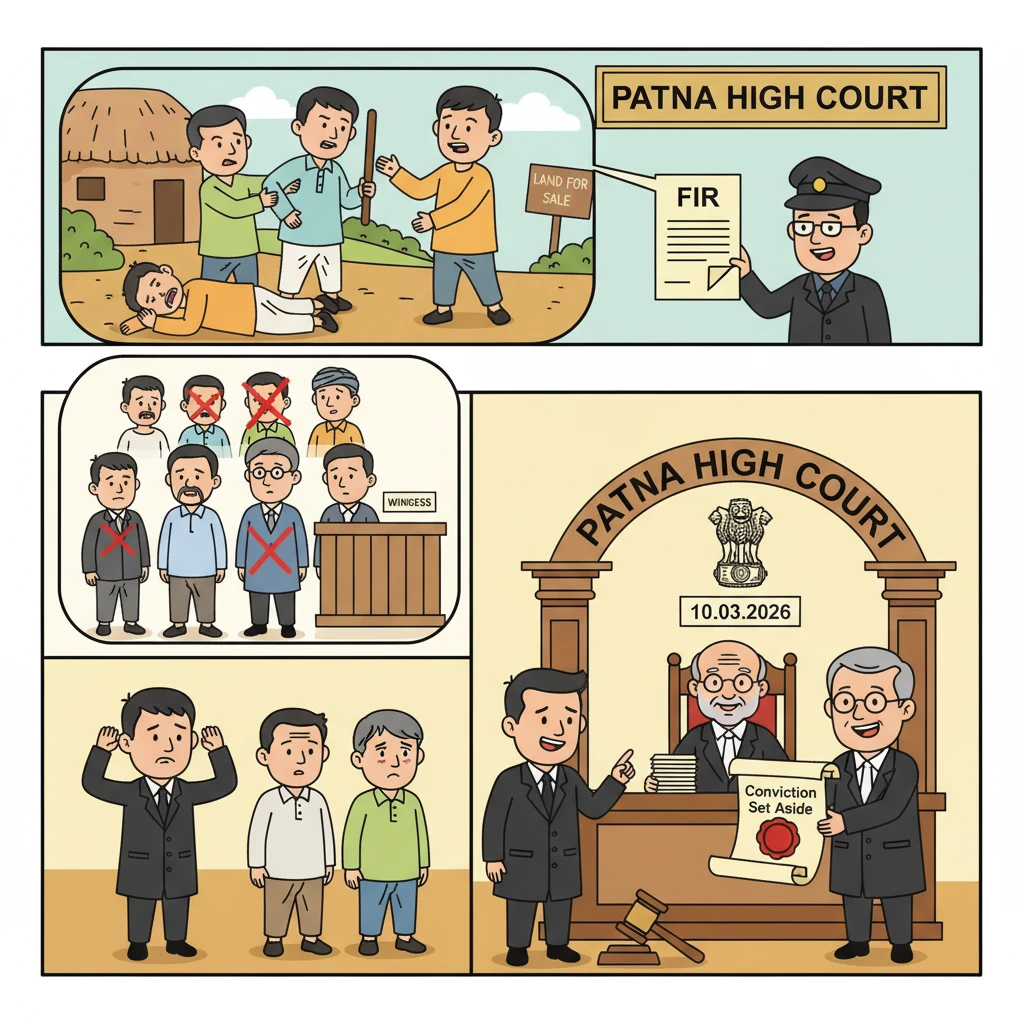
Case Background
This case arose from a dispute about land in village Selar Kala under Fulwariya Police Station in Gopalganj district. According to the written report lodged by the informant, he was present at his “Bathan” at about 4:00 p.m. when several accused persons allegedly came there.
The informant claimed that they abused him and questioned why he had sold the land. He alleged that the accused then assaulted him with lathis. One accused, Kanhaiya Sah, was said to have caught hold of him and urged the others to kill him. It was further alleged that two other accused, including Nanhaku Sah, hit him on the head, causing head injuries and a fracture in his left hand.
On this written report, Fulwariya P.S. Case No. 9 of 2002 was registered under Sections 341, 323, 325 and 307/34 of the Indian Penal Code. After investigation, the police filed charge sheet under the same sections. The Magistrate took cognizance and committed the matter to the Court of Session.
In Sessions Case No. 229/2005/155/2009, charges were framed against the accused under Sections 341, 323, 325 and 307 read with Section 34 IPC. The charges were read over and explained to them. They pleaded not guilty and claimed trial.
On 02.12.2010, the Additional District and Sessions Judge-cum-Fast Track Court-I, Gopalganj, delivered judgment. The trial court did not find the evidence sufficient for the graver charges under Sections 341, 325 and 307/34. However, it held the accused guilty under Section 323/34 IPC for voluntarily causing hurt in furtherance of common intention, and sentenced them to simple imprisonment for nine months.
Against this conviction and sentence, the three accused filed Criminal Appeal (SJ) No. 7 of 2011 before the Patna High Court under Section 374(2) of the Code of Criminal Procedure. Their provisional bail was confirmed when the appeal was admitted on 17.01.2011. Over the years, no one appeared for them despite several adjournments. Considering the age of the appeal and their conduct, the High Court appointed an Amicus Curiae, Mr. Rudra Pratap Singh, to assist the Court.
What the Court Examined and Decided
The Patna High Court carefully went through the trial court records, the evidence led during trial, and the arguments of both sides. The appeal was heard by Hon’ble Mr. Justice Purnendu Singh as an oral judgment.
On behalf of the appellants, the Amicus Curiae attacked the conviction on several grounds. He argued that the entire case arose out of a land dispute, suggesting possibility of false implication due to prior enmity. He pointed out that the prosecution witnesses were interested witnesses whose statements contained contradictions and inconsistencies.
He further submitted that two prosecution witnesses, namely Mansi Mian and Lalan Rai, did not support the prosecution story and were declared hostile. This, according to the defence, weakened the reliability of the case.
A major point raised was that the injuries allegedly suffered by the informant were not proved in the proper legal manner. The injury report had been proved only through a formal witness. The doctor who allegedly examined the informant and prepared the injury report did not appear in court. As a result, the defence was denied the chance to cross-examine the doctor regarding the nature, extent and cause of the injuries.
The Amicus Curiae also argued that there was no specific, clear evidence about what each accused actually did. The evidence was said to be vague and “omnibus” in nature. Even the trial court, he pointed out, had not accepted the more serious charges of wrongful restraint, grievous hurt and attempt to murder under Sections 341, 325 and 307/34 IPC, and had limited the conviction to Section 323/34. This, according to him, showed that the prosecution case was not fully proved and the appellants should receive the benefit of doubt.
On the other hand, the learned Additional Public Prosecutor for the State argued that the trial court had correctly appreciated the evidence and documents and rightly convicted the appellants under Section 323/34 IPC. He urged the High Court to uphold the conviction.
The High Court noted that seven prosecution witnesses were examined at trial: Ramdeo Sah (PW-1), Shyamdeo Sah (PW-2), Subedar Mian (PW-3), Mansi Mian (PW-4), Lalan Rai (PW-5), Umesh Rai (PW-6) and Ainul Huque (PW-7). Two documents were exhibited: the injury report (Exhibit-1) and the signature of the Officer-in-Charge, Fulwariya P.S. (Exhibit-2).
After the close of the prosecution evidence, the appellants were examined under Section 313 of the CrPC. The incriminating materials were put to them, and they denied all allegations, maintaining that they were innocent.
For clarity, the High Court reproduced Section 323 IPC, which provides punishment for voluntarily causing hurt. It allows up to one year’s imprisonment, or fine up to one thousand rupees, or both.
The central question before the High Court was whether, on the evidence actually led, the conviction under Section 323/34 IPC could legally stand.
The Court identified a key defect in the prosecution case: important witnesses were not examined. The informant, who lodged the written report and claimed to be present and assaulted, did not come to the witness box during the trial. The Court described the informant as the eye witness who had alleged that the incident occurred in his presence, yet he failed to examine himself.
In addition, the Investigating Officer and the Medical Officer were also not examined. The Court recognised that both are material witnesses. The Investigating Officer is essential to explain how the investigation was conducted and what steps were taken. The Medical Officer is required to prove the medical evidence, including the nature and cause of the injuries described in the injury report.
The Court observed that examining these witnesses is also crucial for the defence, as it gives the accused a fair chance to test the investigation and medical findings through cross-examination. However, it also noted that non-examination of such witnesses does not automatically render a prosecution case invalid in every case.
To explain this legal position, the High Court referred to the Supreme Court’s decision in Rajesh Patel v. State of Jharkhand, reported in (2013) 3 SCC 791, particularly paragraph 18. That paragraph was reproduced in the judgment. In that case, the Supreme Court discussed the effect of not examining the doctor and Investigating Officer, and emphasised that the impact has to be decided on the facts of each case.
Applying this principle, the Patna High Court considered whether the non-examination of the informant, Investigating Officer and Medical Officer had, in the present case, caused a serious defect in proof of the prosecution story. The Court found that it had.
The Court held that the trial court had failed to appreciate the significance of the informant not being examined, even though the entire case started from his written report and his claim of being assaulted. Without his testimony, the core of the prosecution version remained untested. There was no direct account from the person who said he was injured and who allegedly saw the assault.
Similarly, without the Investigating Officer and the Medical Officer, there was no clear explanation of the investigation steps or reliable medical confirmation of the injuries said to have been suffered, including the alleged fracture of the left hand. The injury report had only been marked through a formal witness, which is not enough when the findings themselves are disputed.
Considering these gaps, the High Court concluded that there was a “vital infirmity” in the trial court’s judgment. It held that the prosecution had “miserably failed” to establish the charges against the appellants during the trial.
The Court also observed that the appellants had been on bail throughout the trial and had not misused the privilege of bail. Ultimately, the High Court allowed the appeal. It set aside the judgment of conviction and sentence dated 02.12.2010 passed by the Additional District and Sessions Judge-cum-Fast Track Court-I, Gopalganj, in Sessions Case No. 229/2005/155/2009 arising out of Fulwariya P.S. Case No. 09 of 2002, G.R. No. 228/02.
As a result, the appellants were acquitted of all charges. Since they were already on bail, they were discharged from further liability on their bail bonds. Any fine they had deposited was ordered to be refunded.
The Court also acknowledged the assistance rendered by the Amicus Curiae. It directed the Patna High Court Legal Services Committee to pay a consolidated fee of Rs. 5,000/- to Mr. Rudra Pratap Singh for his professional services in this appeal. Finally, the Court ordered that the lower court records be sent back to the District Court along with a copy of the judgment.
Why This Judgment Matters
This decision of the Patna High Court is important for anyone facing criminal allegations based on village disputes, especially land disputes. It shows that even when an FIR is lodged and a charge sheet is filed, the prosecution must still present proper evidence in court.
The judgment underlines that the informant or victim, the Investigating Officer and the doctor who examined the injuries are often crucial witnesses. If they are not examined, and the remaining evidence is weak or incomplete, a conviction may not stand.
For ordinary people, the case illustrates that criminal courts require proof beyond reasonable doubt. Allegations alone, without proper witnesses and documents proven in the correct way, are not enough to send someone to jail. It also reassures accused persons that appellate courts can correct errors where the trial court has overlooked serious gaps in evidence.
The judgment further shows the active role of Legal Services and Amicus Curiae in ensuring that appeals are properly argued, even when the original lawyers or parties stop appearing. This is particularly relevant for poor or unrepresented accused persons.
Legal Issues and Answers
- Issue: Whether the conviction of the appellants under Section 323/34 IPC could be sustained when the informant, Investigating Officer and Medical Officer were not examined and when there were contradictions in the prosecution evidence.
Answer: No. The Patna High Court held that due to these vital omissions and infirmities, the prosecution failed to prove the charges beyond reasonable doubt and the appellants were entitled to acquittal. - Issue: Does mere non-examination of the Investigating Officer and Medical Officer automatically invalidate a prosecution case?
Answer: No. The Court, relying on Supreme Court precedent in Rajesh Patel v. State of Jharkhand, clarified that non-examination of such witnesses does not by itself vitiate the case; its effect must be tested on the specific facts. In this case, however, it contributed to serious failure of proof.
Cases Cited by the Court
- Rajesh Patel v. State of Jharkhand, (2013) 3 SCC 791
Case Details
Case Number: Criminal Appeal (SJ) No. 7 of 2011
Case Title: Nannku @ Nanku Sah & Ors. v. State of Bihar
Citation: 2026 (2) PLJR 622
Court: High Court of Judicature at Patna
Coram: Hon’ble Mr. Justice Purnendu Singh
Date of High Court Judgment: 10.03.2026 (Uploaded on 16.03.2026)
Trial Court Case: Sessions Case No. 229/2005/155/2009 arising out of Fulwariya P.S. Case No. 09 of 2002, G.R. No. 228/02
Trial Court Judgment: 02.12.2010, convicting the accused under Section 323/34 IPC and sentencing them to simple imprisonment for nine months
Appellants’ Counsel in High Court: Mr. Rudra Pratap Singh, Amicus Curiae
Counsel for the State: Mr. S. N. Prasad, Additional Public Prosecutor
Nature of Case: Criminal appeal under Section 374(2) CrPC against conviction and sentence for offences under Section 323/34 IPC
Outcome: Appeal allowed; conviction and sentence set aside; appellants acquitted; bail bonds discharged; refund of fine, if any, directed; fee of Rs. 5,000/- awarded to Amicus Curiae
Link to Full Judgment: https://patnahighcourt.gov.in/viewjudgment/MjQjNyMyMDExIzEjTg==-6tykHRCrGxc=
If you found this explanation helpful and wish to stay informed about
how legal developments may affect your rights in Bihar,
you may consider following Samvida Law Associates for more updates.







