

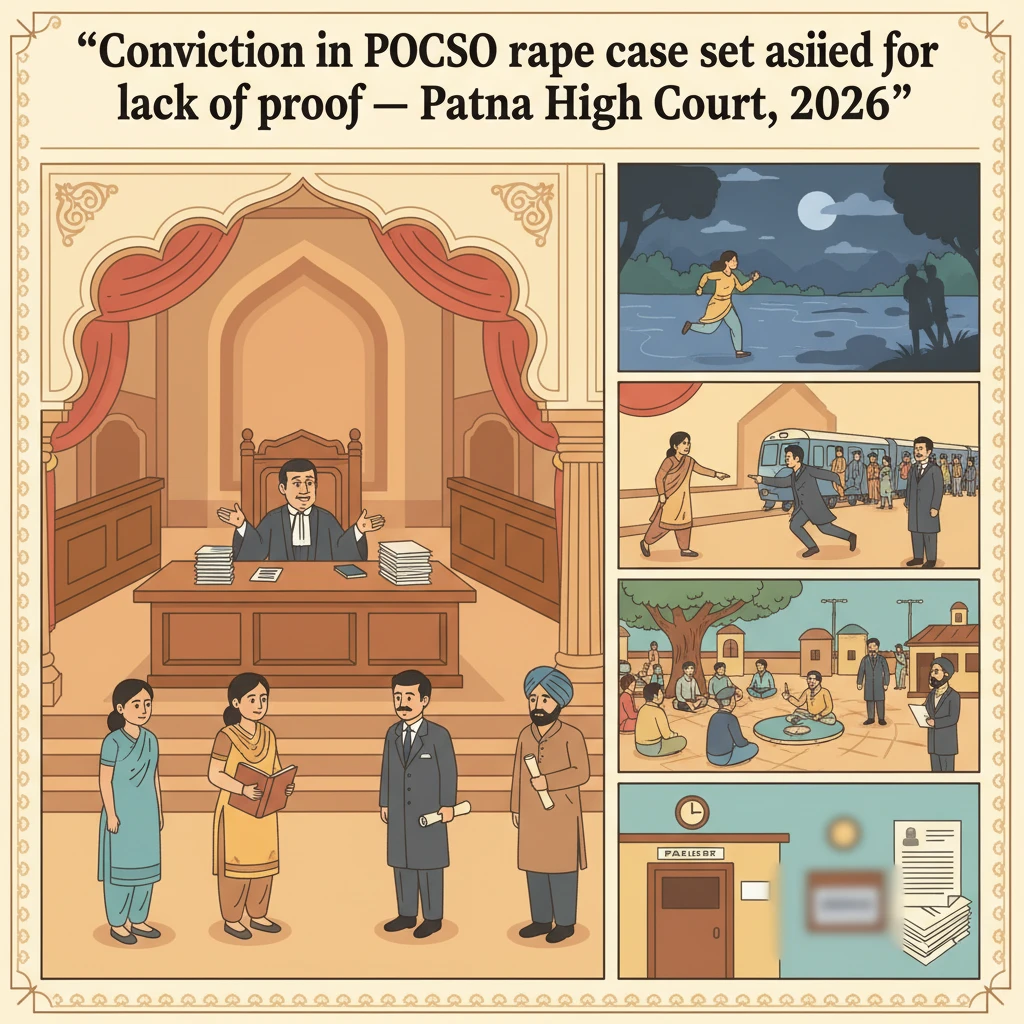
Case Background
This case arose from a criminal appeal filed in the Patna High Court against a conviction passed by the Additional Sessions Judge-I-cum-Special Judge, Supaul, in POCSO Trial No. 17 of 2014. The trial had come from Supaul Mahila Police Station Case No. 59 of 2014.
The appellant had been convicted under Sections 366, 376 and 323 of the Indian Penal Code. He was acquitted of the charges under Sections 366-A and 506 of the IPC and Section 4 of the Protection of Children from Sexual Offences Act. The trial court sentenced him to seven years’ rigorous imprisonment with fine under Sections 366 and 376 IPC (each), and one year’s rigorous imprisonment under Section 323 IPC, with all sentences to run concurrently.
The prosecution story began with a complaint case (No. 438C/2014) filed before the Chief Judicial Magistrate, Supaul, by the victim ‘N’, stated to be the minor daughter of ‘M’. On the basis of this complaint, which was sent to the police under Section 156(3) CrPC, Supaul Mahila P.S. Case No. 59 of 2014 was registered on 02.06.2014.
The police registered the FIR for offences under Sections 323, 376, 506, 366A IPC and Section 4 of the POCSO Act against the appellant and three unknown associates. After investigation, however, the police charge-sheeted only the appellant and only for Sections 366-A and 376 IPC. The trial court differed with the police and took cognizance also under Section 4 of the POCSO Act and other sections, and later framed charges under Sections 323, 366-A, 376, 506 IPC and Section 4 POCSO.
At the trial, the prosecution examined eight witnesses, including the victim, her father, three villagers, the investigating officer and two doctors. Two documents were exhibited: the endorsement on the complaint petition and the medical examination report of the victim. After the prosecution evidence was over, the trial court recorded the appellant’s statement under Section 313 CrPC. He denied the allegations and pleaded innocence, though he did not take any specific defence.
On 04.11.2015 the trial court convicted the appellant for offences under Sections 366, 376 and 323 IPC and sentenced him on 09.11.2015. Aggrieved, he approached the Patna High Court in Criminal Appeal (SJ) No. 2 of 2016.
What the Court Examined and Decided
The appeal was heard by Hon’ble Mr. Justice Shailendra Singh. The Court examined the trial court judgment, the evidence of all witnesses, and the statement of the appellant. Arguments were advanced by counsel for the appellant and the Additional Public Prosecutor representing the State.
The defence primarily attacked three aspects of the prosecution case: delay in filing the complaint, doubt about the place and manner of recovery of the victim, and serious defects in investigation, especially regarding the alleged sexual assault.
First, on delay, it was argued that there was an unexplained delay of 26 days between the alleged incident and the filing of the complaint, which created serious doubt about the truth of the allegations. The complaint was filed on 29.04.2014, whereas the occurrence was said to have taken place on 03.04.2014 and the victim was allegedly recovered the very next day from a railway station.
The State’s counsel replied that the delay had been explained by the victim. According to the victim’s complaint, after she returned home, her father convened panchayat meetings in the village. When no settlement came out of the panchayat and the accused allegedly did not follow the panchayat’s directions, she and her father then went to the police station. As per her version, the police did not act promptly. Only then did she file the complaint in court.
The High Court examined the FIR, the complaint and the oral evidence. It noted that the delay between 04.04.2014 (when the parents came to know of the incident and she was said to have been rescued) and 29.04.2014 (when the complaint was actually filed) required a satisfactory explanation.
The Court held that the explanation based on panchayat meetings and police inaction was not convincing. No sarpanch, panch or any other person said to have attended the panchayat was produced as a witness. Besides, there was a contradiction between the victim and her father. The victim had said that the accused attended the panchayat meetings but did not agree to the directions. The father (P.W.2) said in his examination-in-chief that the accused did not appear in the panchayat at all.
The Investigating Officer (P.W.6) had also not attempted to verify whether any panchayat was actually held. Because of these gaps, the Court held that there was no convincing material to accept the plea of panchayat meetings as the reason for the long delay. The Court said that while delay in lodging FIR is not by itself a ground to discard a prosecution case, it must be plausibly and satisfactorily explained. Otherwise, it raises serious doubt about the allegations.
For this principle, the Court relied on the Supreme Court’s decision in Sekaran v. State of Tamil Nadu, (2024) 2 SCC 176. It reproduced paragraphs 14 and 15 of that judgment, where the Supreme Court explained that delay must be viewed in the context of surrounding circumstances; unexplained or suspicious delay can be fatal if it appears to be an afterthought to falsely implicate someone.
Second, the High Court considered the defence argument that the place and timing of the victim’s recovery were doubtful. According to the complaint, she was rescued by co-villagers from Saharsa railway station when she raised an alarm after seeing them.
The Court noted that in her complaint the victim did not mention the exact time of this rescue. In evidence, she said her villagers reached the station in the morning while searching for her and that when she saw them she raised an alarm and the accused and his associates ran away.
However, P.W.1, Hare Ram Mahto, one of the villagers, deposed that they reached Saharsa railway station at about 11–11:30 p.m. in the night during the search and saw the victim, who raised an alarm from a train. P.W.4, Satya Narayan Mahto, another villager, admitted in cross-examination that after finding the victim they did not give any information to Saharsa Sadar Police Station.
The Court held that such contradiction about whether the recovery occurred at night or in the morning, coupled with the fact that no immediate information was given to the local police, created serious doubt about the prosecution story regarding recovery from Saharsa railway station.
Third, the Court examined the quality of investigation, particularly regarding the second part of the incident—the alleged confinement and rape in the house of the appellant’s maternal sister. The prosecution case had two distinct parts: first, kidnapping near the school and transport by tempo and train; second, confinement and rape in a room at the cousin’s/maternal sister’s house, followed by taking the victim to Saharsa railway station.
The Investigating Officer (P.W.6) admitted in cross-examination that she had not verified the places of occurrence except one place connected with the alleged kidnapping. She did not inspect or identify the house where the sexual assault was said to have occurred. She further stated that all witnesses were examined on the same date and she could not say the dates of their statements.
The Investigating Officer also stated that during investigation some witnesses told her that the incident was the result of a love affair. She did not attempt to seize the tempo allegedly used to transport the victim, nor did she try to find out the identity of the three unknown associates who allegedly helped in kidnapping and confinement.
The High Court held that these were not minor irregularities but serious lapses going to the root of the case. To explain the legal effect of such defective investigation, the Court relied on the Supreme Court’s judgment in Sunil Kundu and Another v. State of Jharkhand, (2013) 4 SCC 422. It quoted paragraph 29 of that decision, where the Supreme Court had said that although mere lapses in investigation cannot automatically lead to acquittal, they can be ignored only if the remaining evidence is of “sterling quality” and the lapses do not undermine the substratum of the prosecution case. Where lapses are grave and the evidence is not fully reliable, the accused is entitled to benefit of doubt.
Applying those principles, the Patna High Court observed that in this case the investigation into the core allegation of sexual assault was perfunctory. The investigating officer did not verify crucial facts or collect corroborative material. When this was seen together with the unexplained delay and contradictions regarding the place and timing of recovery, the Court found the prosecution case to be highly suspicious.
The Court concluded that the trial court had failed to appreciate the evidence in the right perspective. The prosecution had not proved the charges beyond reasonable doubt. In such a situation, criminal law requires that the accused receive the benefit of doubt.
Accordingly, the High Court set aside the judgment of conviction dated 04.11.2015 and the order of sentence dated 09.11.2015 passed in POCSO Trial No. 17 of 2014. The criminal appeal was allowed. As the appellant was already on bail, the Court ordered that his bail bonds stand cancelled and he and his sureties be discharged from their liabilities. The records of the trial court were directed to be sent back along with a copy of the judgment for compliance.
Why This Judgment Matters
This decision of the Patna High Court is important for both complainants and accused persons in serious sexual offence cases.
For victims and their families, it shows that courts will closely examine delays in reporting and contradictions in evidence. If there is a delay, it must be clearly and reliably explained, preferably with supporting witnesses or documents. Mere mention of panchayat meetings or police inaction will not automatically satisfy the court unless properly proved.
For investigating agencies, the judgment is a warning that careless or incomplete investigation can destroy a case. Failure to inspect the place of sexual assault, trace alleged associates, seize vehicles used in the crime, or verify key facts may lead the court to doubt the entire story.
For accused persons, the ruling reinforces the principle that suspicion, however strong, cannot replace proof. Even in sensitive cases under the IPC and POCSO Act, the prosecution must meet the standard of “beyond reasonable doubt.” Where there are serious gaps in evidence and investigation, courts will not hesitate to extend the benefit of doubt.
Overall, the judgment strengthens the message that proper and thorough investigation, prompt reporting and consistent testimony are essential to secure and sustain convictions in sexual offence cases before the Patna High Court and subordinate courts.
Legal Issues and Answers
Issue: Whether the unexplained delay of about 26 days in filing the complaint, along with contradictions about panchayat meetings, affected the credibility of the prosecution case.
Answer: Yes. The Court held that the delay was not satisfactorily explained, as no panchayat members were examined and there were contradictions between the victim and her father.
Issue: Whether the prosecution proved beyond reasonable doubt the alleged kidnapping, confinement and rape of the victim by the appellant.
Answer: No. Serious doubts arose due to inconsistent evidence regarding the place and timing of recovery and serious lapses in investigation concerning the alleged sexual assault.
Issue: Whether defects in investigation could be ignored in this case and the conviction still sustained.
Answer: No. Relying on Supreme Court precedents, the Court held that the lapses were very serious and went to the root of the matter, and the remaining evidence was not of such sterling quality as to overlook those defects. The appellant was therefore entitled to benefit of doubt.
Cases Cited by the Court
- Sekaran v. State of Tamil Nadu, (2024) 2 SCC 176
- Sunil Kundu and Another v. State of Jharkhand and other analogous cases, (2013) 4 SCC 422
Case Details
Case Number: Criminal Appeal (SJ) No. 2 of 2016; arising out of Supaul Mahila P.S. Case No. 59 of 2014; POCSO Trial No. 17 of 2014
Case Title: Mukesh Sharma @ Mukesh Kr. Sharma v. State of Bihar
Citation: 2026 (2) PLJR 288
Court: High Court of Judicature at Patna
Coram: Hon’ble Mr. Justice Shailendra Singh
Date of Judgment: 15.01.2026 (Uploading Date: 21.01.2026)
Advocates: Mr. Shashi Bhushan Prasad, Advocate for the appellant; Ms. Anita Kumari Singh, APP for the State
Nature of Case: Criminal appeal (single judge) challenging conviction and sentence under the IPC and POCSO Act
Link to Judgment: View full judgment on Patna High Court website
If you found this explanation helpful and wish to stay informed about
how legal developments may affect your rights in Bihar,
you may consider following Samvida Law Associates for more updates.







