

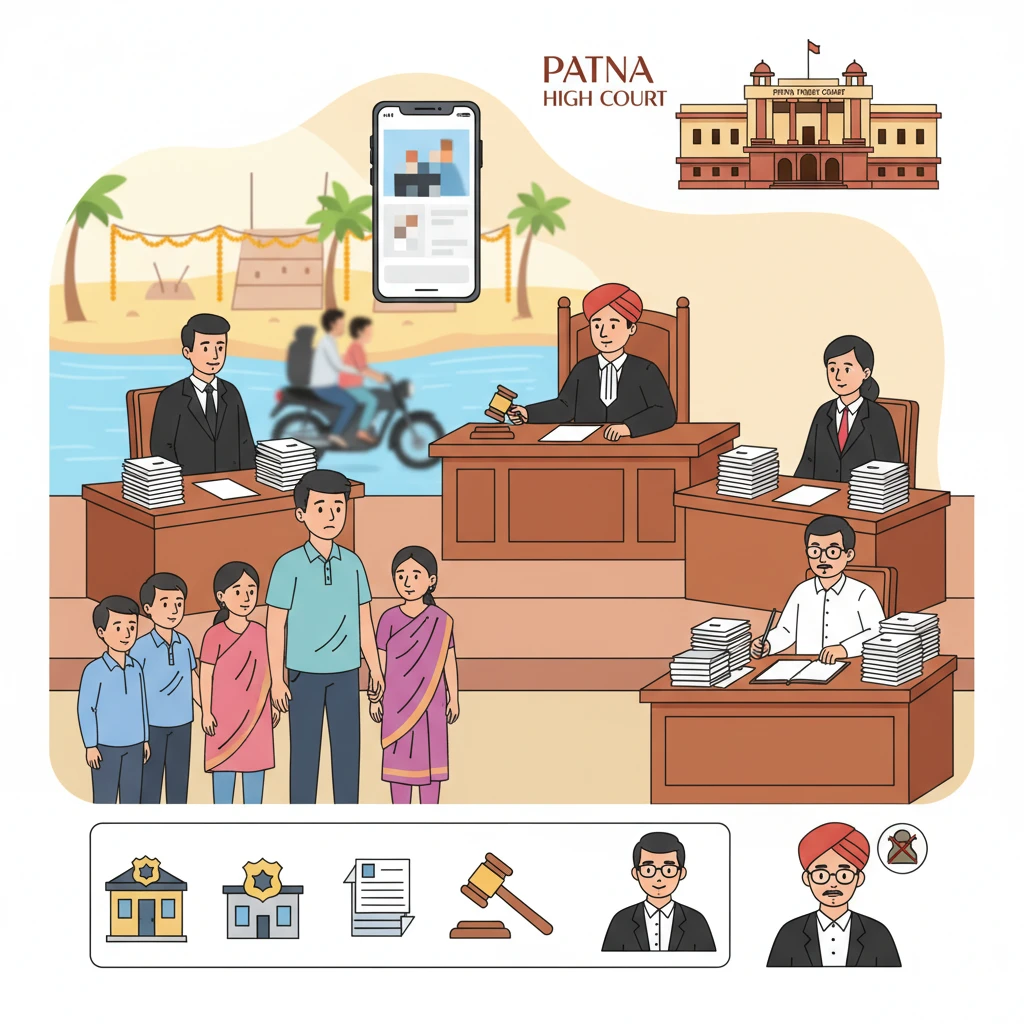
Case Background
The criminal case started with a written complaint by the father of a girl in East Champaran, Bihar. He alleged that on 03.11.2019, during the Chhath festival, his minor daughter, said to be about 12 years old, was going to the Chhath Ghat at around 4:00 a.m.
According to him, the appellant and another accused dragged his daughter, seated her in the middle of their motorcycle and took her towards Ambika Nagar. Some villagers allegedly saw this and informed him. He and his family tried to follow the accused but could not catch them.
He said that when he went to the house of the accused and met their father, he was assured that the girl would be returned. He admitted that he did not make any immediate report to the police. He claimed that the girl was left at a place called “Chati Mai” after 8–10 days.
The informant further alleged that during those days the appellant repeatedly raped his daughter, abused him by taking his caste name, and threatened to upload photos and videos made with his daughter. Later, when his son opened Facebook, the family allegedly found objectionable photos and videos of the girl.
Only after this, the informant lodged the FIR. Turkauliya (Banjariya) P.S. Case No. 850 of 2019 was registered under Sections 363, 366A, 376, 34 IPC, read with Sections 4/8 of the POCSO Act and Section 3(i)(r)(w) of the SC/ST (Prevention of Atrocities) Act.
Police investigated the case and submitted charge-sheet No. 21/2020 dated 27.02.2020. Cognizance was taken on 18.03.2020 under Sections 363 and 365 IPC read with Section 8 POCSO. On 09.09.2021, charges were framed under Sections 363, 365, 370, 376(3) IPC, Sections 4, 10, 14 POCSO, Section 3(i)(w) SC/ST (POA) Act and Section 67B of the IT Act.
The appellant pleaded not guilty and faced trial before the 6th Additional Sessions Judge-cum-Special Judge, POCSO Act, East Champaran, Motihari in P.Tr. No. 14/2020.
By judgment dated 28.01.2023 and order dated 09.02.2023, the trial court convicted the appellant under Section 4(1) POCSO (10 years RI and fine Rs. 20,000), Section 10 POCSO (5 years SI and fine Rs. 10,000), and Section 363 IPC (7 years imprisonment and fine Rs. 10,000). All sentences were to run concurrently.
Aggrieved, the appellant filed Criminal Appeal (SJ) No. 1133 of 2024 before the Patna High Court. The appeal was heard by Hon’ble Mr. Justice Chandra Shekhar Jha, who delivered an oral judgment on 11.09.2024.
What the Court Examined and Decided
The High Court closely re-examined the entire evidence, including the statements of the victim, her parents, the medical officer and the investigating officers. Two main questions were identified based on the arguments of the appellant’s counsel.
First, whether the prosecution had proved that the victim was a “child” under Section 2(1)(d) of the POCSO Act on the date of the alleged offence.
Second, whether the sole testimony of the victim was of such “sterling” quality that conviction for rape or penetrative sexual assault could safely be based only on her version without further corroboration.
Age of the Victim and Applicability of POCSO
The defence pointed out that the only document about age was the medical age determination report (Exhibit 2) which assessed the victim’s age as between 15–16 years on the basis of an X-ray. No school certificate, matriculation certificate or municipal birth certificate was produced.
The appellant relied on Section 94(2) of the Juvenile Justice (Care and Protection of Children) Act, 2015 and the Supreme Court decision in Jarnail Singh v. State of Haryana, (2013) 7 SCC 263, to argue that documentary proof like school or municipal records have priority, and medical (radiological) opinion can be used only when such documents are not available.
The Court reproduced Section 94 JJ Act and the relevant portions of Jarnail Singh, highlighting the step-wise order of preference: matriculation certificate, school first attended, municipal/panchayat birth certificate, and only in their absence medical opinion. Jarnail Singh also clarified that this method should be used not only for juveniles in conflict with law but also for child victims.
In this case, the FIR mentioned the victim’s age as 12 years, but in her Section 164 CrPC statement her age was mentioned as 16 years. No educational or municipal/birth records were produced. The only basis was the medical board’s report (Exhibit 2) placing her between 15–16 years.
The Court then referred to the Supreme Court decision in Rajak Mohammad v. State of Himachal Pradesh, (2018) 9 SCC 248, where it was held that radiological age assessment is not exact and a sufficient margin either way must be allowed.
Applying this to the facts, the High Court noted that if a margin of plus/minus two years is allowed on the 15–16 years assessment, the victim could be above 18 on the date of occurrence. Further, the underlying X-ray plate and allied materials were not properly exhibited in evidence.
Therefore, the Court held that the prosecution had failed to prove that the victim was a “child” as defined under Section 2(1)(d) POCSO. As a result, the legal presumptions under Sections 29 and 30 of the POCSO Act could not operate in this case. The conviction under the POCSO provisions (Sections 4 and 10) was found to be unsustainable.
Reliability of the Victim’s Testimony
On the second question, the defence argued that while a conviction can rest on the sole testimony of a victim, that testimony must be wholly reliable, trustworthy, and of “sterling” quality.
The Court referred to the Supreme Court’s explanation of a “sterling witness” in Rai Sandeep @ Deepu v. State (NCT of Delhi), (2012) 8 SCC 21, where such a witness is described as one whose version is consistent from beginning to end, natural, withstands cross-examination, and matches other evidence including medical and scientific material.
The Court compared the victim’s Section 164 CrPC statement (Exhibit 1) with her later deposition as PW-1 during trial.
In her Section 164 statement, the victim said that at around 5:00 a.m. on Chhath Puja, while she was cooking at home, the appellant entered, tied her mouth with an “orhani” to make her senseless and kidnapped her. She stated that when she regained consciousness she was in a jungle, where the appellant took several objectionable photographs and videos at knife-point and later made them viral. Importantly, she categorically said that “except that appellant did nothing with her”, meaning no allegation of rape was made at that time. She also stated that she went with the appellant to Sitamarhi and stayed with her aunty.
However, in her evidence as PW-1 before the trial court, she gave a different story. She deposed that on the day of Chhath Puja, while she was sleeping in her room in the early morning, the appellant entered her room and committed rape upon her. She further stated that she was taken to a far place and rape was again committed there. She stated that she was kidnapped by two persons, including the appellant, kept in a jungle, and that he repeatedly raped her and uploaded photos and videos on Facebook.
She also stated during examination that she was recovered by the police and brought home. In cross-examination she again changed details, stating she was working in her house at about 3:00 a.m. when the appellant entered. She admitted that she did not previously know the appellant and denied any love affair.
Thus, the Court noticed major discrepancies: different time of occurrence (3:00 a.m., 4:00 a.m., 5:00 a.m.), different description of her activity (sleeping vs cooking vs working), and, most importantly, she did not allege rape in her earlier Section 164 statement but made serious allegations of repeated rape only during trial.
These changes, improvements and contradictions led the Court to hold that her testimony could not be accepted as that of a “sterling witness”. Therefore, further corroboration from medical or other evidence was necessary before upholding a conviction for rape or penetrative sexual assault.
Medical and Other Corroborative Evidence
The only medical witness, PW-5 Dr. Manoj Kumar, Deputy Superintendent, Sadar Hospital, Motihari, was examined. He had been part of the medical board which only determined the age of the girl as 15–16 years based on an X-ray report. His evidence was silent on any findings of sexual or physical assault. The injury report or detailed medical examination regarding rape was not produced.
The Court specifically noted that despite the victim being examined medically, neither the injury report nor any description of genital or other injuries was brought on record.
The father of the victim (PW-2) also did not provide consistent support. In the FIR and his examination-in-chief he said that the kidnapping occurred when the girl was going to Chhath Ghat. During his deposition, he said that the appellant kidnapped her from the house after assaulting her, while she was working at home. He also gave different versions regarding where the girl was dropped: the written complaint (Exhibit 3) mentioned “Chatti Mai”, but in his oral evidence he said “Motihari Station”.
On the other hand, the victim (PW-1) stated that she was actually recovered by the police, not dropped by the appellant at either place. This inconsistency further weakened the prosecution case.
Another important factor was delay in lodging the FIR. The victim was allegedly recovered after about 10 days, yet the FIR was lodged about 15 days after recovery and around 25 days after the alleged occurrence. PW-2 explained this delay by saying he wanted to save his time and avoid police atrocities, and that he finally went to the police only after receiving objectionable photographs through a neighbour. The Court found this explanation unconvincing and considered the long delay as giving sufficient time for afterthought.
The Court also noted that the appellant, in his statement under Section 313 CrPC, said he was falsely implicated because of a quarrel between his father and the victim’s father 2–3 days prior to the alleged incident. While this by itself did not prove innocence, it added to the overall doubt when combined with other inconsistencies and lack of strong evidence.
Final Decision
Considering the failure to prove the victim’s minority, the doubtful and inconsistent testimony of the victim regarding rape and kidnapping, absence of medical proof of sexual assault, contradictions in the parents’ versions, and unexplained delay in lodging the FIR, the Patna High Court held that the conviction recorded by the trial court could not be sustained.
The Court allowed the appeal, quashed and set aside the judgment of conviction dated 28.01.2023 and the order of sentence dated 09.02.2023 passed in P.Tr. No. 14/2020 arising out of Turkauliya (Banjariya) P.S. Case No. 850 of 2019.
The appellant was acquitted of all charges. Since he was in custody only in connection with this case, the Court directed that he be released forthwith if not required in any other case, and that any fine deposited be returned to him. The Trial Court Records were ordered to be sent back with a copy of the High Court judgment.
Why This Judgment Matters
This judgment of the Patna High Court is significant for both accused persons and complainants in sexual offence and POCSO cases.
First, it underlines that for POCSO to apply, the prosecution must firmly prove that the victim was below 18 years, using the method laid down in the Juvenile Justice Act and the Supreme Court guidelines. Mere medical estimation of age by X-ray, without proper supporting documents and without considering the margin of error, is not enough.
Second, it shows that courts will not automatically accept every later version of a victim if it departs sharply from her earlier statement. When there are major changes, especially about whether rape occurred at all, courts will look for strong corroboration from medical or other independent evidence.
Third, the decision reminds complainants and investigating agencies about the importance of prompt FIRs, consistent statements, and complete medical records. Delay and contradictions can create serious doubt and may result in acquittal.
For ordinary citizens, this case illustrates how higher courts examine evidence step by step. It also shows that both the rights of victims and the rights of the accused are protected by strict rules of proof and fairness.
Legal Issues and Answers
- Issue: Did the prosecution prove that the victim was a “child” under Section 2(1)(d) of the POCSO Act on the date of the alleged incident?
Answer: No. Only a radiological age estimate of 15–16 years was produced. With no school or birth records and allowing the legally recognised margin of error, the Court held that the victim could be a major and that POCSO was not proved to apply. - Issue: Was the victim’s testimony of such “sterling” quality that a conviction for rape/penetrative sexual assault could rest solely on her evidence?
Answer: No. Her Section 164 statement did not allege rape, while her later deposition alleged repeated rape, and there were major inconsistencies about time, place and manner. Without medical or other corroboration, the Court found it unsafe to sustain the conviction. - Issue: Could the conviction for kidnapping and allied offences stand despite these evidentiary issues and delay in FIR?
Answer: No. Contradictions about how and where the kidnapping occurred and how the victim was recovered, coupled with unexplained delay of about 25 days in lodging the FIR, created serious doubt. The appellant was therefore acquitted of all charges.
Cases Cited by the Court
- Jarnail Singh v. State of Haryana, (2013) 7 SCC 263 – applied for method of age determination.
- Krishna Kumar Malik v. State of Haryana, (2011) 7 SCC 130 – cited regarding reliance on victim’s testimony in sexual offences.
- Rai Sandeep @ Deepu v. State (NCT of Delhi), (2012) 8 SCC 21 – relied upon for concept of “sterling witness”.
- Rajak Mohammad v. State of Himachal Pradesh, (2018) 9 SCC 248 – relied upon for margin of error in radiological age determination.
Case Details
Case Number: Criminal Appeal (SJ) No. 1133 of 2024; arising out of Turkauliya (Banjariya) P.S. Case No. 850 of 2019; P.Tr. No. 14/2020.
Case Title: Pradeep Srivastava v. The State of Bihar.
Coram: Hon’ble Mr. Justice Chandra Shekhar Jha.
Citation: 2024(4) PLJR 426.
Advocates: Mr. Sudhir Kumar Singh, Advocate and Mr. Priyesh Kumar, Advocate for the appellant; Mrs. Anita Kumari Singh, Additional Public Prosecutor for the State.
Nature of the Case: Criminal appeal (single judge) against conviction and sentence under POCSO Act and Indian Penal Code by Special POCSO Court.
Link to the Judgment: Click here to read the full Patna High Court judgment.
If you found this explanation helpful and wish to stay informed about how legal developments may affect your rights in Bihar, you may consider following Samvida Law Associates for more updates.







