
Case Background
The case started with a written application submitted on 22.07.2021 at Aurangabad Mahila Police Station by the stepmother of a girl referred to as ‘X’.
In this written complaint (marked as Exhibit 2), the informant stated that her stepdaughter ‘X’, described as about ten years old, was living in village Bantara with her maternal uncle, the appellant, who was then about 55 years old.
The informant alleged that this maternal uncle was sexually exploiting the girl for several months. According to her, the child did not disclose the acts earlier because she was afraid of him. She also alleged that when she came to know about this from her daughter, the appellant began to threaten both of them with death.
Based on this written complaint, Aurangabad (Mahila) P.S. Case No. 25 of 2021 was registered on 22.07.2021 under Sections 376AB and 506 of the Indian Penal Code and Section 4 of the POCSO Act.
After investigation, the police filed Charge Sheet No. 30 of 2021 under Sections 376AB/506 IPC and Section 4 of the POCSO Act against the appellant. The Special POCSO Judge, Aurangabad, took cognizance on 29.09.2021.
On 17.11.2021, charges were framed against the appellant under Sections 376 and 506 IPC and Section 4 of the POCSO Act. He pleaded not guilty and claimed trial.
During trial in G.R. POCSO and CIS No. 45 of 2021, the prosecution examined six witnesses: the victim (PW-1), her mother/stepmother (PW-2), two maternal uncles (PW-3 and PW-4), the doctor (PW-5), and the Investigating Officer (PW-6). Several documents, including the written complaint, FIR, medical report and identity documents, were exhibited.
The appellant’s statement under Section 313 CrPC was then recorded. He claimed innocence and alleged false implication due to a land dispute and a money dispute of Rs. 30,000/-. The defence examined two witnesses (DW-1 and DW-2), including the appellant’s son and a co-villager, but led no documentary evidence through them.
The trial court, after evaluating the prosecution evidence, held that the appellant had committed rape on the victim and convicted him under Section 376AB IPC and Section 4 of the POCSO Act. He was sentenced to rigorous imprisonment for 20 years and fine of Rs. 10,000 under Section 4 of the POCSO Act, with default sentence of 12 months’ simple imprisonment.
Against this conviction and sentence, the appellant filed the present Criminal Appeal (DB) No. 23 of 2023 before the Patna High Court. Notice was served to the informant (Respondent No. 2), but she did not appear through any advocate.
What the Court Examined and Decided
The Division Bench of the Patna High Court (Hon’ble Mr. Justice Rajeev Ranjan Prasad and Hon’ble Mr. Justice Sourendra Pandey) heard counsel for the appellant and the Additional Public Prosecutor for the State.
The core prosecution story rested on Exhibit 2, the written complaint drafted by PW-3 (husband of the elder sister of PW-2). In that document, the victim’s age was stated to be ten years, and the allegation was of repeated sexual exploitation by the maternal uncle, followed by threats.
The Court first looked at the recording of the victim’s statement under Section 164 CrPC. The statement itself was on record, but only the victim’s signature was formally exhibited (Exhibit 1). Importantly, the Magistrate who recorded the statement was not examined at trial.
The Magistrate had mentioned that he asked “some basic questions” to test the child’s mental ability and voluntariness, but he did not record what those questions were. The High Court noted this gap.
In her Section 164 CrPC statement, the victim mentioned new details not present in the original complaint. For the first time, she described the “gaushala” (cowshed) as the place where the accused used to take her and do “wrong act”, and sometimes to an orchard. She also alleged that after this, he would give her Rs. 10–20, and that he once took her to Gaya and kept her in a house there for the whole night.
When it came to proving age, the Court found serious shortcomings. The victim (PW-1) said she studied in Class V but did not know her date of birth and did not remember what age was recorded at the time of school admission. The Investigating Officer (PW-6) had not collected any school certificate or other proof of age. She also did not record the statements of the victim’s siblings, who, according to PW-2, lived in the same house.
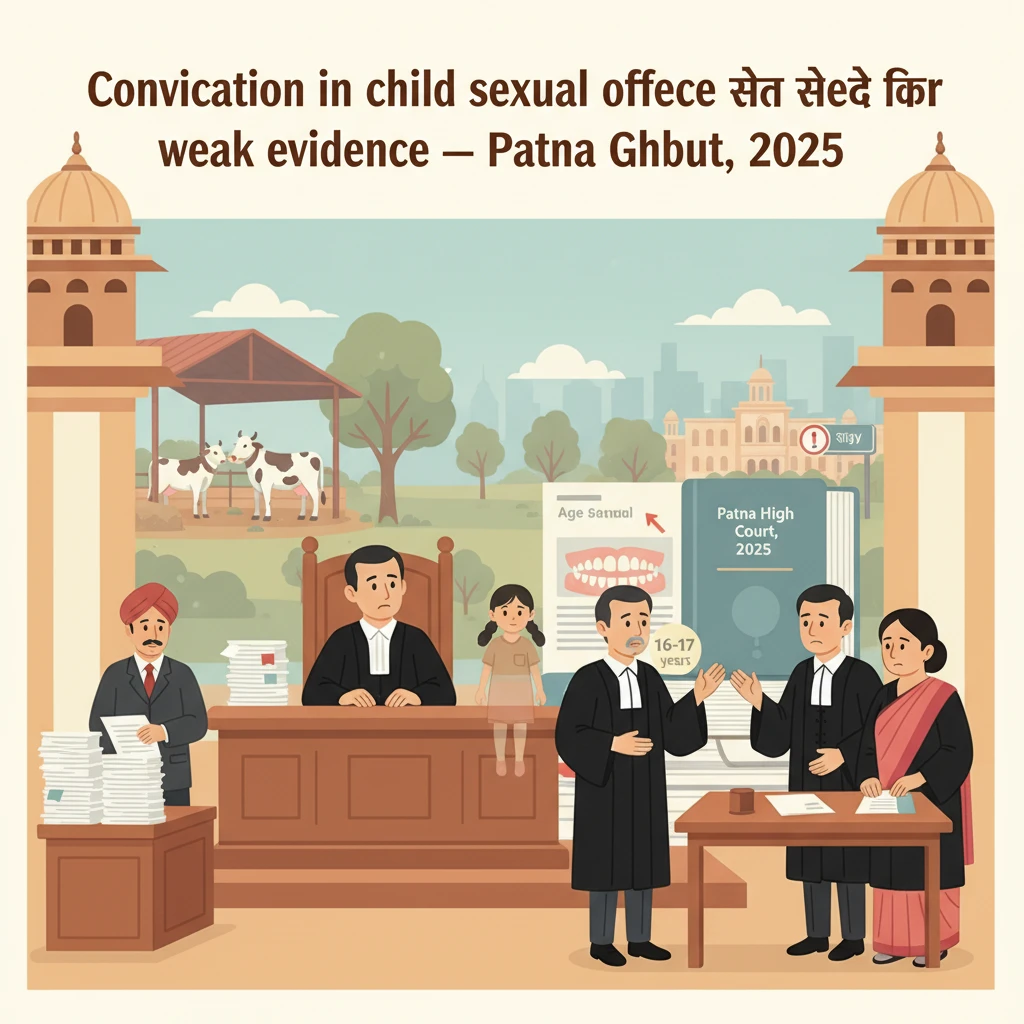
Thus, the only material on age was the medical examination report (Exhibits 3 and 3/1) proved by PW-5, Dr. Anshu Priya, a member of a Medical Board at Sadar Hospital, Aurangabad. The Board, after general and local examination, and dental examination (28 teeth, 14/14), assessed the victim’s age as approximately 16–17 years.
PW-5 also noted that the victim was average built, afraid at the time of examination and not answering all questions properly. There were no injuries on back, lips, hands or thighs. Labia majora and minora were intact, no urethral or anal injury was found, but the hymen was ruptured and the introitus admitted two loose fingers.
In cross-examination, PW-5 clearly stated that the hymen was not recently ruptured, there was no sign of recent sexual intercourse, and that hymen rupture could occur due to various injuries. She added that a 28-teeth dentition could also be seen in a person aged about 19–20 years.
The High Court observed that the trial court had not determined the age of the victim at all. Relying on the judgments in Court on its own Motion v. State of NCT of Delhi (Crl. Ref. 2/2024, 2024 SCC OnLine Delhi 4484) and Rajak Mohammad v. State of H.P. (2018) 9 SCC 248, the defence argued that medical age assessments allow a margin of plus/minus two years. Applying that, the upper limit of the victim’s age could go up to around 19 years or more, consistent with PW-5’s own admission about 28 teeth.
The High Court agreed that, in absence of documentary age proof and with this medical evidence, the prosecution failed to establish that the victim was a child so as to attract the POCSO Act. On that basis alone, the Court held that the basic foundational fact for invoking POCSO was not proved, and that the victim, on the record, appeared to be a major.
The Court then turned to inconsistencies regarding the place of occurrence. Exhibit 2 did not mention any specific place. In her Section 164 statement, the girl spoke of the gaushala and orchard. However, in her examination-in-chief at trial, she described an incident where she was trying to pluck mangoes in the orchard and an act was committed there but did not speak of gaushala or the appellant’s house.
She further stated that the appellant had taken her to Gaya once but, apart from that, no other incident took place. In cross-examination, she claimed the appellant committed wrong acts with her every day in the orchard in the afternoon and nowhere else.
PW-2, the stepmother, on the other hand, deposed that the appellant was doing wrong acts in the gaushala. When the Investigating Officer (PW-6) verified the place of occurrence, she described the place as the appellant’s house. In paragraph 5 of her deposition, PW-6 said the place of occurrence was the house of the appellant.
The High Court highlighted these shifting versions — gaushala, orchard, house — and held that the prosecution evidence about the place of occurrence was vacillating and inconsistent.
Another serious concern related to the recording and appreciation of the victim’s evidence as a child witness. At trial, her age was recorded as ten years, yet the trial court did not conduct or record any test of her competence, as is required when examining a child witness.
The High Court referred in detail to the Supreme Court decision in P. Ramesh v. State represented by Inspector of Police (2019) 20 SCC 593, which explains that a judge must test a child’s capacity and understanding through appropriate questions before treating the child as a competent witness. No such exercise was reflected in the record.
The Court also noted, from PW-2’s evidence, that the victim was described as “mentally weak”. The trial court itself had mentioned in paragraph 31 of the victim’s deposition that she used to laugh like a child and sometimes did abnormal acts in court. Despite this, there was no medical assessment of her mental condition before recording her testimony. The High Court considered this an additional reason for caution in relying solely on her uncorroborated and inconsistent version.
An important aspect was the existence of an earlier application to Devkund Police Station. PW-2 admitted that she had first gone with her brother PW-4 to Devkund P.S., where an application was written and signed by both. A lady constable then took them to Mahila Police Station. PW-2 further said that at Mahila Police Station, a “second application” was written by her brother-in-law PW-3 (which became Exhibit 2). She stated she could produce the first application but did not do so.
The defence suggested in cross-examination that the first application did not mention the appellant’s name or any allegation of rape, and that this was why it had been withheld. The High Court found that this suppression of the first version was admitted in substance and held that withholding the first application was fatal to the prosecution, casting serious doubt on the authenticity and genuineness of the FIR as it finally stood.
The defence also led evidence through DW-1 (Nasir Khan), the eldest son of the appellant, who supported the case of a land dispute and a loan of Rs. 30,000 allegedly given by the appellant’s younger son to the informant’s son for studies. DW-1 deposed that when the money was demanded back, and in view of the informant’s demand for a share in ancestral property, the appellant was falsely implicated. DW-2, a former Mukhiya, corroborated this background. The High Court noted that the trial court had “missed out” on properly considering these defence witnesses.
Bringing all these elements together, the Patna High Court concluded that the prosecution had failed to prove the foundational facts necessary to invoke the presumption under Section 29 of the POCSO Act. The inconsistencies, the failure to prove age, the doubtful FIR genesis, and the ignored defence evidence meant that guilt was not proved beyond reasonable doubt.
The Court emphasised that even under POCSO, the presumption of innocence remains, and the benefit of doubt must go to the accused where the prosecution case is shaky.
Accordingly, the High Court set aside the conviction and sentence, acquitted the appellant by giving him the benefit of doubt, and directed that he be released from custody forthwith, if not required in any other case. The appeal was allowed, and the trial court records were ordered to be sent back.
Why This Judgment Matters
This judgment from the Patna High Court is important for both accused persons and complainants in sexual offence cases, especially those involving POCSO.
First, it underlines that the prosecution must firmly prove that the victim is a minor through reliable evidence. Mere assertion of age in a complaint is not enough, especially when medical evidence leaves room for doubt.
Second, it shows that courts will not ignore unexplained inconsistencies about where and how the incident occurred. Changing versions about the place of occurrence, without proper clarification, can weaken the entire case.
Third, the decision stresses that the first version of a complaint to the police is crucial. If that first application is withheld, it can seriously damage the credibility of the case later, even in sensitive offences.
Fourth, the Court reiterates that child witnesses must be examined carefully. Their mental ability and understanding must be tested on record. If they are mentally weak or behave abnormally, the court must proceed with extra care and, where needed, seek medical assessment.
Finally, this judgment confirms that the presumption under POCSO does not take away the basic rule that guilt must be proved beyond reasonable doubt. When there are serious contradictions and gaps in investigation, the accused is entitled to acquittal.
Legal Issues and Answers
-
Issue: Did the prosecution prove that the victim was a child so as to attract the provisions of the POCSO Act and Section 376AB IPC?
Answer: No. The Court held that in absence of documentary age proof and with a medical assessment of 16–17 years (with an accepted margin of error), the prosecution failed to establish that the victim was a minor, and on the record she could be treated as major. -
Issue: Was the conviction sustainable when there were inconsistencies about the place of occurrence, suppression of the first complaint, and gaps in the treatment of the child witness’s evidence?
Answer: No. The High Court found material contradictions regarding place and manner of occurrence, non-production of the first application to police, failure to test the competence and mental condition of the child witness, and ignored defence evidence. Together, these created reasonable doubt, making the conviction unsustainable. -
Issue: Could the presumption under Section 29 of the POCSO Act be invoked in favour of the prosecution on these facts?
Answer: No. The Court held that the basic foundational facts required to trigger Section 29 were not proved, and even otherwise, the defence had successfully shaken the prosecution case. The presumption of innocence prevailed and the appellant was entitled to benefit of doubt.
Cases Cited by the Court
- P. Ramesh v. State represented by Inspector of Police, (2019) 20 SCC 593
- Court on its own Motion v. State of NCT of Delhi, Crl. Ref. 2/2024, 2024 SCC OnLine Delhi 4484
- Rajak Mohammad v. State of H.P., (2018) 9 SCC 248
- Dattu Ramrao Sakhare v. State of Maharashtra, (1997) 5 SCC 341
- Ratansinh Dalsukhbhai Nayak v. State of Gujarat, (2004) 1 SCC 64
Case Details
Case Number: Criminal Appeal (DB) No. 23 of 2023, arising out of Aurangabad Mahila P.S. Case No. 25 of 2021
Case Title: Farid Khan v. The State of Bihar & Anr.
Coram: Hon’ble Mr. Justice Rajeev Ranjan Prasad; Hon’ble Mr. Justice Sourendra Pandey
Citation: 2025 (4) PLJR 542
Advocates:
For the Appellant: Mr. Ajay Kumar Thakur, Advocate; Mr. Prince Kumar Mishra, Advocate; Ms. Priyanka Kumari, Advocate
For the State: Mr. Abhimanyu Sharma, Additional Public Prosecutor
Nature of the Case: Criminal appeal (Division Bench) against conviction and sentence under Section 376AB IPC and Section 4 of the POCSO Act passed by the Additional District and Sessions Judge-cum-Special Exclusive Judge, POCSO, Aurangabad, Bihar.
Date of Patna High Court Judgment: 07.10.2025
Link to the Judgment: View judgment on Patna High Court website
If you found this explanation helpful and wish to stay informed about
how legal developments may affect your rights in Bihar,
you may consider following Samvida Law Associates for more updates.







