

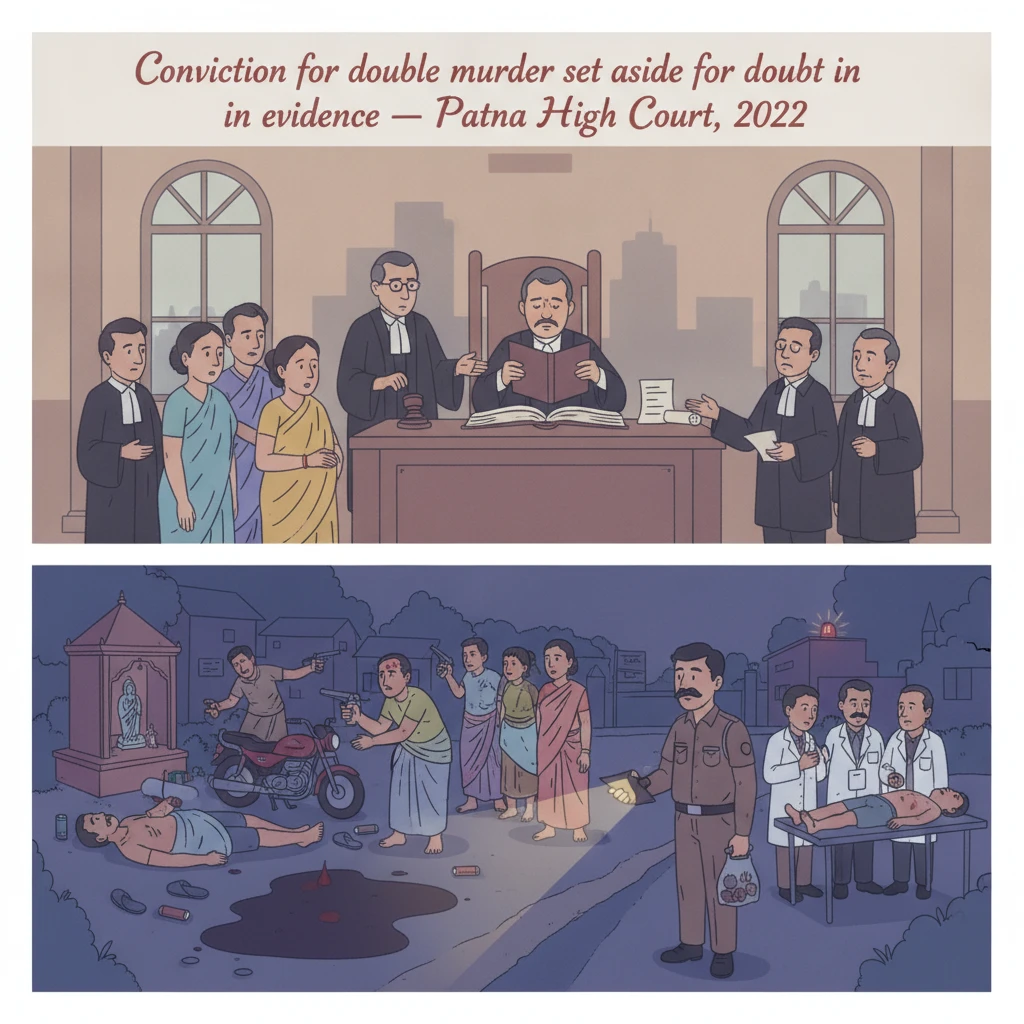
Case Background
This case arose from Aurangabad Mufassil P.S. Case No. 151 of 2012. The prosecution alleged that on the evening of 02.10.2012, near the Devi Asthan on the southern side of village Akauna, two men, Tega Yadav and Daroga Yadav, were shot dead.
According to the written report of the informant Ajay Yadav, his uncle Tega Yadav and cousin brother Daroga Yadav had gone near the Devi Asthan for watering their crops. There, they allegedly encountered several co-villagers. It was alleged that after abuses and exhortation to kill, one accused fired at Tega Yadav’s abdomen and another fired at the left rib area of Daroga Yadav, causing their instant death.
When the informant tried to intervene, he claimed he was assaulted with lathis and suffered injuries near his right eyebrow and on his left hand. He also stated that some co-villagers witnessed the incident.
The written report was handed over on 02.10.2012 at Sadar Hospital, Aurangabad, to the S.H.O. of Town Police Station who was camping there. It was then forwarded to Aurangabad Mufassil Police Station, where a formal FIR was drawn on 03.10.2012 at 01:00 AM under Sections 147, 148, 149, 323, 307, 302, 504 of the Indian Penal Code and Section 27 of the Arms Act.
After investigation, a charge sheet was submitted on 30.12.2012 against two main accused (later appellants) and two others under the same sections. Cognizance was taken by the Magistrate and, after supplying case papers under Section 207 Cr.P.C., the case was committed to the Sessions Court.
The Additional Sessions Judge-III, Aurangabad framed charges under Section 302 IPC and Section 27 Arms Act against the two appellants, and also under Sections 147, 148, 307/149, 302/149 and 504/149 IPC against them and two other accused. After trial, by judgment dated 22.06.2016, the Trial Court convicted the appellants under Section 302 IPC and Section 27 Arms Act and sentenced them on 28.06.2016 to life imprisonment with fine. No separate sentence was passed under the Arms Act. The other two accused were not convicted under Section 302 IPC.
The appellants filed Criminal Appeal (DB) No. 736 of 2016 before the Patna High Court challenging their conviction and sentence.
What the Court Examined and Decided
The Division Bench of the Patna High Court, comprising Hon’ble Mr. Justice Ashwani Kumar Singh (authoring the judgment) and Hon’ble Mr. Justice Arvind Srivastava, examined the entire evidence. The Court focused on four main areas: the medical evidence of death, the timing and manner of FIR and investigation, the reliability of eyewitnesses, and the unexplained injuries and counter case involving one appellant.
First, the Court confirmed that the deaths were homicidal. Three doctors from Sadar Hospital, Aurangabad (P.W.7 Dr. Sunil Kumar, P.W.8 Dr. Anup Kumar Sinha and P.W.9 Dr. Sunil Mahendra Kapoor) formed a Medical Board that conducted post-mortem examinations on both deceased in the early hours of 03.10.2012.
For Tega Yadav, the Board noted a firearm entry wound on the right side of the abdomen with charring and an exit wound on the back below the right scapula, along with a separate lacerated wound on the forehead caused by a hard, blunt substance. The cause of death was haemorrhage and shock due to these injuries, leading to cardiac respiratory failure. Time since death was within 12 hours.
For Daroga Yadav, the Board found a firearm entry wound on the left side of the abdomen and a corresponding exit wound on the back below the right scapular region. These injuries communicated with each other. Again, the cause of death was haemorrhage and shock from the firearm injuries, with time since death within 12 hours.
On this basis, the Court had no doubt that both men died due to firearm injuries on the relevant date and time.
The crucial question, however, was whether the prosecution had proved beyond reasonable doubt that the appellants were the shooters.
The Court next examined the timing of FIR and the start of investigation. The prosecution case was that the occurrence took place at about 07:30 PM on 02.10.2012. However, one eyewitness, P.W.4 Kameshwar Yadav, stated that the incident occurred at 05:30 PM. P.W.3 Chhedi Yadav’s evidence also suggested a time mismatch. This inconsistency in timing made the Court cautious.
The first Investigating Officer, P.W.13 Om Prakash, deposed that he took over investigation at 09:45 PM on 02.10.2012, based on a station diary entry (Sanha). He said he inspected the place of occurrence at the bund, about 300 metres south of village Akauna and 20 metres from Devi Asthan, at 09:45 PM, where he found a large quantity of blood. He seized a damaged motorcycle, slippers, Nippo batteries, a broken torch and blood-stained soil, and prepared a seizure list at 10:15 PM on 02.10.2012.
The problem was that this seizure list (marked as Exhibit-9) already carried the full case number “Mufassil P.S. Case No. 151 of 2012” and sections of law, even though the formal FIR was registered only later, at 01:00 AM on 03.10.2012. The Court found it “surprising” and drew the conclusion that the case had in fact been treated as registered on 02.10.2012 itself, much before the written report formally reached the police station.
The inquest reports for both deceased (Exhibits-6 and 7) also showed that police action had started earlier. They were prepared at Sadar Hospital, Aurangabad at 11:15 PM on 02.10.2012 by officers of Aurangabad Town P.S. The inquest reports recorded gunshot injuries and bore the names of witnesses Nagendra Yadav (P.W.1) and Rajendra Kumar Yadav (P.W.10), but contained no case number and did not name any accused.
The officers who prepared these inquest reports were not examined in the Sessions Trial, and there was no explanation for their non-examination. The Court treated this as a serious omission.
The Court then turned to the eyewitness accounts. The main eyewitnesses produced were P.W.1 Nagendra Yadav (nephew and cousin of the deceased), P.W.3 Chhedi Yadav (real brother of one deceased), P.W.4 Kameshwar Yadav, P.W.6 Satwant Kumar and the informant P.W.11 Ajay Yadav. All were closely related to the deceased or were accused in a counter case.
P.W.11 largely repeated the FIR version, saying the shots were fired near Devi Asthan. However, P.W.1 said the occurrence was at the “Aahar bund” and described nearby houses of Sao, Baitha, Yadav and other castes. P.W.3 and P.W.4 also stated that the firing took place at the bund, not near Devi Asthan. This created inconsistency about the exact place of occurrence.
Further, P.W.1 stated that his own statement was recorded by a police officer at 11:00 PM on 02.10.2012 in the Sadar Hospital, i.e., before the inquest reports were prepared. But this earlier statement did not see the light of day. The Court pointedly asked: if P.W.1 was truly an eyewitness and his statement was recorded at 11:00 PM, what happened to that statement, and why did it not contain names of assailants in the inquest reports?
P.W.4 admitted that prior to 10:00 PM the police had already reached the place of occurrence, inquired from villagers, and prepared documents, including a seizure list, on the same night. Yet, the written report that formed the FIR basis was shown to have been handed over only around 10:30 PM at Sadar Hospital, reaching Mufassil Police Station later.
The Court concluded that the earliest version of events, as first told to police at the spot and at the hospital, had been suppressed by the prosecution. Instead, a later written report was projected as the starting point. This created doubt about whether the names of the appellants were inserted later after deliberation.
A further serious weakness lay in the handling of seized articles. Defence witnesses D.W.1 (Malkhana guard) and D.W.2 (police official) proved that, as per the Malkhana register and station diary from 02.10.2012 to early October 2012, there was no entry showing that the seized motorcycle and other materials in Mufassil P.S. Case No. 151 of 2012 were ever deposited in Malkhana or noted in the diary. These items were also never produced in court during trial.
The Court also considered injuries to one of the appellants, Sushil Singh. The same doctor who was on the Medical Board, P.W.7 Dr. Sunil Kumar, had examined Sushil Singh at 10:20 PM on 02.10.2012 and found seven injuries, including one grievous injury. The injury report (Exhibit-A) was brought by the defence. The Investigating Officer himself admitted that Sushil Singh had opened the canal, the prosecution side objected, and they assaulted him, causing these injuries.
Yet, not a single prosecution witness explained how Sushil Singh received these injuries in the same incident. The Court noted that in a counter case started by Sushil Singh (Aurangabad P.S. Case No. 153 of 2012), prosecution witnesses P.W.1, P.W.3, P.W.4 and P.W.11 had themselves been convicted under Section 325 IPC for causing grievous hurt to him. This strongly suggested that the incident was a mutual clash over canal water, and that the prosecution witnesses were not telling the full story in this case.
On delay in FIR, the Court accepted that, in law, some delay is permissible if properly explained. The informant’s side argued that any delay was due to police forwarding of papers between Town P.S. and Mufassil P.S. However, given the clear evidence that investigation and seizure had begun earlier, and that inquest and witness questioning had occurred before the formal FIR, the Court held that the sequence was highly doubtful and suggested manipulation.
In sum, the Court found:
- Suppression of the earliest versions given to police.
- Inconsistencies in time and place of occurrence among witnesses.
- Non-examination of key police officers who prepared inquest reports.
- Unexplained injuries on appellant Sushil Singh, despite a proved counter case.
- Non-production and non-entry of seized materials in official records.
- Seizure lists bearing the FIR case number even before formal registration.
Under criminal law, guilt must be proved beyond reasonable doubt. The Court stressed that conviction cannot rest on the thought that the prosecution story “may be true”; it must be proved that it “must be true”. Because of the above doubts, the Court held that the prosecution had failed to discharge its burden.
Therefore, the Patna High Court set aside the conviction dated 22.06.2016 and the sentence dated 28.06.2016 passed by the Trial Court in Sessions Trial No. 24/13/96/14. The appellants Sushil Singh and Raju Singh were acquitted of all charges and directed to be released forthwith, unless required in any other case. The criminal appeal was allowed.
Why This Judgment Matters
This judgment is significant for villagers and ordinary citizens because it shows that the Patna High Court will not uphold a conviction if the investigation and evidence are doubtful, even in a serious double murder case.
The Court closely checked whether the police started investigation before properly recording the FIR, whether all early witness statements were produced, and whether injuries to the accused were explained. When it found serious gaps and contradictions, it gave benefit of doubt to the accused.
For families involved in clashes over land, water or village resources, this decision underlines that both sides’ injuries and complaints must be fairly recorded. If one side’s version is suppressed, it can weaken the entire case in higher courts.
For police and prosecutors, the case is a reminder that seizure of articles, Malkhana entries, station diary records and prompt, honest recording of first statements are all vital. Failure to follow these procedures can lead to acquittal even where deaths are proved.
Legal Issues and Answers
- Issue: Did the prosecution prove beyond reasonable doubt that the appellants shot and killed the two deceased near Devi Asthan / Aahar bund on 02.10.2012?
Answer: No. The Patna High Court found major contradictions in witness testimonies, suppression of earlier statements, irregularities in FIR timing and investigation, unexplained injuries to one appellant, and mishandling of seized articles. These created reasonable doubt, so the appellants were entitled to acquittal. - Issue: Was the delay and manner of lodging the FIR fatal to the prosecution case in the facts of this matter?
Answer: Yes, in the specific circumstances. Though some delay is legally permissible, here the investigation, seizure lists and inquest reports clearly pre-dated the formal FIR, and yet earlier versions and names of assailants were not recorded. This unexplained gap undermined the reliability of the prosecution story. - Issue: What is the effect of non-explanation of injuries on the accused and existence of a counter case arising from the same incident?
Answer: In this case, the serious injuries to appellant Sushil Singh, coupled with conviction of prosecution witnesses in the counter case, showed that the prosecution had not presented the true genesis of the occurrence. Non-explanation of these injuries further weakened the prosecution and supported giving benefit of doubt to the appellants.
Cases Cited by the Court
- The judgment discusses general principles about FIR delay and standard of proof in criminal cases but does not expressly cite or rely on any specific earlier case law by name. Therefore, no particular precedent is listed.
Case Details
Case Number: Criminal Appeal (DB) No. 736 of 2016; arising out of Aurangabad Mufassil P.S. Case No. 151 of 2012; Sessions Trial No. 24/13/96/14.
Case Title: Sushil Singh & Anr. v. The State of Bihar.
Citation: 2022 (2) PLJR 171.
Court: High Court of Judicature at Patna.
Coram: Hon’ble Mr. Justice Ashwani Kumar Singh; Hon’ble Mr. Justice Arvind Srivastava.
Date of High Court Judgment: 30.03.2022.
Trial Court Judgment Under Challenge: Judgment of conviction dated 22.06.2016 and order of sentence dated 28.06.2016 passed by the Additional Sessions Judge-III, Aurangabad.
Advocates:
- For the appellants: Mr. Kanhaiya Prasad Singh, Senior Advocate; Md. Javed Jafar Khan, Advocate.
- For the State (respondent): Mr. Dilip Kumar Sinha, Additional Public Prosecutor.
- For the informant: Mr. Ram Chandra Singh, Advocate.
Nature of the case: Criminal appeal (Division Bench) against conviction and life sentence under Section 302 IPC and Section 27 Arms Act.
Final Outcome: Appeal allowed; conviction and sentence set aside; appellants acquitted and directed to be released unless wanted in any other case.
Link to full judgment: Patna High Court Judgment dated 30-03-2022
If you found this explanation helpful and wish to stay informed about
how legal developments may affect your rights in Bihar,
you may consider following Samvida Law Associates for more updates.







