

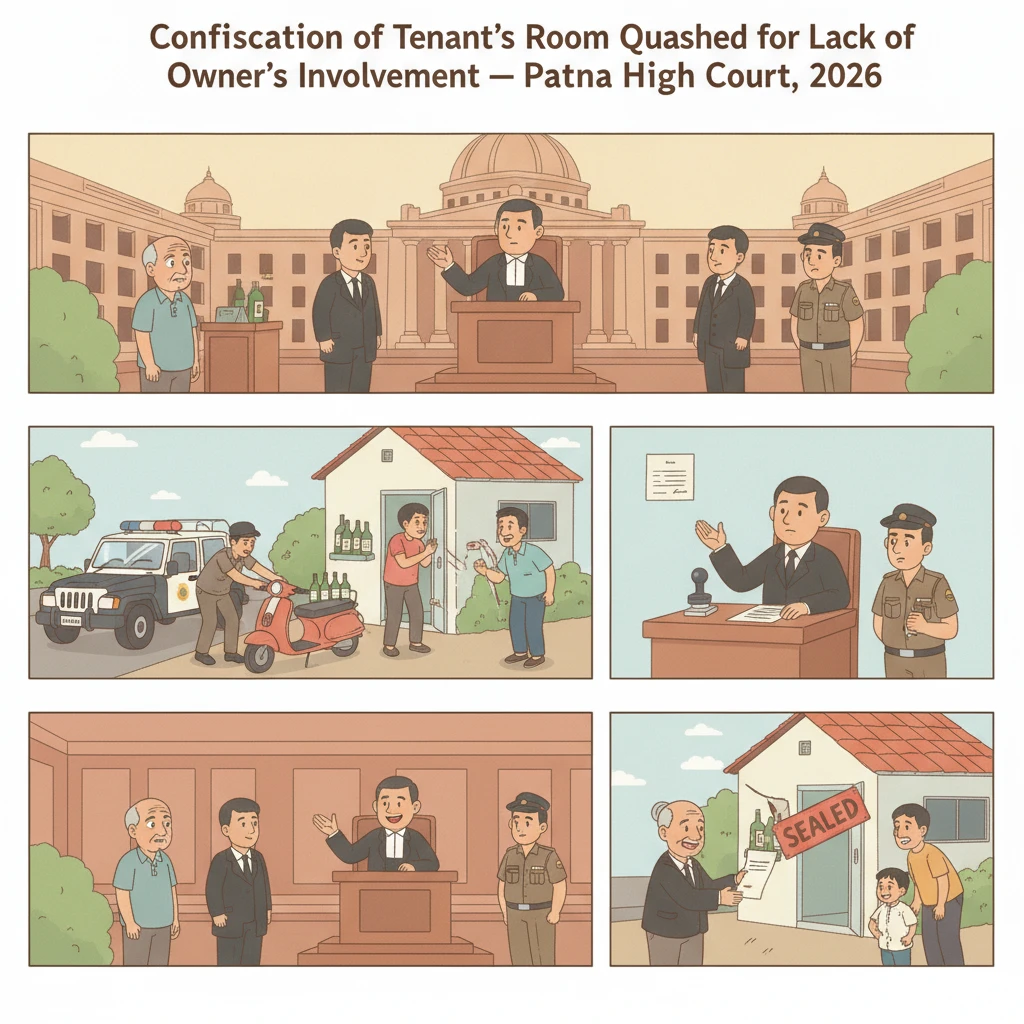
Case Background
The matter arose from a raid conducted by the police at Rajgir in Nalanda district on 05.05.2024.
On that day, a Sub-Inspector of Police posted at Rajgir Police Station was on patrolling duty with a police team and was also engaged in raids to recover illicit liquor.
At about 2:00 PM, the Officer-in-Charge of Rajgir Police Station informed the Sub-Inspector that the tenants of a particular house, belonging to the present petitioner, were allegedly involved in illegal trade of liquor and were supplying liquor using a Scooty bearing registration number BR 21S 5962.
Acting on this information, the Sub-Inspector and the police force raided the petitioner’s house at around 2:30 PM. They focused on the room occupied by the tenants.
From that room, the police recovered 100 litres of illicit liquor and 0.360 litres of illicit English liquor. A further 0.735 litres of illicit liquor was recovered from the Scooty mentioned in the information.
On the basis of the written complaint of the Sub-Inspector (the informant), Rajgir P.S. Case No. 158 of 2024 dated 05.05.2024 was registered under Section 30(a) of the Bihar Prohibition & Excise Act, 2016 (as amended) against the tenants, namely Shrinath Kumar @ Shivnath Prasad @ Ramlal and his son, Himansu Kumar @ Tutu.
It is important that neither the petitioner nor his family members were named as accused in this criminal case.
Separately from the criminal case, confiscation proceedings were initiated before the Sub-Divisional Magistrate, Rajgir, in Confiscation (Excise) Case No. 31 of 2024. By order dated 14.07.2025, the Sub-Divisional Magistrate ordered confiscation of the room of the petitioner’s house at Mauza-Rajgir, P.S. No. 485, appertaining to Khata No. 145, Khasara No. 4895.
The room was sealed, and the petitioner was effectively deprived of that part of his property.
Aggrieved by this, the petitioner approached the Patna High Court in Civil Writ Jurisdiction Case No. 16004 of 2025. He sought quashing of the confiscation order dated 14.07.2025 and a direction to de-seal and release the room in his favour.
What the Court Examined and Decided
The Division Bench of the Patna High Court, comprising Hon’ble Mr. Justice Mohit Kumar Shah and Hon’ble Mr. Justice Arun Kumar Jha, heard the matter. The oral judgment was delivered on 27.04.2026 by Justice Mohit Kumar Shah.
The petitioner’s side argued that the case itself, as recorded in the FIR, clearly showed that the illicit liquor was recovered from the room in possession of the tenants and from their Scooty, not from the petitioner.
They highlighted that:
The petitioner was not named as an accused in Rajgir P.S. Case No. 158 of 2024.
There was no allegation in the FIR that the petitioner or his family members had any role in the illegal liquor trade.
The tenants alone, namely Shrinath Kumar @ Shivnath Prasad and Himansu Kumar @ Tutu, were made accused.
The confiscated room formed part of the petitioner’s residential house at Mauza-Rajgir, P.S. No. 485, Khata No. 145, Khasara No. 4895.
According to the petitioner, the Sub-Divisional Magistrate had ignored these basic facts and wrongly ordered confiscation of the room, even though there was no material to show any involvement or connivance of the petitioner in storing illicit liquor.
On the other hand, the State’s counsel accepted that the liquor was indeed recovered from the tenants’ room but maintained that the quantity of illicit liquor was large and that there was no infirmity in the confiscation order passed by the Sub-Divisional Officer.
The Court examined the materials and first noted that the criminal case, Rajgir P.S. Case No. 158 of 2024 dated 05.05.2024, was specifically registered against the two tenants under Section 30(a) of the Bihar Prohibition & Excise Act, 2016. These tenants were living in a room in the petitioner’s house from where the illicit liquor had been recovered.
The Bench then turned to the legal framework under the Bihar Prohibition & Excise Act, 2016 and the Bihar Prohibition and Excise (Amendment) Rules, 2022.
It considered Section 30, which prescribes punishment for unlawful manufacture, possession, transport, sale, etc. of liquor or intoxicants.
More importantly for this case, the Bench carefully referred to Section 56 (Confiscation of Seized Items), Section 57B (Things or premises liable to be released upon penalty) and Section 58 (Confiscation by District Collector) of the Act, 2016.
Section 56 allows the Collector or an officer authorized by him to confiscate items when an offence under the Act is committed, including any premises or part thereof.
Section 57B(2) provides that any premises or part thereof used for committing an offence under the Act, and seized by the police or excise officer, may be released upon payment of penalty.
Section 58 lays down that when anything liable to confiscation is seized, the seizing officer must report to the District Collector. The Collector, on being satisfied that an offence has been committed, may order confiscation, whether or not prosecution is instituted and whether or not a case is pending before any court. Crucially, subsection (3) of Section 58 requires giving a reasonable opportunity of being heard to the person concerned before passing the confiscation order.
The Court then examined Rule 12B and Rule 13B of the Bihar Prohibition and Excise (Amendment) Rules, 2022.
Rule 12B deals with release of premises on payment of penalty. It states that when premises or part of it is seized or sealed under the Act, the Collector or authorized officer may release or unseal it on payment of penalty, on an application from the owner. While deciding the penalty, the authority must keep in mind:
the economic status of the individual,
the nature of his involvement in the crime,
the location of the premises, and
the quantum of intoxicant recovered.
Rule 13B prescribes the procedure of confiscation of premises. It requires that after receiving a proposal for confiscation from the police or excise officer, the Collector or authorized officer must:
Issue show cause notice to the owner(s) of the premises or property;
Seek reports from the Chemical Examiner or revenue officers; and
Provide reasonable opportunity of hearing to the owner(s) and allow the investigating/inquiry officer to participate.
The officer must then pass an appropriate order of confiscation or unsealing on being satisfied whether an offence has been committed in terms of the Act.
After surveying these provisions, the High Court distilled the legal position. It held that although the Act and Rules permit seizure and confiscation of premises used for committing an offence, direct involvement or connivance of the owner in illegal use of the premises for storing illicit liquor is an essential precondition for such drastic action, or for imposing any penalty for release.
Applying this test to the facts, the Court noted:
The petitioner was not made an accused in the criminal case.
No recovery of illicit liquor had been made from the petitioner’s possession.
The respondents, in their counter affidavit, could not produce any material to show any involvement, connection or connivance of the petitioner with the tenants’ illegal activity.
There was no proof that the petitioner had any relationship with the accused tenants beyond ownership of the house, or that he had any role, direct or indirect, in using the premises for stacking illicit liquor.
In absence of any such material, the Bench found that the State authorities’ action in sealing the premises and confiscating the room by order dated 14.07.2025 was arbitrary.
The Court declared that this action was hit by Article 14 of the Constitution of India, which guarantees equality before law and prohibits arbitrary State action.
Further, the Court held that the seizure and confiscation order violated the petitioner’s constitutional right to hold property under Article 300A of the Constitution. Article 300A provides that no person shall be deprived of his property except by authority of law.
Since, in the Court’s view, the Bihar Prohibition & Excise Act, 2016 did not authorize confiscation of premises in a case where the owner had no proven involvement or connivance, the seizure and confiscation in this case were held to be without authority of law.
On this reasoning, the High Court set aside the Sub-Divisional Magistrate’s order dated 14.07.2025 in Confiscation (Excise) Case No. 31 of 2024.
The Court directed that the room concerned be de-sealed and the premises be released in favour of the petitioner, subject to the State authorities satisfying themselves about the petitioner’s ownership of the premises.
This exercise of verification and release was ordered to be completed within two weeks from the date of receipt or production of a copy of the High Court’s judgment.
With these directions, the writ petition was allowed.
Why This Judgment Matters
This judgment is significant for landlords and property owners in Bihar, especially in areas where prohibition laws are strictly enforced.
It shows that merely because liquor is recovered from a part of a house, the owner cannot automatically be punished or lose his property, if there is no evidence that he was involved in or aware of the illegal activity.
The Patna High Court has made it clear that under the Bihar Prohibition & Excise Act, 2016 and the related Rules, authorities must look for direct involvement or connivance of the owner before seizing or confiscating a house or room, or demanding penalty for its release.
The decision also reinforces constitutional protections. Confiscation that deprives a person of property must be supported by law and must not be arbitrary. Any sealing or confiscation order that ignores these safeguards can be struck down under Articles 14 and 300A of the Constitution.
For ordinary citizens, especially those who rent out rooms or houses, this ruling provides reassurance that they will not be made scapegoats for tenants’ actions, so long as there is no evidence of their own involvement.
Legal Issues and Answers
Issue: Can a room in a landlord’s house be seized and confiscated under the Bihar Prohibition & Excise Act, 2016 when illicit liquor is recovered from tenants, but there is no material showing the landlord’s involvement or connivance?
Answer: The Patna High Court held that confiscation in such circumstances is illegal. Direct involvement or connivance of the owner in using the premises for illicit liquor is an essential prerequisite for seizure, confiscation, or penalty. In absence of such proof, sealing and confiscation are arbitrary and violate Articles 14 and 300A of the Constitution.
Issue: Does the Bihar Prohibition & Excise Act, 2016 authorize deprivation of property without adherence to the safeguards in the Act and Rules, and without proof of an owner’s role?
Answer: The Court held that the Act, 2016 does not authorize such action. Confiscation must follow the procedure in Sections 56, 57B and 58 and Rules 12B and 13B, and requires satisfaction about commission of an offence involving the owner. Otherwise, deprivation of property is without authority of law and unconstitutional.
Cases Cited by the Court
- No previous judicial precedents have been cited or relied upon in the text of this judgment. The Court based its decision on the Bihar Prohibition & Excise Act, 2016, the Bihar Prohibition and Excise (Amendment) Rules, 2022, and constitutional provisions.
Case Details
Case Number: Civil Writ Jurisdiction Case No. 16004 of 2025
Case Title: Bhushan Mistri v. The State of Bihar & Ors.
Citation: 2026 (3) PLJR 517
Court: High Court of Judicature at Patna
Coram: Hon’ble Mr. Justice Mohit Kumar Shah and Hon’ble Mr. Justice Arun Kumar Jha
Date of Judgment: 27.04.2026
For the Petitioner: Mr. Shailendra Kumar, Advocate; Mr. Ajit Ranjan Kumar, Advocate; Mr. Surendra Kumar, Advocate
For the Respondents: Mr. Indreshwar Pd. Mandal, AC to GA-3
Nature of the Case: Writ petition challenging confiscation order under the Bihar Prohibition & Excise Act, 2016
Impugned Order: Order dated 14.07.2025 passed by the Sub-Divisional Magistrate, Rajgir in Confiscation (Excise) Case No. 31 of 2024
Link to Judgment: Patna High Court Judgment in CWJC No. 16004 of 2025
If you found this explanation helpful and wish to stay informed about
how legal developments may affect your rights in Bihar,
you may consider following Samvida Law Associates for more updates.







