
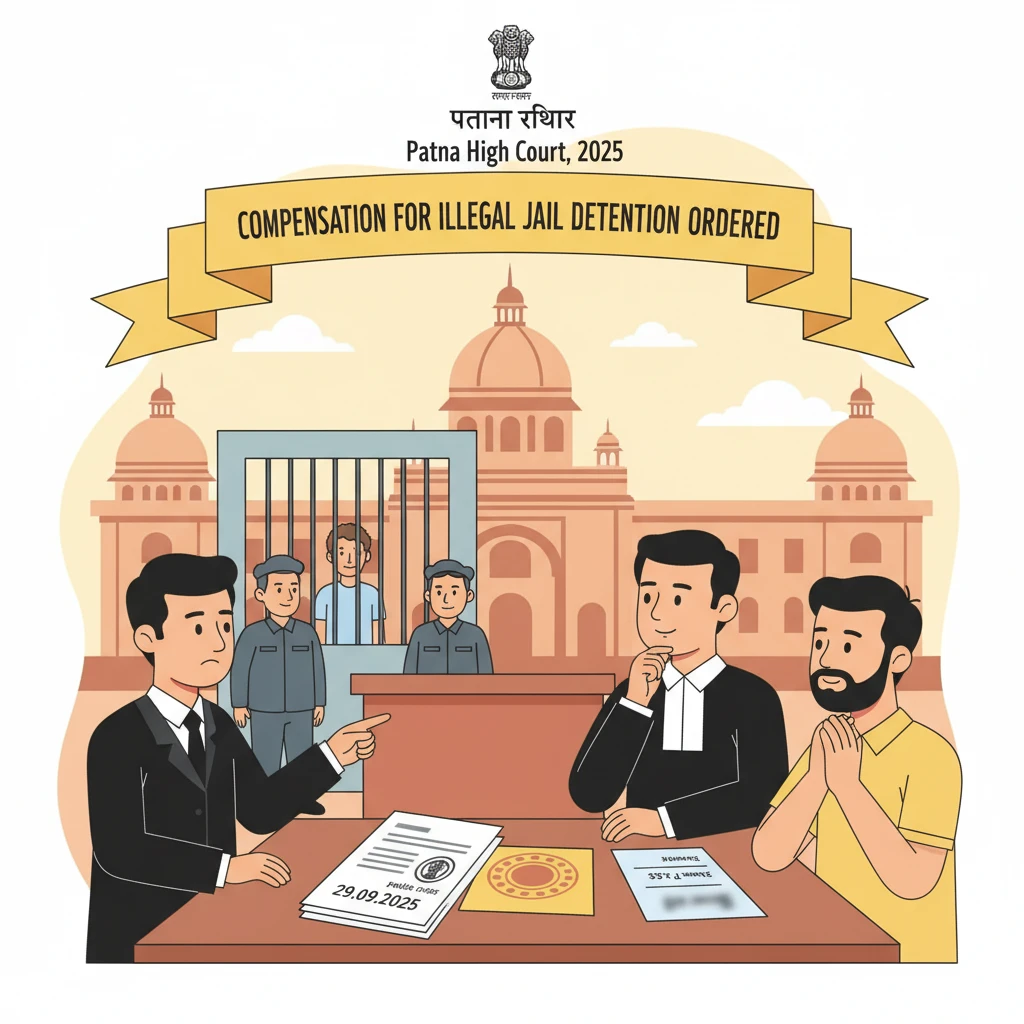
Case Background
The petitioner was in custody at Central Jail, Gaya in connection with Sarbahda P.S. Case No. 91 of 2025. This case was registered on 31.07.2025 under Section 30(a) and Section 37 of the Bihar Prohibition and Excise Act, 2016.
In that case, the competent court granted him bail by order dated 23.09.2025. Following this, the learned Exclusive Special Excise Judge, Court No. 2, Gaya issued a warrant of release on 29.09.2025, directing that the petitioner be released unless he was liable to be detained in some other matter. This release warrant was communicated to the Superintendent, Central Jail, Gaya.
Before this release warrant was received, the Superintendent, Central Jail, Gaya had already received a production warrant from the court of the learned Chief Judicial Magistrate, Buxar. This was in connection with Buxar P.S. Case No. 87 of 2025, in which the petitioner was stated to be involved in an offence of theft punishable under Section 303(2) of the Bharatiya Nyay Sanhita.
The production warrant (Annexure R-1/B) required the jail to produce the petitioner before the Chief Judicial Magistrate, Buxar on 04.09.2025 by 10:00 a.m. However, the Superintendent, Central Jail, Gaya did not produce the petitioner in the Buxar court on that date. Instead, the Superintendent sent communications to the Exclusive Special Judge, Excise, 2nd Gaya, to the Senior Superintendent of Police, Gaya, and to the Chief Judicial Magistrate, Buxar (Annexures R-1/C, R-1/D, R-1/E), explaining that he was seeking adequate police force and a vehicle with fuel to take the petitioner to Buxar.
No response from the office of the Senior Superintendent of Police, Gaya has been placed on record, nor is it clear if any court at Gaya was moved for appropriate orders for transportation and production. In the meantime, even after the release order in the Sarbahda case reached the jail, the petitioner continued in custody on the alleged “strength” of the old production warrant whose date had already passed.
In Letter No. 9322/Jail dated 06.10.2025, the Superintendent, Central Jail, Gaya informed the Senior Superintendent of Police, Gaya that after receipt of the release order from the local court, the petitioner had been released, but was being kept confined on the basis of the production warrant. This communication itself showed that despite claiming release, the petitioner remained confined in jail.
What the Court Examined and Decided
On 12.11.2025, the Patna High Court noted that the matter raised an issue of serious concern for a constitutional court, because a constitutional court is a guardian of the fundamental right to life and personal liberty. The Court examined how the petitioner’s detention continued even after his release order was issued.
The Court recorded that the production warrant from the Chief Judicial Magistrate, Buxar had fixed 04.09.2025 for production of the petitioner. That date had expired long before the release order dated 29.09.2025 in the Sarbahda case reached the jail. The Court took note of the petitioner’s submission that under Section 304 read with Section 305 of the Bharatiya Nagarik Suraksha Sanhita, 2023, once the date in a production warrant expires, and the order of release is in the hands of the Superintendent, the prisoner must be released unless there is a fresh valid order.
It was further pointed out that, prior to receiving the release order, the proper course would have been for the authorities to request the Buxar court to issue a fresh production warrant. On such a fresh warrant, the petitioner could have been produced before the Buxar court before the release order came into effect. That was not done.
Instead, the Superintendent’s letter dated 06.10.2025 falsely suggested that the petitioner had been released, while in the same letter admitting that he was still confined “on the strength” of an already outdated production warrant. The Court held that this meant the petitioner’s continued detention was without authority of any competent court and therefore violated his fundamental right.
Initially, on 12.11.2025, based on the material then available, the Court observed that the petitioner had been kept in jail for about 18 days after his release order without any court’s authorization. The petitioner had been produced in the Buxar court only on 17.10.2025, leaving a long period of detention in between with no valid legal backing.
On 13.11.2025, when the matter was taken up again “For Orders”, the learned AC to A.G. referred to Annexure R-1/J in the counter affidavit. This document showed that the petitioner had been produced virtually before the In-charge Chief Judicial Magistrate, Buxar on 04.10.2025, and remanded to custody until 17.10.2025. In light of this, the State argued that the completely unauthorized detention period should be counted only from 29.09.2025 (date of receipt of release order) to 04.10.2025 (date of virtual production), i.e., five days, not eighteen.
The Inspector General of Prisons and Correctional Services, Bihar, who was present virtually, accepted that the petitioner had been confined even after 29.09.2025 without any competent court’s order, but sought to explain this on the ground of intervening Durga Puja holidays. The Court rejected this explanation, pointing out that even during Durga Puja holidays, an In-charge Court is always available, and in fact the petitioner’s virtual production on 04.10.2025 itself occurred during the Puja period.
Upon this, the Inspector General frankly admitted that there had been illegal detention for at least five days. He assured the Court that corrective measures would be taken and that necessary steps would be initiated promptly.
The Court then focused on two aspects: the individual redress for this petitioner and the systemic problem. It noted that there was an admitted case of unauthorized detention from 29.09.2025 to 04.10.2025, and that the practice of continuing detention on the basis of an expired production warrant, even after a release order, appeared to be followed more widely in Bihar’s prisons without adequate departmental scrutiny.
The Court reiterated that it could not remain a silent spectator when a citizen’s liberty is curtailed without authority of law. It recorded that departmental proceedings had been initiated on the administrative side against the Jail Superintendent, Central Jail, Gaya, and would be taken to their logical conclusion. At the same time, the Court proceeded to award monetary compensation for the illegal deprivation of liberty.
On the question of quantum, the Court heard all sides. The Inspector General of Prisons suggested an amount of Rs. 10,000/- as appropriate. The learned AC to A.G. submitted that a lenient view be taken and proposed Rs. 10,000/- per day of illegal detention.
The petitioner’s counsel strongly opposed any merely symbolic compensation. He argued that the case involved a clear violation of Article 21 of the Constitution since the petitioner’s liberty had been curtailed without following due process. He pointed out that the government should, in such cases, have a policy of paying ex gratia compensation to illegal detenues, and that the amount should then be recovered from the erring official, so that the public exchequer is not burdened for individual misuse of power.
For this proposition, he relied on the Patna High Court judgment in K.K. Pathak @ Keshav Kumar Pathak v. Ravi Shankar Prasad and Others, reported in 2019 (1) PLJR 1051. The Court in that case had held that compensation paid due to misuse of powers by an officer should be recovered from that officer. The Supreme Court had dismissed the appeal in SLP (Crl) No. 003566/2019 on 26.04.2019, leaving that principle intact.
The petitioner’s counsel also relied on the Delhi High Court decision in Pankaj Kumar Sharma v. Government of NCT of Delhi and Others, 2023 SCC OnLine Del 6215. There, compensation of Rs. 50,000/- was awarded for illegal detention of about half an hour. He further drew attention to the recent Patna High Court judgment in Arvind Kumar Gupta v. State of Bihar and Others, 2025 (6) BLJ 52. In that case, compensation of Rs. 1,00,000/- each was awarded to two persons for unauthorized detention in police custody due to illegal arrest, and the Court directed recovery from the erring police officials following the principles in K.K. Pathak.
The High Court quoted relevant paragraphs from Arvind Kumar Gupta, including reliance on the Supreme Court’s judgment in Rudal Sah v. State of Bihar, AIR 1983 SC 1086, where the Supreme Court held that refusal to award compensation for unlawful detention would be “doing mere lip service” to fundamental rights.
After considering the facts, the period of five days of illegal detention, and the legal principles in these precedents, the Patna High Court held that a consolidated amount of Rs. 2,00,000/- would be a reasonable compensation to the petitioner for his unauthorized detention by the Superintendent, Central Jail, Gaya.
The Court further observed that it had “come to know that this practice is going on” among other Jail Superintendents in the State. Therefore, it directed the Inspector General of Prisons and Correctional Services to issue appropriate guidelines to all Jail Superintendents in Bihar. These guidelines must require strict compliance with the constitutional mandate and court orders in matters of custody and release. The guidelines are to be issued within two weeks.
The State of Bihar was directed to pay the compensation of Rs. 2,00,000/- to the petitioner within one month. In line with K.K. Pathak, the Court directed that this amount be realized from the erring official in accordance with law, so that the burden does not remain on the public exchequer.
With these directions, the writ application was allowed to the extent indicated in the judgment.
Why This Judgment Matters
This judgment is significant because it directly addresses the problem of prisoners remaining in jail even after a court has ordered their release. It confirms that a production warrant with an expired date cannot be used as a pretext to keep a person in custody.
For undertrial prisoners and their families in Bihar, the decision sends a clear message: jail authorities must strictly follow court orders and constitutional protections. If they fail, the affected person can seek compensation through the Patna High Court.
The Court has also insisted that compensation should ultimately be recovered from the officer responsible, not from public funds. This is meant to create individual accountability and deter casual or negligent violations of personal liberty.
Finally, by directing the Inspector General of Prisons to issue State-wide guidelines, the Court has tried to correct the system, not only provide relief in one case. If these directions are properly implemented, they can reduce similar illegal detentions in the future.
Legal Issues and Answers
- Issue: Can a jail keep an undertrial prisoner in custody after a release order, relying on an old production warrant whose date has already expired?
Answer: No. The Patna High Court held that once the release order is received and the date in the production warrant has lapsed, continued detention without a fresh court order is illegal. - Issue: Is the State liable to pay compensation for such unauthorized detention, and can the amount be recovered from the erring official?
Answer: Yes. The Court awarded Rs. 2,00,000/- as compensation for five days of illegal detention and directed the State to recover this amount from the concerned jail officer, following settled precedent. - Issue: What systemic steps must be taken when such illegal detention appears to be a wider practice in the State?
Answer: The Court directed the Inspector General of Prisons to issue guidelines to all Jail Superintendents in Bihar within two weeks, ensuring strict adherence to constitutional mandates and court orders regarding release and production.
Cases Cited by the Court
- Rudal Sah v. State of Bihar and Another, AIR 1983 SC 1086
- K.K. Pathak @ Keshav Kumar Pathak v. Ravi Shankar Prasad and Others, 2019 (1) PLJR 1051
- Pankaj Kumar Sharma v. Government of NCT of Delhi and Others, 2023 SCC OnLine Del 6215
- Arvind Kumar Gupta v. State of Bihar and Others, 2025 (6) BLJ 52
Case Details
Case Number: Criminal Writ Jurisdiction Case No. 2761 of 2025
Arising Out of: Sarbahda P.S. Case No. 91 of 2025, District Gaya
Case Title: Neeraj Kumar @ Neeraj Singh v. State of Bihar & Others
Coram: Hon’ble Mr. Justice Rajeev Ranjan Prasad and Hon’ble Mr. Justice Sourendra Pandey
Date of Judgment: 13.11.2025
Citation: 2026 (1) PLJR 13
Advocates:
- For the Petitioner: Mr. Siddharth Harsh, Advocate; Mr. Jitendra Kumar, Advocate
- For the State: Mr. P.N. Sharma, AC to A.G.
- For Prisons Department: Mr. Pranav Kumar, Inspector General of Prisons and Correctional Services (online/virtual mode)
Nature of the Case: Criminal writ petition alleging illegal detention and seeking enforcement of fundamental right to personal liberty, with claim for compensation.
Link to Full Judgment: Patna High Court Judgment in Cr. WJC No. 2761 of 2025
If you found this explanation helpful and wish to stay informed about
how legal developments may affect your rights in Bihar,
you may consider following Samvida Law Associates for more updates.







