
Case Background
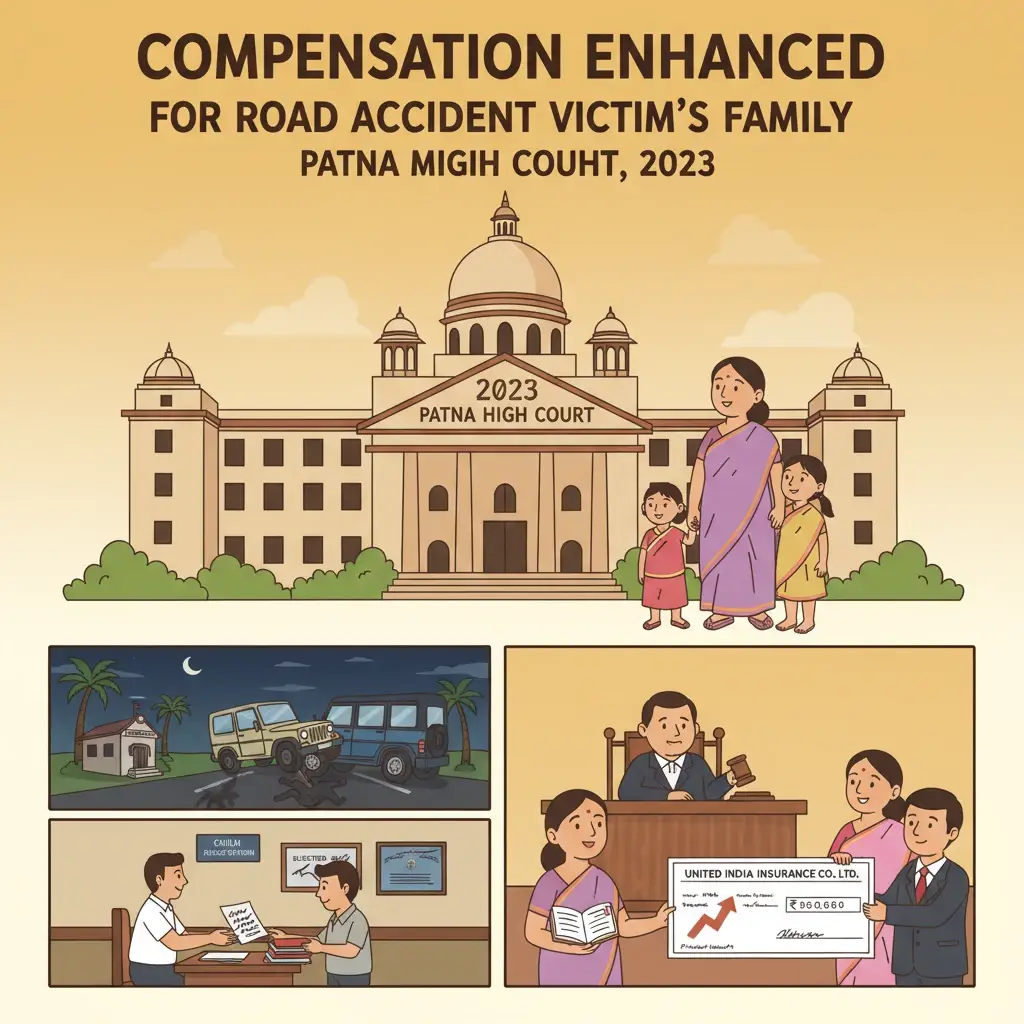
This case arose from a fatal road accident that took place on 15.06.2002 at about 8:00 PM.
The husband of appellant no. 1 was travelling to Mirzapur after completing his office work. He was going in a jeep bearing registration number UP3A 6198. The jeep met with an accident with a Tata Sumo.
In this accident, the husband of appellant no. 1 died.
In connection with the accident, Case No. 26 dated 16.06.2002 was registered at Chilh Police Station, Janpad Mirzapur. After investigation, the police submitted charge-sheet against the driver, Pappu Sonkar, under Sections 279, 304A, 338 and 427 of the Indian Penal Code.
According to claimant no. 1, her husband was working in an establishment named Electro Jecknow at Mirzapur. His monthly salary was stated to be Rs. 4,100/-, and at the time of the accident and death he was 30 years old. The employer of the deceased certified that the deceased was working there and earning Rs. 4,100/- per month.
The widow and two daughters of the deceased filed Claim Case No. 82 of 2003 before the Motor Accident Claims Tribunal, Hajipur, Vaishali. They sought compensation under the Motor Vehicles Act, 1988.
By order dated 02.08.2014 and award dated 02.03.2015, the Tribunal allowed a total compensation of Rs. 4,99,500/- with simple interest at 6% per annum. The Tribunal directed respondent no. 3, the United India Insurance Company Ltd., to pay this amount to the claimants.
The Insurance Company had opposed the claim before the Tribunal only on what the High Court later described as “ornamental grounds”. As the Insurance Company did not file any appeal against the Tribunal’s award, those defences were not examined in detail by the High Court.
Unsatisfied with the quantum of compensation, the claimants filed this Miscellaneous Appeal No. 236 of 2015 before the Patna High Court under Section 173 of the Motor Vehicles Act, 1988. They sought enhancement of the compensation awarded by the Tribunal.
What the Court Examined and Decided
The Patna High Court, through Hon’ble Mr. Justice Rajeev Ranjan Prasad, heard the appeal on 09.01.2023.
The core dispute in the High Court was not about whether the accident occurred or who was at fault. The Tribunal had already held, on the basis of evidence, that the husband of claimant no. 1 died in the accident due to the fault of the driver.
The main question was whether the Tribunal had correctly calculated the amount of compensation.
The Tribunal had accepted the deceased’s monthly income as Rs. 4,100/-. However, while calculating loss of dependency, it did not add any amount towards “future prospects”. It allowed only Rs. 2,500/- for funeral expenses and Rs. 5,000/- as spousal consortium. It also deducted 1/3rd of the income towards the deceased’s personal expenses.
On this basis, the Tribunal arrived at a total compensation of Rs. 4,99,500/-, with interest at 6% per annum from the date of filing of the claim petition.
The appellants attacked this calculation on several grounds.
First, they argued that the deceased had left behind three dependents – his widow and two minor daughters. The deceased was an employee of a private company and his salary was proved in evidence. The Tribunal had accepted the salary of Rs. 4,100/- per month, but failed to add 40% as future prospects, as required by the Supreme Court judgment in National Insurance Co. Ltd. v. Pranay Sethi & Ors., (2017) 16 SCC 680.
Second, they argued that since there were three dependents, the Tribunal should not have deducted 1/3rd of the income for personal expenses. Relying on Sarla Verma & Ors. v. Delhi Transport Corporation & Anr., (2009) 6 SCC 121, they submitted that the deduction should have been 1/4th, not 1/3rd.
Third, they challenged the very low amounts granted under conventional heads such as funeral expenses, loss of estate, and loss of consortium. With reference to the Constitution Bench judgment in Pranay Sethi, they claimed entitlement to funeral expenses of Rs. 15,000/-, loss of estate of Rs. 15,000/-, spousal consortium of Rs. 40,000/- for the widow, and parental consortium of Rs. 40,000/- each for the two minor daughters.
They also pointed out that in Chandra @ Chanda @ Chandraram & Anr. v. Mukesh Kumar Yadav & Ors., (2022) 1 SCC 198, the Supreme Court had, relying on Sarla Verma and Magma General Insurance Company Ltd. v. Nanu Ram @ Chuhru Ram & Ors., (2018) 18 SCC 130, recognised parental consortium of Rs. 40,000/- each. They further argued, following Pranay Sethi, that a 10% increase should be added to the amounts under conventional heads because of the time gap.
Fourth, they submitted that, considering the deceased’s age of 30 years, the correct multiplier was ‘17’ as per the multiplier table in Sarla Verma, which has been approved in Pranay Sethi for claims under Section 166 of the Motor Vehicles Act. They also sought interest on the enhanced compensation.
On the other side, counsel for the Insurance Company mainly argued that although future prospects at 40% could be allowed, no interest should be paid on the amount added towards future prospects. For this, reliance was placed upon a judgment of the Gauhati High Court in Oriental Insurance Company Ltd. v. Smiti Rumi Barman & Ors. (MACApp./77/2017, decided on 11.02.2021), where it was held that the component of future prospects should not carry further interest.
After hearing both sides and considering the Supreme Court judgments, the Patna High Court proceeded step by step.
The Court first noted that there was no dispute about applying a multiplier of 17 in this case, nor about allowing future prospects and amounts under conventional heads. The main points were the percentage of deduction for personal expenses, the quantum under conventional heads, and whether interest should be given on the future prospects component.
On future prospects, the Court referred to paragraphs 57 and 59.4 of Pranay Sethi. The Supreme Court had held that future prospects must be added to the income even in the case of self-employed or fixed salary earners to ensure “just compensation” under Section 168 of the Motor Vehicles Act. The Court noted that for a deceased below 40 years, an addition of 40% of the established income is mandated.
On deduction for personal and living expenses, the Court reviewed paragraphs 30–32 of Sarla Verma, which lay down that where the deceased was married and there are 2–3 dependent family members, 1/3rd of the income is generally deducted; where there are 4–6 dependents, 1/4th is deducted; and where there are more than six dependents, 1/5th is deducted. The Court also pointed out that these standards were approved in Reshma Kumari v. Madan Mohan, (2013) 9 SCC 65, and adopted in Pranay Sethi.
Applying these principles to the facts, the Court observed that the deceased had left his widow and two minor daughters as dependents. In such a situation, it could not be assumed that he would have been spending 1/3rd of his income solely on himself. The Court therefore held that a deduction of 1/4th of the income towards personal expenses would be appropriate.
Next, the Court turned to conventional heads. It referred to paragraph 48 and, importantly, paragraph 59.8 of Pranay Sethi, where the Supreme Court fixed “reasonable figures” on these heads: Rs. 15,000/- for loss of estate, Rs. 40,000/- for loss of consortium, and Rs. 15,000/- for funeral expenses, with a further 10% enhancement every three years.
The Court further referred to Magma General Insurance Company Ltd. and United India Insurance Company Ltd. v. Satinder Kaur @ Satwinder Kaur & Ors., (2021) 11 SCC 780, noting that by judicial pronouncements, it is now settled that the widow is entitled to spousal consortium, minor children to parental consortium, and dependent parents to filial consortium, with the amount under consortium increasing at 10% every three years.
In the present case, therefore, the Court held that appellant no. 1 (widow) would be entitled to Rs. 44,000/- as spousal consortium and appellant nos. 2 and 3 (minor daughters) would be entitled to Rs. 44,000/- each as parental consortium. The Court also held that they were entitled to Rs. 15,000/- towards funeral expenses and Rs. 15,000/- towards loss of estate.
On the dispute regarding interest on future prospects, the Court clearly rejected the view of the Gauhati High Court. It reasoned that future prospects are added to the income as part of the computation of total loss of dependency under the binding Supreme Court law. Once included in the compensation, there was no reason why that component should not earn interest like the rest of the award. The Court noted that there was no Supreme Court mandate prohibiting interest on future prospects, and expressed its “regret” at being unable to agree with the Gauhati High Court view.
Finally, the Court re-calculated the compensation as follows:
- Monthly income: Rs. 4,100/-
- Add 40% future prospects: Rs. 1,640/-
- Total monthly income for calculation: Rs. 5,740/-
- Less 1/4th personal expenses (Rs. 5,740 x 1/4): Rs. 1,435/-
- Monthly loss of dependency: Rs. 4,305/-
- Annual loss of dependency: Rs. 4,305 x 12 x 17 = Rs. 8,78,220/-
- Funeral expenses: Rs. 15,000/-
- Loss of estate: Rs. 15,000/-
- Spousal consortium (widow): Rs. 44,000/-
- Parental consortium (two minor children at Rs. 44,000/- each): Rs. 88,000/-
This gave a total compensation of Rs. 10,40,220/-.
Since the Tribunal had already awarded Rs. 4,99,500/-, the balance payable came to Rs. 5,41,720/-. The Court directed that this balance amount be paid with interest at 6% per annum from the date of filing of the claim petition till payment.
The Insurance Company was directed to make this payment to the claimants within two weeks from the date of receipt or communication of a copy of this order.
Why This Judgment Matters
This judgment is important for families of road accident victims, especially in Bihar, because it shows how the Patna High Court ensures that compensation is calculated fairly and in line with Supreme Court rulings.
First, it confirms that future prospects must be added even for private employees or fixed salary earners below 40 years, and that this addition is not optional.
Second, it clarifies that when there are three dependents, the deduction for the deceased’s own expenses may be 1/4th rather than 1/3rd, which increases the compensation that actually goes to the family.
Third, it reinforces that standard amounts must be allowed for funeral expenses, loss of estate, and different types of consortium (spousal and parental), and that these amounts increase periodically by 10%.
Fourth, it clearly holds that interest at the awarded rate applies to the entire compensation, including the portion added as future prospects. This ensures that families are not deprived of interest on a significant part of their lawful entitlement.
For claimants and practitioners, this Patna High Court decision serves as a clear guide on how claims under Section 166 of the Motor Vehicles Act should be assessed and what heads of compensation should be properly considered.
Legal Issues and Answers
- Issue: Whether the compensation awarded by the Motor Accident Claims Tribunal for the death of the earning member was inadequate in law and required enhancement.
Answer: Yes. The Patna High Court enhanced the compensation by adding 40% towards future prospects, correcting the deduction for personal expenses to 1/4th, and granting higher amounts under conventional heads, including spousal and parental consortium. - Issue: Whether interest at 6% per annum should also be paid on the portion of compensation representing future prospects.
Answer: Yes. The Court held that future prospects form part of the total loss of dependency and there is no reason to exclude that component from earning interest, rejecting the contrary view of the Gauhati High Court. - Issue: What is the correct approach to deduction for personal and living expenses and to amounts under conventional heads in a death claim where the deceased leaves behind a widow and two minor daughters.
Answer: The Court applied a 1/4th deduction for personal expenses and granted funeral expenses (Rs. 15,000/-), loss of estate (Rs. 15,000/-), spousal consortium (Rs. 44,000/-) and parental consortium for each minor child (Rs. 44,000/-), in line with Supreme Court precedents and the 10% enhancement rule.
Cases Cited by the Court
- National Insurance Co. Ltd. v. Pranay Sethi & Ors., (2017) 16 SCC 680
- Sarla Verma & Ors. v. Delhi Transport Corporation & Anr., (2009) 6 SCC 121
- Reshma Kumari v. Madan Mohan, (2013) 9 SCC 65
- Puttamma v. K.L. Narayana Reddy, (2013) 15 SCC 45
- UP SRTC v. Trilok Chandra, (1996) 4 SCC 362
- Rajesh v. Rajbir Singh, (2013) 9 SCC 54
- Magma General Insurance Company Ltd. v. Nanu Ram @ Chuhru Ram & Ors., (2018) 18 SCC 130
- United India Insurance Company Ltd. v. Satinder Kaur @ Satwinder Kaur & Ors., (2021) 11 SCC 780
- Chandra @ Chanda @ Chandraram & Anr. v. Mukesh Kumar Yadav & Ors., (2022) 1 SCC 198
- Oriental Insurance Company Ltd. v. Smiti Rumi Barman & Ors., MACApp./77/2017 (Gauhati High Court, decided on 11.02.2021) – referred to and disagreed with on the point of interest on future prospects
Case Details
Case Number: Miscellaneous Appeal No. 236 of 2015
Case Title: Sangita Devi & Ors. v. Rajesh Kumar & Ors.
Court: High Court of Judicature at Patna
Coram: Hon’ble Mr. Justice Rajeev Ranjan Prasad
Date of Judgment: 09.01.2023
Citation: 2023 (1) PLJR 719
Advocates:
- For the appellants (claimants): Mr. Alok Kumar @ Alok Kr. Shahi, Advocate
- For respondent no. 3 (United India Insurance Company Ltd.): Mr. Durgesh Kumar Singh, Advocate
Parties (as per cause title):
- Appellants: Sangita Devi (widow of the deceased), Ansu (minor daughter), Anubha (minor daughter), residents of Village Pahetiya, P.S. Sadar Hajipur, District Vaishali
- Respondent no. 1: Rajesh Kumar, S/o Girja Prasad, District Muzaffarnagar, Uttar Pradesh
- Respondent no. 2: Raj Narayan Singh, S/o Suman Bahadur Singh, Resident of Village Dingur Patti, District Mirzapur
- Respondent no. 3: United India Insurance Company Ltd. through Branch Manager, District Hajipur
Nature of the Case: Miscellaneous Appeal under Section 173 of the Motor Vehicles Act, 1988, seeking enhancement of compensation awarded by the Motor Accident Claims Tribunal in a motor accident death claim (Claim Case No. 82 of 2003).
Link to Judgment:https://patnahighcourt.gov.in/viewjudgment/MiMyMzYjMjAxNSMxI04=—ak1–dxcEXja8lY=
If you found this explanation helpful and wish to stay informed about
how legal developments may affect your rights in Bihar,
you may consider following Samvida Law Associates for more updates.







