
Case Background
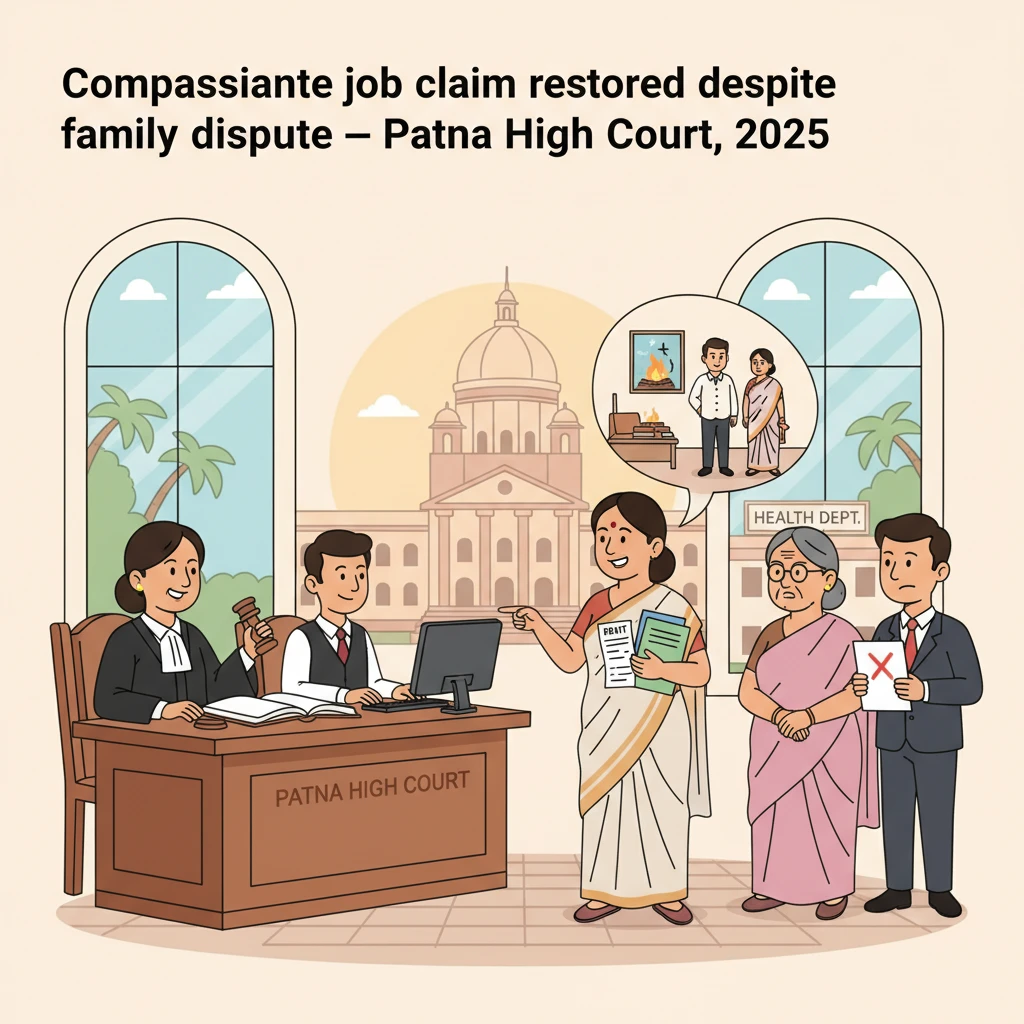
The petitioner is the widow of a government employee who worked as a Clerk at the Primary Health Centre, Bihta, in the Health Department, Government of Bihar. Her husband died in harness on 05.09.2023 while serving as a Class-III employee.
After his death, the petitioner applied for appointment on compassionate grounds. Such appointments are meant to provide immediate financial support to the family of a deceased government servant.
However, the District Compassionate Committee, headed by the District Magistrate-cum-Chairman, Patna, rejected her application. The decision was taken through a proceeding dated 22.02.2025, where her case appeared in the list of rejected applications at item no. 2.
Feeling aggrieved, the petitioner approached the Patna High Court under its civil writ jurisdiction. She challenged the rejection order and requested directions for her appointment on compassionate grounds and release of consequential monetary benefits after her husband’s death.
What the Court Examined and Decided
Justice Sandeep Kumar of the Patna High Court heard the matter on 01.09.2025. Both sides were represented by counsel. The Court examined the petition, the reasons given for rejection, and the submissions of both the petitioner and the State.
The petitioner stated that she is the legally wedded wife of the deceased employee. She narrated that there were serious matrimonial disputes during her husband’s lifetime. These disputes were mainly due to her husband’s habit of drinking liquor and resultant ill-treatment.
Because of this, she had earlier filed Complaint Case No. 238 of 2018. That complaint was registered under sections 498-A and 380 of the Indian Penal Code and under section 3/4 of the Dowry Prohibition Act. Later, based on her husband’s assurance, she resumed living with him.
The petitioner further stated that, on the instigation of her mother-in-law, her husband filed Matrimonial Case No. 1027 of 2018. That matrimonial case was ultimately dismissed for default on 11.11.2022.
After this, according to the petitioner, her husband again started drinking and allegedly tortured her. This forced her to file another criminal complaint. This second complaint was registered as Complaint Case No. 1448 of 2019 under sections 498-A, 354-B, 380 and 367 of the Indian Penal Code and section 3/4 of the Dowry Prohibition Act.
The petitioner alleged that the mother-in-law even turned her out of the matrimonial home. Despite this, she and her husband later started living together as husband and wife in a separate rented flat at Bahadurpur Colony, Patna.
To support this, she placed on record an undertaking dated 02.03.2020 relating to a dispute between the couple and their neighbour. She said this document clearly showed that they were living together as a couple. She also asserted that she performed the last rites of her deceased husband.
After his death on 05.09.2023, she applied for compassionate appointment. Her grievance before the Court was that the District Compassionate Committee rejected her application on 22.02.2025 without properly considering the fact that, as the legally wedded wife, she is entitled to the job and monetary benefits arising from her husband’s service.
She also brought to the Court’s notice that her father-in-law had been a government servant. After his death, her mother-in-law is already receiving family pension. Despite this, the mother-in-law opposed the petitioner’s appointment on compassionate grounds.
The petitioner further gave an undertaking before the Court that if she is appointed on compassionate grounds, she will look after her mother-in-law.
On the other hand, the State relied on a Will said to have been executed by the deceased employee. According to the State counsel, all rights of compassionate appointment should go to the mother of the deceased, i.e., the petitioner’s mother-in-law, on the basis of that Will.
However, this Will was unprobated and was the subject matter of Probate Case No. 166 of 2023, pending before the Court of the learned A.D.J.-V, Danapur, Patna. The Will was stated to be in favour of one Mukesh Kumar Verma.
The petitioner’s counsel countered this argument. He submitted that the Will being relied upon is forged and cannot be given effect to unless and until the probate case is decided and the competent court declares the Will genuine. Till then, the Will has no binding effect.
After hearing both sides, the Patna High Court carefully considered the submissions and examined the materials on record. The key question was whether the rejection of the petitioner’s application for compassionate appointment was justified on the grounds mentioned by the District Compassionate Committee.
The Court noted that the rejection was based on two grounds: first, that the mother-in-law of the petitioner was opposing her appointment; and second, that there existed a Will executed by the deceased husband in favour of a third person, which was pending for probate.
The Court held that the claim for appointment on compassionate grounds cannot be rejected merely on the objection of the mother-in-law. It also held that the pendency of a probate case concerning an unprobated Will is not a valid ground to deny compassionate appointment.
Importantly, the Court observed that, apart from the petitioner, there was no other claimant for the job on compassionate grounds after the death of the deceased employee. It was an admitted fact that the petitioner is the legally wedded wife of the deceased employee.
The Court acknowledged that there had been differences between the husband and wife during his lifetime. Those differences led to criminal complaints and matrimonial litigation. However, the Court was clear that such past differences do not dis-entitle the petitioner from being considered for compassionate appointment.
The Court also clarified that the pendency of Probate Case No. 166 of 2023 regarding the alleged Will in favour of Mukesh Kumar Verma cannot, by itself, be a reason to deny the petitioner’s claim for compassionate appointment. The compassionate job is not a property that can be disposed of by Will, and, in any case, the Will had not yet been probated.
Therefore, the High Court found the decision of the District Magistrate-cum-Chairman, District Compassionate Committee, Patna, taken on 22.02.2025, to be unsustainable. It set aside that proceeding so far as it related to the petitioner’s case.
The Court then directed the respondents to take a fresh decision on the petitioner’s application for compassionate appointment. This fresh decision is to be made within two weeks from the date of receipt or production of a copy of the Court’s order. The District Compassionate Committee has been told to consider the application in the light of the Court’s discussions and observations.
With these findings, the writ petition was allowed to the extent of setting aside the earlier rejection and directing reconsideration.
Why This Judgment Matters
This judgment of the Patna High Court is important for widows and dependants of deceased government employees facing family disputes.
It clarifies that objections from in-laws, by themselves, cannot block a legally wedded widow from being considered for compassionate appointment.
The Court has also made it clear that an unprobated Will, which is still under challenge in probate proceedings, cannot be used as a ground to deny a compassionate job.
Further, the existence of past marital disputes, including criminal cases and matrimonial cases, does not automatically cancel a widow’s right to be considered for such employment if she is otherwise eligible.
This decision may guide District Compassionate Committees in Bihar and beyond to focus on legal entitlement and dependency, rather than family pressure or unresolved property disputes.
Legal Issues and Answers
-
Issue: Can a District Compassionate Committee reject a widow’s claim for compassionate appointment solely because her mother-in-law objects and an unprobated Will in favour of another person is pending in probate court?
Answer: No. The Patna High Court held that objection by the mother-in-law and reliance on an unprobated Will are not valid grounds to reject the compassionate appointment claim of the legally wedded wife, and directed reconsideration of her application. -
Issue: Do past marital disputes and litigation between the deceased employee and his wife disqualify her from seeking compassionate appointment?
Answer: No. The Court held that differences between husband and wife during his lifetime do not dis-entitle the legally wedded wife from being granted compassionate appointment.
Cases Cited by the Court
- No prior cases or precedents have been expressly cited or relied upon in the text of this judgment.
Case Details
Case Number: Civil Writ Jurisdiction Case No. 6637 of 2025
Case Title: Rinku Tiwari @ Rinku Kumari vs. The State of Bihar & Ors.
Court: High Court of Judicature at Patna
Coram: Hon’ble Mr. Justice Sandeep Kumar
Date of Judgment: 01.09.2025
Citation: 2025(4) PLJR 142
Advocates for Petitioner: Dr. Anjani Pd. Singh, Advocate; Mr. Sunny Kumar, Advocate; Mr. Saurav Kumar Pandey, Advocate
Advocate for Respondents (State): Mr. Kameshwar Kumar, G.P.-17
Nature of the Case: Writ petition seeking compassionate appointment and quashing of District Compassionate Committee’s rejection order
Impugned Order: Proceeding dated 22.02.2025 of the District Magistrate-cum-Chairman, District Compassionate Committee, Patna, rejecting the petitioner’s compassionate appointment application (listed at item no. 2 in rejected list)
Direction Issued: Impugned proceeding set aside; respondents directed to take a fresh decision on the petitioner’s application for compassionate appointment within two weeks from receipt/production of the Court’s order.
Link to Judgment: Click here to view the full judgment of the Patna High Court
If you found this explanation helpful and wish to stay informed about
how legal developments may affect your rights in Bihar,
you may consider following Samvida Law Associates for more updates.







