

Case Background
The matter arose from Bagaha P.S. Case No. 463 of 2015, District West Champaran, based on a written report by the informant on 15.11.2015 at about 8:30 a.m.
The informant stated that at about 5:30 a.m. that same morning, he woke up to noise, opened the gate of his house and allegedly found several persons, including the present petitioners and five others, constructing a hut on his land.
On his protest, some accused persons allegedly caught hold of him and assaulted him by fists and slaps. On his alarm, his sons Arif, Sanu and Janus, and his nephew Afroj, came to his rescue.
According to the allegation, petitioner Azad Khan assaulted Afroj with a khanti, causing him to fall after injury. Accused Sonu Khan and Pappu Khan allegedly assaulted his son Sanu Khan with a farsa. Petitioners Bablu Khan and Hakik Khan allegedly assaulted the informant with lathi.
When the informant’s bhabhi, Saida Khatoon, came there, accused Majre Alam and Raju allegedly assaulted her with leg, fist and lathi. Accused Khus Mohammad and Monu Khan allegedly assaulted his eldest son Arif with lathi and fist. On alarm, villagers gathered and took the injured to hospital for treatment.
Police registered the case and investigated. After investigation, the Investigating Officer submitted charge-sheet No. 9/2015 dated 27.01.2016, in which the petitioners were exonerated.
Before that charge-sheet was submitted, the informant moved an application before the learned A.C.J.M., Bagaha, stating that the injured witnesses had not been examined during investigation and that their statements under Section 161 of the Code of Criminal Procedure (CrPC) had not been recorded.
On this, by a detailed judicial order dated 13.04.2014, the Investigating Officer was directed by the court to record the statements of the injured witnesses under Section 161 CrPC. A show cause was also issued to the Investigating Officer as to why he should not be prosecuted under Sections 218, 219 and 221 of the Indian Penal Code (IPC).
Subsequently, reinvestigation was carried out to the limited extent of recording the statements of the injured witnesses under Section 161 CrPC. On this basis, another charge-sheet No. 145/2016 dated 13.05.2016 was submitted.
Even in this supplementary charge-sheet, after considering the statements of the injured witnesses, the petitioners were again not sent up for trial and stood exonerated by the police.
Despite this, on 16.06.2016, the learned A.C.J.M., Bagaha, West Champaran, took cognizance of offences under Sections 147, 149, 307, 323, 325, 341 and 504 IPC against all accused persons named in the FIR, including the petitioners. This cognizance order, as well as the earlier endorsement in the charge-sheet format, became the subject matter of challenge before the Patna High Court in Criminal Miscellaneous No. 32735 of 2016.
What the Court Examined and Decided
The petitioners approached the Patna High Court seeking quashing of the cognizance order dated 16.06.2016 passed by the A.C.J.M., Bagaha. They argued that the Magistrate had mechanically taken cognizance against them, despite two investigation reports exonerating them, and without assigning any reasons for disagreeing with the police findings.
Learned senior counsel for the petitioners pointed out that the cognizance was initially endorsed in column 10 of charge-sheet No. 145/2016 dated 13.05.2016. Column 10 of the final form is meant for details of seized articles and property connected with the occurrence.
Instead of describing any seized items, the Magistrate made a general and very brief endorsement in English: “Cog taken u/s 147,149,307,323,325,341 & 504 against all accused persons named in FIR. Sig/- 16/06/16”.
This endorsement was later reduced into a formal order on the same date. In that order, the Magistrate noted that on perusal of the charge-sheets and case diary, there was sufficient material in the case diary against nine accused persons, including the petitioners, for taking cognizance under the above IPC sections. The Magistrate accordingly directed issuance of summons against them.
The key grievance of the petitioners was that the Magistrate differed from the police’s conclusion, which had exonerated them even after recording statements of the injured witnesses, yet the Magistrate did not disclose any reasons for such disagreement.
It was submitted on their behalf that, as per settled law, when a Magistrate disagrees with the final form submitted by the police and decides to summon persons who have been exonerated, the Magistrate must apply his judicial mind and record reasons. The absence of reasons, according to the petitioners, showed a mechanical and cryptic approach.
To support this contention, learned senior counsel relied upon the decision of the Hon’ble Supreme Court in Almohan Das v. State of W.B., 1968 SCC OnLine SC 85. The High Court reproduced paragraph 9 of that judgment.
In that paragraph, the Supreme Court explained the role of a Magistrate at the stage of inquiry under Section 209 of the earlier Code of Criminal Procedure. The Court held that a Magistrate is not to act as a mere recording machine. He is entitled to sift and weigh the materials on record, but only to see whether there is sufficient evidence to proceed, not to see whether there is sufficient evidence to convict.
The Supreme Court further held that if there is no prima facie evidence or the evidence is totally unworthy of credit, it is the Magistrate’s duty to discharge the accused. If there is some evidence on which a conviction may reasonably be based, he must commit the case. The Magistrate has no power at that stage to evaluate the evidence for satisfying himself of guilt; the question is whether there is some credible evidence which would sustain a conviction.
The Patna High Court treated this principle as a guiding note, even though Section 209 in terms applies to cases instituted otherwise than on a police report. The principle equally applies where the case is instituted on a police report because the Magistrate must apply his mind to the material and must not act mechanically.
On the other hand, learned APP for the State, assisted by learned counsel for opposite party no. 2, opposed the petition. They argued that taking cognizance is based on the subjective satisfaction of the jurisdictional Magistrate and that, on this ground alone, the cognizance order should not be set aside.
After hearing both sides, the High Court closely examined the manner in which the Magistrate had taken cognizance. It noted that the cognizance order was first endorsed in column 10 of the final form, which is actually meant to list seized items relating to the occurrence.
The Court found that instead of recording any discussion or analysis, the Magistrate had simply endorsed that cognizance under specified sections was being taken against all accused persons named in the FIR. This was then transformed into a brief order on the same date, again without explaining why the Magistrate was differing from the police’s conclusion exonerating the petitioners.
The High Court observed that the Magistrate supplied no reasons at all while taking a different view from the investigation, particularly when the second charge-sheet (submitted after recording statements of injured witnesses under Section 161 CrPC) had again exonerated the petitioners.
In this situation, the High Court concluded that the order taking cognizance was mechanical and cryptic. The absence of reasons, despite clear exoneration in the police report, created an impression that the Magistrate had not meaningfully applied his judicial mind.
Referring to the principle laid down in Almohan Das, the Court emphasised that a Magistrate must at least show in his order that he has sifted and weighed the materials to see if there is some credible evidence requiring proceedings against a person. When the Magistrate departs from the police’s conclusion, this becomes even more necessary to avoid arbitrary or casual exercise of power.
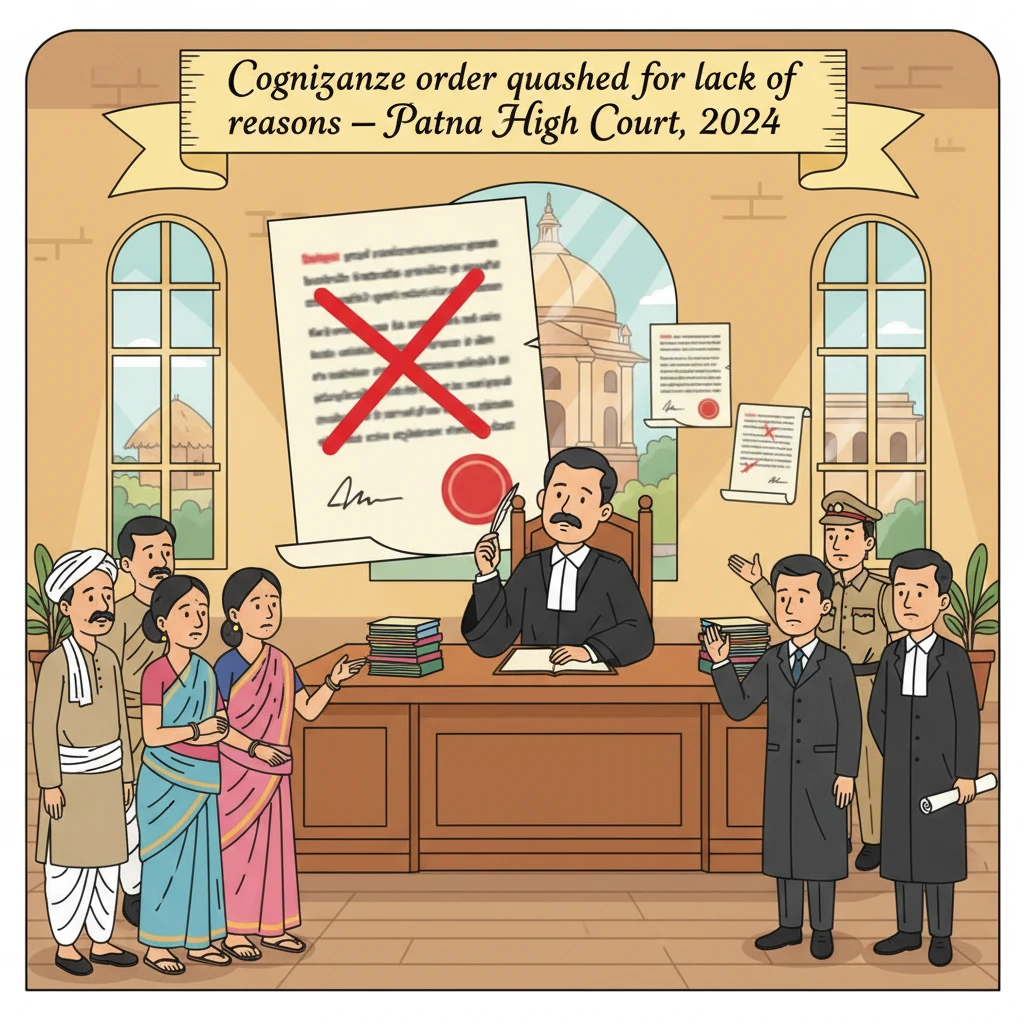
On this basis, the Patna High Court held that the cognizance order dated 16.06.2016, passed by the A.C.J.M., Bagaha, West Champaran, in Bagaha P.S. Case No. 463 of 2015, deserved to be quashed so far as the petitioners were concerned.
However, instead of terminating the case outright, the High Court directed the learned jurisdictional Magistrate to pass a fresh order in accordance with law. The Magistrate was specifically directed to supply reasons if he chose to differ from the investigation report, so as to avoid the impression of a mechanical or cryptic approach.
Accordingly, the application was allowed to that extent. The High Court also directed its office to communicate a copy of the judgment to the court of the learned jurisdictional Magistrate without delay.
Why This Judgment Matters
This decision of the Patna High Court is significant for accused persons who have been exonerated by the police during investigation but later find themselves summoned by the Magistrate.
The judgment clearly shows that if a Magistrate wants to disagree with the police and take cognizance against such persons, he must record reasons. A mere one-line endorsement noting that cognizance is taken is not enough.
For ordinary citizens, this means that the court cannot lightly start criminal proceedings once the police have, after investigation, found no case against them. The Magistrate has to show, in writing, that he examined the material and that there is some credible evidence.
The ruling also guides Magistrates on how to exercise their power: they must avoid mechanical orders, especially where the police, even after reinvestigation and recording statements of injured witnesses, have not sent up certain persons for trial.
Legal Issues and Answers
- Issue: Can a Magistrate mechanically take cognizance against persons exonerated in the police report, without giving reasons for differing from the investigation findings?
Answer: No. The Patna High Court held that such a mechanical and cryptic order, without reasons, is unsustainable and must be quashed. The Magistrate must pass a fresh, reasoned order. - Issue: What is the required approach of a Magistrate while considering a police report and deciding whether to proceed against an accused?
Answer: Guided by the Supreme Court’s decision in Almohan Das v. State of W.B., the Magistrate must sift and weigh the material to see if there is prima facie, credible evidence to proceed, without acting as a mere recording machine.
Cases Cited by the Court
- Almohan Das v. State of W.B., 1968 SCC OnLine SC 85
Case Details
Case Number: Criminal Miscellaneous No. 32735 of 2016 (arising out of Bagaha P.S. Case No. 463 of 2015)
Case Title: Azad Khan & Ors. v. The State of Bihar & Anr.
Coram: Hon’ble Mr. Justice Chandra Shekhar Jha
Date of Judgment: 15.04.2024
Citation: 2024 (2) PLJR 483
Advocates:
- For the petitioners: Mr. Baxi S.R.P. Sinha, Senior Advocate; Mr. Vijay Kr. Singh No. 1, Advocate
- For the State: Mr. Lalan Kumar, APP
- For opposite party no. 2: Mr. Bashishth Narain Mishra, Advocate
Nature of the Case: Criminal miscellaneous application seeking quashing of order taking cognizance in a police case
Link to Judgment: View full judgment on Patna High Court website
If you found this explanation helpful and wish to stay informed about how legal developments may affect your rights in Bihar, you may consider following Samvida Law Associates for more updates.







