
Case Background
This case arose out of a business dispute between the petitioner, associated with Harischandra Builder Private Limited, and opposite party no. 2, who issued the legal notice and complaint.
The opposite party no. 2 claimed that there was a partnership-type business arrangement between his side and the petitioner’s side. A written deed of partnership, dated 15.10.2019, was said to have been executed between them. According to the petitioner, that deed was not complied with in its true spirit, and disputes developed in the course of their business dealings.
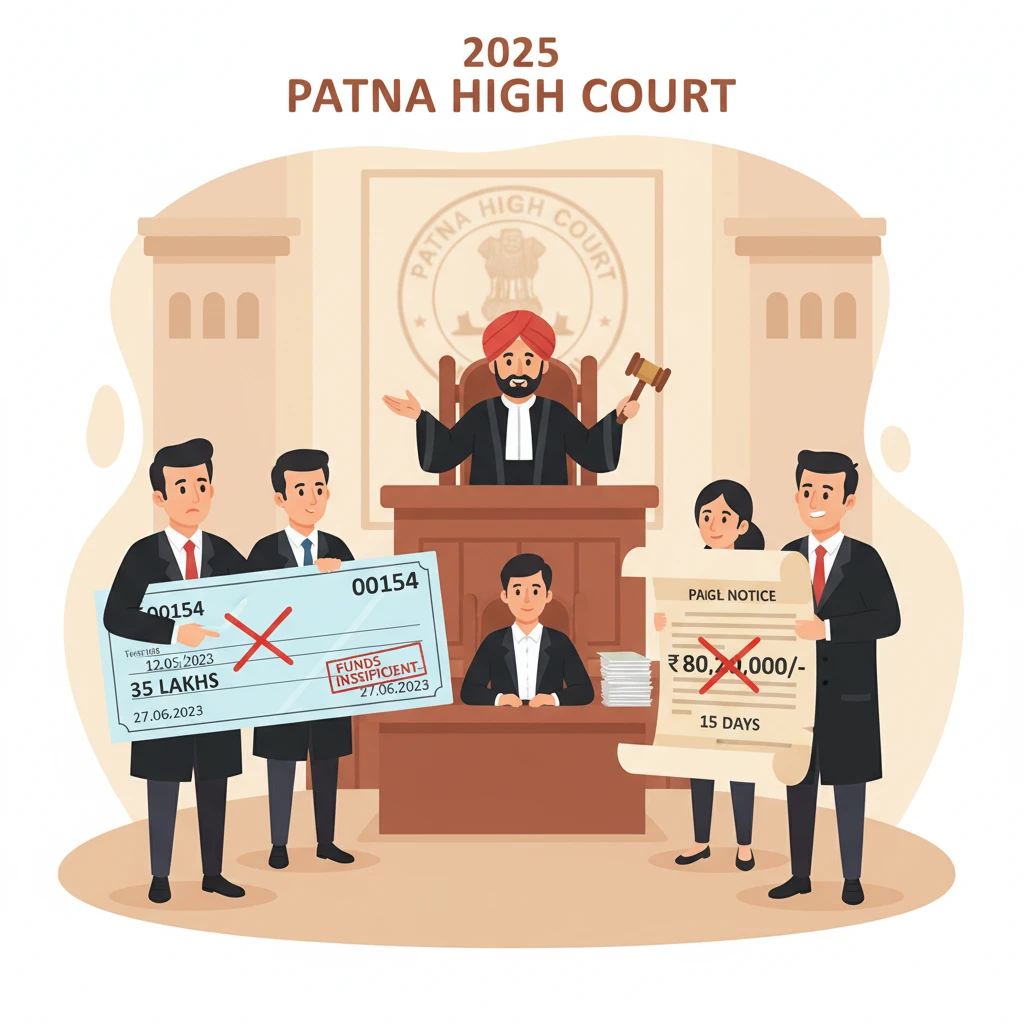
During these dealings, a cheque came to be issued which later got dishonoured. The cheque in question was drawn on Bank of Baroda for an amount of Rs. 35 lakhs, dated 11.05.2023, bearing no. 00154. This cheque was allegedly issued by the petitioner’s side and was presented for encashment, but it was returned unpaid due to insufficient funds.
After the dishonour, opposite party no. 2 served a legal notice dated 26.07.2023 on the petitioner. On the basis of this notice and the subsequent complaint, the learned Judicial Magistrate 1st Class, Siwan, took cognizance for an offence under Section 138 of the Negotiable Instruments Act, 1881, in Complaint Case No. 1619 of 2023, by order dated 12.10.2023.
Feeling aggrieved, the petitioner moved the Patna High Court in Criminal Miscellaneous No. 76684 of 2024, seeking quashing of the cognizance order and all further criminal proceedings arising out of the said complaint case.
What the Court Examined and Decided
The matter came up before Hon’ble Mr. Justice Chandra Shekhar Jha. The Court heard counsel for the petitioner, for the State of Bihar, and for opposite party no. 2.
The central attack by the petitioner was on the validity of the statutory legal notice issued under Section 138(b) of the Negotiable Instruments Act. Under this provision, after a cheque is dishonoured, the payee or holder in due course must make “a demand for the payment of the said amount of money” by written notice to the drawer within thirty days of receiving information about the dishonour.
The phrase “said amount” is crucial. It refers specifically to the amount for which the cheque was drawn and which was dishonoured. If the notice does not clearly demand this cheque amount, the basic condition for launching a complaint under Section 138 is not fulfilled.
The petitioner’s counsel argued that the legal notice issued by opposite party no. 2 did not demand the cheque amount of Rs. 35 lakhs at all. Instead, it demanded a larger figure of Rs. 80,20,000/-, along with interest and other amounts, without clearly linking the demand to the particular cheque which was dishonoured.
To support this contention, the Court carefully examined the text of the notice dated 26.07.2023, which was reproduced in the judgment. The notice was drafted in Hindi. It narrated the business relationship and transactions between the parties, including references to construction work, payments made through bank accounts, and alleged outstanding dues.
The notice recounted that there had been earlier payments from one side to the other under their arrangement. It stated that, according to opposite party no. 2, a sum of Rs. 80,20,000/- remained due towards his share. It also described that a cheque for Rs. 35 lakhs was issued by the petitioner’s side, presented through HDFC Bank, and dishonoured twice for “Funds Insufficient”.
However, when the Court focused on the actual demand portion of the notice, especially paragraph 11 (as indicated at pages 32 to 35 of the record), it found that the notice demanded payment of the entire sum of Rs. 80,20,000/- (eighty lakh twenty thousand rupees), with interest, within fifteen days. The demand was not framed specifically for the cheque amount of Rs. 35 lakhs.
The judgment expressly notes that the notice “nowhere suggest that any demand qua Rs. 35 lacs” was raised, even though Rs. 35 lakhs was the amount of the dishonoured cheque drawn on Bank of Baroda dated 11.05.2023 with cheque no. 00154. There was also no clear description in the notice of the particular cheque which formed the subject matter of the criminal complaint.
The Court then examined Section 138(b) of the Negotiable Instruments Act. The provision, as reproduced in the judgment, requires that:
The payee or holder must “make a demand for the payment of the said amount of money” by giving notice in writing to the drawer within thirty days of receiving information of dishonour.
In simple words, the law insists that the notice must tell the drawer: your cheque for a specific amount has bounced, and you must pay that same amount within the prescribed time. Only if such a notice is properly served and the drawer still does not pay, can a criminal case under Section 138 proceed.
The Court then turned to the Supreme Court judgment in Upasana Mishra Vs. Trek Technology India Pvt. Ltd., reported in 2023 SCC OnLine SC 1740, which was strongly relied upon by the petitioner. Paragraphs 7 and 8 of that decision were reproduced.
In Upasana Mishra, the Supreme Court dealt with a notice that demanded an “omnibus amount” of Rs. 6,50,000/- which was not the cheque amount, along with interest, damages per month, and notice charges. The Supreme Court held that such an omnibus demand, not confined to the cheque amount, did not satisfy Section 138(b). As a result, the notice was held invalid and the criminal proceedings were quashed.
Drawing a clear parallel, the Patna High Court observed that in the present case too, the notice did not demand the “said amount” of the cheque, i.e., Rs. 35 lakhs. Instead, paragraph 11 raised a demand for Rs. 80,20,000/- with interest, which is not the cheque amount involved in the complaint.
The Court specifically recorded that the demand for Rs. 80,20,000/- “is not the ‘said amount’ in terms of Section 138(b) of the Negotiable Instrument Act as discussed above.” On this basis, the Court concluded that the case was fully covered by the ratio in Upasana Mishra.
Because the statutory notice was defective, an essential requirement for maintaining a prosecution under Section 138 NI Act was missing. Without a valid demand notice for the cheque amount, the criminal complaint and the cognizance order could not stand in law.
Although the petitioner had raised other points, such as the nature of the business relationship, the alleged non-compliance with the partnership deed, and the question whether the company should have been made an accused, the Court’s decision turned on the legal notice defect. This single ground was sufficient to dispose of the matter.
Ultimately, the Patna High Court held that the impugned cognizance order dated 12.10.2023 passed by the Judicial Magistrate 1st Class, Siwan, in Complaint Case No. 1619 of 2023 was liable to be set aside. The Court quashed the cognizance order and all consequential proceedings “qua petitioner”, meaning in respect of the petitioner before the High Court.
The Court directed that a copy of the order be sent to the trial court without delay. The judgment was delivered on 25.02.2025, and the uploading and transmission date was recorded as 27.02.2025.
Why This Judgment Matters
This judgment is important for anyone involved in cheque bounce disputes under Section 138 of the Negotiable Instruments Act.
It clarifies that the legal notice after cheque dishonour must clearly demand the exact cheque amount, referred to as the “said amount” in the law. If the notice only demands a larger, overall business due or mixes several amounts together without clearly demanding the cheque amount, the notice can be treated as invalid.
For complainants, this means that even if a large sum is pending in business accounts, the Section 138 notice must separately and clearly ask for the specific cheque amount that bounced. Otherwise, the entire criminal case may collapse at the threshold.
For accused persons, especially business partners and small entrepreneurs, this judgment shows that the Patna High Court is willing to quash proceedings where the basic legal safeguards have not been followed. A defective notice cannot be used as a foundation to pursue criminal liability.
The decision, relying on the Supreme Court’s ruling in Upasana Mishra, reinforces that Section 138 is a strict provision and must be complied with in letter and spirit. It is not enough that some notice is sent; it must be the right kind of notice as the law demands.
Legal Issues and Answers
-
Issue: Whether a cheque bounce prosecution under Section 138 NI Act can continue when the statutory notice does not demand the specific cheque amount (“said amount”) but instead demands a larger outstanding sum.
Answer: No. The Patna High Court held that since the notice demanded Rs. 80,20,000/- instead of the cheque amount of Rs. 35 lakhs and did not clearly describe the cheque, the requirement under Section 138(b) was not satisfied, making the notice invalid. -
Issue: Whether the cognizance order in Complaint Case No. 1619 of 2023 could stand when based on such an invalid notice.
Answer: No. Following the Supreme Court’s decision in Upasana Mishra Vs. Trek Technology India Pvt. Ltd., the Court found the notice defective and quashed the cognizance order dated 12.10.2023 and all consequential proceedings against the petitioner.
Cases Cited by the Court
- Upasana Mishra Vs. Trek Technology India Pvt. Ltd., 2023 SCC OnLine SC 1740
Case Details
Case Number: Criminal Miscellaneous No. 76684 of 2024 (arising out of Complaint Case No. 1619 of 2023, PS Case No. 1619 of 2023, Siwan)
Case Title: Aniket Kumar vs. The State of Bihar & Anr.
Citation: 2025 (2) PLJR 556
Coram: Hon’ble Mr. Justice Chandra Shekhar Jha
Date of Judgment: 25.02.2025
Advocates:
- For the Petitioner: Mr. Rakesh Mohan Singh, Advocate
- For the State / Opposite Party No. 1: Mr. Pramod Kumar Pandey, APP
- For Opposite Party No. 2: Mr. D.K. Sinha, Senior Advocate; Mr. Alexander Ashok, Advocate; Ms. Shyama Rani, Advocate
Nature of the Case: Criminal miscellaneous petition seeking quashing of cognizance order under Section 138 of the Negotiable Instruments Act, 1881.
Link to Judgment: Patna High Court Judgment – Criminal Misc. No. 76684 of 2024
If you found this explanation helpful and wish to stay informed about
how legal developments may affect your rights in Bihar,
you may consider following Samvida Law Associates for more updates.







