

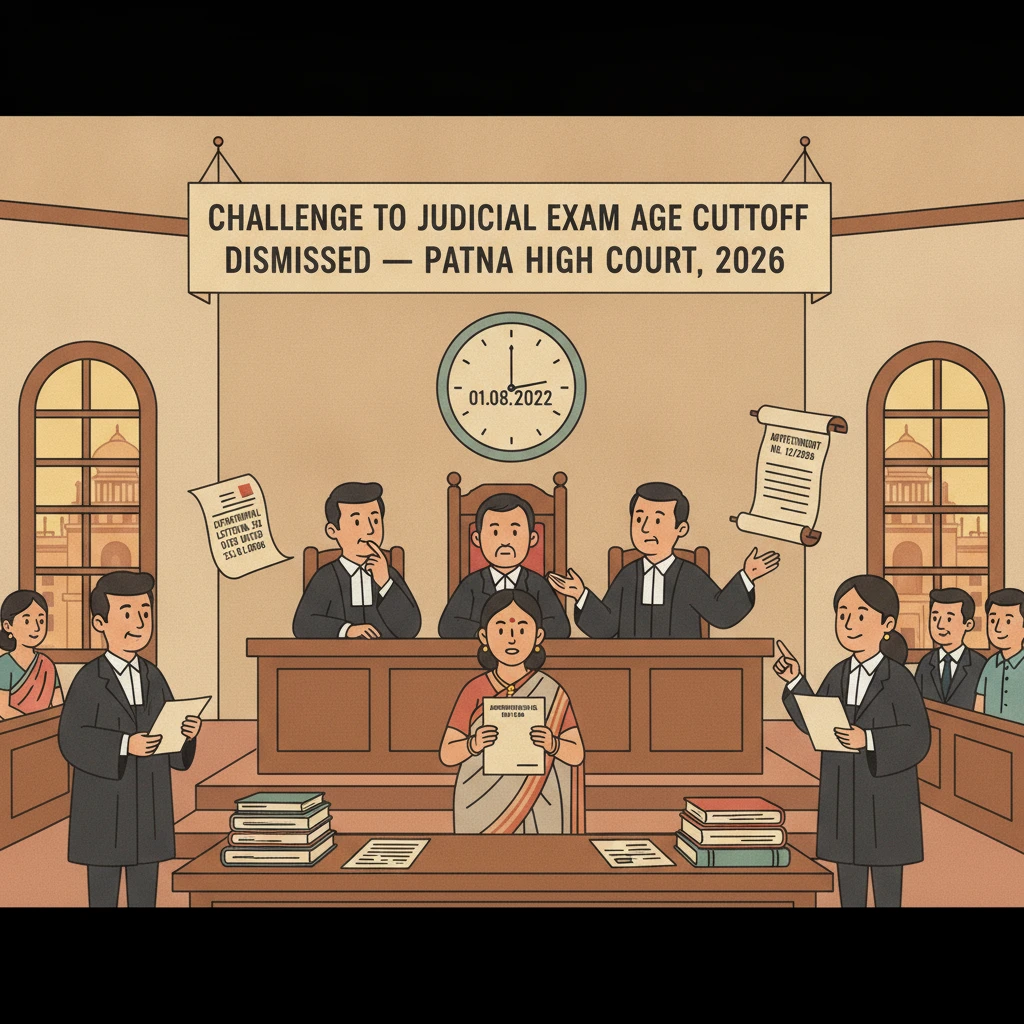
Case Background
The case arose from Advertisement No. 12/2026 issued for the 33rd Bihar Judicial Service Competitive Examination. The advertisement fixed the maximum age eligibility for unreserved women candidates at forty years, with the cut-off date as 01.08.2022.
The petitioner, an unreserved female aspirant for the post of Civil Judge (Junior Division), approached the Patna High Court under Article 226 of the Constitution of India. She challenged Clause 3 of the advertisement to the extent it fixed this cut-off date.
According to her, the fixation of 01.08.2022 as the relevant date for calculating maximum age violated Departmental Letter No. 212 dated 23.01.2006 issued by the Government of Bihar, Department of Personnel and Administrative Reforms. She also claimed that the method of fixing the cut-off date in the impugned advertisement was inconsistent with the pattern followed in the advertisements for the 31st and 32nd Bihar Judicial Service Examinations.
The petitioner asked the Court to quash Clause 3 of Advertisement No. 12/2026 and direct the authorities to fix the cut-off date for maximum age as 01.08.2020 instead of 01.08.2022.
What the Court Examined and Decided
The Bench comprising Hon’ble the Chief Justice and Hon’ble Mr. Justice Harish Kumar heard the matter. The Patna High Court, the State of Bihar and the Bihar Public Service Commission (BPSC) were all represented by counsel.
On behalf of the petitioner, learned Senior Advocate Mr. Mrigank Mauli argued that the State’s General Administration Department had already laid down a clear policy on age cut-off in recruitment through Letter No. 212 dated 23.01.2006. This letter, he submitted, required yearly review of vacancies and forwarding of requisitions to BPSC or the relevant recruitment agency.
He emphasised that the letter further provided that if vacancies were not reviewed each year and requisitions were not forwarded, candidates who had met the age criteria under the previous advertisement but later crossed the age limit before a fresh advertisement should not be denied the chance to appear. In simple terms, if the State delayed issuing a new advertisement, the candidate should not suffer because her age just crossed the limit during that gap.
To support this, he pointed out that the last advertisement for Civil Judge (Junior Division) before the present one was Advertisement No. 23/2023 for the 32nd Bihar Judicial Service Examination. Before that, Advertisement No. 04/2020 had been issued for the 31st examination.
In Advertisement No. 23/2023, Clause 3 fixed the maximum age for unreserved female candidates at forty years with a cut-off date of 01.08.2019. In Advertisement No. 04/2020 for the 31st examination, the same maximum age of forty years applied to unreserved women, with the cut-off date of 01.08.2018.
The petitioner argued that, going by the same logic and in line with the 2006 Departmental Letter, the cut-off date for the 33rd examination should have been 01.08.2020. She claimed that fixing 01.08.2022 as the cut-off was arbitrary, contrary to the policy in the 2006 letter, and had directly prevented her from appearing in the examination.
On the other side, counsel for the Patna High Court, Mr. Piyush Lall, submitted that the writ petition was misconceived and not legally tenable. He relied on the 3rd proviso to Rule 4 and Rule 6(a) of the Bihar Civil Service (Judicial Branch) (Recruitment) Rules, 1955, which govern recruitment to the Bihar Judicial Service.
He also pointed out that a similar issue had already been considered and clarified by a co-ordinate Bench of the Patna High Court in C.W.J.C. No. 5619 of 2020 (Ram Milan Thakur v. The State of Bihar & Ors.) and C.W.J.C. No. 5638 of 2020 (Vijaya Jaiswal & Ors. v. The State of Bihar & Ors.), where challenges to Clause 3 of Advertisement No. 04/2020 were rejected.
The State and the BPSC supported these submissions and opposed the relief sought by the petitioner.
The Court then examined the relevant statutory rules. The Bihar Civil Service (Judicial Branch) (Recruitment) Rules, 1955 were framed under Article 234 of the Constitution and have been amended from time to time after consultation with the Patna High Court and BPSC. These rules regulate recruitment to the Bihar Civil Service (Judicial Branch).
Rule 4 requires the Commission to announce each year the number of vacancies to be filled by direct recruitment on the basis of a competitive examination and to invite applications from eligible candidates. The 3rd proviso to Rule 4 states that if a common competitive examination is conducted for a particular year or years as a special case, then an applicant is entitled to upper age relaxation so long as the applicant was eligible in that recruitment year for which the common examination is being held.
More crucial for this case was Rule 6(a), substituted by notification no. 7733 dated 03.10.2000 and further amended by notification no. 17283 dated 28.12.2016. Rule 6(a) provides that a candidate must be over 22 years and under 35 years of age on the 1st day of August in the preceding year in which the examination is held. For candidates belonging to reserved categories, including women and orthopedically disabled candidates, the maximum age is 40 years on the same date. It also limits the number of chances for non-reserved candidates.
After carefully reading Rule 6(a), the Court held that the cut-off date for both minimum and maximum age is clearly fixed as the first day of August in the preceding year of the examination. This is a statutory rule and not merely an administrative guideline.
The Court then compared the three advertisements placed on record. In the 32nd Bihar Judicial Service Competitive Examination (Advertisement No. 23/2023), the maximum age for unreserved female candidates was forty years with a cut-off date of 01.08.2019. In the 31st examination (Advertisement No. 04/2020), the maximum age was again forty years with a cut-off date of 01.08.2018.
The Court concluded that in all three advertisements, including the present Advertisement No. 12/2026, the authorities had fixed the cut-off date strictly in line with Rule 6(a). For Advertisement No. 23/2023, the preceding year to the 2020 examination was 2019, hence 01.08.2019. For Advertisement No. 04/2020, the preceding year was 2018, hence 01.08.2018. For the 33rd examination under Advertisement No. 12/2026, the earlier examination had been held in 2023. Therefore, as per the rule, the cut-off date for maximum age of forty years was correctly taken as 01.08.2022.
The Bench agreed with Mr. Lall’s submission that the very same issue had already been settled in Ram Milan Thakur and Vijaya Jaiswal. In those writ petitions, candidates had asked the Court to quash Clause 3 of Advertisement No. 04/2020, raising similar grievances about age cut-off. The co-ordinate Bench had rejected those claims after explaining the mandate of Rule 6(a).
In that earlier decision, the Patna High Court had also relied on the Supreme Court judgment in Dr. Ami Lal Bhat v. State of Rajasthan and Ors., (1997) 6 SCC 614. The Supreme Court had held that fixing a cut-off date for determining maximum or minimum age is within the discretion of the rule-making authority or employer. Such a date cannot be tailored with mathematical precision so as to avoid hardship in every possible case.
The Supreme Court further observed that whenever a cut-off date is fixed, some candidates will fall just within it and some just outside it. That, by itself, does not make the cut-off date arbitrary, unless it is so unreasonable as to be wholly irrational. Mere hardship to some candidates does not make a statutory provision illegal, capricious or arbitrary.
Applying these principles, the Patna High Court in the present case held that any interpretation of Letter No. 212 dated 23.01.2006 which goes against the clear language of the 1955 Rules, especially Rule 6(a), is not permissible. Administrative letters must operate within the framework of the statutory rules, not override them.
The Court therefore ruled that Clause 3 of Advertisement No. 12/2026, including the fixation of 01.08.2022 as the cut-off date for maximum age, is fully consistent with the statutory rules and earlier judicial precedent. The petitioner’s grievance, though understandable on individual hardship, had no legal basis.
On this reasoning, the Court found the writ petition to be without merit and dismissed it.
Why This Judgment Matters
This judgment is important for all aspirants of the Bihar Judicial Service and other government recruitments in Bihar. It clarifies that where statutory recruitment rules clearly fix a cut-off date for age, that date will govern, even if some candidates feel unfairly excluded.
The decision reinforces that administrative letters or circulars, such as the 2006 letter relied on by the petitioner, cannot override or contradict statutory rules framed under constitutional authority. Any benefit under such letters must be read in harmony with the rules, not against them.
The Patna High Court also reiterates the principle that hardship to individual candidates, including those who cross the age limit due to delay in holding examinations, is not enough to strike down a rule-based cut-off date. Unless the cut-off date is plainly unreasonable or contrary to the rules, courts will not interfere.
For candidates, this means that they must carefully check the relevant recruitment rules, especially provisions like Rule 6(a) in the Bihar Civil Service (Judicial Branch) (Recruitment) Rules, 1955. Expectations created by past advertisements or administrative letters cannot override the statutory framework.
Legal Issues and Answers
Issue: Was the fixation of 01.08.2022 as the cut-off date for maximum age in Clause 3 of Advertisement No. 12/2026 for the 33rd Bihar Judicial Service Competitive Examination arbitrary or contrary to Departmental Letter No. 212 dated 23.01.2006?
Answer: No. The Patna High Court held that the cut-off date strictly followed Rule 6(a) of the Bihar Civil Service (Judicial Branch) (Recruitment) Rules, 1955, and could not be displaced by the 2006 departmental letter. The writ petition was dismissed.
Issue: Can administrative instructions or letters be interpreted in a manner that overrides or contradicts statutory recruitment rules?
Answer: No. The Court held that Letter No. 212 dated 23.01.2006 must be interpreted in consonance with the 1955 Rules, especially Rule 6(a). Any contrary interpretation is impermissible.
Issue: Does individual hardship of candidates who become overage make an age cut-off date arbitrary or unconstitutional?
Answer: No. Following the Supreme Court in Dr. Ami Lal Bhat, the Court held that some hardship is inevitable when a cut-off date is fixed, and this alone does not render the provision arbitrary.
Cases Cited by the Court
- Ram Milan Thakur v. The State of Bihar & Ors., C.W.J.C. No. 5619 of 2020 (Patna High Court).
- Vijaya Jaiswal & Ors. v. The State of Bihar & Ors., C.W.J.C. No. 5638 of 2020 (Patna High Court).
- Dr. Ami Lal Bhat v. State of Rajasthan and Ors., (1997) 6 Supreme Court Cases 614.
Case Details
Case Number: Civil Writ Jurisdiction Case No. 6500 of 2026
Case Title: Kiran Kumari v. The State of Bihar & Ors.
Coram: Hon’ble the Chief Justice; Hon’ble Mr. Justice Harish Kumar (oral judgment per Hon’ble Mr. Justice Harish Kumar)
Date of Judgment: 29.04.2026
Citation: 2026 (3) PLJR 408
Advocates:
- For the petitioner: Mr. Mrigank Mauli, Senior Advocate; Mr. Sushant Praveer, Advocate.
- For the State of Bihar: Mr. Kinkar Kumar, Standing Counsel No. 9; Mr. Shashank Shekhar Dubey, AC to SC-9.
- For the Bihar Public Service Commission: Mr. Sanjay Pandey, Advocate.
- For the Patna High Court: Mr. Piyush Lall, Advocate.
Nature of the Case: Writ petition under Article 226 of the Constitution of India challenging conditions in a recruitment advertisement for the Bihar Judicial Service.
Link to Full Judgment: Click here to read the judgment on the Patna High Court website
If you found this explanation helpful and wish to stay informed about
how legal developments may affect your rights in Bihar,
you may consider following Samvida Law Associates for more updates.







