
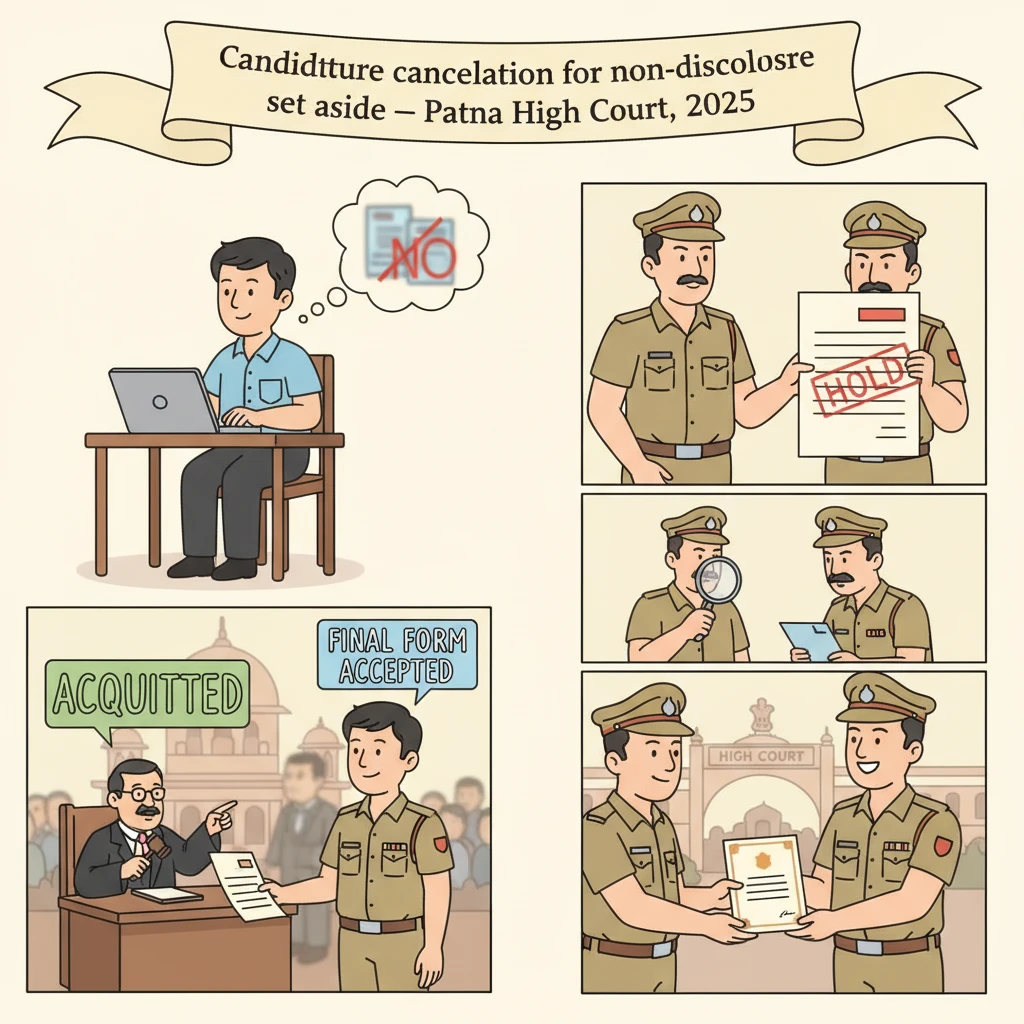
Case Background
The petitioner applied for the post of Assistant Sub Inspector in the Bihar Police, pursuant to Advertisement No. 01/2017 issued by the Bihar Police Sub-Ordinate Services Commission.
Along with the application, candidates had to fill an acknowledgment form giving clear answers about any criminal case, FIR, arrest, trial, conviction, acquittal, or bond for good behaviour.
In this acknowledgment, the petitioner answered “No” to all questions about any past or pending criminal case, arrest, trial, conviction, acquittal or bond.
The petitioner cleared the preliminary exam, mains exam and the physical test. He was then selected for the post of Assistant Sub Inspector through Memo No. 211/Commission dated 09.03.2019 issued by the Commission, with directions to join with original documents and identity proof.
On 27.05.2019, the petitioner submitted his joining along with a declaration form. During verification on 27.04.2019, he disclosed two criminal cases from Wazirganj Police Station: Case No. 50 of 2011 and Case No. 111 of 2019.
After this disclosure, the Deputy Superintendent of Police (Home), I.G. Office, Magadh Range, Gaya, by Memo No. 1412 dated 03.09.2019, kept his joining “on hold” till final disposal of the criminal cases.
Subsequent inquiries, and a fresh character verification report from the Senior Superintendent of Police, Gaya, showed that the petitioner had been acquitted in Case No. 50 of 2011 and that Case No. 111 of 2019 was found “not true” against him, with final form submitted and accepted by the court.
Despite these outcomes, the Deputy Inspector General of Police (Abhiyaan), Special Work Force, Bihar (respondent no. 4), by Memo No. 22 dated 25.01.2021, cancelled the petitioner’s candidature, declaring him ineligible for the post due to “concealment” of criminal cases in the initial acknowledgment.
What the Court Examined and Decided
The Patna High Court, presided over by Hon’ble Mr. Justice Harish Kumar, focused on one central question: whether the petitioner’s failure to mention his criminal cases in the online acknowledgment form amounted to suppression or fraud serious enough to permanently disqualify him from police service.
First, the Court recorded the undisputed factual sequence. In the acknowledgment form, the petitioner had ticked “No” to all five criminal-antecedent questions. Later, during character verification, he voluntarily disclosed:
(a) Wazirganj P.S. Case No. 50 of 2011 under Sections 447, 341, 307, 504 and 354/34 IPC, which ended in acquittal by judgment dated 30.08.2019 in Sessions Trial No. 154 of 2016; and
(b) Wazirganj P.S. Case No. 111 of 2019 under Sections 341, 323, 354 and 504/34 IPC, in which he was not originally an accused, his name surfaced in investigation, but the final form (Final Form No. 127/2019 dated 06.07.2019) found the case not true against him and was accepted by the court.
The petitioner argued that he made a mistake at the time of filling the computer-based form because he was not well acquainted with computers. He stressed that he himself disclosed the cases during verification, which triggered detailed character reports. Those reports confirmed that no case was pending and he had no adverse finding of guilt.
He also argued that the underlying disputes were trivial rural quarrels, one over unauthorized grazing of cattle in the family field and the other involving minor scuffle and abuse between two groups. He submitted that such cases, ending in acquittal or closure, should not ruin a young person’s entire career, especially when he later told the truth.
The petitioner relied on several Supreme Court judgments: Avtar Singh v. Union of India, Commissioner of Police v. Sandeep Kumar, Commissioner of Police Delhi v. Dhaval Singh, Rajasthan Rajya Vidyut Prasaran Nigam Ltd. v. Anil Kanwariya, Pawan Kumar v. Union of India, and Ravindra Kumar v. State of UP. He also placed reliance on two Single Judge decisions of the Patna High Court in Sonu Kumar v. State of Bihar and Rakesh Kumar Singh v. State of Bihar, where similar non-disclosure in the original form was later corrected in character verification forms and cancellation of candidature was set aside.
The State and the Commission took a strong stand that police recruitment demands the highest standards of integrity and transparency. They argued that any misrepresentation about criminal cases, even if later disclosed or even if the candidate is acquitted, damages public trust in the police.
They heavily relied on Rule 673 and Rule 668 of the Bihar Police Manual:
Rule 673 provides that a verification roll must show that the candidate’s statement about his antecedents is truthful, and if the character is reported bad or the statement false, “he shall be removed from the force”.
Rule 668 requires truthful character verification and states that any false declaration about criminal antecedents makes a candidate ineligible.
The State argued that the petitioner clearly answered “No” to all questions at the application stage, despite having a criminal case pending. This, according to them, was deliberate suppression and violated the Bihar Police Manual, justifying cancellation. They cited Avtar Singh and the Supreme Court’s judgment in State of Madhya Pradesh v. Parvez Khan, and also referred to a Patna High Court decision in Union of India v. Bindeshwari Prasad, where non-disclosure led to rejection.
The Court then turned to the settled legal principles from the Supreme Court on suppression of criminal antecedents in public employment. It noted:
In Devendra Kumar v. State of Uttaranchal, the Supreme Court held that suppressing information about a pending criminal case is itself an act of moral turpitude, distinct from the case itself, and can justify termination even if the person is later acquitted or discharged.
In S.P. Chengalvaraya Naidu v. Jagannath, the Supreme Court stated that appointments obtained by misrepresentation or fraud cannot be sustained in law.
However, the Court also examined a long line of decisions — Jainendra Singh, Avtar Singh, Mohammed Imran, Ravindra Kumar, Umesh Chandra Yadav, Satish Chandra Yadav — which clarify that:
Character and antecedent verification is essential, especially for disciplined forces.
Every case of non-disclosure is not to be treated mechanically; the employer must act reasonably and consider special circumstances.
In trivial cases, especially where there is acquittal and the candidate later discloses facts truthfully, the employer may in its discretion condone the lapse.
Even where disclosure is complete, employers may still refuse appointment if antecedents show unsuitability; but where non-disclosure occurs, authorities must still look at the seriousness of the case, the stage of proceedings, and the nature of the post.
In Sandeep Kumar and Dhaval Singh, the Supreme Court particularly emphasised that “youth will be youth”, minor indiscretions when young should not brand someone as a criminal for life, and that later truthful disclosure can be considered as curing an initial defect.
The Patna High Court then applied these principles to the facts.
It noted that:
At the time of final decision by respondent no. 4, there was no pending criminal case and no conviction against the petitioner.
The cases were trivial in nature, arising out of a small dispute over cattle grazing and a scuffle between groups.
The petitioner had voluntarily disclosed the cases at the time of character verification, which led authorities to put his joining on hold, not to immediately cancel his candidature.
The Senior Superintendent of Police, Gaya, in the fresh verification report dated 08.09.2020, clearly recorded the acquittal and the closure of the other case as “not true” against him.
The Court accepted the reasoning in Sonu Kumar and Rakesh Kumar Singh that non-disclosure in the initial form, if later rectified in the character verification form by truthful disclosure, should not automatically be treated as fatal.
The Court further took note of a proposed resolution dated 09.09.2024 issued by the Deputy Inspector General of Police, Administration, Bihar, Patna, aligning with Avtar Singh, stating that in cases of non-disclosure, the appointing authority must take a decision on the merits of each case.
In light of this framework, the Court held that the authority, while cancelling the candidature, failed to consider the special facts and circumstances objectively. It emphasized that the exercise of power must be reasonable and not mechanical, especially when the petitioner was about 22 years old at the time of filling the form and had later come clean during verification.
The Court distinguished the Supreme Court’s judgment in Anil Kanwariya. In that case, the candidate was already convicted when he applied, suppressed the conviction, and only later sought relief under the Probation of Offenders Act. Here, by contrast, the petitioner voluntarily disclosed his cases at verification stage and had been acquitted or found innocent before the final decision on his appointment.
Ultimately, the Patna High Court concluded that the cancellation order, Memo No. 22 dated 25.01.2021, could not stand. It set aside the order and directed respondent no. 4 to reconsider the petitioner’s candidature afresh in light of the Court’s observations and the legal principles laid down by the Supreme Court.
Why This Judgment Matters
This judgment matters for thousands of young job-seekers in Bihar, especially those applying for police and other disciplined forces.
It confirms that while honesty in forms is very important, authorities cannot treat every mistake in the same harsh way. Where a candidate later tells the full truth, the criminal cases are trivial, and there is acquittal or closure, the authority must look at the entire situation before ruining a career.
For candidates, the message is clear: always disclose criminal cases honestly. But if a genuine mistake happens and is later corrected, this judgment of the Patna High Court shows that there is still scope for fair reconsideration, not automatic rejection.
For departments, the decision reinforces that rules like those in the Bihar Police Manual must be applied with reason and in line with Supreme Court guidance in Avtar Singh, Sandeep Kumar and other cases. A mechanical “one-size-fits-all” approach to non-disclosure is not acceptable.
Legal Issues and Answers
- Issue: Does failure to disclose pending or past criminal cases in the initial application form, later voluntarily disclosed in character verification, amount to such grave suppression that it justifies automatic cancellation of candidature for police service?
Answer: The Patna High Court held that in the facts of this case, considering the petitioner’s later voluntary disclosure, the trivial nature of the cases, and his acquittal/innocence, automatic cancellation was not justified. The cancellation order was set aside, and the authority was directed to reconsider the candidature objectively. - Issue: Are the Bihar Police Manual Rules 668 and 673 to be applied mechanically whenever there is any false or incomplete disclosure of criminal antecedents?
Answer: The Court held that while these Rules demand truthfulness and allow removal where statements are false, their application must be consistent with Supreme Court guidance. Authorities must examine the nature of the offence, stage and outcome of the case, later disclosures, and the overall facts instead of applying a rigid thumb rule.
Cases Cited by the Court
- Avtar Singh v. Union of India and Others, (2016) 8 SCC 471
- Commissioner of Police and Others v. Sandeep Kumar, (2011) 4 SCC 644
- Commissioner of Police Delhi and Another v. Dhaval Singh, (1999) 1 SCC 246
- Rajasthan Rajya Vidyut Prasaran Nigam Ltd. v. Anil Kanwariya, (2021) 10 SCC 136
- Pawan Kumar v. Union of India, (2023) 12 SCC 317
- Ravindra Kumar v. State of UP and Others, (2024) 5 SCC 264
- State of Madhya Pradesh v. Parvez Khan, (2015) 2 SCC 591
- Devendra Kumar v. State of Uttaranchal and Others, (2013) 9 SCC 363
- S.P. Chengalvaraya Naidu v. Jagannath, (1994) 1 SCC 1
- Jainendra Singh v. State of U.P. Tr. Prinl. Sec. Home and Others, (2012) 8 SCC 748
- Mohammed Imran v. State of Maharashtra and Others, (2019) 17 SCC 696 (as quoted in Ravindra Kumar)
- Umesh Chandra Yadav v. Northern Railway, (2022) 14 SCC 244
- Satish Chandra Yadav v. Union of India and Others, (2023) 7 SCC 536
- Sonu Kumar v. The State of Bihar and Others, C.W.J.C. No. 6827 of 2023 (Patna High Court)
- Rakesh Kumar Singh v. The State of Bihar and Others, C.W.J.C. No. 15943 of 2023 (Patna High Court)
- The Union of India and Others v. Bindeshwari Prasad, C.W.J.C. No. 10560 of 2019 (Patna High Court, as referred)
Case Details
Case Number: Civil Writ Jurisdiction Case No. 12746 of 2021
Case Title: Umesh Kumar Chaudhary v. The State of Bihar & Ors.
Coram: Hon’ble Mr. Justice Harish Kumar
Citation: 2025 (2) PLJR 713
Advocates:
- For the Petitioner: Mr. Ranjeet Kumar, Advocate
- For the State of Bihar: Mr. Suman Kumar Jha, AC to AAG-3
- For the Bihar Police Sub-Ordinate Services Commission: Mr. Vivek Anand Amritesh, Advocate
Nature of the Case: Writ petition (service/recruitment – cancellation of candidature for Assistant Sub Inspector post in Bihar Police)
Date of Judgment: 27-03-2025
Court: High Court of Judicature at Patna
Final Outcome: Impugned cancellation order (Memo No. 22 dated 25.01.2021) set aside; respondent no. 4 directed to reconsider the petitioner’s candidature afresh. Writ petition allowed; no order as to costs.
Link to judgement; https://patnahighcourt.gov.in/viewjudgment/MTUjMTI3NDYjMjAyMSMxI04=-ZYIKAorLUAc=
If you found this explanation helpful and wish to stay informed about
how legal developments may affect your rights in Bihar,
you may consider following Samvida Law Associates for more updates.







