

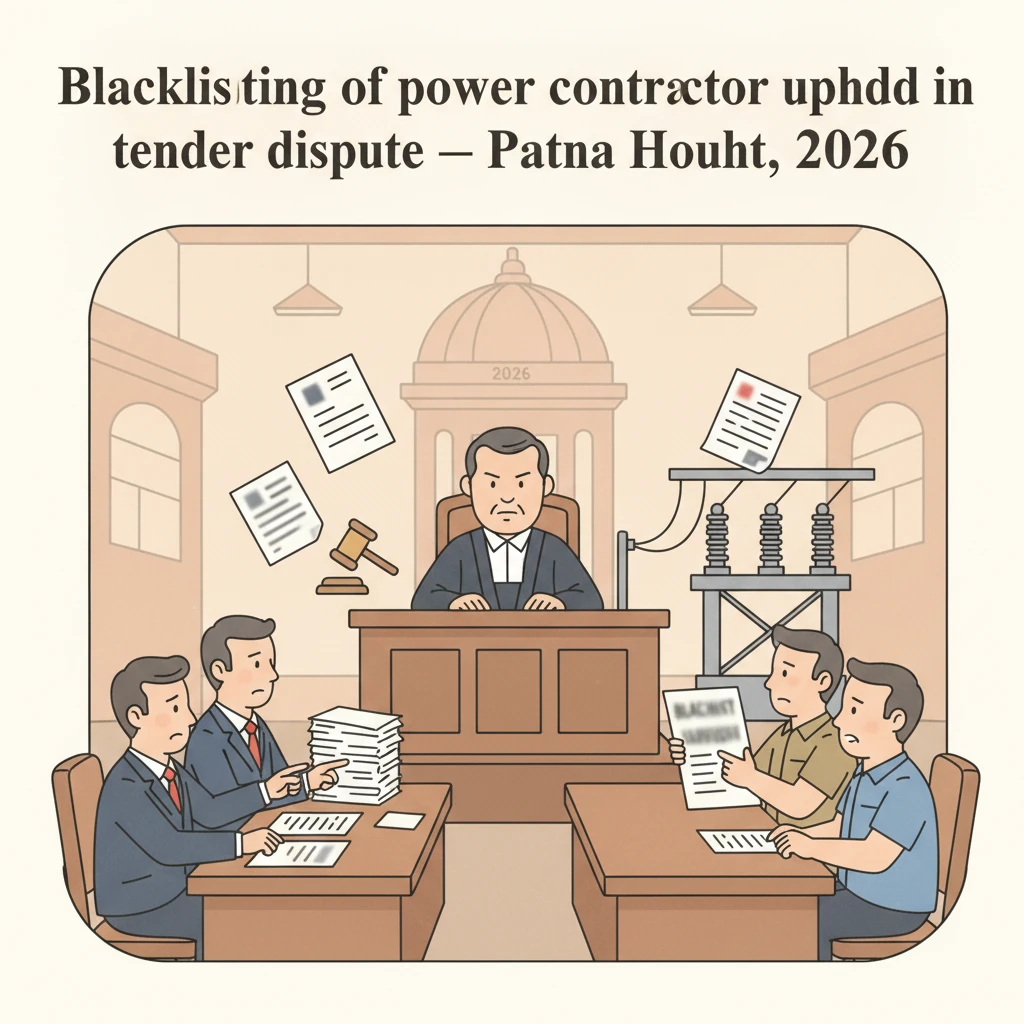
Case Background
The case arose from a government tender issued by South Bihar Power Distribution Company Limited (SBPDCL) for construction of five 2×5 MVA, 33/11 KV power sub-stations with associated 33 KV and 11 KV lines in Nalanda and Patna districts.
Gupta Power Infrastructure Limited, a registered company and contractor, participated in this tender, which was floated under NIT No. 42/PR/SBPDCL/2019.
After the tender process, SBPDCL awarded the work to the contractor through two Letters of Award, both dated 19.09.2019. These covered two broad parts of the work: first, supply of materials and equipment for construction of three 2×5 MVA, 33/11 KV power sub-stations with associated lines; and second, erection, installation, testing and commissioning of those works.
Two separate Contract Agreements, No. 07/2019 and No. 08/2019, both dated 16.10.2019, were then signed between the parties. The work concerned three locations: Kosiyawan, Jaitipur and Kaladiyara. The completion period was linked to the date of award or handing over of land.
During execution, the contractor completed the works at Kosiyawan and Jaitipur, including supply, civil work, erection and commissioning of 2×5 MVA, 33/11 KV sub-stations and associated lines. These sub-stations were taken over by SBPDCL and made operational.
However, the work at Kaladiyara, which was of similar nature, remained partly completed. Over time, SBPDCL grew dissatisfied with the slow progress there.
According to the judgment, notices dated 13.11.2024 and 21.11.2024 were issued to the contractor asking for an explanation regarding non-completion of the Kaladiyara work. Finally, on 31.12.2024, SBPDCL passed an order terminating the contracts, invoking the performance bank guarantee, blacklisting the contractor for a defined period, and directing that the remaining work would be completed through other means.
The contractor approached the Patna High Court under Article 226 of the Constitution, filing a writ petition to challenge this order and seek several related reliefs.
What the Court Examined and Decided
The contractor challenged Letter No. 2311 dated 31.12.2024, issued by the Chief Engineer, Project‑I (Rural), SBPDCL. This letter cancelled the remaining work under the Letters of Award dated 19.09.2019, ordered invocation of bank guarantees, and blacklisted the contractor for three years.
The contractor argued that this action was arbitrary and illegal, and that it violated principles of natural justice. It also claimed that SBPDCL had no legal power to blacklist it because neither the NIT, nor the Letters of Award, nor the Agreements contained any clause authorising blacklisting.
On the other hand, SBPDCL’s counsel submitted that several notices had been issued to the contractor under Clause 39 of the NIT. These notices, dated 10.09.2024, 13.11.2024 and 21.11.2024, clearly mentioned possible actions such as termination and blacklisting.
SBPDCL argued that the contractor had been given enough chances to explain and improve its performance. The reply it finally submitted was considered by the competent authority, and the final order dated 31.12.2024 was a reasoned, speaking order based on the record.
On the legal question of whether SBPDCL could blacklist without a specific clause in the contract, the power company relied on Supreme Court decisions in Kulja Industries Limited v. Chief General Manager, Western Telecom Project Bharat Sanchar Nigam Limited and others, and Patel Engineering Limited v. Union of India and another.
The Patna High Court identified two main issues. First, could the State or its instrumentalities blacklist a contractor even when the NIT or agreement did not expressly provide such a power? Second, was the impugned order dated 31.12.2024 passed in compliance with principles of natural justice, including adequate show cause notice and proper consideration of the contractor’s reply?
On the first issue, the Court held that the point was already settled. Even without an express clause in the NIT or contract, a State instrumentality retains an inherent executive power to blacklist a contractor.
The Court emphasised that this power is not unlimited. It must be used fairly, reasonably and in a non‑arbitrary manner. There must be a clear and specific show cause notice, disclosure of the grounds, a meaningful opportunity of hearing, and the final order must be reasoned, proportionate and based on relevant material.
The Court referred to the Supreme Court’s discussion in Kulja Industries, where blacklisting was described as a business decision by which the party affected by breach chooses not to enter into further contracts with the defaulting party. The Supreme Court had held that while private parties can take such a decision freely, State entities are bound by principles of natural justice and proportionality, and their decisions are open to judicial review.
The Patna High Court also relied on Patel Engineering, which built upon the earlier Erusian Equipment & Chemicals Ltd. decision. The Supreme Court had held that the power to blacklist flows from Article 298 of the Constitution, which grants the executive power to carry on trade and make contracts. The only limitation is that the State must act fairly and rationally, in line with Article 14.
Based on these authorities, the Patna High Court concluded that SBPDCL, as an instrumentality of the State, was legally competent to initiate and pass an order of blacklisting, even in the absence of a specific clause in the NIT or contract documents.
On the second issue, the Court turned to the factual record of notices and opportunities given to the contractor.
From the impugned order, the Court noted that SBPDCL had repeatedly asked the contractor in weekly and monthly review meetings to expedite the work at the three sub‑station sites. Beyond meetings, several formal communications were issued.
Letter No. 247 dated 06.03.2023 called upon the contractor to show cause why it should not be debarred or blacklisted. In response, the contractor gave an undertaking that it would complete the Kaladiyara power sub‑station by 31.06.2023 and requested that no debarment action be taken.
Even after this self‑given timeline expired, the work did not show significant progress. As a result, SBPDCL debarred the contractor from participating in future tenders until completion of the project or for two years, through Letter No. 263 dated 28.02.2024.
Subsequently, SBPDCL issued a series of termination notices under Clause 39 of the NIT:
Letter No. 607 dated 13.05.2024, giving 30 days’ time; Letter No. 1447 dated 10.09.2024, giving 15 days; Letter No. 1920 dated 13.11.2024, giving 7 days; and finally Letter No. 1963 dated 21.11.2024, giving 48 hours’ final notice and specifically mentioning possible termination, invocation of bank guarantee and blacklisting.
The Court recorded that the contractor did not reply to the earlier notices. Only after receipt of the final notice dated 21.11.2024 did it submit its reply through Letter No. 328 dated 23.11.2024.
SBPDCL examined this reply and found it unsatisfactory. The impugned order then discussed the physical progress of work and noted that out of three allotted power sub‑stations, only two had been completed even after more than five years from commencement of the project.
The authority concluded that the delay was due to consistent non‑performance and negligence on the part of the contractor, despite repeated opportunities.
The High Court referred again to the Supreme Court rulings in Kulja Industries, Patel Engineering and Erusian Equipment, which require that before blacklisting, the affected party must be given notice and a reasonable opportunity of hearing.
Applying these principles, the Court found that in this case repeated notices were issued over a long period, the proposed actions including blacklisting were clearly stated, and the contractor was given a chance to explain. The reply was considered, and the final order contained reasons. The Court held that the order could not be described as cryptic or non‑speaking.
Therefore, the Court concluded that the requirements of natural justice had been adequately satisfied. The decision of SBPDCL to terminate the contract, invoke the bank guarantee and blacklist the contractor did not warrant interference in writ jurisdiction.
On the contractor’s complaint about non‑payment of dues for work already completed, the Court did not grant direct relief. Instead, it gave the contractor liberty to avail such remedy as may be available under law before the appropriate forum or authority.
In the end, the writ application was dismissed, and any pending applications were also disposed of.
Why This Judgment Matters
This judgment is important for contractors and government bodies dealing with public works contracts in Bihar and beyond.
First, it confirms that government companies like SBPDCL can blacklist a contractor even if the tender or contract is silent on blacklisting. The power comes from the State’s general executive authority, not only from contract clauses.
Second, it shows that courts will closely check whether the contractor was given a fair chance before such harsh action is taken. Here, the long series of letters, review meetings and show‑cause notices convinced the Patna High Court that natural justice was followed.
Third, it signals to contractors that simply completing part of the work, or giving assurances that are not honoured, may not be enough to avoid blacklisting where delays are serious and persistent.
Finally, the judgment leaves space for contractors to pursue payment disputes through other legal forums, even if their challenge to blacklisting fails in writ proceedings.
Legal Issues and Answers
Issue: Can SBPDCL, as a State instrumentality, blacklist a contractor when the NIT and contract documents do not contain any express blacklisting clause?
Answer: Yes. The Patna High Court held that the State and its instrumentalities have inherent executive power to blacklist contractors, as recognised by the Supreme Court in Kulja Industries and Patel Engineering, provided the power is exercised fairly and in compliance with natural justice.
Issue: Was the impugned order dated 31.12.2024 passed in violation of principles of natural justice?
Answer: No. The Court found that repeated notices, including specific show‑cause notices mentioning proposed blacklisting, were issued, the contractor had an opportunity to reply, its explanation was considered, and the final order was reasoned. Therefore, natural justice was satisfied.
Issue: Did the circumstances justify interference with SBPDCL’s decision in writ jurisdiction?
Answer: No. Given the prolonged delay, repeated opportunities, and compliance with due process, the Court held that the decision did not suffer from arbitrariness warranting interference under Article 226.
Cases Cited by the Court
- Kulja Industries Limited v. Chief General Manager, Western Telecom Project Bharat Sanchar Nigam Limited and others, (2014) 14 SCC 731.
- Patel Engineering Limited v. Union of India and another, (2012) 11 SCC 257.
- Erusian Equipment & Chemicals Ltd. v. State of West Bengal, (1975) 1 SCC 70 (discussed within Patel Engineering).
Case Details
Case Number: Civil Writ Jurisdiction Case No. 2966 of 2025
Case Title: Gupta Power Infrastructure Limited v. The South Bihar Power Distribution Company Limited and others
Citation: 2026 (3) PLJR 642
Coram: Hon’ble Mr. Justice Sudhir Singh; Hon’ble Mr. Justice Shailendra Singh
Date of Judgment: 13.05.2026
Advocates: Mr. Anjani Kumar Jha, Advocate for the petitioner; Mr. Anand Kumar Ojha, Senior Advocate, with Mr. Ashok Kumar, Advocate, and Mr. Abhishek Raj, Advocate, for the respondents.
Nature of the Case: Writ petition under Article 226 of the Constitution challenging termination of contract, blacklisting order, invocation of bank guarantees, and related actions in relation to a power sub‑station construction project.
Link to Judgment: Patna High Court official judgment link
If you found this explanation helpful and wish to stay informed about
how legal developments may affect your rights in Bihar,
you may consider following Samvida Law Associates for more updates.







