
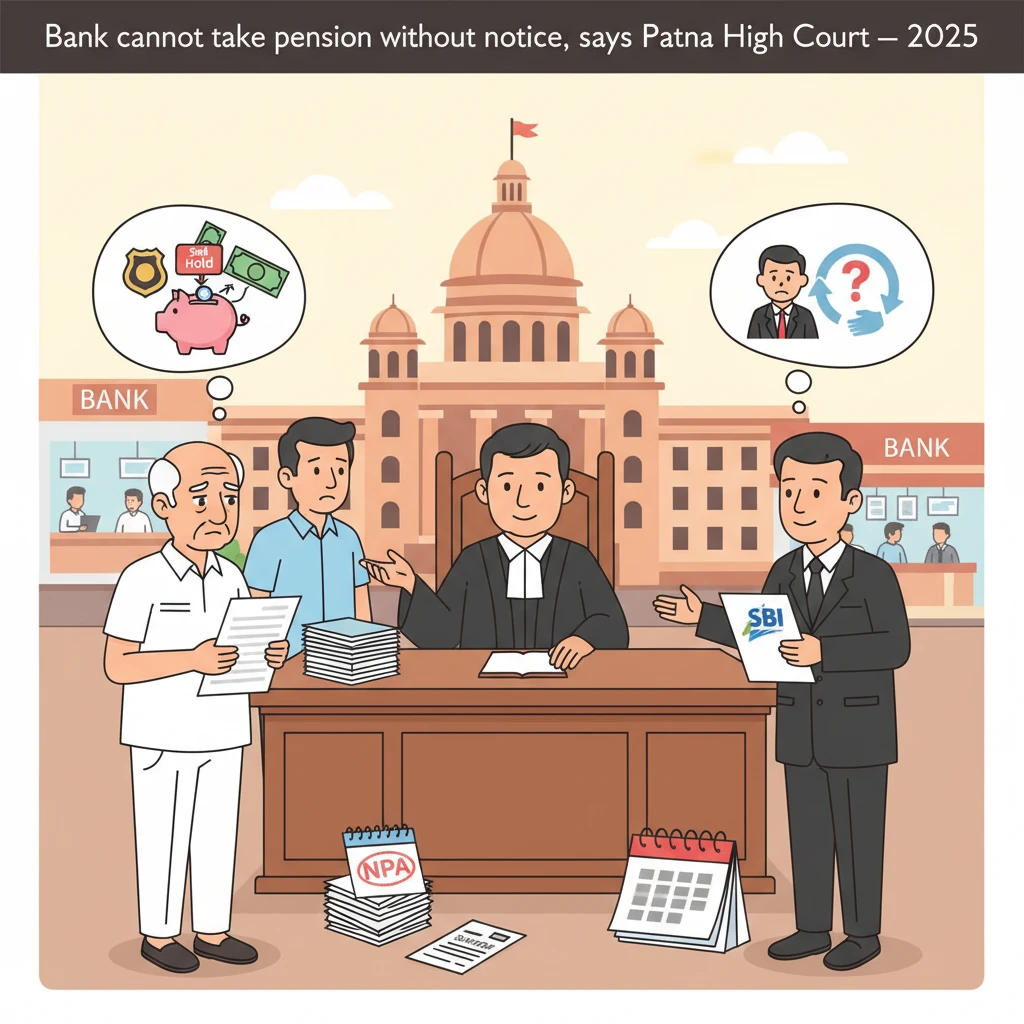
This case challenged State Bank of India’s recovery of a retired police constable’s gratuity and pension without notice.
The Patna High Court held that SBI’s action was illegal and violated natural justice and limitation law.
The Court ordered the Bank to return Rs. 3,14,000 to the petitioner’s account.
The matter stands closed with the writ petition allowed.
Case Background
The petitioner was a Head Constable in Bihar Police, posted at Munger from 2008 to 2012.
In December 2011, he took a personal loan of Rs. 5,00,000 from State Bank of India, Munger Branch, for his daughter’s marriage. This loan was repaid fully through 60 EMIs.
On 29.12.2011, another constable posted at Munger, respondent no. 11, took a personal loan of Rs. 5,26,179 from the same SBI Munger Branch. The petitioner agreed to stand as guarantor for this loan and executed a Deed of Guarantee in favour of respondent no. 11 on the same date.
According to the petitioner, the borrower later defaulted in repayment and the loan was classified as a Non-Performing Asset (NPA) on 31.12.2012. For several years, no demand was, according to him, made against him as guarantor.
The petitioner retired on 31.03.2017. In June 2017, his post-retirement benefits, including gratuity and provident fund, were credited to his account in SBI Sonepur Branch. On 29.06.2017, SBI Munger Branch placed a “Set Hold” of Rs. 3,00,000 on his account, and ultimately debited a total of Rs. 3,14,000, including part of his pension.
The petitioner then approached the Patna High Court in Civil Writ Jurisdiction Case No. 1674 of 2018, challenging this recovery and seeking refund with interest, documents from the Bank, and a restraint on any further deductions.
What the Court Examined and Decided
The Patna High Court, through Hon’ble Justice Smt. G. Anupama Chakravarthy, heard both sides and examined whether the Bank could unilaterally recover the outstanding dues of the borrower from the guarantor’s post-retiral benefits and pension, without prior notice and after the limitation period had expired.
The petitioner’s case was that he stood as guarantor relying on professional trust with respondent no. 11. He alleged that the borrower defaulted and the account was declared NPA on 31.12.2012. He asserted that no notice, demand or communication invoking his liability as guarantor was issued within the limitation period.
He stated that only a legal notice dated 28.08.2017 was received by him on 06.09.2017, almost five years after the NPA classification. According to him, this was contrary to the clauses of the loan agreement and the guarantee deed (specifically clauses 7, 8, 11 and 14), which required demand and notice before invoking the guarantor’s liability.
The petitioner further contended that his retiral dues were credited in June 2017 and, without warning, a Set Hold was placed on Rs. 3,00,000 on 29.06.2017 by SBI Munger Branch. Subsequently, Rs. 3,14,000 was debited from his account, including a part of his pension.
He argued that this recovery was barred by limitation, since three years from the date of NPA (31.12.2012) had already expired. He also claimed violation of principles of natural justice as no prior notice or opportunity was given. He said he made representations and replied to the legal notice seeking copies of the loan agreement, sanction letter, borrower’s acknowledgments, and communications about the default and NPA, but the Bank did not supply these documents.
The petitioner alleged that the Bank acted arbitrarily, in connivance with the borrower, failed to invoke the guarantee in time, and unlawfully attached his post-retirement benefits, causing mental and financial distress.
On the other hand, respondents 3 to 10 (SBI authorities) filed a detailed counter affidavit. The Bank admitted that both the petitioner and respondent no. 11 were police constables at Munger and both took personal loans from SBI Munger Branch on 29.12.2011, for Rs. 5,00,000 and Rs. 5,26,179 respectively. It was stated that both stood as mutual guarantors for each other’s loan accounts.
The Bank accepted that the petitioner repaid his own loan in full but alleged that respondent no. 11 defaulted. According to the Bank, as guarantor, the petitioner failed to honour his obligations under the Deed of Guarantee either to repay or to bring the borrower before the Bank.
The Bank went further and alleged that both the petitioner and the borrower appeared to have conspired to misuse the banking system by taking mutual loans and standing as guarantors for each other to evade liability.
The Bank claimed that multiple oral and written communications were made to the borrower and to the petitioner as guarantor. It stated that both avoided contact and became untraceable after leaving Munger, and denied that there was any lack of notice.
It was submitted by the Bank that due to repeated default, the account was declared NPA on 31.12.2012. After unsuccessful attempts to contact the borrower and guarantor, the Bank traced the petitioner’s savings account at SBI Sonepur Branch and, in June 2017, placed a Set Hold of Rs. 3,00,000 to recover part of the outstanding dues, invoking the co-extensive liability of the guarantor under law.
The Bank argued that it had a contractual and legal right of set-off and lien over deposits and could exercise this without prior notice. It denied any arbitrariness or mala fide intention and stated that it acted according to banking norms and its contractual rights. It submitted that proceedings were taken only after exhausting all remedies.
The Court heard counsel for both sides and examined the legal position. The Bank’s counsel relied on the Supreme Court judgment in AIR 1992 SC 1815 (Punjab National Bank & Ors. v. Surendra Prasad Sinha) to argue that while a suit may be time-barred after the limitation period, the Bank retains the right to set off amounts due without prior notice.
The petitioner’s counsel relied on AIR 1991 Andhra Pradesh 258 (Canara Bank v. M/s Taraka Prabhu Publishers Pvt. Ltd.) and (2025) 1 SCC 456 (BRS Ventures Investments Ltd. v. Srei Infrastructure Finance Limited & Anr.).
The Patna High Court extracted portions from the Canara Bank judgment. That decision dealt with the right of a bank to transfer amounts from a current account to a loan account to enforce contractual set-off against loan defaulters, and held that such action could not be attacked as violating fundamental rights when it arose from a contract. It also observed that such disputes are essentially in the domain of contract law and normally belong in civil suits, not writ petitions, unless there is arbitrariness or mala fide.
However, after considering these precedents and the facts of this case, the Patna High Court took a clear view in favour of the petitioner.
The Court held that, in view of the legal principle and facts, there was merit in the petitioner’s claim that the recovery made by SBI was in violation of the principles of natural justice and the terms of the guarantee deed.
Specifically, the Court found that the Bank failed to issue any prior notice or demand before invoking the petitioner’s liability as guarantor. This failure went against both natural justice and the terms governing the guarantee.
The Court then turned to the question of limitation. It held that the limitation period for recovery of the amount is three years. Once the limitation period expires, the Bank cannot recover amounts from the petitioner for a time-barred debt.
The judgment records that the Bank itself had classified the loan account of respondent no. 11 as NPA on 31.12.2012. The Court held that limitation started from that date. Therefore, the Bank had to file a money suit for recovery within three years from 31.12.2012.
By June 2017, when the Bank placed the Set Hold and recovered Rs. 3,14,000 from the petitioner’s account, more than three years had already expired from 31.12.2012. Hence, the debt was time-barred, and the Bank’s unilateral recovery was impermissible.
In light of this reasoning, the Court allowed the writ petition. It directed the respondent Bank to re-credit the amount of Rs. 3,14,000 to the petitioner’s account forthwith. Any interlocutory application stood disposed of along with the main case.
Why This Judgment Matters
This judgment is important for retired employees and guarantors, especially those whose salaries, pensions, or gratuity are routed through banks.
First, the Patna High Court has made it clear that a bank cannot quietly block or withdraw a person’s retiral benefits or pension without giving prior notice and a chance to respond, especially where a guarantee is involved.
Second, the Court reaffirmed that limitation law applies to banks as well. Once three years pass from the date when the loan becomes NPA or otherwise due, the bank cannot treat the debt as alive for forcible recovery against a guarantor without filing a proper suit in time.
Third, for guarantors, this decision highlights that although they are legally bound for the borrower’s dues, banks must still follow due process, including notice, adherence to contractual terms, and respect for limitation.
For banks, the ruling is a reminder that unilateral set-off from sensitive funds like pension and gratuity, especially after limitation has expired and without clear prior notice, is vulnerable to being struck down by constitutional courts.
Legal Issues and Answers
- Issue: Can State Bank of India recover a borrower’s defaulted loan amount from a guarantor’s post-retirement benefits and pension account without prior notice?
Answer: No. The Court held that the Bank’s recovery without prior notice violated principles of natural justice and the terms of the guarantee deed. - Issue: Can a bank unilaterally recover a time-barred loan amount from a guarantor’s account by way of set-off, without filing a suit within limitation?
Answer: No. The Court held that limitation for recovery is three years from the date of NPA (31.12.2012), and the Bank cannot recover amounts from the petitioner for a time-barred debt. - Issue: Was the petitioner entitled to refund of the amount already recovered from his account?
Answer: Yes. The Court directed the Bank to re-credit Rs. 3,14,000 to the petitioner’s account forthwith.
Cases Cited by the Court
- AIR 1992 Supreme Court 1815 (Punjab National Bank & Ors. v. Surendra Prasad Sinha)
- AIR 1991 Andhra Pradesh 258 (Canara Bank v. M/s Taraka Prabhu Publishers Pvt. Ltd.)
- (2025) 1 SCC 456 (BRS Ventures Investments Ltd. v. Srei Infrastructure Finance Limited & Anr.)
Case Details
Case Number: Civil Writ Jurisdiction Case No. 1674 of 2018
Case Title: Saroj Kumar Singh v. The State of Bihar & Ors.
Citation: 2025(3) PLJR 931
Coram: Hon’ble Justice Smt. G. Anupama Chakravarthy
Date of Judgment: 22.07.2025
Advocates for Petitioner: M/s Jagjit Roshan, Apul, Rajiv Ranjan, Jayant Kumar Ray, Anjani Kumar, Advocates
Advocates for State: M/s Md. Nadeem Seraj, GP 5; Shalini, AC to GP 5
Advocate for Bank: Mr. Sanjeev Kumar, Advocate
Respondents: State of Bihar and its officers; Chairman, General Managers, Deputy General Manager and Regional/Branch Managers of State Bank of India; and respondent no. 11 (borrower)
Nature of Case: Writ petition under Article 226 challenging recovery of loan dues from guarantor’s post-retirement benefits and pension account.
Link to Judgment: Click here to access the official Patna High Court judgment
If you found this explanation helpful and wish to stay informed about how legal developments may affect your rights in Bihar, you may consider following Samvida Law Associates for more updates.








Being law professnal in civil n session court mathura
I need various case laws judgements.
I need of case laws n judgements as I am law professnal in practice as civil n session court mathura.