
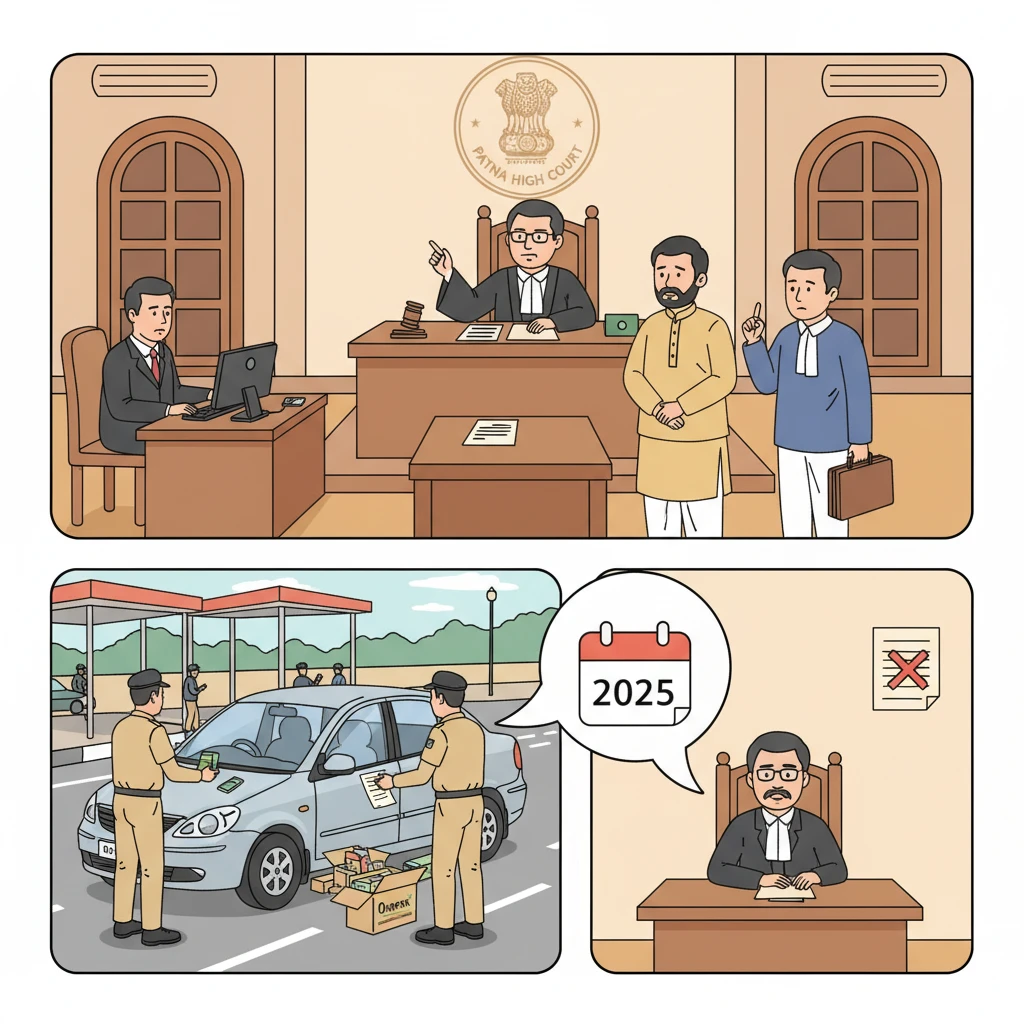
Case Background
The case arises from Harlakhi P.S. Case No. 64 of 2025, Madhubani, registered on 19.03.2025. The petitioner, a resident of Sindhuli district in Nepal, was arrested on 20.03.2025.
According to the written report of Sashastra Seema Bal (SSB) personnel, an SSB team was on check-post duty near the Indo–Nepal border. They received information that a silver-coloured four-wheeler was carrying intoxicating medicine from India towards Nepal.
On this information, they stopped a Tata Indigo Manza car going from India to Nepal. During search in the presence of the driver and another occupant, 40 bottles of 100 ml each of cough syrup containing codeine phosphate and Triprolidine Hydrochloride (brand “Oxerex”, Batch No. ONTS-1663) were recovered from under the seat.
The two persons in the car were the present petitioner and a co-accused, Giban Patal. The SSB also seized the car (Reg. No. BaE 2295), with its engine and chassis numbers noted, and an OPPO Reno-8 5G mobile phone with two SIMs. An FIR was lodged, and both were arrested.
The case was registered under Sections 20 and 22 of the Narcotic Drugs and Psychotropic Substances Act, 1985 (NDPS Act) and is pending before the Principal Sessions Judge-cum-Special Court, NDPS Act, Madhubani.
Before approaching the Patna High Court, the petitioner had applied for anticipatory bail before the Special Court, NDPS, Madhubani. That court rejected his plea, holding that 40 bottles of cough syrup constituted commercial quantity in light of the Supreme Court judgment in Hira Singh v. Union of India, (2020) 20 SCC 272, and that witnesses in the case diary supported the prosecution version. Considering Section 37 of the NDPS Act, anticipatory bail was denied.
The petitioner then filed the present Criminal Miscellaneous petition under Sections 483 and 484 of the Bharatiya Nagarik Suraksha Sanhita, 2023, seeking regular bail before the Patna High Court.
What the Court Examined and Decided
The Patna High Court, through Hon’ble Mr. Justice Jitendra Kumar, heard detailed arguments from both sides. The central questions were whether the seized cough syrup was covered by the NDPS Act and whether, in such circumstances, the petitioner could be granted bail.
On behalf of the petitioner, counsel argued first that he was innocent and falsely implicated. The main legal plank was that there had been non-compliance with Section 42 of the NDPS Act, which deals with recording and forwarding information before search and seizure. Counsel claimed that this alleged non-compliance vitiated the entire prosecution and therefore bail should be granted.
Second, the petitioner’s lawyer argued that the seized material was not “narcotic drug or psychotropic substance” under the NDPS Act but an essential cough syrup containing less than 2.5% codeine. He submitted that such preparations are covered only by the Drugs and Cosmetics Act, 1940, not by the NDPS Act. He relied heavily on the Allahabad High Court judgment in Vibhor Rana v. Union of India, 2021 SCC OnLine All 908, which had held that “New Fancy Deal Linctus Cough Syrup” with low codeine content did not fall within the NDPS regime and was instead governed by the Drugs and Cosmetics Act.
He also contended that if the neutral (non-drug) portion of the cough syrup was excluded, the actual codeine content would be below commercial quantity and hence the strict bar on bail under Section 37 of the NDPS Act would not apply. Further, he highlighted that the petitioner had no criminal antecedents and had been in custody since 20.03.2025.
The State opposed the bail strongly. The Additional Public Prosecutor pointed out that 40 bottles of 100 ml cough syrup containing codeine were recovered from the car in which the petitioner was sitting. Taking the total liquid quantity into account, the seized material amounted to commercial quantity as per the law clarified in Hira Singh.
The State submitted that once commercial quantity is involved, Section 37 of the NDPS Act comes into play. Under this section, bail can be granted only if the court is satisfied that there are reasonable grounds to believe that the accused is not guilty and is not likely to commit any offence while on bail.
The APP also argued that even if codeine is present in less than 2.5% of the total preparation, the cough syrup is still a “manufactured drug” and an “essential narcotic drug”. Its possession, sale, purchase, transport and use are tightly regulated under the NDPS Act and the NDPS Rules, 1985. The petitioner had not claimed any licence or permit to possess such quantity. Therefore, he was liable to be prosecuted under the NDPS Act. For this, the State relied on decisions such as Mohd. Ahsan v. Customs, 2022 SCC OnLine Del 2910, and Azhar Javad Rather v. UT of J and K, AIR OnLine 2023 J & K 270, which had taken a stricter view regarding cough syrups with codeine.
The Court then examined the statutory scheme in detail. It stressed Section 80 of the NDPS Act, which makes clear that the NDPS Act is in addition to, and not in derogation of, the Drugs and Cosmetics Act. That means NDPS provisions do not get excluded simply because a substance is also regulated as a drug.
The Judge explained the different purposes of the two laws: the Drugs and Cosmetics Act focuses on quality and standard of medicines; the NDPS Act focuses on controlling misuse, trafficking, and illicit consumption of narcotic and psychotropic substances.
The Court discussed Section 8 of the NDPS Act, which prohibits production, manufacture, possession, sale, purchase, transport, import, export and other dealings in narcotic drugs and psychotropic substances, except for medical or scientific purposes and only as permitted by the Act, rules or licences. It then referred to Section 9, which authorises the Central Government to frame rules regulating manufacture, possession, transport, sale, purchase, consumption and use of essential narcotic drugs and psychotropic substances.
The judgment set out the definitions and punishment provisions under Sections 21 and 22 for contraventions relating to manufactured drugs and psychotropic substances, as well as the definitions of “manufactured drug”, “psychotropic substance” and “preparation”.
Crucially, the Court referred to Chapter VA of the NDPS Rules, 1985, introduced in 2015, which specifically governs essential narcotic drugs. Under Rule 52A, no person can possess any essential narcotic drug except as per the rules, and only limited quantities are allowed, typically by licensed medical practitioners, institutions, dealers or chemists.
In the table under Rule 52A(3), Methyl morphine (codeine) and ethyl morphine and their salts are listed as essential narcotic drugs, with a limited exemption only for preparations containing not more than 100 mg per dosage unit and not more than 2.5% concentration, and established in therapeutic practice. The Court read this in conjunction with the broader NDPS framework and held that even such “essential” drugs are controlled and regulated, and violation of these controls attracts NDPS liability.
The Court then discussed how “small quantity” and “commercial quantity” are determined under Central Government notifications issued under Section 2(viia) and 2(xxiiia). It noted that, after initial confusion due to the Supreme Court’s judgment in E. Micheal Raj, (2008) 5 SCC 161, a Note (Note 4) was added to the 19.10.2001 notification in 2009, clarifying that for mixtures, the entire weight of the mixture, including neutral substances, must be considered for deciding whether the quantity is small or commercial.
This Note 4 was upheld by a three-Judge Bench of the Supreme Court in Hira Singh v. Union of India, which held that the full mixture weight, not just pure drug content, must be taken into account. The Patna High Court relied on this binding precedent.
From this legal framework, the Court drew a clear conclusion: even cough syrup with less than 2.5% codeine is not outside the NDPS regime. Its possession without proper authorization is an NDPS offence, despite it also being an “essential drug” under medical regulatory laws. The Court agreed with the views of the Delhi High Court in Mohd. Ahsan and the Jammu & Kashmir High Court in Azhar Javad Rather, and distinguished the Allahabad High Court decision in Vibhor Rana on the ground that Section 9 NDPS and Chapter VA of the NDPS Rules, 1985, had not been brought to that Court’s attention.
The Court also referred to the Supreme Court judgment in Union of India v. Sanjeev V. Deshpande, (2014) 13 SCC 1, which clarified that dealing in narcotic drugs and psychotropic substances is permissible only for medical or scientific purposes and only in the manner authorised by the Act and Rules. Another Supreme Court decision, Mohd. Sahabuddin v. State of Assam, (2012) 13 SCC 491, was cited to highlight that large-scale transport of cough syrup containing codeine phosphate, without satisfactory explanation, could justify denial of bail.
Applying this to the present case, the Court observed that the petitioner was found in possession of 40 bottles of 100 ml cough syrup containing codeine and there was no claim of any licence or authorization. Therefore, Sections 21 and 22 read with Section 8 of the NDPS Act were clearly attracted.
On the quantity issue, the Court held that once the total liquid quantity (including neutral substances) is taken into account, the seized material constituted commercial quantity, in terms of Note 4 to the 19.10.2001 notification and the Hira Singh ruling. Consequently, Section 37 of the NDPS Act applied in full force.
Under Section 37, bail for offences involving commercial quantity is heavily restricted. The Court recalled the Supreme Court’s repeated position, including in State of M.P. v. Kajad, (2001) 7 SCC 673, Narcotics Control Bureau v. Mohit Aggarwal, (2022) 18 SCC 374, and Narcotics Control Bureau v. Kashif, (2024) 11 SCC 372, that in such NDPS cases “negation of bail is the rule and grant is an exception.” The Court must be satisfied on two cumulative conditions: there must be reasonable grounds to believe the accused is not guilty, and that he is not likely to commit any offence while on bail.
The High Court held that in the present case, there were no reasonable grounds at this stage to believe that the petitioner was not guilty, nor to believe that he would not commit an offence under the NDPS Act while on bail. The seizure, the quantity, and the lack of authorization weighed against him.
Regarding the argument of non-compliance with Section 42 NDPS Act, the Court referred to Karnail Singh v. State of Haryana, (2009) 8 SCC 539, Union of India v. Mohd. Nawab Khan, AIR 2021 SC 4476, and Buta Singh v. State of Haryana, AIR 2021 SC 1913. Those decisions hold that whether there is adequate or substantial compliance with Section 42 is a question of fact to be decided on evidence in each case. The Patna High Court therefore held that such a challenge is a matter for trial and cannot be finally decided at the bail stage.
In sum, the Court found that the statutory conditions under Section 37 were not met and that the seriousness of the offence and the nature of the seized material did not justify release on bail at this stage. The regular bail application was accordingly rejected.
Why This Judgment Matters
This judgment is important for anyone dealing with or transporting cough syrups containing codeine near border areas like Madhubani–Nepal. It makes clear that such syrups, even with low codeine content, are treated as “essential narcotic drugs” under the NDPS Act if possessed without proper licence.
The Patna High Court has firmly aligned itself with the stricter national approach after Hira Singh, counting the entire mixture weight of cough syrup to decide commercial quantity. This means that what may look like “ordinary medicine” can still lead to serious NDPS charges with harsh bail conditions.
For accused persons, the ruling reinforces that in NDPS cases involving commercial quantity, bail is very difficult. Arguments about technical non-compliance, or that the product is a “medicine” governed by the Drugs and Cosmetics Act, will not easily succeed at the bail stage, especially when there is no licence or clear lawful purpose for carrying large quantities.
For law enforcement in Bihar and along the Indo–Nepal border, the judgment supports continued strict action against cross-border movement of codeine-based cough syrups. For lawyers and non-lawyers alike, it clarifies that dual regulation by both Drugs and Cosmetics Act and NDPS Act does not dilute NDPS liability.
Legal Issues and Answers
- Issue: Is codeine-based cough syrup with less than 2.5% codeine content outside the scope of the NDPS Act and only governed by the Drugs and Cosmetics Act?
Answer: No. The Court held that such cough syrup is an “essential narcotic drug” whose possession, transport and sale are controlled by the NDPS Act and NDPS Rules. Violation of these controls attracts prosecution under the NDPS Act, despite its regulation as a drug. - Issue: Does the seized quantity of 40 bottles of 100 ml cough syrup constitute “commercial quantity” for the purpose of bail under Section 37 NDPS Act?
Answer: Yes. Following Note 4 to the 19.10.2001 notification and the Supreme Court’s decision in Hira Singh, the Court treated the entire mixture weight (including neutral substances) as relevant and held that the seizure amounted to commercial quantity, triggering Section 37. - Issue: Can alleged non-compliance with Section 42 of the NDPS Act be a ground for grant of bail at this stage?
Answer: No. The Court held that whether Section 42 has been adequately complied with is a question of fact to be decided at trial, relying on Supreme Court precedents. It is not a ground to override Section 37 and grant bail at the pre-trial stage.
Cases Cited by the Court
- Hira Singh v. Union of India, (2020) 20 SCC 272
- Vibhor Rana v. Union of India, 2021 SCC OnLine All 908
- Mohd. Ahsan v. Customs, 2022 SCC OnLine Del 2910
- Azhar Javad Rather v. UT of J and K, AIR OnLine 2023 J & K 270
- Directorate of Revenue Intelligence v. Raj Kumar Arora, 2025 SCC OnLine SC 819
- State of Punjab v. Rakesh Kumar, (2019) 2 SCC 466
- Union of India v. Sanjeev V. Deshpande, (2014) 13 SCC 1
- E. Micheal Raj v. Narcotic Control Bureau, (2008) 5 SCC 161
- Union of India and Anr. v. Sanjeev V. Deshpande, (2014) 13 SCC 1
- Mohd. Sahabuddin and Anr. v. State of Assam, (2012) 13 SCC 491
- State of M.P. v. Kajad, (2001) 7 SCC 673
- Narcotics Control Bureau v. Mohit Aggarwal, (2022) 18 SCC 374
- Narcotics Control Bureau v. Kashif, (2024) 11 SCC 372
- Karnail Singh v. State of Haryana, (2009) 8 SCC 539
- Union of India v. Mohd. Nawab Khan, AIR 2021 SC 4476
- Buta Singh v. State of Haryana, AIR 2021 SC 1913
Case Details
Case Number: Criminal Miscellaneous No. 54100 of 2025 (arising out of Harlakhi P.S. Case No. 64 of 2025, G.R. No. 24 of 2025)
Case Title: Nilendra Kumar Karan @ Nilendra v. The State of Bihar
Citation: 2025 (4) PLJR 243
Court: High Court of Judicature at Patna
Coram: Hon’ble Mr. Justice Jitendra Kumar
Date of Judgment: 27.08.2025 (CAV judgment; CAV date 13.08.2025)
Advocates:
- For the Petitioner: Mr. Jitendra Kumar Bharti, Advocate; Mr. Pankaj Kumar Jha, Advocate
- For the State: Mr. Upendra Kumar, APP
Nature of Case: Petition for regular bail under Sections 483 and 484 of the Bharatiya Nagarik Suraksha Sanhita, 2023, in an NDPS prosecution.
Offences Alleged: Sections 20 and 22 of the NDPS Act, 1985
Result: Regular bail petition rejected; petitioner to remain in custody.
Link to Judgment: Patna High Court official judgment link
If you found this explanation helpful and wish to stay informed about how legal developments may affect your rights in Bihar, you may consider following Samvida Law Associates for more updates.







