

Case Background
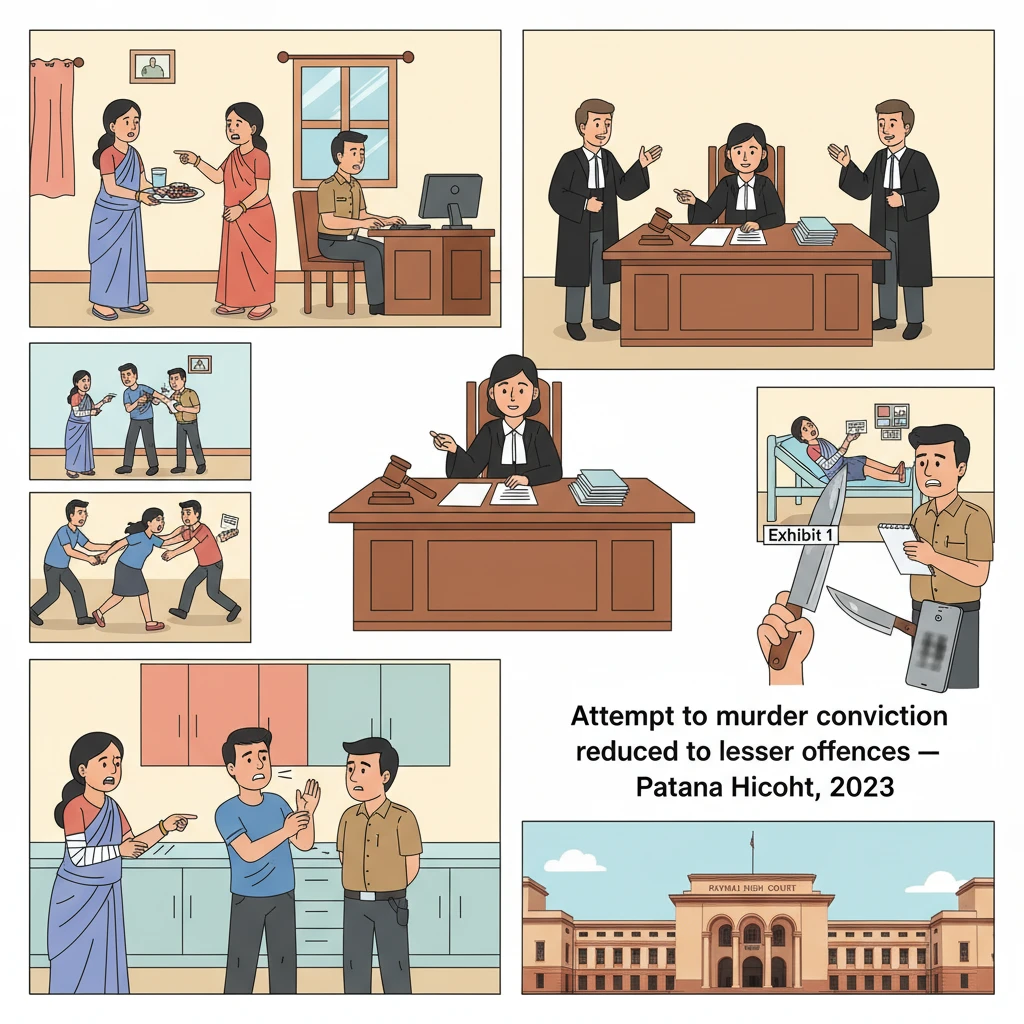
This case arose from an incident on 06.07.2015 at Muzaffarpur, where a young woman, a student of I.Sc. (examined as PW6), was allegedly attacked with a knife inside her own house.
According to the First Information Report (FIR), lodged by the victim herself on 07.07.2015 at the hospital, the appellant came to her house on 06.07.2015. She received him, offered snacks and water, and then went to go upstairs to inform her father over the phone about his arrival.
At that point, as per her statement, the appellant closed the door from inside and tried to outrage her modesty. When she resisted, he allegedly became angry and stabbed her multiple times, dragged her by her hair, and pressed her against the kitchen wall.
The victim shouted for help, and many people from the neighbourhood came. She was taken to Prashant Hospital, where she remained admitted for about ten days. She claimed that before leaving the house, she requested the people gathered there not to let the appellant escape, as he had inflicted the injuries on her.
On the basis of her statement in the hospital on 07.07.2015, the police registered Muzaffarpur Town P.S. Case No. 497/2015 under Sections 354, 324, 326, 307 and 506 of the Indian Penal Code. After investigation, the police submitted charge-sheet against the appellant, and he was put on trial in Sessions Trial No. 599/2015 before the Additional District and Sessions Judge-XII, Muzaffarpur.
The trial court examined fifteen prosecution witnesses and one defence witness. By judgment dated 08.07.2022, it convicted the appellant under Sections 326, 506, 324, 354 and 307 IPC. By order dated 14.07.2022, it sentenced him to life imprisonment under Section 307 IPC, along with separate terms under the other sections, with all sentences to run concurrently.
The appellant then filed Criminal Appeal (DB) No. 626 of 2022 before the Patna High Court. The appeal was heard by a Division Bench of Hon’ble Mr. Justice Ashutosh Kumar and Hon’ble Mr. Justice Nani Tagia, which delivered an oral judgment on 02.12.2023.
What the Court Examined and Decided
The Patna High Court carefully examined the evidence, particularly focusing on how and when the appellant was arrested, what injuries were found on both the victim and the appellant, and whether the evidence proved an intention to kill or to outrage the victim’s modesty.
The defence argued that, although the victim’s injuries were not in dispute and she had herself stated that the appellant assaulted her, there were serious doubts arising from the timing of the arrest and the way the police investigation was recorded.
It appeared from the evidence of the Investigating Officer (PW8) that the appellant was arrested on 07.07.2015 from the victim’s house. However, other witnesses indicated that the appellant had been confined in the victim’s house by local people immediately after the incident, while the victim was taken to hospital.
The seizure list (Exhibit 1) showed that the police seized a steel knife of about 18 cm and a mobile phone from the place of occurrence on 06.07.2015 itself. The seizure list was signed by PW1, who confirmed the seizure on the same day. From this, the Court inferred that the police had reached the house on the very date of the occurrence.
If the police had already reached on 06.07.2015 and seized the knife and mobile phone, the Court noted that there should have been no need to record the arrest date as 07.07.2015. This created confusion about the exact timing of arrest, and the Court found that the Investigating Officer might have been confused or mistaken.
However, the Court held that this inconsistency, by itself, did not make the entire prosecution case doubtful. It noted that the mother of the victim (PW5), a teacher, was not present at the time of occurrence. She stated that she was informed by a local person that her daughter had been stabbed by someone.
PW5 said she first went to Prashant Hospital but was not allowed to meet her daughter. When she returned to her house, she looked through the window from outside and saw the appellant sitting inside. This supported the version that the appellant had been confined in the house after the incident with the help of local people who responded to the victim’s cries.
The Court also discussed the injuries found on the appellant. According to the case, the victim had bitten him on his hand and chest while trying to free herself, and cut injuries were found on his fingers and arms. The doctor who examined the appellant, PW12 (Dr. Abhishek Tiwary), deposed that he had examined him on 06.07.2015. But the investigation record showed that the requisition for his medical examination was given on 08.07.2015, and PW12’s report was also dated 08.07.2015.
The defence argued that because the doctor verbally mentioned 06.07.2015, the injuries recorded in the written report dated 08.07.2015 could not be trusted. Counsel suggested that the injuries might actually have been caused when several people confined the appellant in the victim’s house, and that specific cut marks were deliberately recorded to match the victim’s statement and make the case appear more genuine.
The Court did not fully accept this line of argument. It acknowledged confusion about dates but treated it as an error rather than proof of fabrication. Taking the evidence together, the Bench concluded that the appellant was indeed present in the victim’s house at the time of occurrence and was the one who caused the injuries to the victim.
The defence also tried to show that the parties knew each other from earlier. The victim, in her injured state, had given the exact address of the appellant, who belonged to a different district. Witnesses mentioned some relationship between the families: the victim’s father was said to be a customer of the appellant’s father, who ran a jewellery shop in the locality.
Despite this, the Court found no clear evidence about any marriage proposal, disagreement, or breakdown of relationship between them. It stated that without such evidence, it was difficult to conclude whether the attack was by a “jilted lover” or for any other emotional reason.
The victim had alleged in her statement that the appellant made certain overtures indicating an attempt to outrage her modesty, and that he had shut the room’s door. However, after assessing the entire material, the Court held that it did not clearly appear that the appellant had intended to outrage her modesty, or that he had attacked her with the intention of killing her.
Another point raised related to the knife. The seizure list described it as a large kitchen knife about 18 cm long, which, the defence argued, could not reasonably be carried in a pocket. It also did not record any bloodstains on the knife, which weakened the forensic opinion that the weapon was smeared with blood.
The Court asked, in effect, what the real trigger was for using a kitchen knife. Was the appellant attacked? Was there pressure on him regarding marriage? The Court clearly stated that the evidence on these possible angles was incomplete.
Nonetheless, it emphasised that, on the available record, there was no suggestion of house burglary or any other person causing such injuries to the victim, who was alone in the house. The victim had to remain in hospital for about ten days and, as per the informant’s counsel, was “completely disfigured” and her studies came to a halt. While the Court noted that this claim was made from the Bar, the hospitalisation and gravity of injuries were established.
Importantly, many witnesses, including PW1 and the victim’s mother, had seen the appellant in the victim’s house after the incident. The victim’s narrative that she screamed, people gathered, she was taken to hospital, and she told them not to let the appellant escape, appeared “very logical” to the Court.
At the same time, the Bench held that, though the injuries were multiple and serious, they did not seem to have been inflicted with an intention to cause death. There was no clear immediate cause or strong motive shown for the appellant to try to end the victim’s life, and this intention was not convincingly reflected in the trial record.
On this reasoning, the Court held that the conviction under Section 307 IPC (attempt to murder) and Section 354 IPC (outraging modesty) was not justified due to paucity of evidence as to intention. However, it upheld the conviction under Sections 324 and 326 (causing hurt and grievous hurt by dangerous weapons) and Section 506 IPC (criminal intimidation).
Considering the appellant’s age at the time of the incident and the fact that the circumstances did not clearly show an intention to kill, the Court decided to reduce his sentence. It altered the sentence to the period of custody already undergone, while directing that the fines under all counts must still be paid.
The Bench was informed that the appellant had been in jail since the date of his arrest and had already served more than eight years. Therefore, the Court ordered that he be released forthwith, unless wanted in any other case. The appeal was thus partially allowed, and directions were given to communicate the judgment to the jail authorities and return the records to the trial court.
Why This Judgment Matters
This judgment is important for both victims and accused persons in serious assault cases.
First, the Patna High Court recognised that the victim had been seriously injured inside her own home and confirmed that the appellant was responsible. It did not let confusion about dates or minor lapses in investigation completely derail the case.
At the same time, the Court insisted that for the harsh offence of attempt to murder (Section 307 IPC), the prosecution must prove more than serious injuries. There must be clear evidence of intention to kill. In this case, that intention was not clearly shown from the facts and circumstances.
Similarly, for an offence under Section 354 IPC, the Court looked for strong proof of an intention to outrage modesty, and found the evidence insufficient. This shows that courts will carefully separate what is clearly proved from what is only suspected or argued.
For people facing similar situations, the judgment underlines two things: serious violence will not be ignored, but punishment must closely match the proved intention and role of the accused.
Legal Issues and Answers
- Issue: Did the prosecution prove that the appellant attempted to murder the victim under Section 307 IPC?
Answer: No. The Court held that while the injuries were multiple and serious, the evidence did not clearly establish an intention to cause the victim’s death. The conviction under Section 307 IPC was set aside. - Issue: Was the appellant guilty of using criminal force with intent to outrage the victim’s modesty under Section 354 IPC?
Answer: No. Despite the victim’s allegation of certain overtures and closing of the door, the Court found the evidence insufficient to safely infer an intention to outrage modesty. The conviction under Section 354 IPC was set aside. - Issue: Did the evidence establish the appellant’s liability for causing hurt and grievous hurt with a dangerous weapon and for criminal intimidation?
Answer: Yes. The Court found that the appellant alone caused the knife injuries to the victim and that the victim’s evidence, supported by other witnesses, was reliable. The convictions under Sections 324, 326 and 506 IPC were upheld, though the sentence was reduced to the period already undergone.
Cases Cited by the Court
- The judgment does not mention or rely upon any reported precedent or prior case law by name.
Case Details
Case Number: Criminal Appeal (DB) No. 626 of 2022; arising out of Muzaffarpur Town P.S. Case No. 497 of 2015; Sessions Trial No. 599 of 2015.
Case Title: Vicky Kumar v. The State of Bihar
Citation: 2024 (1) PLJR 449
Court: High Court of Judicature at Patna
Coram: Hon’ble Mr. Justice Ashutosh Kumar and Hon’ble Mr. Justice Nani Tagia
Date of Patna High Court Judgment: 02.12.2023
Nature of the Case: Criminal appeal (Division Bench) against conviction and sentence in a sessions trial.
Offences Involved: Sections 326, 506, 324, 354 and 307 of the Indian Penal Code.
Result in Appeal: Convictions under Sections 324, 326 and 506 IPC sustained; convictions under Sections 354 and 307 IPC set aside; sentence reduced to period already undergone; appellant directed to be released, subject to payment of fines and absence of any other case.
Advocates:
For the Appellant: Mr. Ajay Kumar Thakur, Advocate
For the State: Mr. Abhimanyu Sharma, APP
For the Informant: Mr. Purushottam Sharma, Advocate
Link to Full Judgment: Patna High Court Judgment in Cr. App. (DB) No. 626 of 2022
If you found this explanation helpful and wish to stay informed about
how legal developments may affect your rights in Bihar,
you may consider following Samvida Law Associates for more updates.







