

Case Background
The case arose from income tax proceedings against Bihar Industrial Area Development Authority, a statutory body created under the Bihar Industrial Area Development Act, 1974.
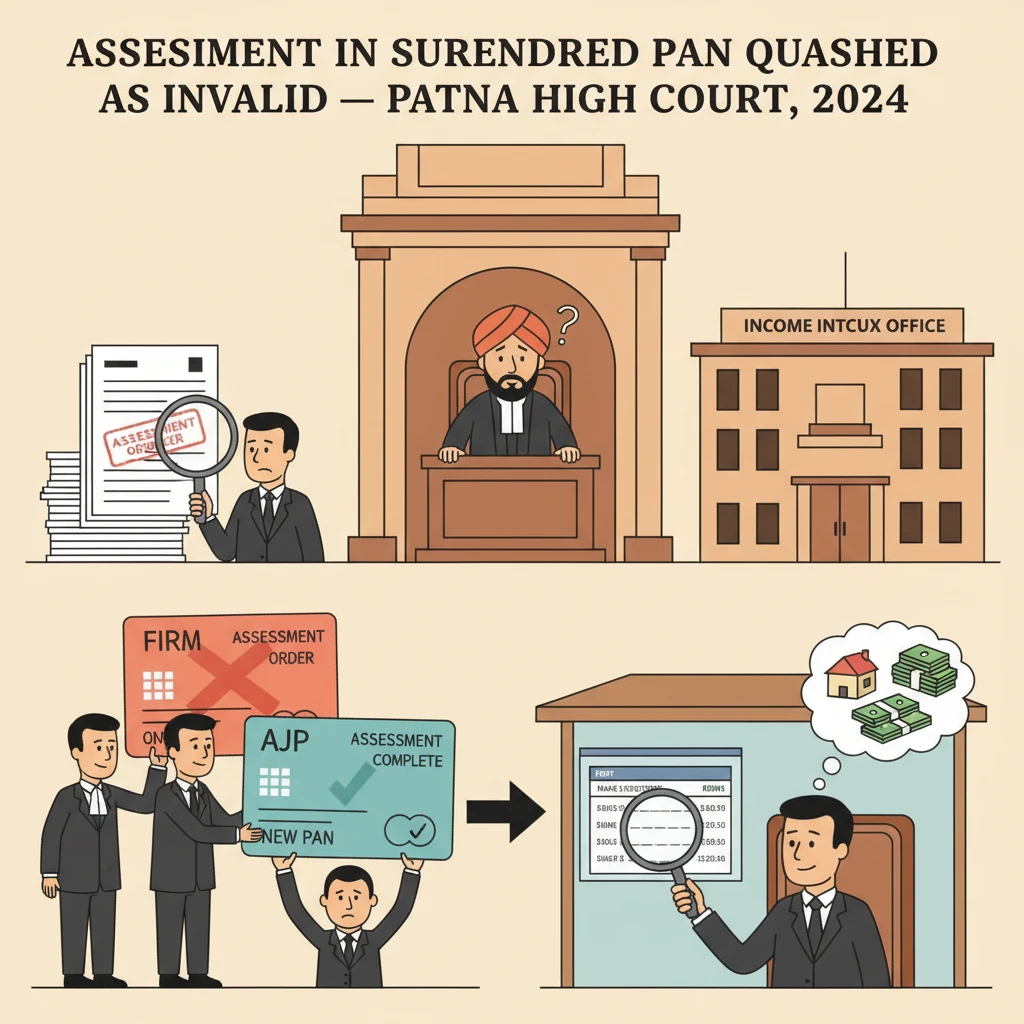
Originally, the authority had a Permanent Account Number (PAN) in the status of a “Firm”. Later, its status was changed to “Artificial Juridical Person” (AJP), and a new PAN was allotted. The earlier PAN was surrendered.
For assessment year 2018-19, the authority was assessed under the new PAN as an AJP. For assessment year 2019-20 also, an assessment was already completed under the new PAN by the jurisdictional Assessing Officer. An appeal against this assessment was filed before the National Faceless Appeal Centre, and its acknowledgment was placed on record.
Despite this, the Department issued a fresh reassessment notice for the same assessment year 2019-20 in the old PAN, treating the authority again as a “Firm”. This later resulted in a separate assessment order in the surrendered PAN.
Aggrieved by this second assessment order in a non-existent PAN, the authority approached the Patna High Court under its civil writ jurisdiction.
What the Court Examined and Decided
The key complaint before the Patna High Court was that the Department had passed two independent assessment orders for the same assessment year 2019-20 for the same assessee, using two different PANs and two different statuses.
The petitioner explained that a valid assessment for 2019-20 had already been completed under the new PAN (status AJP) based on a notice dated 31.03.2023. This assessment order, marked as Annexure-P/6, had been challenged by appeal before the Commissioner of Income Tax (Appeals), National Faceless Appeals. The appeal acknowledgment was produced as Annexure-P/7.
Meanwhile, another notice dated 20.03.2023 under Section 147 read with Section 148 of the Income Tax Act, 1961, was issued in the old PAN (status Firm) by the Deputy Commissioner/Assistant Commissioner, Exemption Circle, Patna. This was followed by further proceedings, including a notice under Section 142(1), and finally an assessment order, Annexure-P/1, in the surrendered PAN.
The petitioner’s senior counsel argued that this dual assessment was illegal. He submitted that:
First, there cannot be two assessment orders for the same assessment year for the same legal entity. Second, there cannot be two PANs operating simultaneously for the same entity, particularly in view of Section 139A(7) of the Act, which bars holding more than one PAN. Third, for the same assessment year, two different Assessing Officers cannot exercise concurrent jurisdiction.
Reliance was placed on Section 124 of the Act regarding jurisdiction, and on two High Court decisions: Kai Balkrishna R. Gawade Mandi Vyapari Premises Sahakari Sanstha Maryadit v. Income Tax Officer and others, (2023) 457 ITR 41 (Bombay), and Shree Ramkrishna Sishu Tirtha and another v. Income Tax Officer and others, (2023) 457 ITR 729 (Calcutta).
On the Department’s side, it was contended in the counter affidavit that certain bank accounts of the petitioner still carried the old PAN. Because of this, some transactions appeared linked to the old PAN and were not shown in the return filed under the new PAN. According to the Department, time deposits and rental receipts in the old PAN were not disclosed or assessed under the new PAN, and there had been no response to the notice issued under Section 148.
In reply, the petitioner pointed out that the proper course, if such non-disclosure existed, was not to reopen assessment under the surrendered PAN, but to invoke the statutory remedies in relation to the valid assessment already made in the new PAN. These options, as noted in the writ petition itself and later in the judgment, included:
(i) suo motu revision by the Commissioner under Section 263 of the Act; or
(ii) exercise of appellate powers under Section 251 by the appellate authority; or
(iii) reassessment proceedings under Section 148 by the jurisdictional Assessing Officer in the new PAN, following the procedure under Section 148A and the faceless assessment mechanism.
The Court then examined the two precedents cited.
In (2023) 457 ITR 41 (Bombay), the Bombay High Court faced a situation where an assessee had mistakenly obtained one PAN in the wrong status and later obtained another with the correct status. Despite repeated requests, the old PAN was not cancelled by the Department. A notice for reopening assessment was issued based on a bank time deposit in the old PAN. The assessee stated that no new deposit existed and all deposits and interest had been disclosed in the return under the new PAN. The Bombay High Court held that the Income Tax Officer had a duty to verify the cancellation of the old PAN and the returns under the new PAN before issuing notice. It quashed the order under Section 148A(d), directed cancellation of the old PAN, and ordered assessment only under the new PAN.
In (2023) 457 ITR 729 (Calcutta), the Calcutta High Court dealt with an order under Section 148A(d) passed in a PAN that had already been surrendered. That order was set aside as a non-speaking order and the matter was remanded to the Assessing Officer.
The Patna High Court noted that these decisions involved facts identical to the present case, with the only difference being that here the assessee originally had a PAN in the status of “Firm”, which was surrendered when obtaining a new PAN as “AJP”. The Court recorded that for assessment year 2018-19 the assessment was completed in the new PAN, and even for 2019-20 (the year in question) an assessment had already been completed under the new PAN, as per Annexure-P/6.
The impugned order (Annexure-P/1) itself showed that a notice under Section 142(1) had been issued. In response, the assessee had clearly informed the Assessing Officer about the existence of the new PAN. Further, the assessment under Annexure-P/1 was not a faceless assessment but was completed by an officer to whom the case had been transferred as the jurisdictional Assessing Officer under Section 144B(8) on the understanding that it was a case of “duplicate PAN”.
The Court rejected this assumption. It held that this was not a case of duplicate PAN because the earlier PAN had been surrendered and a new PAN issued with a changed status. Once the old PAN was surrendered, it ceased to exist for assessment purposes.
Even if some transactions had been carried out using the old PAN, the Court held it was entirely open to the jurisdictional Assessing Officer to proceed with reassessment under the new PAN. The officer could treat the transactions in the old PAN as belonging to the assessee in its new status and include them in reassessment, provided they related to the relevant assessment year and had escaped assessment.
On this reasoning, the Court held that Annexure-P/1, the assessment order passed in the surrendered PAN, was untenable. It set aside this order solely on the ground that assessment had been made in a PAN that had already been surrendered.
However, the Court was careful not to shut out the Department altogether. It clarified that the Department remained free to initiate fresh proceedings by choosing any legally permissible option, including those mentioned by the petitioner itself: revision under Section 263, appeal powers under Section 251, or reassessment under Section 148 read with Section 148A in the new PAN, through the faceless assessment procedure.
Importantly, the Court held that the assessee would not be entitled to raise a plea of limitation in respect of such fresh proceedings. Any proceeding initiated now would be treated as relating back to the date on which the earlier notice under Section 148A was issued in the old PAN.
With these directions and clarifications, the writ petition was allowed and the impugned assessment order in the surrendered PAN was quashed.
Why This Judgment Matters
This judgment is significant for any taxpayer who has changed their PAN due to change of legal status, merger, or other restructuring.
The Patna High Court makes it clear that once a new PAN is issued and the old one is surrendered, the Income Tax Department cannot continue to assess or reassess in the old PAN as if it still exists. Any income or transactions linked to the old PAN must be brought under the new PAN.
At the same time, the judgment confirms that such technical errors by the Department do not automatically wipe out tax liability. The Department can still use lawful routes to tax any income that has escaped assessment, but it must do so in the correct PAN and through proper statutory procedures.
For assessees in Bihar, including statutory bodies and organisations, this decision provides reassurance that they cannot be subjected to duplicate assessments for the same year merely because old PAN details appear in bank records. It also underlines the importance of properly informing the Department about surrendered PANs and maintaining clarity in returns and correspondence.
Legal Issues and Answers
- Issue: Can the Income Tax Department validly complete a reassessment for a particular assessment year in a PAN that has already been surrendered, when an assessment for the same year has been completed in the new PAN?
Answer: No. The Patna High Court held that an assessment made in a surrendered PAN is untenable. Any reassessment must proceed in the new PAN, even if transactions were recorded in the old PAN. - Issue: Does quashing the assessment in the old PAN bar the Department from taking further action regarding undisclosed transactions for that year?
Answer: No. The Court held that the Department is free to initiate fresh proceedings through legally permissible mechanisms such as Section 263, Section 251, or reassessment under Sections 148 and 148A in the new PAN. Such proceedings will relate back to the date of the earlier Section 148A notice, and the assessee cannot raise limitation.
Cases Cited by the Court
- Kai Balkrishna R. Gawade Mandi Vyapari Premises Sahakari Sanstha Maryadit v. Income Tax Officer and others, (2023) 457 ITR 41 (Bombay)
- Shree Ramkrishna Sishu Tirtha and another v. Income Tax Officer and others, (2023) 457 ITR 729 (Calcutta)
Case Details
Case Number: Civil Writ Jurisdiction Case No. 7018 of 2024
Case Title: Bihar Industrial Area Development Authority v. The Deputy Commissioner/Assistant Commissioner, Exemption Circle, Income Tax Department, Patna
Coram: Hon’ble The Chief Justice K. Vinod Chandran; Hon’ble Mr. Justice Partha Sarthy
Citation: 2024 (4) PLJR 891
Advocates: For the petitioner: Mr. Ajay Kumar Rastogi, Senior Advocate; Ms. Smriti Singh, Advocate; Mrs. Kalpana Rastogi, Advocate. For the respondent: Mrs. Archana Sinha, Senior Standing Counsel, Income Tax Department.
Nature of the Case: Writ petition challenging the validity of a reassessment order under the Income Tax Act passed in a surrendered PAN for assessment year 2019-20.
Link to Judgment: Patna High Court Judgment in CWJC No. 7018 of 2024
If you found this explanation helpful and wish to stay informed about how legal developments may affect your rights in Bihar, you may consider following Samvida Law Associates for more updates.







