

Case Background
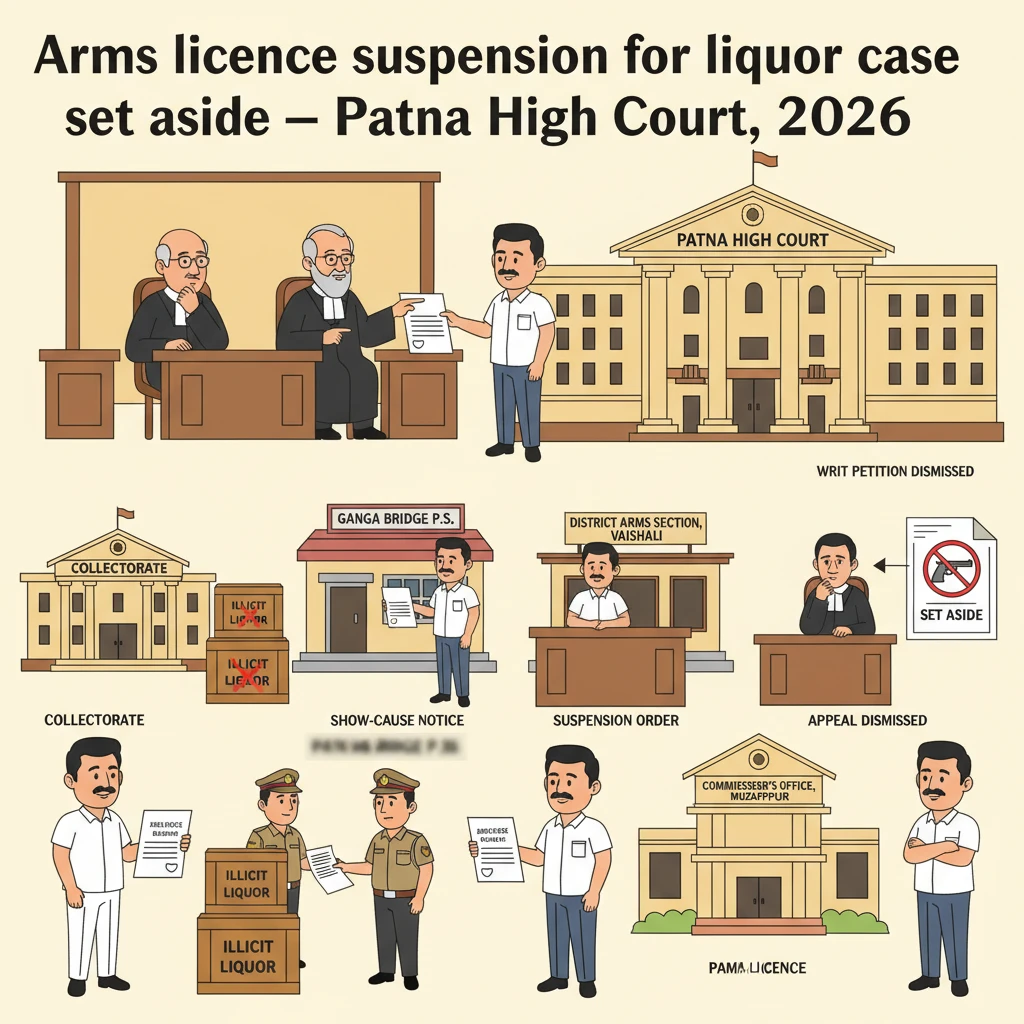
The appellant held a valid arms licence issued by the Collector, Vaishali at Hajipur. The licence bore No. 2776/NH/KNA for one N.P. bore pistol. It was inspected from time to time and renewed as required by law. There was no allegation at any stage that the weapon had ever been misused.
On 15.10.2018, Ganga Bridge P.S. Case No. 143 of 2018 was registered under Sections 30(A), 38 and 47 of the Bihar Prohibition and Excise Act, 2016. The case related to seizure of 18,000 litres of illicit liquor. The appellant was named as an accused in this case. He was granted bail by the competent court on 18.01.2019.
After registration of the liquor case, the In-charge Officer, District Arms Section, Vaishali at Hajipur issued a show-cause notice to the appellant. In reply dated 08.11.2019, the appellant clearly stated that he had never misused his licensed arm.
Despite this, by order dated 31.12.2019, the In-charge Officer suspended the arms licence of the appellant with immediate effect. The order did not record any instance of misuse of the weapon, or any specific finding that the appellant posed a threat to public peace or safety.
The appellant then filed an appeal before the Commissioner, Tirhut Division, Muzaffarpur challenging the suspension order. The Commissioner dismissed the appeal on 25.01.2023, holding that there was no reason to interfere with the order of suspension.
Aggrieved, the appellant approached the Patna High Court in Civil Writ Jurisdiction Case No. 7091 of 2023. The learned Single Judge dismissed the writ petition on 02.01.2024. The Single Judge recorded an observation that the petitioner “seems” to be a smuggler involved in smuggling of liquor and remarked that such criminals do not deserve sympathy. The order upheld the Commissioner’s decision.
The present Letters Patent Appeal No. 809 of 2024 was then filed against the dismissal of the writ petition. The Division Bench of Hon’ble Mr. Justice Sudhir Singh and Hon’ble Mr. Justice Ritesh Kumar heard the matter and delivered judgment on 16.01.2026.
What the Court Examined and Decided
The Division Bench first looked at the basic undisputed facts. The appellant had a valid arms licence. It had been properly verified and regularly renewed. There was no allegation, either by the district authorities or by the State, that the licensed pistol had been used in any illegal act.
The only criminal case against the appellant was Ganga Bridge P.S. Case No. 143 of 2018 under the Bihar Prohibition and Excise Act, 2016. The Court noted that this case concerned seizure of 18,000 litres of illicit liquor. Importantly, the licensed firearm had no connection with that case and had not been used or employed in any way in relation to the alleged offence. The appellant was already on bail in that case.
The core legal question before the Court was whether mere pendency of such a criminal case can, by itself, justify suspension of an arms licence under Section 17 of the Arms Act, 1959.
On behalf of the appellant, it was argued that Section 17(3) of the Arms Act requires the licensing authority to form an independent and objective satisfaction that continuing the licence would be against public peace or public safety. Suspension cannot be based only on the fact that a criminal case is pending.
Counsel for the appellant also pointed out that none of the conditions under the Arms Rules, 2016 or Form III, Schedule III had been violated. There was no allegation that the appellant carried the weapon in violation of any rule framed by the Central or State Government. There was also no material to indicate that the appellant posed any threat to public order or safety.
Another point emphasised was that the licence had been suspended for an indefinite period. According to the appellant, such open-ended suspension without specific justification is not permissible in law.
To support these submissions, the appellant relied on the Full Bench judgment of the Patna High Court in Kapildeo Singh vs. State of Bihar, AIR 1987 Pat 122. Paragraph 11 of that judgment, which the Division Bench reproduced, explains that not every criminal case can automatically lead to suspension or revocation of an arms licence.
In Kapildeo Singh, the Full Bench cautioned that criminal cases can range from minor traffic offences to serious capital crimes. Only in suitable cases, particularly where the licensed weapon is involved in the alleged crime or where the nature of the offence justifies such action after notice and hearing, can suspension under Section 17(3) be warranted. Otherwise, a mechanical approach is not permissible.
The State, on the other hand, supported the orders of the licensing authority, the Commissioner and the Single Judge. It relied on paragraph 4 of its counter affidavit. There it was stated that because the appellant had been made accused in a prohibition case which, according to the State, fell under “organized crime,” the licensing authority was empowered under Section 17(1)(3)(b)(d) of the Arms Act to suspend or revoke the licence if there was apprehension regarding security of public peace or safety.
The State also argued that grant of an arms licence is a privilege, not a right, and therefore the authorities were justified in taking a cautious approach when the licence holder faced a serious criminal case.
After hearing both sides and examining the record, the Division Bench reached several clear findings.
First, it recorded that the arms licence in favour of the appellant “has never been misused.” This was an important factual foundation. Neither the show-cause notice, nor the suspension order, nor the counter affidavit alleged any misuse of the pistol.
Second, the Court accepted that the prohibition case related to seizure of illicit liquor and did not involve the licensed pistol in any way. There was no claim that the weapon had been carried, brandished, or used in connection with the alleged smuggling.
Third, the Court held that “mere pendency of a criminal case cannot, by itself, constitute a ground for suspension or revocation of an arms licence.” For this proposition, it expressly relied on paragraph 11 of the Full Bench decision in Kapildeo Singh.
Fourth, the Court examined whether the authorities had pointed out any violation of the conditions of licence or the Arms Rules, 2016. It concluded that the State authorities had “failed to show any violation” by the appellant of the rules or conditions relating to issuance or possession of arms and ammunition.
The Bench then turned to Section 17 of the Arms Act, 1959. This provision sets out the specific grounds on which an arms licence may be suspended or revoked. The Court observed that a plain reading of Section 17 together with the Arms Rules, 2016 showed that none of those grounds had been triggered in the appellant’s case.
The Court also examined the Bihar Prohibition and Excise Act, 2016. It noted that this Act, under which the appellant was accused, does not contain any express provision requiring or mandating suspension or revocation of an arms licence merely because a person is accused under it.
Going further, the Court addressed the idea of “precautionary suspension.” It accepted that in some situations authorities may suspend a licence in advance to prevent harm. But such action must be based on “concrete material” indicating a real potential threat to public peace or safety. In the absence of such material, a prolonged or indefinite suspension, as in this case, becomes arbitrary.
The Court held that where there is no allegation of misuse, no link of the licensed weapon with the criminal case, and no finding of threat to public peace, the order of suspension cannot stand. The actions of the licensing authority and the subsequent upholding of that action by the appellate authority and the Single Judge were found to be unsustainable in law.
Finally, in light of this analysis, the Division Bench allowed the Letters Patent Appeal. It set aside the Single Judge’s order dated 02.01.2024 in CWJC No. 7091 of 2023. Consequently, it also set aside the suspension of the appellant’s arms licence and directed the licensing authority to restore the licence. All pending applications were ordered to stand disposed of.
Why This Judgment Matters
This judgment is important for arms licence holders in Bihar and elsewhere. It makes clear that the State cannot suspend or cancel an arms licence only because a criminal case has been registered against the licence holder.
For many people, especially in rural areas, an arms licence is issued after strict verification and long waiting periods. The Court has clarified that once a licence is validly granted and the weapon is not misused, authorities must have strong, concrete reasons related to public peace or safety before taking it away, even temporarily.
The decision also acts as a safeguard against labels such as “smuggler” or “criminal” being casually used at an early stage of a criminal case. Until guilt is established and unless the weapon is actually misused, the mere allegation cannot be treated as proof.
Further, by emphasising that precautionary suspension must not be indefinite and must be backed by material, the judgment offers protection against arbitrary and prolonged deprivation of rights under the Arms Act. It reinforces that official discretion must be exercised fairly and with proper reasons.
Legal Issues and Answers
-
Issue: Can an arms licence be suspended solely because the licence holder is an accused in a criminal case under the Bihar Prohibition and Excise Act, 2016, when there is no allegation of misuse of the licensed weapon?
Answer: No. The Patna High Court held that mere pendency of a criminal case, without any misuse of the weapon or concrete material showing threat to public peace or safety, is not a valid ground for suspension or revocation under Section 17 of the Arms Act, 1959. -
Issue: Is prolonged or indefinite “precautionary” suspension of an arms licence permissible without specific material showing danger to public peace or safety?
Answer: No. The Court held that any precautionary suspension must be based on concrete material indicating potential threat. Indefinite suspension without such material is arbitrary and unsustainable. -
Issue: Did the orders of the licensing authority, the Commissioner and the learned Single Judge, which were based mainly on the pendency of the prohibition case, withstand judicial scrutiny?
Answer: No. The Division Bench set aside all these orders and directed restoration of the arms licence, holding that the statutory conditions for suspension under Section 17 of the Arms Act were not met.
Cases Cited by the Court
- Kapildeo Singh vs. State of Bihar, AIR 1987 Pat 122 (Full Bench) – relied upon for the principle that pendency of a criminal case, by itself, does not automatically justify suspension or revocation of an arms licence.
Case Details
Case Number: Letters Patent Appeal No. 809 of 2024 in Civil Writ Jurisdiction Case No. 7091 of 2023
Case Title: Amitav Bachchan Ray vs. The State of Bihar & Ors.
Citation: 2026(2) PLJR 181
Coram: Hon’ble Mr. Justice Sudhir Singh and Hon’ble Mr. Justice Ritesh Kumar
Date of Judgment: 16-01-2026
Advocates:
For the Appellant: Mr. Yogesh Chandra Verma, Senior Advocate with Mr. Gajendra Kumar Singh, Advocate
For the State: Mr. P.K. Verma, AAG-3 with Mr. Saroj Kumar Sharma, AC to AAG-3
Nature of the Case: Intra-court Letters Patent Appeal against dismissal of writ petition challenging suspension of arms licence
Link to Judgment: Full text of judgment on Patna High Court website
If you found this explanation helpful and wish to stay informed about
how legal developments may affect your rights in Bihar,
you may consider following Samvida Law Associates for more updates.







