
Case Background
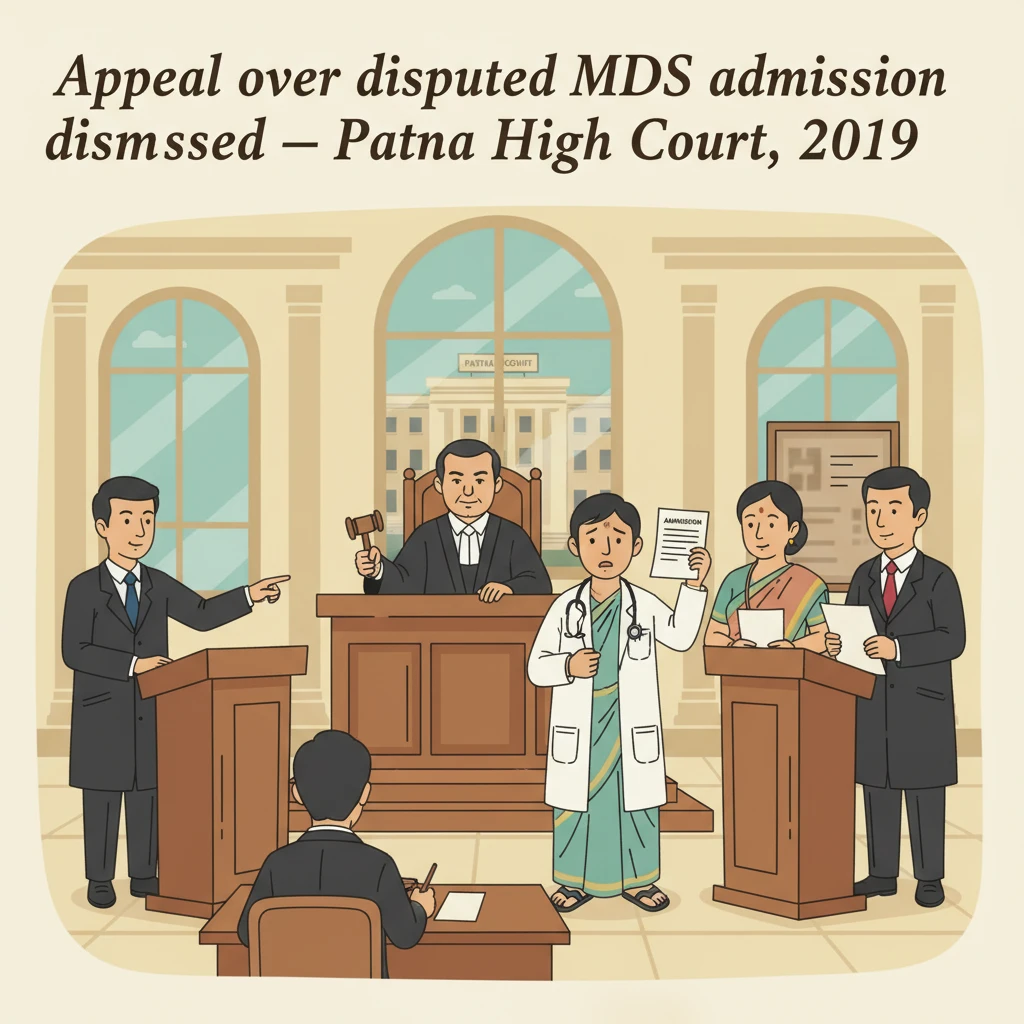
The case arose from a dispute about admission to the Master of Dental Surgery (M.D.S.) course at Dr. B.R. Ambedkar Dental College and Hospital, Patna, for the academic session 2013-14.
The appellant, a doctor, claimed that he had been admitted to this M.D.S. course. According to him, he pursued the course for almost three years and attended classes as per the norms of the Dental Council of India.
However, when the time for examinations came, he was allegedly denied the benefit of appearing as a student of the college. Feeling aggrieved, he filed a writ petition before the Patna High Court seeking relief.
The writ petition was heard by a learned single judge of the Patna High Court. During those proceedings, the college and other respondents disputed the appellant’s very admission to the M.D.S. course. This central conflict—whether he was a validly admitted student—became the key issue.
What the Court Examined and Decided
The Letters Patent Appeal (L.P.A. No. 1161 of 2018) came before a Division Bench of the Patna High Court, presided over by Hon’ble the Chief Justice and Hon’ble Justice Smt. Anjana Mishra. The appeal challenged the order of the learned single judge, who had dismissed the writ petition.
The Division Bench first noted that the writ petition had not been dismissed on technical grounds, but because the appellant failed to comply with a specific direction given by the single judge on 16.02.2018.
Earlier, during the writ proceedings, the single judge had entertained the petition and then asked the appellant to place on record clear proof of his admission. This was necessary because the respondent institute had objected, saying that the appellant was never admitted to the M.D.S. course.
To answer this objection, an order dated 31.01.2018 was passed, after which the appellant filed a supplementary affidavit on 05.02.2018. In that affidavit, he tried to show that he was indeed a student of the institution.
He relied on four main pieces of material: first, that the Principal of the institution had issued him an identity card; second, that he was allowed to mark his attendance in the daily attendance register; third, that the list of students which the institute sent to the Dental Council of India (DCI) contained his name at serial number 5; and fourth, that an inspection report dated 08.11.2014 reflected that he had attended classes in the institute as per the Regulations of the Dental Council of India.
After this affidavit was filed, the single judge passed another order on 16.02.2018. In that order, the judge recognised that questions still remained regarding whether the appellant had actually paid the requisite fee to the college to pursue the M.D.S. course.
The judge therefore directed the appellant to file a further affidavit. This new affidavit was to bring on record concrete evidence showing that he had paid the course fees. The order expressly asked him to state the mode and manner of payment, along with details of the dates on which such payments were made.
The matter was then listed for 26.02.2018 under the heading “For Admission,” meaning that the writ petition’s further progress depended on his compliance with this direction.
The appellant, however, admittedly did not file any such affidavit. He also did not tender any information about how, when, or in what form he might have paid the fees to the institute.
Because of this failure, the learned single judge dismissed the writ petition. The judge held that there was a “complete absence of evidence” about deposit of fees, and without that the claim of valid admission could not be accepted.
In the Letter Patent Appeal, learned senior counsel for the appellant argued that, despite the lack of formal proof of fee payment, the truth of the matter was clear. He pointed out that the institution had informed the Dental Council of India that the appellant was among the admitted students, and that he had been allowed to attend classes for nearly three years.
According to the appellant’s counsel, this conduct of the college itself showed that he was admitted and had paid the requisite fees. Counsel suggested that the transactions were probably in cash, which is why documentary proof might not be readily available.
On the other side, the learned senior counsel for the Dental Council of India did not dispute that the institute had included the appellant’s name in the list of admitted students sent to the DCI. Therefore, for the purpose of the appeal, the inclusion of his name and his attending classes were facts accepted by both sides.
However, the Division Bench focused on a narrower but crucial point: whether there was any evidence of payment of fees by the appellant. The Court observed that even at the appellate stage, no material had been brought on record to show that any fees were ever deposited with the institution.
The Court took note of the oral submission that the transaction was a cash transaction and that the appellant was allowed to continue in the course for almost three years. But the judges emphasised that such oral explanations, without any supporting records, were inadequate.
The Bench clearly stated that the contention of cash payment “does not find substantiated in any form.” Simply put, there was nothing on record—no receipt, no bank entry, no affidavit with particulars—to show that any fee was actually paid.
In this context, the Division Bench examined the reasoning of the learned single judge. It held that, in the absence of any evidence about fee deposit, the single judge was not unjustified in refusing to treat the appellant as a validly admitted student of the institute.
Attendance records, identity cards, and inclusion of name in lists may show that the institution treated someone as a student in practice. But when the Court specifically asks for proof of fee payment, and the petitioner fails to supply any, the Court cannot ignore this gap in evidence.
The Division Bench also made it clear that once the appellant had been directed to file an affidavit giving full details of fee payment, compliance with that order was essential. Non-compliance meant that a vital fact remained unproved. Therefore, the grant of relief was not possible.
On this basis, the Court concluded that the appeal had no merit. It affirmed the order of the single judge dismissing the writ petition and rejected the Letters Patent Appeal.
As a result, the appellant remains without judicial relief regarding his claim to M.D.S. admission or examination benefits from Dr. B.R. Ambedkar Dental College and Hospital, Patna.
Why This Judgment Matters
This judgment is significant for students and educational institutions in Bihar and beyond. It underlines that courts require hard evidence, especially about crucial facts like payment of course fees.
Even if a student has an identity card, attends classes regularly, and is shown in institutional lists, the Court may still insist on proof that fees were actually paid. Without such proof, the student may not be recognised as a validly admitted candidate when a dispute arises.
The ruling also sends a message that when a court directs a petitioner to file a specific affidavit with details and evidence, ignoring that direction can fatally weaken the case. Non-compliance can lead to dismissal, even when some other facts appear favourable.
For institutions, the case highlights the importance of maintaining clear records of fee receipts and admission formalities. For students, it is a reminder to always insist on and preserve fee receipts and written acknowledgments, especially where payments are made in cash.
Legal Issues and Answers
- Issue: Can a student be treated as a validly admitted M.D.S. candidate, and be granted relief by the Court, without producing any evidence of payment of course fees, despite a specific court direction to do so?
Answer: No. The Patna High Court held that in the complete absence of evidence of fee deposit, and in view of non-compliance with the order to file an affidavit detailing such payment, the student could not be treated as a validly admitted candidate and the relief claimed could not be granted.
Cases Cited by the Court
- The judgment does not mention or rely upon any earlier decided case. No prior case law has been cited.
Case Details
Case Number: Letters Patent Appeal No. 1161 of 2018 in Civil Writ Jurisdiction Case No. 1928 of 2018
Case Title: Dr. Shashi Kumar v. The Dental Council of India & Ors.
Coram: Hon’ble the Chief Justice Amreshwar Pratap Sahi and Hon’ble Justice Smt. Anjana Mishra
Date of Judgment: 15-04-2019
Citation: 2019 (2) PLJR 913
Advocates:
- For the Appellant: Mr. Kamal Nayan Choubey, Senior Advocate; Mr. Prashant Kumar, Advocate; Mr. Animesh Kumar, Advocate
- For the Dental Council of India: Mr. S.D. Sanjay, Senior Advocate; Mr. M. Agarwal, Advocate
- For Magadh University: Mr. Ritesh Kumar, Advocate
Nature of the Case: Letters Patent Appeal against the dismissal of a writ petition (Civil Writ Jurisdiction Case) relating to alleged denial of M.D.S. course benefits and recognition of admission.
Link to Judgment: Click here to access the full judgment on the Patna High Court website
If you found this explanation helpful and wish to stay informed about how legal developments may affect your rights in Bihar, you may consider following Samvida Law Associates for more updates.







