

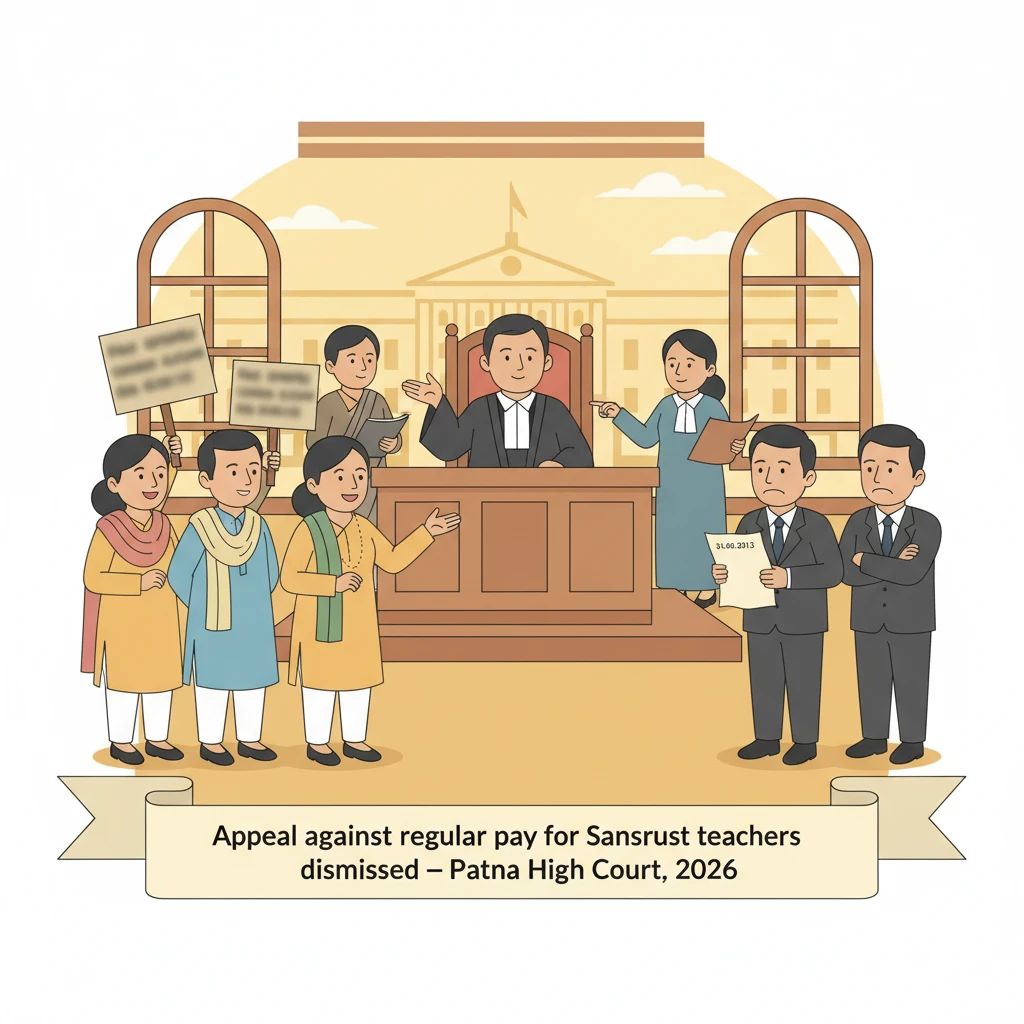
Case Background
The dispute arises from Resolution No. 970 dated 31.08.2013 issued by the Education Department, Government of Bihar.
Under Clause 6 of this Resolution, teaching and non-teaching employees of non-government recognised aided Sanskrit Schools and Madarsas, who were appointed on or after 15.02.2011, were put on a fixed salary.
The writ petitioners, who are associated with a recognised Sanskrit school, challenged this clause before the Patna High Court in Civil Writ Jurisdiction Case No. 14725 of 2023. They contended that placing them on fixed salary was illegal, especially when their school was recognised prior to 15.02.2011.
The learned Single Judge noted that a Division Bench of the Patna High Court had already dealt with this very issue in earlier cases, including C.W.J.C. No. 985 of 2015 (Imran Alam & Ors. v. The State of Bihar & Ors.) and C.W.J.C. No. 15299 of 2015 and connected petitions.
Those earlier Division Bench judgments had quashed the Education Department’s 31.08.2013 resolution (to the extent relevant) and granted regular pay to similarly placed teachers of recognised Sanskrit schools which were on the grant-in-aid list before 15.02.2011.
Relying on these binding decisions, and recording agreement of both sides that the issue was already concluded, the Single Judge allowed the writ petition on 08.04.2024, quashed the impugned Resolution and granted consequential benefits, including regular pay scale.
The State of Bihar, through the Director and Special Director, Secondary Education (Sanskrit), then filed Letters Patent Appeal No. 713 of 2024 before a Division Bench of the Patna High Court challenging the Single Judge’s order.
There was a delay of 92 days in filing the appeal. The State first moved Interlocutory Application No. 02 of 2024 for condonation of delay. On 23.02.2026, the Division Bench condoned the delay after considering the reasons mentioned in the application and allowed the interlocutory application.
After condonation of delay, the Division Bench heard the main intra-court appeal on merits.
What the Court Examined and Decided
The Division Bench comprising Hon’ble Mr. Justice Sudhir Singh and Hon’ble Mr. Justice Rajesh Kumar Verma heard both sides in the Letters Patent Appeal.
The State appellants argued that the Single Judge should not have granted relief based on the earlier Division Bench judgment in C.W.J.C. No. 985 of 2015 because the State had already sought review of that judgment.
It was pointed out on behalf of the State that:
(i) Against the judgment in C.W.J.C. No. 985 of 2015, the State had filed Civil Review No. 295 of 2019.
(ii) That review petition was dismissed for non-prosecution.
(iii) Thereafter, the State filed a restoration application being M.J.C. No. 2022 of 2023, which was still pending at the time of hearing of the present appeal.
On this basis, counsel for the appellants submitted that, since the restoration application was pending, the learned Single Judge ought to have kept the writ petition in abeyance instead of deciding it. In other words, the State wanted the writ case to wait until the restoration of the earlier review was decided.
On the other hand, counsel for the writ petitioners (respondents in the appeal) argued that the issue had already been settled by binding Division Bench decisions of the Patna High Court. The Single Judge had only followed those decisions. According to them, there was no legal error in the Single Judge’s order which would justify interference in an intra-court appeal.
The Division Bench identified a narrow question for determination. It was not re-examining whether the Resolution of 31.08.2013 was legally valid in itself. Instead, the Bench focused on a specific point: could the State challenge, in appeal, an order that was passed by the Single Judge after both sides had agreed that the matter was already covered by Division Bench judgments?
The Court therefore treated the Single Judge’s order as being “in the nature of a consent order”. The central issue became whether such an order, based on an agreement between counsels that the matter is concluded by earlier decisions, could be interfered with in Letters Patent Appeal.
To answer this, the Division Bench carefully read the Single Judge’s order dated 08.04.2024. The order clearly recorded that “both the counsels agree” that the issue involved in the writ petition stood finally adjudicated by the Division Bench in C.W.J.C. No. 15299 of 2015 and connected petitions, which had in turn relied upon C.W.J.C. No. 985 of 2015.
In those earlier matters, the Division Bench had noted that five writ petitions before them related to salary claims by teachers appointed in Sanskrit schools recognised prior to 15.02.2011 and included among 531 schools on the grant-in-aid list. They had been deprived of benefits due to the Resolution dated 31.08.2013.
That Division Bench quashed the impugned resolution dated 31.08.2013 “to the extent indicated” in C.W.J.C. No. 985 of 2015. It also held that the petitioners in those cases were entitled to the same benefits as decided in Imran Alam (C.W.J.C. No. 985 of 2015).
On this basis, the Single Judge in the present writ case held that the petitioner would also be entitled to regular pay scale since he had been appointed as a Sanskrit school teacher in a school recognised prior to 15.02.2011. As a result, Annexure-P/4 and the Resolution dated 31.08.2013 (Annexure-P/3) were quashed, and the writ petition was allowed with all consequential benefits.
The Division Bench then considered an important principle of law regarding what is recorded in judicial orders as submissions of counsel. It relied on the Supreme Court decision in State of Maharashtra v. Ramdas Shrinivas Nayak, (1982) 2 SCC 463.
In that case, the Supreme Court held that what is recorded in a judgment as having been stated by counsel is conclusive and binding on the parties. The Court explained that judicial records cannot be questioned by later affidavits or claims at the Bar. Matters of judicial record are “unquestionable” and courts will not reopen what has been officially recorded as having happened in court.
The Division Bench quoted the well-known paragraph from Ramdas Shrinivas Nayak, where the Supreme Court refused to entertain any attempt to dispute what had been recorded in the High Court’s order about submissions of counsel. Judges cannot be “dragged into the arena” and their statements in judgments about what transpired in court must be accepted as final.
Applying this principle, the Patna High Court held that the Single Judge’s record that both counsels agreed that the issue was already covered by earlier Division Bench judgments is conclusive. The State did not produce any material to show that the Single Judge had wrongly recorded this agreement.
In absence of any such material, and in light of Ramdas Shrinivas Nayak, the Division Bench held that the correctness of that recorded agreement cannot be reopened in appellate proceedings.
Once this is accepted, the logical consequence follows. If both parties agreed that the matter is fully covered by binding Division Bench decisions, and the Single Judge merely followed those decisions, the State cannot later come in intra-court appeal and try to re-agitate the same issue.
The Court also implicitly rejected the argument that pendency of a restoration application in the earlier review case (M.J.C. No. 2022 of 2023) could dilute the binding effect of the existing Division Bench judgments. Till such time as those judgments are actually set aside or modified, they remain binding on Single Judges and on parties.
Therefore, the Division Bench concluded that there was no illegality or infirmity in the Single Judge’s order dated 08.04.2024 that would warrant interference in appellate jurisdiction under the Letters Patent.
On this reasoning, the Court dismissed Letters Patent Appeal No. 713 of 2024. It also ordered that any pending applications in the appeal stand disposed of.
Why This Judgment Matters
This judgment is significant for teachers and non-teaching staff of non-government recognised aided Sanskrit schools and Madarsas in Bihar whose schools were recognised before 15.02.2011.
The Single Judge’s order, now upheld in appeal, confirms that such staff cannot be forced onto a fixed salary under Clause 6 of the Education Department Resolution dated 31.08.2013. They are entitled to regular pay scale in line with earlier Division Bench rulings.
For government departments, the judgment sends a strong message. Once their counsel agrees in court that an issue is covered by binding precedent, and the judge records this, they cannot later deny or undo that agreement through intra-court appeal.
More broadly, the Patna High Court reinforces the Supreme Court’s view that statements recorded in judgments about what was argued or agreed in court are final. Attempting to challenge those records later is not permitted.
This gives certainty to litigants and courts. Parties must be careful about what their lawyers concede or accept in court, because such concessions can decide the fate of their case and cannot easily be undone later.
Legal Issues and Answers
- Issue: Can the State challenge, by Letters Patent Appeal, a Single Judge order passed on the recorded agreement of both sides that the matter is covered by binding Division Bench judgments?
Answer: No. When the Single Judge has recorded such agreement of counsel, that record is conclusive. The order is in the nature of a consent order, and the State cannot re-agitate the same issue in intra-court appeal. - Issue: Does pendency of a restoration application against dismissal of a review petition dilute the binding effect of existing Division Bench judgments on the same issue?
Answer: No. The Division Bench treated the earlier judgments as binding and held there was no ground to keep the writ petition in abeyance or interfere with the Single Judge’s order based on those judgments. - Issue: Are teachers of recognised Sanskrit schools on the grant-in-aid list prior to 15.02.2011 entitled to regular pay scale rather than fixed salary under Resolution No. 970 dated 31.08.2013?
Answer: Yes. Following earlier Division Bench decisions, such teachers are entitled to regular pay scale, and the relevant part of the 31.08.2013 Resolution stands quashed.
Cases Cited by the Court
- C.W.J.C. No. 985 of 2015 (Imran Alam & Ors. v. The State of Bihar & Ors.) – Division Bench judgment quashing the August 2013 memo/resolution and granting benefits to Sanskrit school teachers.
- C.W.J.C. No. 15299 of 2015 and connected petitions – Division Bench judgment applying Imran Alam to similarly placed teachers of Sanskrit schools recognised prior to 15.02.2011.
- State of Maharashtra v. Ramdas Shrinivas Nayak, (1982) 2 SCC 463 – Supreme Court decision holding that what is recorded in a judgment as having been stated by counsel is conclusive and cannot be contradicted later.
Case Details
Case Number: Letters Patent Appeal No. 713 of 2024 in Civil Writ Jurisdiction Case No. 14725 of 2023
Case Title: The State of Bihar through Director, Secondary Education (Sanskrit) & Anr. v. Sanjay Kumar Tiwari & Ors.
Coram: Hon’ble Mr. Justice Sudhir Singh and Hon’ble Mr. Justice Rajesh Kumar Verma
Date of Judgment: 23.02.2026
Citation: 2026(3) PLJR 291
Advocates: Mr. Anil Kumar (A.C. to G.P.20) for the appellants (State authorities); Mr. Sriram Krishna, Advocate; Mr. Prabhat Kumar Singh, Advocate; and Mr. Amarjeet, Advocate for the respondents (writ petitioners and other respondents).
Nature of the Case: Intra-court appeal (Letters Patent Appeal) against a Single Judge order in a writ petition concerning salary and service conditions of teaching and non-teaching staff of non-government recognised aided Sanskrit schools.
Impugned Order: Order dated 08.04.2024 passed by the learned Single Judge in C.W.J.C. No. 14725 of 2023.
Link to Judgment: Click here to read the full Patna High Court judgment
If you found this explanation helpful and wish to stay informed about
how legal developments may affect your rights in Bihar,
you may consider following Samvida Law Associates for more updates.







