
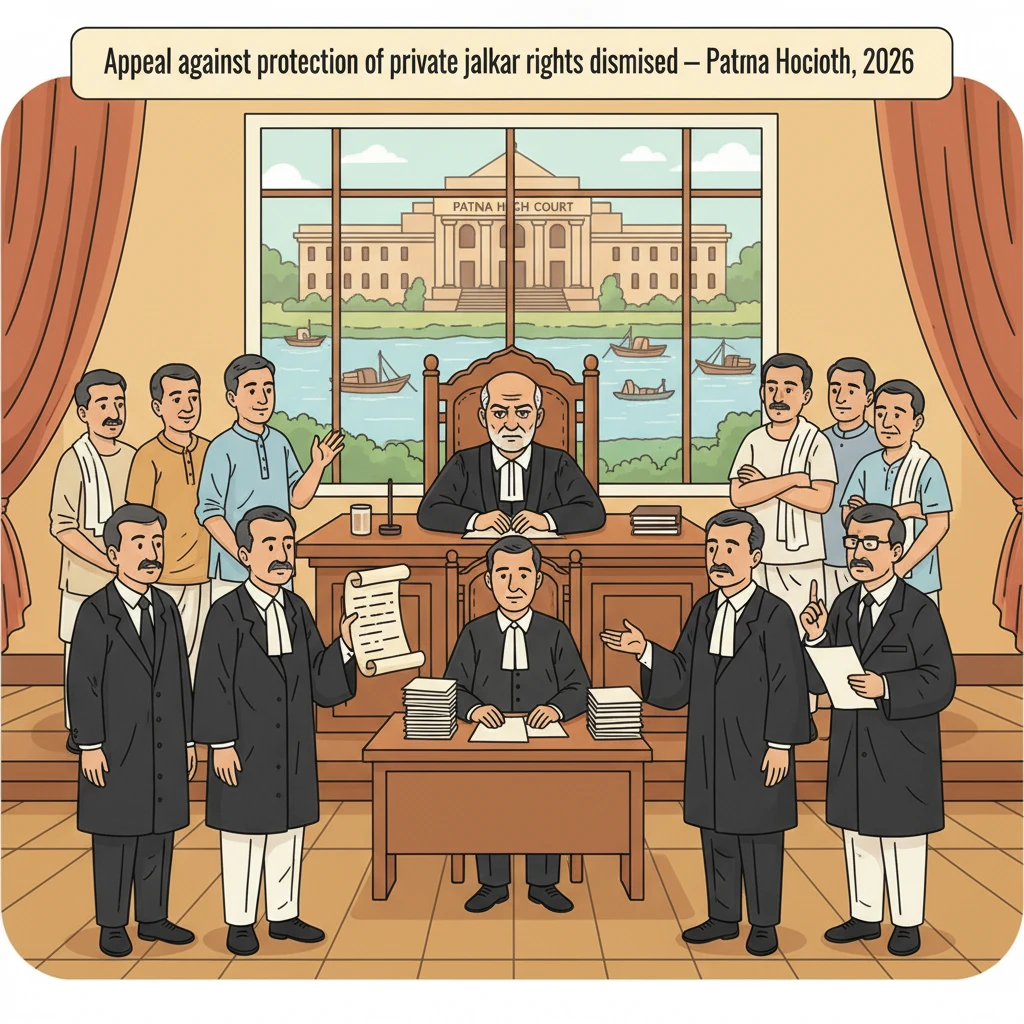
Case Background
This case arises from a long-running dispute over fishing rights in certain water bodies (jalkars) in Naugachia, District Bhagalpur. The jalkars are described in the judgment as “Kharnai Nadi” and “Til Juggadhar”.
Respondent numbers 6 to 9 in the appeal had earlier filed a civil suit, Title Suit No. 23 of 1965. In that case, the State of Bihar was a party. In 1973, on contest, a judgment and decree were passed in favour of those plaintiffs. According to the single judge, that decree recognised their private rights over the jalkars.
Despite this old civil court decree, the State authorities continued to settle the same jalkars in favour of others, by issuing parwanas (settlement orders). The writ petitioners claimed that such settlements were being made in favour of a private respondent, and that their peaceful fishing rights were being disturbed by the State “by applying its might”.
Because of this, respondent numbers 6 to 9 (writ petitioners) approached the Patna High Court in Civil Writ Jurisdiction Case No. 14526 of 2023. They requested protection from interference with their jalkars, and asked for any parwana issued in favour of respondent number 6 for the year 2023–2024 to be produced and quashed. They also sought police protection to exercise their fishing rights.
On 20.01.2025, a learned single judge of the Patna High Court allowed the writ petition in part. The Court criticised the conduct of the State authorities and directed the District Magistrate-cum-Collector, Bhagalpur and the District Fisheries Officer-cum-Chief Executive Officer, Bhagalpur not to interfere with the petitioners’ private jalkars so long as the 1965 title suit decree remains in force.
Aggrieved by this order, Meera Devi Mantri, representing Naugachia Block Matshjivi Sahyog Samiti Ltd., filed the present Letters Patent Appeal (L.P.A. No. 157 of 2025) before a Division Bench of the Patna High Court.
What the Court Examined and Decided
The Division Bench, comprising Hon’ble the Chief Justice and Hon’ble Mr. Justice Sudhir Singh, examined the correctness of the single judge’s order dated 20.01.2025 in the writ case. The core challenge brought by the appellant was procedural: she claimed that she had not got a proper opportunity to file a counter affidavit in the writ petition.
According to the appellant, she had appeared through counsel on 15.01.2025 before the single judge and sought time to file a counter affidavit. By an order dated 15.01.2025, the writ case was directed to be posted on 18.01.2025. The grievance raised in the appeal was that the case was not listed on 18.01.2025, but instead appeared on 21.01.2025, when it was finally disposed of. On this ground, the appellant argued violation of the principles of natural justice.
The Division Bench closely examined the single judge’s judgment. It noted that the submissions made on behalf of the appellant’s counsel had been recorded in paragraph 16 of that judgment. The Bench specifically observed that, even if time had been granted to the appellant’s counsel, she did not utilise that opportunity by filing a counter affidavit.
Therefore, the Bench held that it could not be said that any principle of natural justice was violated. The appellant had been heard, and the failure to file a counter affidavit could not be blamed on the Court.
The Bench then looked at what the single judge had actually ordered. The crucial direction of the single judge, reproduced in paragraph 18 of the judgment, was limited and clear: the District Magistrate-cum-Collector, Bhagalpur, and the District Fisheries Officer-cum-Chief Executive Officer, Bhagalpur, were restrained from interfering with the writ petitioners’ private jalkars until the judgment and decree in Title Suit No. 23 of 1965 remains in existence.
In paragraph 17, the single judge had also severely criticised the State authorities. The Court found that the State was continuously settling the jalkars in favour of private respondents without first challenging the civil court decree of 1973 in Title Suit No. 23 of 1965. The pleadings of the State in paragraph 13 of its counter affidavit before the single judge were said to “border on contempt”, as the State admitted that only after 51 years it was “contemplating” filing an appeal against the 1965 title suit decree.
The Division Bench took note of these observations. During the hearing of the appeal, the Bench asked a direct question to the appellant’s counsel: had the judgment and decree in Title Suit No. 23 of 1965 been challenged anywhere? The answer was “no”. So, as on the date of the appeal, the civil court decree in favour of the writ petitioners remained valid and unchallenged.
The Bench next addressed the legal limits of a Letters Patent Appeal. It emphasised that the scope of a Letters Patent Appeal is very limited and cannot exceed the scope of the original writ petition itself. In other words, the appellate court cannot go beyond the pleadings, issues and materials that were placed before the writ court.
To support this approach, the Division Bench relied on two Supreme Court decisions. First, it cited Netai Bag v. State of W.B., reported in (2000) 8 SCC 262. The relevant observation from that case was that an appeal in continuation of a writ petition “cannot enlarge the scope of inquiry at this belated stage”. This reinforced that in an intra-court appeal, new grounds or wider issues cannot be opened beyond what was argued earlier.
Secondly, the Bench referred to Devilal Modi v. STO, reported in 1964 SCC OnLine SC 17. The Court quoted the Supreme Court’s explanation of the rule of constructive res judicata in writ proceedings. The principle is that if a party could have taken a certain plea in an earlier proceeding but did not, that party cannot later raise that plea in another proceeding based on the same cause of action. The Supreme Court noted that without applying this rule to writ cases, a person could keep filing one proceeding after another, raising new grounds each time, which would be against public policy.
By referring to these authorities, the Patna High Court highlighted that an appellant cannot use a Letters Patent Appeal to raise new points or to expand the dispute beyond what was initially brought before the single judge.
After considering the record and submissions, the Division Bench concluded that there was no “palpable error” on the face of the record in the single judge’s order. The restraint placed on the District Magistrate and the District Fisheries Officer was directly linked to the existing and unchallenged civil court decree in favour of the writ petitioners.
The Court also made it clear that it did not accept the appellant’s contention that she was denied an opportunity of hearing to file a counter affidavit. Since the appellant’s submissions were found recorded in the single judge’s judgment, and no counter affidavit had been filed even after time was granted, the allegation of violation of natural justice had no basis.
In the result, the Division Bench declined to interfere. The Letters Patent Appeal was dismissed, and all pending applications stood disposed of. The single judge’s order, preventing the authorities from interfering with the writ petitioners’ jalkars as long as the 1965 title suit decree stands, continues in force.
Why This Judgment Matters
This judgment is important for people who hold rights under old civil court decrees, especially over land or water bodies. The Patna High Court has clearly indicated that government authorities cannot ignore such decrees and continue to make fresh settlements over the same property without first getting the decree set aside by a higher court.
In practical terms, for fishery cooperatives, traditional fishers and landholders, this means that if a civil court has already recognised their private rights, the administration must respect that decision. Any settlement or parwana issued in disregard of such a decree can be restrained by the High Court.
The judgment also sends a message that an appeal under the Letters Patent is not a second chance to re-argue the case from scratch. The appellate bench will not allow parties to expand the dispute beyond what was raised earlier, and technical complaints about listing dates will not succeed where the party had a fair opportunity to participate.
Legal Issues and Answers
Issue: Whether the appellant was denied natural justice because the writ petition was decided before she could file a counter affidavit.
Answer: No. The Division Bench held that the appellant’s submissions were recorded by the single judge, time had been granted, but no counter affidavit was filed, so natural justice was not violated.
Issue: Whether the Letters Patent Appeal could be used to disturb the single judge’s protection of the writ petitioners’ private jalkars based on an old civil court decree.
Answer: No. Given the limited scope of a Letters Patent Appeal and the unchallenged decree in Title Suit No. 23 of 1965, the Court found no palpable error warranting interference and dismissed the appeal.
Cases Cited by the Court
- Netai Bag v. State of W.B., (2000) 8 SCC 262
- Devilal Modi v. STO, 1964 SCC OnLine SC 17
Case Details
Case Number: Letters Patent Appeal No. 157 of 2025 in Civil Writ Jurisdiction Case No. 14526 of 2023
Case Title: Meera Devi Mantri, Naugachia Block Matshjivi Sahyog Samiti Ltd. v. The State of Bihar & Ors.
Coram: Hon’ble the Chief Justice (Sangam Kumar Sahoo, CJ) and Hon’ble Mr. Justice Sudhir Singh
Citation: 2026 (1) PLJR 608
Advocates: Mr. Baidya Nath Thakur, Advocate for the appellant; Mr. Addl. Advocate General (12) for the respondents
Nature of the Case: Letters Patent Appeal (intra-court appeal) against the order in a writ petition concerning interference with private jalkar (fishing) rights and validity of administrative settlements/parwanas
Link to Judgment: http://Link to Judgment: https://patnahighcourt.gov.in/viewjudgment/MyMxNTcjMjAyNSMxI04=-StIZPjeWN–ak1–0=
If you found this explanation helpful and wish to stay informed about
how legal developments may affect your rights in Bihar,
you may consider following Samvida Law Associates for more updates.







