
Case Background
This criminal appeal was filed under the proviso to Section 372 of the Code of Criminal Procedure, 1973. The appellant is the informant in the case and the father of the deceased.
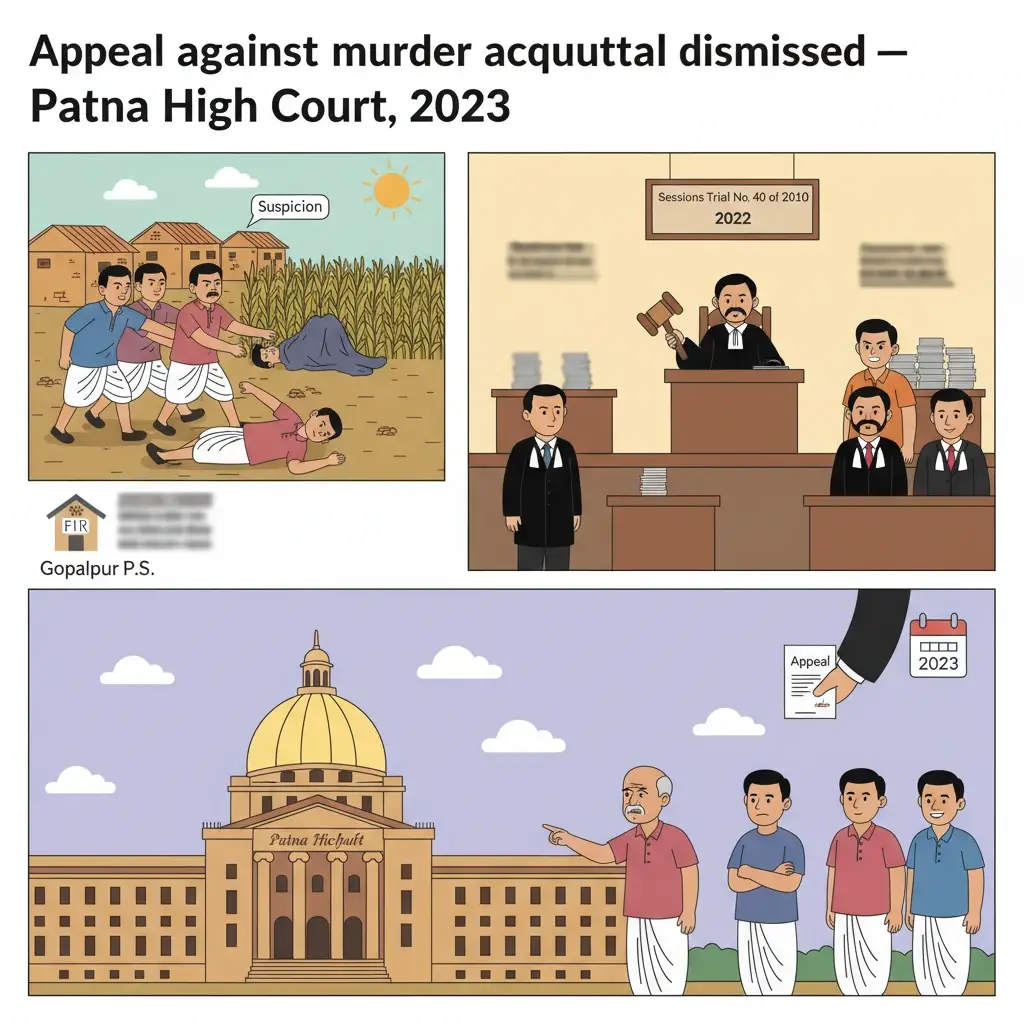
The dispute arose from an incident in village Darhara, under Gopalpur Police Station, District Bhagalpur. The daughter of the Mukhiya of the informant’s village was married to a person in Khagaria. She left her matrimonial home without leaving any clue. On this basis, suspicion arose that the deceased might have helped her to elope from her matrimonial home.
According to the prosecution, harbouring this suspicion, the accused persons, including respondents no. 2 to 4, caught hold of the deceased at his maternal uncle’s place. It was alleged that he was brutally assaulted and killed by use of firearms. His dead body was later found lying in a maize crop field on 27.06.2009.
On this accusation, Gopalpur P.S. Case No. 255 of 2009 was registered for offences under Sections 302, 201 read with Section 34 of the Indian Penal Code and Section 27 of the Arms Act, 1959. After investigation, the police submitted charge sheet against the private respondents and others, showing one accused, Promod Kumar Singh, as absconder.
The learned Magistrate took cognizance of the offences and committed the case to the Court of Session. The learned 3rd Additional District and Sessions Judge, Naugachia, Bhagalpur, framed charges on 01.02.2010 against respondents no. 2 to 4 for offences under Sections 302, 201 read with Section 34 of the IPC and Section 27(3) of the Arms Act, 1959.
The trial was registered as Sessions Trial No. 40 of 2010 (C.I.S. No. 1593 of 2014). On 23.02.2022, the trial court acquitted respondents no. 2 to 4 of all charges. Aggrieved by this acquittal, the informant approached the Patna High Court in Criminal Appeal (DB) No. 699 of 2022 under the proviso to Section 372 Cr.P.C.
What the Court Examined and Decided
The Division Bench of the Patna High Court, comprising Hon’ble Mr. Justice Chakradhari Sharan Singh and Hon’ble Mr. Justice Rajesh Kumar Verma, delivered an oral judgment on 02.01.2023.
The High Court first noted the prosecution evidence led before the trial court. In all, 12 witnesses were examined. These included the informant (father of the deceased) as PW-2, the doctor who conducted the post-mortem as PW-5, and the Investigating Officers as PW-11 and PW-12.
During investigation, statements of two witnesses were recorded under Section 164 of the Cr.P.C. After prosecution evidence was closed, the trial court examined the accused under Section 313 Cr.P.C., putting to them all incriminating circumstances appearing in the prosecution evidence, and gave them an opportunity to explain.
The trial court, after evaluating the oral and documentary evidence, held that the prosecution had failed to prove the role of respondents no. 2 to 4 in inflicting fatal injuries which led to the death of the victim beyond all reasonable doubt. On this basis, it acquitted them.
In the High Court, learned counsel for the appellant argued that the trial court had “miserably failed” to appreciate the evidence of an eye witness, Rupesh Singh. According to counsel, Rupesh Singh had fully supported the prosecution case in his statement under Section 164 Cr.P.C., but later resiled from that statement while deposing at trial. He was, therefore, declared hostile at the instance of the prosecution.
The appellant’s counsel contended that despite Rupesh Singh turning hostile at trial, his earlier statement under Section 164 Cr.P.C. should have been relied upon, at least as part of circumstantial evidence. He referred to Section 145 of the Indian Evidence Act to argue that the trial court ought not to have ignored the Section 164 Cr.P.C. statement of the alleged eye witness. He further submitted that, even on circumstantial evidence alone, the trial court should have convicted respondents no. 2 to 4.
The High Court carefully perused the impugned judgment of the trial court and considered the submissions of the appellant. It specifically noted that no ground was taken in the memo of appeal, nor any submission made at the hearing, to say that the trial court had incorrectly recorded the prosecution evidence in its judgment.
The High Court then referred to important features of the prosecution case as recorded by the trial court. First, the informant (PW-2) claimed he had learnt about the killing of his son on 26.06.2009 itself. However, he admitted that he did not give any information to the police on that day.
On the next morning, he gave an oral information to the police that the accused had assaulted the deceased and that the deceased was missing. This delay and the nature of the initial report were part of the factual background considered by the trial court.
Second, PW-9, the maternal uncle of the deceased, claimed to be an eye witness. However, on cross-examination, the trial court found that he was not actually an eye witness to the occurrence. This significantly weakened the prosecution claim of direct eyewitnesses to the assault and killing.
Third, both PW-2 (informant/father) and PW-9 (maternal uncle) had claimed that the deceased was injured by firearms. But the doctor (PW-5), relying on the post-mortem report, deposed that the ante-mortem injuries were caused by a hard and blunt substance. This contradiction between alleged firearm injuries and medical evidence was noted by the trial court.
The trial court had also discussed the evidence of PW-10, the mother of the victim. She was examined for the first time at trial, five years after the occurrence. Her examination-in-chief took place, but she did not turn up thereafter for cross-examination. As a result, her cross-examination remained incomplete. The trial court, therefore, could not rely on her untested testimony.
The High Court took into account all these aspects as discussed in the trial court’s judgment. The Bench emphasised that the trial court had scrutinised the entire prosecution evidence before acquitting the accused. The High Court accepted the trial court’s finding that no witness at the trial had, in fact, been found to be a genuine eye witness to the incident.
In this backdrop, the High Court examined whether the trial court’s conclusion was a “reasonably possible view” based on the evidence. The Court held that, on close scrutiny, the view taken by the trial court was indeed a reasonably possible view arising from the evidence on record.
This finding is significant because, in an appeal against acquittal, the appellate court usually does not interfere if the trial court’s view is a possible and reasonable one, even if another view is also possible. The High Court did not find any perversity or serious misreading of evidence by the trial court that would justify setting aside the acquittal.
The Bench also did not accept the suggestion that the trial court had ignored the Section 164 Cr.P.C. statement of Rupesh Singh in an unlawful manner. The judgment records that the Court was satisfied that the trial court had duly appreciated all evidence, including the conduct of witnesses, contradictions between statements, and the medical evidence.
Since the prosecution case depended largely on witnesses who either turned hostile, were not in fact eye witnesses, or whose testimony could not be properly tested, and in view of the mismatch between oral accounts of firearm use and medical evidence of blunt force injuries, the High Court found no ground to disturb the acquittal.
Consequently, the High Court held that the appeal had no merit. The criminal appeal filed by the informant under the proviso to Section 372 Cr.P.C. was dismissed. The acquittal of respondents no. 2 to 4 recorded by the learned 3rd Additional District and Sessions Judge, Naugachia, Bhagalpur, in Sessions Trial No. 40 of 2010, stands confirmed.
Why This Judgment Matters
This judgment shows how the Patna High Court approaches appeals against acquittal in serious offences like murder. Even in a case involving the death of a young man and the grief of his father, the Court insisted that conviction must rest on strong, reliable evidence.
The decision underlines that suspicion, however strong, cannot replace proof. Where alleged eye witnesses turn hostile, or are found not to be present at the scene, and where medical evidence does not support the prosecution’s version, the benefit of doubt goes to the accused.
For victims’ families, this judgment is a reminder that appeals against acquittal face a high threshold, especially when the trial court has carefully discussed the evidence. For lawyers and trial courts, it reinforces the need to ensure that witnesses are examined promptly, medical evidence is consistent with the prosecution story, and that statements under Section 164 Cr.P.C. are properly used in line with the Evidence Act, but cannot alone replace trustworthy in-court testimony.
Legal Issues and Answers
- Issue: Whether the acquittal of respondents no. 2 to 4 for offences under Sections 302, 201/34 IPC and Section 27(3) of the Arms Act should be set aside in an appeal by the informant under the proviso to Section 372 Cr.P.C.
Answer: No. The Patna High Court held that the trial court’s acquittal was based on a reasonably possible view of the evidence, and the prosecution had failed to prove the accused persons’ role in causing the fatal injuries beyond reasonable doubt. - Issue: Whether the trial court erred in not relying on the statement of an alleged eye witness recorded under Section 164 Cr.P.C., particularly in light of Section 145 of the Indian Evidence Act.
Answer: The High Court did not find any such error warranting interference. It accepted the trial court’s evaluation of evidence, including the fact that the witness had resiled from his Section 164 Cr.P.C. statement at trial and was declared hostile, and held that the overall appreciation of evidence was proper.
Cases Cited by the Court
- No prior case law has been cited or expressly relied upon in the judgment.
Case Details
Case Number: Criminal Appeal (DB) No. 699 of 2022; arising out of Gopalpur P.S. Case No. 255 of 2009, District Bhagalpur; Sessions Trial No. 40 of 2010 (C.I.S. No. 1593 of 2014)
Case Title: Om Prakash Singh v. The State of Bihar & Ors.
Coram: Hon’ble Mr. Justice Chakradhari Sharan Singh and Hon’ble Mr. Justice Rajesh Kumar Verma
Citation: 2023 (1) PLJR 760
Advocates: For the appellant (informant/father of the deceased): Mr. Rajive Ranjan Singh, Advocate. For the respondent State of Bihar: Mr. Binod Bihari Singh, APP. Advocates for private respondents are not mentioned in the judgment.
Nature of the Case: Criminal appeal (Division Bench) under proviso to Section 372 Cr.P.C. filed by the victim/informant challenging an order of acquittal passed by the Sessions Court in a murder case.
Judgement link ; https://patnahighcourt.gov.in/viewjudgment/NSM2OTkjMjAyMiMxI04=-wX8b1PEgC8Y=
If you found this explanation helpful and wish to stay informed about how legal developments may affect your rights in Bihar, you may consider following Samvida Law Associates for more updates.







