
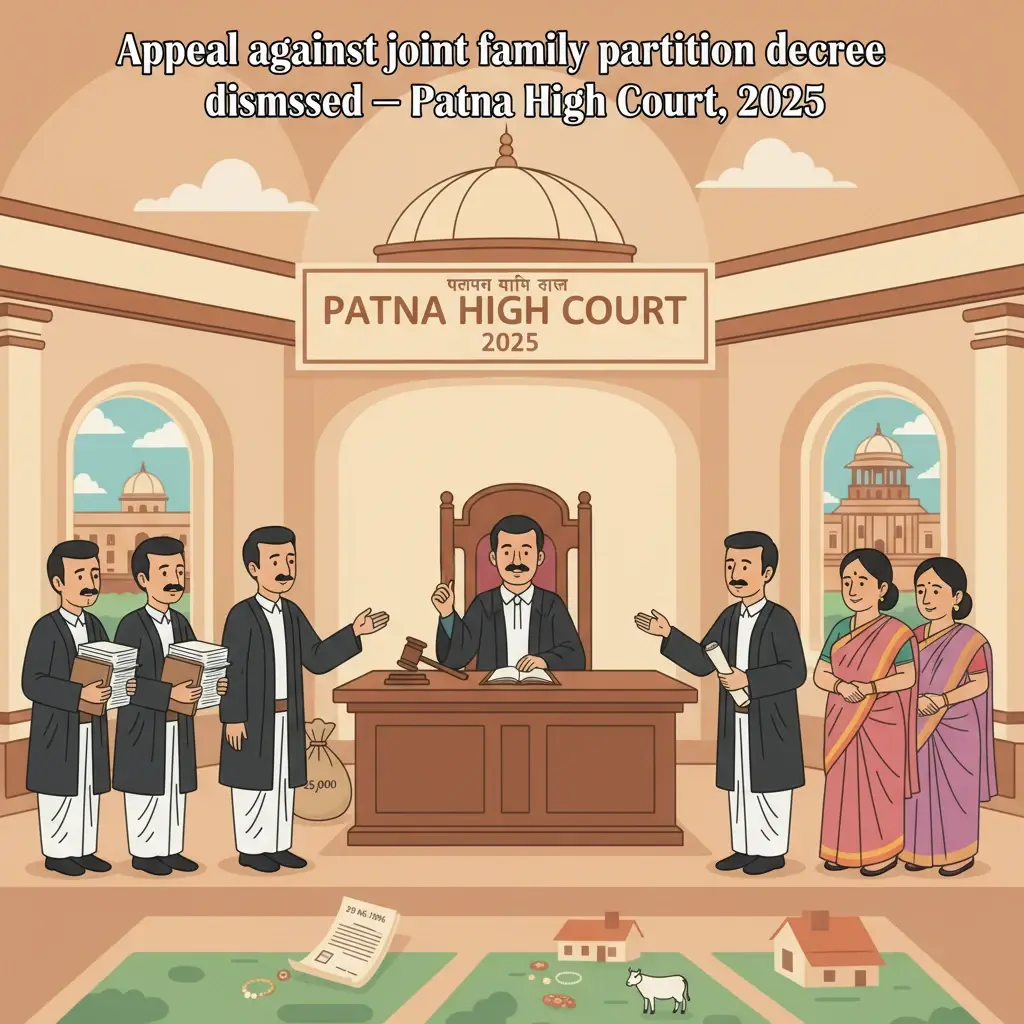
Case Background
This case arises from a long-running family dispute over ancestral property in Village Neemora, Police Station and Block Dhanarua, District Patna. The parties belong to a joint Hindu family governed by the Mitakshara School of Hindu Law, descending from one common ancestor, Raman Singh.
Raman Singh had three sons: Chitu Singh, Mukhi Singh and Jugal Singh. Chitu and Jugal died issueless. By survivorship, the property passed to the three sons of Mukhi Singh: Lal Narain Prasad Singh, Gulab Prasad Singh @ Mohit Narain Singh (defendant no.1) and Bhuneshwar Prasad Singh (defendant no.12).
Lal Narain’s branch consists of plaintiff no.1, plaintiff no.2 and plaintiff no.3. Gulab @ Mohit’s branch includes defendant no.2 Kauleshwar Prasad Singh and his brothers (defendant nos.3 to 8), with defendant nos.9 and 10 being sons of defendant no.2, and defendant no.11 being son of another brother. Bhuneshwar’s branch includes defendant nos.13 and 14. All these branches claim rights in the same ancestral and acquired properties.
In 1974, the plaintiffs filed Title (Partition) Suit No.218 of 1974 (46 of 1986) in the court of Sub Judge VI, Patna. They sought partition of the properties described in Schedules I (lands and houses) and II (movable assets like cattle and ornaments), claiming that all were joint family properties never partitioned by metes and bounds.
On 31.03.1987, the trial court decreed the suit. It passed a preliminary decree granting 1/3rd share to the plaintiffs, 1/3rd share to co-plaintiff nos.4 to 6 (defendant nos.12 to 14), and 1/3rd share to defendant nos.1 to 11. The court also directed that, after the preliminary decree, a Survey Knowing Pleader Commissioner be appointed on petition to carve out separate “takhta” of 1/3rd share for each side.
Defendant no.2 (Kauleshwar Prasad Singh) and his sons (defendant nos.9 and 10), who were arrayed as defendants in the suit, filed this First Appeal No.254 of 1987 before the Patna High Court. They challenged the preliminary decree, mainly claiming that they had already separated in 1957 and that there had been a complete partition among other branches in 1969, so no further partition suit could lie.
What the Court Examined and Decided
The Patna High Court, through Hon’ble Mr. Justice Sunil Dutta Mishra, examined in detail the family history, the alleged earlier partitions, and the nature of one particular purchase of land in 1956, which became the main point of dispute.
The core claim of the plaintiffs and supporting co-plaintiffs (defendant nos.12 to 14) was that the entire properties in Schedules I and II were joint family properties. They asserted that defendant no.1, as the eldest, was the karta and managed joint family affairs and documents. They said there had never been any partition by metes and bounds, though some members had separated in “mess” (separate cooking) only.
They further alleged that defendant no.1 had kept all title documents and also retained about Rs.25,000/-, alleged to be joint family income, and that this too should be partitioned. They claimed 1/3rd share in all suit properties.
Defendant no.1 and his sons (defendant nos.3 to 8) filed a joint written statement, and defendant no.2 with his sons (defendant nos.9 and 10, the present appellants) filed a separate written statement adopting the same stand. They denied unity of title and possession and pleaded that the suit was bad for estoppel, acquiescence and waiver.
They admitted that in 1956, 9 bigha 16 katha of land under touzi no.16257 was purchased from Syed Md. Kadri by registered sale deed dated 29.06.1956 (Ext.1/B), in the names of plaintiff no.1 and defendant no.2, for Rs.5,000/-. But they claimed that Rs.2,500/- of this was from the “tilak” money received by defendant no.2 at his marriage, and the remaining Rs.2,500/- from joint family funds. On this basis, they argued that half of this purchased land was the self-acquired property of defendant no.2.
They further alleged that in Jeth 1957, defendant no.2 had a dispute with his father and step-mother, revolted and sought separation. According to them, a partial partition was done then: defendant no.2 was given half share in the 1956 purchased land plus one decimal of the ancestral house land (survey plot no.484) on the southern side, and in return he renounced all rights in other joint family properties.
They also claimed that after this, defendant no.2 purchased additional homestead land (plot no.478) from one Kapildeo Singh by sale deed dated 12.11.1959 (Ext.A) with his own funds and constructed his own house, living separately with his family. They said movable properties were also partitioned in 1957.
For the rest of the family, they pleaded that in Baisakh 1959 there was separation in mess and business among the three branches, and in Jeth 1969, a complete partition by metes and bounds was done among them. They relied on rent receipts, chaukidari tax receipts, and alleged panchayati “yadast” of 14.07.1973 and another list dated 15.03.1975, to claim that all parties had separate lands and there was no unity of title.
On the other hand, co-plaintiffs (defendant nos.12 to 14) supported the plaintiffs and denied all stories of previous partitions. They insisted that defendant no.1 was karta, that papers were prepared at his instance, and accused defendant no.1 and defendant no.2 of trying to grab more than their legitimate share by setting up false pleas of earlier partition and self-acquisition.
The trial court weighed this evidence and held in favour of the plaintiffs: that there was unity of title and possession, that no partial partition in 1957 or complete partition in 1969 had been proved, and that the 1956 purchase was a joint family acquisition. It therefore passed the preliminary partition decree which was now under appeal.
Before the Patna High Court, the appellants repeated their arguments: that they had separated in 1957; that half the 1956 purchase was their self-acquired property; that documentary evidence and rent/chaukidari receipts showed separation; and that the trial court ignored their witnesses and the compromise/panchayati documents (Exts.A to I).
The High Court first addressed the nature of the 1956 purchase. It noted the settled legal principle, as summarised by the Supreme Court in D.S. Lakshmaiah & Anr. vs. L. Balasubramanyam & Anr., that there is no automatic presumption that property is joint just because there is a joint family, but where joint family nucleus is proved, the presumption tilts towards jointness and the person claiming self-acquisition must prove it.
Here, it was admitted that in 1956 the family was joint, there were about 40–50 bighas of ancestral land, and defendant no.1 was karta. Thus, there was a substantial joint family nucleus capable of funding purchases. The Court held that the initial facts about joint status and family properties were admitted, so the burden shifted to the appellants to prove that half of the 9 bigha 16 katha purchased on 29.06.1956 was truly separate, bought out of tilak money of defendant no.2.
The Court closely examined the pleadings and evidence. In the written statement, it was claimed that Rs.2,500/- from tilak money remained with defendant no.2 and went into the purchase. But in oral evidence, defendant no.1 (DW-6) stated that his uncle Jugal Singh had joint family funds in his hand at the time and that money of defendant no.2 was also given by Jugal, who was karta then. He also admitted that he had no proof of the tilak money.
Plaintiff witnesses, including plaintiff no.1 himself and co-plaintiff Bhuneshwar Prasad Singh, deposed that defendant no.1 was karta and that the 9 bigha 16 katha was purchased from joint family income. On tilak, they said only about Rs.1,000/- was received for defendant no.2’s marriage and that even that much was less than marriage expenses. This directly undercut the appellants’ claim of Rs.4,500/- tilak with Rs.2,500/- supposedly saved and invested.
Defendant no.2’s own testimony was shaky: he claimed Rs.4,500/- was received at tilak, Rs.2,500/- spent on marriage, and the remaining Rs.2,500/- put into the sale deed, but admitted he did not know when the consideration amount was actually paid and that his knowledge came second-hand from the now deceased Jugal Singh.
The Court noted an internal inconsistency in the defence: defendant no.2 claimed half of the purchased land was his self-acquired property, yet also said that when he demanded partition, that same “self-acquired” half was allotted to him in partial partition of Jeth 1957. The Court remarked that if the property was truly self-acquired, there was no question of giving it again in partition.
The Court also observed that at the time of purchase, plaintiff no.1 and defendant no.2 were younger members with no independent income, and there was no material to show that half the land was purchased from tilak funds. It found that the appellants had failed to discharge their burden, and therefore held that the entire land purchased via sale deed dated 29.06.1956 was joint family property.
On the issue of alleged partition in 1957 and 1969, the Court undertook a detailed review of evidence. It was admitted that no written document of the 1957 partition was filed. Witnesses for the defendants gave contradictory versions: some said no written document existed; defendant no.1 said a paper was prepared and handed over to defendant no.2; some witnesses admitted they were not present at the time of alleged partitions; one witness under Section 145 Cr.P.C. proceedings appeared as co-party with defendant no.2, showing closeness.
Defendant no.1 also admitted that jamabandi for the lands remained joint and that no mutation was sought in the Anchal office to record any partition. Ext.1, a sale deed of 04.02.1960 executed jointly by defendant no.1, plaintiff no.1 and co-plaintiff no.4 for family needs, further showed that even in 1960 the family acted as joint owners.
Panchayati efforts and lists from 1973 and 1975 (Exts.B, C, G, I and related documents) were shown to be attempts to settle disputes and complete partition that had not already been finalised. Some schedules were not signed by parties or punches. The Court held that these documents, and the panchayats they reflected, indicated that partition was still under discussion, not already complete.
The Court also emphasised settled legal principles: in a Hindu Mitakshara family, there is a strong presumption of jointness until partition is clearly proved. Separate residence, separate mess or even separate cultivation does not, by itself, prove partition by metes and bounds. Rent receipts and chaukidari receipts in individual names carry limited value; they may only show separate cultivation or convenience, as held in earlier Patna High Court decision in Deoki Mallah vs. Surji Mallahain & Ors. (1999 (1) PLJR 199).
Referring to the Supreme Court’s decision in Shub Karan Bubna vs. Sita Saran Bubna (2009) 9 SCC 689, the Court explained that “partition” is a re-distribution of pre-existing rights and must be clear; “separation of share” cannot be claimed without proof of a proper partition. The appellants could not show such clear division.
After reviewing the oral and documentary evidence, the Court agreed with the trial court that there was no credible proof of partial partition in 1957 or complete partition in 1969, and that unity of title and possession over the suit properties continued.
Finally, the Court reminded itself of the limited scope of interference with trial court’s findings of fact, especially where credibility of witnesses is involved, relying on Madhusudan Das vs. Narayanibai (1983) 1 SCC 35. It found no material irregularity or misreading of evidence by the trial court which would justify overturning its findings.
Accordingly, the High Court held that the trial court’s preliminary decree for partition—1/3rd share for plaintiffs, 1/3rd for co-plaintiffs (defendant nos.12 to 14), and 1/3rd for defendant nos.1 to 11—was correct and sustainable. The First Appeal No.254 of 1987 was dismissed on contest on 21.03.2025, with parties to bear their own costs.
Why This Judgment Matters
This judgment is important for families in Bihar and elsewhere living in joint Hindu families where some members try to claim that they have already separated and therefore cannot be asked to share property.
The Patna High Court made it clear that:
If a family is admittedly joint and has sufficient ancestral property, then any land purchased in the names of junior members is presumed to be joint property unless there is strong proof of self-acquisition.
Simply living separately, cooking separately, or having separate rent or tax receipts is not enough to prove a final partition. Clear, consistent evidence is required to show that the family actually divided its property by metes and bounds.
For victims in similar situations, this judgment shows that a stronger, better-documented case is needed to rebut a plea of “we already partitioned earlier”, especially when the other side produces contradictory and weak evidence.
Legal Issues and Answers
-
Issue: Was half of the land purchased by sale deed dated 29.06.1956 the self-acquired property of defendant no.2 (the appellant)?
Answer: No. The Court held that the entire 9 bigha 16 katha purchased in 1956 was joint family property, as the appellants failed to prove self-acquisition from tilak money. -
Issue: Had there been a partial partition in 1957 between defendant no.2 and others, and a complete partition by metes and bounds in 1969 among the remaining branches?
Answer: No. The Court found no reliable documentary or oral evidence of such partitions and held that the joint family continued. -
Issue: Did unity of title and possession over the suit properties still exist, justifying a fresh partition suit?
Answer: Yes. The Court affirmed that unity of title and possession subsisted and upheld the preliminary decree granting 1/3rd shares to the three branches.
Cases Cited by the Court
- D.S. Lakshmaiah & Anr. vs. L. Balasubramanyam & Anr., 2003 (10) SCC 310
- Shub Karan Bubna alias Shub Karan Prasad Bubna vs. Sita Saran Bubna & Ors., (2009) 9 SCC 689
- Madhusudan Das vs. Narayanibai (deceased) through LRs. & Ors., (1983) 1 SCC 35
- Deoki Mallah vs. Surji Mallahain & Ors., 1999 (1) PLJR 199
Case Details
Case Number: First Appeal No.254 of 1987
Trial Court Case: Title (Partition) Suit No.218 of 1974 / 46 of 1986, Sub Judge VI, Patna
Case Title: Kauleshwar Pd. Singh & Ors. vs. Smt. Pamila Devi & Ors.
Court: High Court of Judicature at Patna
Coram: Hon’ble Mr. Justice Sunil Dutta Mishra
Date of High Court Judgment: 21.03.2025
Citation: 2025 (2) PLJR 469
Advocates for Appellants: Mr. K.N. Choubey, Senior Advocate; Mr. Raj Ballabh Singh, Advocate
Advocates for Respondents: Ms. Shilpi Keshri, Advocate; Mr. Suryajit Prakash, Advocate; Ms. Akanksha Verma, Advocate
Nature of the Case: First Appeal against preliminary decree in partition suit
Outcome: Appeal dismissed; trial court’s preliminary decree for partition affirmed; parties to bear their own costs.
Link to Judgment: Patna High Court Judgment – First Appeal No.254 of 1987
If you found this explanation helpful and wish to stay informed about
how legal developments may affect your rights in Bihar,
you may consider following Samvida Law Associates for more updates.







