

Case Background
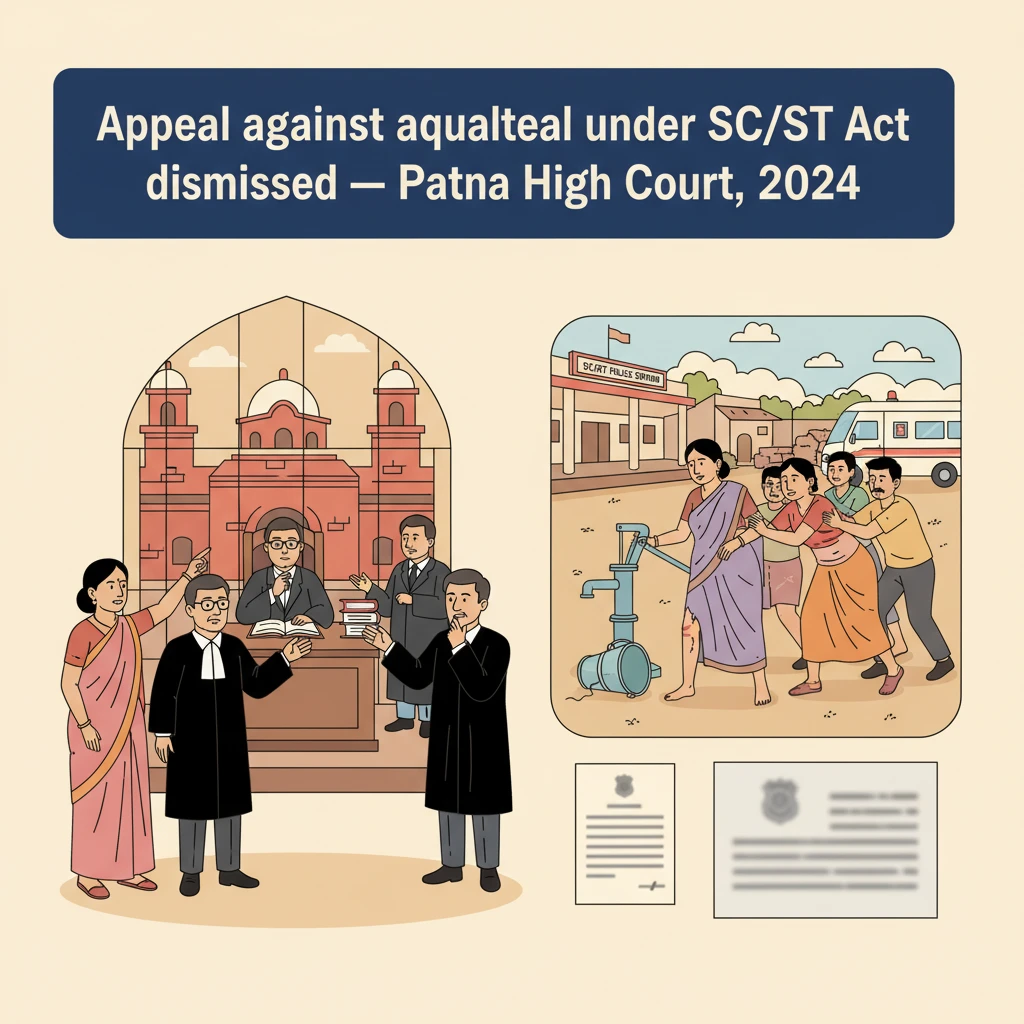
The criminal appeal arose from an incident dated 22.01.2014 in a village in Sitamarhi district, Bihar. The informant, a woman, stated in her written complaint that she went to a government hand pump to fetch water.
She alleged that one co-villager stopped her, questioned her right to draw water from the hand pump by referring to her caste, snatched her filled bucket and threw the water. According to the complaint, other family members of that co-villager then gathered, assaulted her with fists, slaps and lathis, and one person allegedly hit her with an iron rod on her leg and back.
The informant further claimed that two of the accused tore her clothes, leaving her naked, and assaulted her further. On her alarm, her mother and sister reached the spot, and they too were allegedly assaulted while being called by a caste-related term. It was also alleged that one accused snatched a gold earring said to be worth Rs. 20,000 from her mother’s ear.
After the alleged assault, her brother-in-law took her to Sitamarhi Government Hospital for treatment. On the basis of her written information, Sitamarhi Scheduled Caste & Scheduled Tribe Police Station Case No. 04 of 2014 was registered.
The FIR was initially registered for offences under Sections 341, 323, 504, 506, 354, 379, 34 of the Indian Penal Code and Sections 3(1)(x)/3(1)(ii) of the Scheduled Caste & Scheduled Tribe (Prevention of Atrocities) Act, 1989. It was later converted to Sections 341, 323, 504, 506, 354, 379, 34 IPC and Section 3(1)(x)(xi) of the SC/ST Act.
After investigation, the investigating agency submitted a charge-sheet. The trial court took cognizance on 20.02.2016 for the offences under Sections 341, 323, 504, 506, 379, 34 IPC and Sections 3(1)(x)(xi) of the SC/ST Act. Charges were framed on 25.07.2016.
The case was tried as Sessions Trial No. 342 of 2016 / CIS No. 368 of 2016 before the court of the Additional Sessions Judge 1-cum-Special Judge, Sitamarhi. After trial, by judgment dated 29.11.2022, the Special Judge acquitted the accused (respondent nos. 2 to 8) of all charges except Section 323 IPC.
The trial court convicted them under Section 323 IPC (voluntarily causing hurt) and imposed a fine of Rs. 1,000 on each, with a default sentence of three months’ simple imprisonment. This conviction under Section 323 IPC was not challenged in the appeal.
The informant, examined as PW-8 in the trial, filed Criminal Appeal (SJ) No. 1953 of 2023 before the Patna High Court, challenging the acquittal from the other IPC offences and the offences under the SC/ST Act.
What the Court Examined and Decided
The Patna High Court, through Hon’ble Mr. Justice Chandra Shekhar Jha, heard the appeal. The central question was whether the trial court’s acquittal of respondent nos. 2 to 8 from the SC/ST Act charges and other IPC offences (except Section 323 IPC) was legally incorrect and required interference.
The prosecution case at trial rested on oral evidence and documentary exhibits. Twelve prosecution witnesses were examined:
PW-1 Ashma Khatoon, PW-2 Yugal Paswan, PW-3 Devki Devi, PW-4 Shankar Mahto, PW-5 Janu Baitha, PW-6 Rajesh Paswan, PW-7 Indrajeet Thakur, PW-8 Sinku Kumari (informant), PW-9 Rinku Devi, PW-10 Lalita Devi, PW-11 Pramod Kumar Paswan (Investigating Officer), and PW-12 Dr. Himanshu Shekhar (doctor who examined the injured).
The prosecution also produced the following documents:
Exhibit 1 – Signature of the informant on the written application.
Exhibit 2 – Formal First Information Report.
Exhibit 2/1 – Formal First Information Report (another copy).
Exhibit 3 – Endorsement on the written application.
Exhibit – Carbon copy of the medical report.
The defence examined two witnesses, DW-1 Gagan Baitha and DW-2 Kdai Baitha.
During the appeal, the informant’s counsel argued that the prosecution evidence fully supported the allegations. He pointed out that the informant had specifically deposed that she was abused by her caste name and beaten at a government tube-well, which is a public place. On that basis, it was argued that the ingredients of Section 3(1)(x) of the SC/ST Act were satisfied.
The appellant’s counsel further relied on the injuries spoken of by PW-12, the doctor, to say that the occurrence could not be denied outright and that the acquittal on the SC/ST charges and other IPC provisions was therefore perverse and should be set aside.
On the other hand, counsel for the respondents contended that there is a legal difference between “public place” and “public view” under the SC/ST Act. He submitted that merely because the occurrence allegedly took place at a government tube-well, it does not automatically prove that it happened in public view as required for certain offences under the Act.
It was also argued that even from the informant’s own testimony (PW-8), there was no clear statement that she was abused by taking her caste name or that the occurrence took place in public view. On this basis, counsel submitted that the trial court’s findings could not be treated as perverse and should not be interfered with by the appellate court.
The Patna High Court carefully examined the trial court records, including the evidence of all witnesses. It noted first that PW-1, PW-2, PW-4 and PW-5, who were claimed as eye-witnesses, had turned hostile during trial. Nothing useful emerged from their cross-examination by the State that could strengthen the prosecution case or be used to corroborate the supporting witnesses.
More importantly, the High Court emphasised that from the depositions of almost all prosecution witnesses who supported the prosecution case, none had stated during trial that the informant belonged to a Scheduled Caste community. No document to that effect was exhibited either.
This factual gap had already been noticed by the trial court, which recorded the point in its judgment. The High Court agreed that this omission was significant when considering the charges under the SC/ST (Prevention of Atrocities) Act. Without clear evidence that the informant was a member of a Scheduled Caste or Scheduled Tribe, the special provisions of the Act could not be attracted.
After considering the evidentiary record and the rival submissions, the High Court affirmed the trial court’s approach. It held that the prosecution had failed to prove its case against the respondents beyond reasonable doubt with respect to the offences other than Section 323 IPC.
To frame its reasoning within settled law, the Court referred to the Supreme Court judgment in Chandrappa & Ors. v. State of Karnataka, (2007) 4 SCC 415. In that decision, the Supreme Court laid down general principles on how an appellate court should deal with an appeal against an acquittal.
The Patna High Court quoted paragraph 42 of Chandrappa, which states that while an appellate court has full power to review, re-appreciate and reconsider evidence, it must remember that in an acquittal there is a “double presumption” of innocence in favour of the accused. First, every person is presumed innocent unless proved guilty. Second, once a trial court acquits a person, that presumption of innocence is reinforced and strengthened.
The Supreme Court has also held that if two reasonable views are possible on the evidence, the appellate court should not disturb a finding of acquittal recorded by the trial court. Expressions like “substantial and compelling reasons” or “glaring mistakes” are used only to underline the need for caution, not to restrict appellate powers, but they highlight the general reluctance to interfere with acquittals.
Applying these principles to the present case, the Patna High Court concluded that the trial court had not committed any error. The prosecution had not proved key ingredients necessary for conviction under the SC/ST Act, particularly proof of the informant’s caste status and the circumstances of public view. Several key witnesses had turned hostile and there was no supporting documentary evidence on caste.
In view of these gaps, the trial court’s decision to extend the benefit of doubt to the accused on the SC/ST charges and certain IPC offences was held to be justified. The High Court therefore declined to interfere with the acquittal.
Ultimately, the Court dismissed the appeal filed by the informant. It specifically clarified that the dismissal of the appeal would have no bearing on the existing conviction and sentence of the respondents under Section 323 IPC. The respondents retain the legal right to challenge that conviction and sentence separately, if so advised, in accordance with law.
Why This Judgment Matters
This judgment is important for complainants and lawyers handling cases under the SC/ST (Prevention of Atrocities) Act in Bihar and elsewhere. It shows that allegations of caste abuse, even when serious, must be backed by clear evidence that the victim belongs to a Scheduled Caste or Scheduled Tribe.
The Patna High Court underlined that such status cannot be assumed; it must be proved through oral evidence or documents. If this basic element is missing, courts are likely to acquit the accused of offences under the SC/ST Act, even if some violence is otherwise proved.
The decision also highlights how appellate courts treat appeals against acquittal. Even if another view of the evidence is possible, the High Court will be slow to overturn an acquittal unless the trial court’s findings are clearly unreasonable. This protects the presumption of innocence of accused persons.
For victims of caste-based violence, the case underlines the need to ensure that their caste status and the public nature of the incident are clearly recorded in the FIR, statements, and during evidence in court, and supported wherever possible by documents.
Legal Issues and Answers
- Issue: Whether the acquittal of the respondents from offences under the SC/ST (Prevention of Atrocities) Act and other IPC provisions, except Section 323 IPC, was perverse and required interference by the Patna High Court.
Answer: No. The Court held that the prosecution failed to prove beyond reasonable doubt that the informant was a member of a Scheduled Caste and failed to establish other essential ingredients. The trial court had rightly extended the benefit of doubt and its acquittal order was upheld. - Issue: Whether an appellate court should interfere with an order of acquittal when two reasonable views of the evidence are possible.
Answer: No. Relying on Chandrappa & Ors. v. State of Karnataka, the Court reiterated that in such situations, the appellate court should not disturb the acquittal because of the double presumption of innocence in favour of the accused.
Cases Cited by the Court
- Chandrappa & Ors. v. State of Karnataka, (2007) 4 SCC 415.
Case Details
Case Number: Criminal Appeal (SJ) No. 1953 of 2023, arising out of Sitamarhi SC/ST P.S. Case No. 04 of 2014; Sessions Trial No. 342 of 2016 / CIS No. 368 of 2016.
Case Title: Sinki Kumari @ Sinku Kumari v. State of Bihar & Ors.
Citation: 2024 (4) PLJR 84.
Coram: Hon’ble Mr. Justice Chandra Shekhar Jha.
Date of Judgment (High Court): 22.08.2024.
Trial Court: Court of the Additional Sessions Judge 1-cum-Special Judge, Sitamarhi.
Advocates:
For the appellant/informant: Mr. Uday Kumar, Advocate.
For the State (respondent no. 1): Ms. Usha Kumari 1, Special Public Prosecutor.
For respondent nos. 2 to 8: Mr. Rishikesh Rajan, Advocate; Mr. Jainanda Kumar, Advocate; Mr. Abhinay Priyadarshi, Advocate.
Nature of the case: Criminal appeal (special jurisdiction) by the informant against an order of acquittal passed in a sessions trial under the Indian Penal Code and the Scheduled Caste & Scheduled Tribe (Prevention of Atrocities) Act, 1989.
Link to Judgment: Click here to read the full judgment of the Patna High Court
If you found this explanation helpful and wish to stay informed about how legal developments may affect your rights in Bihar, you may consider following Samvida Law Associates for more updates.







