
Case Background
The dispute started with the appointment of a woman officer as Deputy Registrar in Aryabhatta Knowledge University (AKU), Patna.
She was originally appointed as a Child Development Project Officer (CDPO) in the Department of Social Welfare, Government of Bihar, and joined that post on 24.10.2000 in the pay scale of Rs. 6500–10,500.
After about 13 years of service, she was granted the first Assured Career Progression (ACP) in PB-2 with Grade Pay of Rs. 5400.
Later, she applied for a non-teaching post of Deputy Registrar in AKU, Patna, in response to a University advertisement. That advertisement prescribed minimum experience conditions, including either nine years of teaching and educational administration experience, or five years of administrative experience as Assistant Registrar or equivalent. It also provided that this minimum experience could be relaxed on the recommendation of the Screening/Selection Committee.
She was considered and appointed as Deputy Registrar on deputation, while retaining her lien on the CDPO post. Sometime in 2014, she was confirmed in the University service. After her confirmation, she resigned from the substantive CDPO post in 2017. That resignation was accepted with effect from the earlier date of her initial appointment as Deputy Registrar in the University.
Her appointment and confirmation in AKU passed audit scrutiny. Later, a public interest litigation (PIL) bearing CWJC No. 5406 of 2020 was filed, challenging her appointment. During the pendency of that PIL, a private person filed another writ petition, specifically questioning the experience claimed by her, which had persuaded the University to appoint her as Deputy Registrar.
The latter writ petition was disposed of with liberty to that private person to approach the office of the Chancellor of Universities, Bihar, for a “correctional decision”.
Acting on that, the matter was placed before the Hon’ble Chancellor. The challenge was that the writ petitioner did not have the minimum advertised experience for the post. The Chancellor, by order dated 26.09.2023, concluded that although she met the academic qualifications, she lacked the necessary advertised experience for being appointed as Deputy Registrar.
The learned Single Judge who later heard her writ petition found that this order of the Chancellor was communicated to her only on 06.01.2024. On this basis, and after examining records and hearing officials from Raj Bhavan, the Single Judge held that the Chancellor’s order appeared to be ante-dated and also made strong adverse remarks against the Officers on Special Duty (Judicial and University) in the Governor’s Secretariat, and indirectly against the functioning of the Chancellor’s office.
The Single Judge also allowed her writ petition, set aside the termination of her services, and directed that the judgment be placed before the Acting Chief Justice for possible remedial action, including training for the judicial officer posted at Raj Bhavan.
Against these remarks, two Letters Patent Appeals were filed: one by the judicial officer who had been deputed to Raj Bhavan at the relevant time (LPA No. 263 of 2025), and another by the Principal Secretary to the Governor of Bihar (LPA No. 356 of 2025). Initially, merits of the Single Judge’s main decision were also questioned in one of the appeals, but at the time of final hearing, both appellants restricted their challenge only to the adverse remarks and directions against them and the gubernatorial office.
What the Court Examined and Decided
The Division Bench of the Patna High Court, comprising Hon’ble the Acting Chief Justice and Hon’ble Mr. Justice Partha Sarthy, heard both appeals together and disposed of them by a common oral judgment dated 08.07.2025.
The Bench first noted how the Single Judge had approached the main service dispute. The Single Judge had relied on several key factors:
One, the University’s advertisement itself allowed relaxation of the experience requirement on the recommendation of the Screening/Selection Committee.
Two, the writ petitioner had worked in the post for more than a decade before her appointment was seriously questioned, leading to a presumption that the experience requirement had in fact been relaxed in her case.
Three, there was a perceived bar on reopening the decision of the Expert Committee after such a long lapse of time.
Four, the long gap between her initial appointment and the Chancellor’s decision to terminate her services on the ground of defective initial appointment weighed heavily with the Single Judge. The Judge also noted that after being confirmed in the University, she had resigned from her substantive government post, which made the consequences of termination even more severe for her.
Beyond this, the Single Judge criticised the process adopted by the Chancellor’s office, including observations that the Judicial Officer on deputation and another officer had not correctly presented the factual background before the Chancellor, that they had misled him, and that the order dated 26.09.2023 was ante-dated to avoid Supreme Court directions about pronouncing reserved judgments in time.
The Single Judge went on to extract from the record, summon the concerned Officers on Special Duty from the Governor’s Secretariat, and after noting that they failed to give “satisfactory answers” and only tendered oral apologies, concluded that the allegation of ante-dating had merit. On that basis, the Single Judge held them unfit for their positions and directed that they be sent for appropriate training. The judgment also directed that the order be placed before the Acting Chief Justice for appropriate action regarding the judicial officer.
In appeal, the Division Bench made it clear that the High Court, represented through counsel, was not contesting the merits of the Single Judge’s decision regarding the writ petitioner. The focus was strictly on the adverse remarks and directions against the judicial officer and Raj Bhavan officials.
The Bench then recalled well-settled Supreme Court principles on when appellate courts may expunge adverse remarks from judgments. It emphasised that:
Any adverse comment against a party or person should be avoided if it is not necessary for deciding the case on facts. This restraint applies even more strongly when the criticism is against persons or institutions who are not formal parties to the proceeding.
The only justification for such comments is their clear relevance and necessity for adjudication of the dispute. If not necessary, they should not find place in a judgment.
Even where adverse comments may be needed, the person or institution concerned must be given a fair opportunity to place their version on record before the court reaches any final conclusions about misconduct or impropriety.
The Bench stressed that remarks in a judgment should serve a public or legal purpose, not be a mere “mechanical act of cracking whip” on any person or institution. The Court also noted that such comments, especially against a judicial officer, can seriously harm professional reputation and career prospects, including entries in the Annual Confidential Report (ACR).
Referring to Supreme Court decisions such as Dr. Raghubir Sharan vs. The State of Bihar (AIR 1964 SC 1), State of Uttar Pradesh vs. Mohammad Naim (AIR 1964 SC 703), Niranjan Patnaik vs. Sashibhusan Kar (1986 (2) SCC 569), In the matter of ‘K’ A Judicial Officer (2001 (3) SCC 54), and Om Prakash Chautala vs. Kanwar Bhan (2014 (5) SCC 417), the Bench reiterated that:
Judges must maintain restraint, avoid unnecessary rhetoric, and ensure that any strong language is supported by clear reasons and legal principles. Adverse comments should not be made casually, especially against persons who are not parties, or without solid proof.
Reputation is a facet of the right to life under Article 21 of the Constitution and cannot be undermined lightly in the course of deciding a case.
Applying these principles, the Division Bench held that the Single Judge’s conclusion that the Chancellor’s order was ante-dated was not supported by sufficient material. The mere fact that the order was communicated to the writ petitioner later, on 06.01.2024, could not, by itself, justify a firm finding that the order dated 26.09.2023 had been ante-dated.
The Bench clarified that it was not examining or disturbing the main relief granted to the writ petitioner. It only disagreed with the finding of ante-dating and the resulting adverse remarks.
The Bench further pointed out that although the Single Judge had summoned the officers from the Chancellor’s office for clarification, this limited interaction did not amount to giving them a full opportunity of being heard on charges that they misled the Chancellor, concealed facts, or allowed ante-dating of the order. There was no proper procedure where they could put their version on record before the Court reached such serious conclusions.
In the view of the Division Bench, these off-the-cuff observations about ante-dating, misleading the Chancellor, and the Chancellor’s office being dysfunctional were not essential to decide whether the writ petitioner fulfilled the experience criteria or whether her termination was valid. The Single Judge could have decided the writ purely on the legal and factual aspects of her appointment and the Chancellor’s jurisdiction, without casting aspersions on individual officers or the institution of Raj Bhavan.
Since the remarks were held to be irrelevant to the ultimate decision in the writ petition and were made without giving adequate opportunity to the affected officers, the Division Bench categorised them as “unmerited, undeserved and uncharitable”. The Court therefore held that they should not be allowed to stand in the interest of justice and public confidence in institutions.
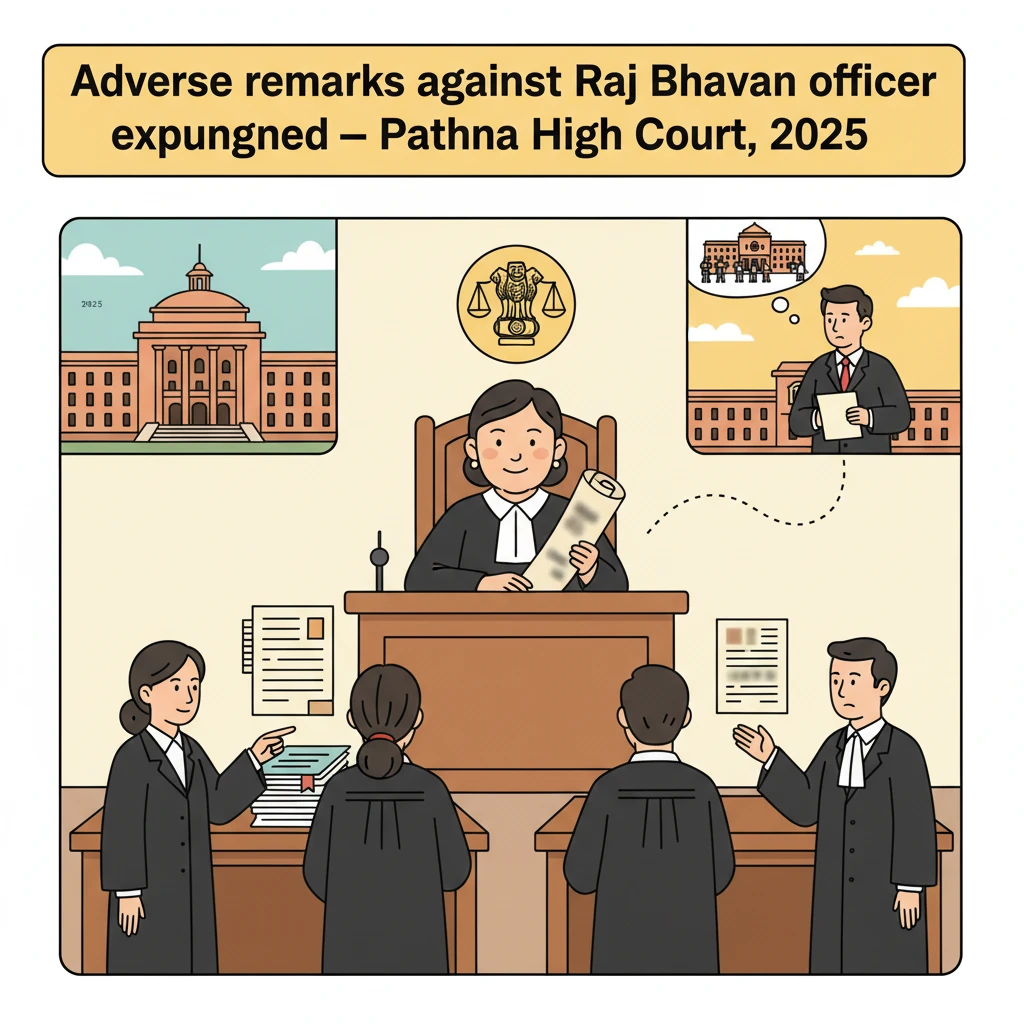
On that reasoning, the Patna High Court expunged paragraphs 52, 53 and 57 to 61 of the Single Judge’s judgment. It also stated clearly that nothing contained in those paragraphs should be treated as a finding against the institution of the Chancellor’s office or against the concerned officers, including the judicial officer on deputation. The Bench further directed that these comments should not affect or “percolate” into the ACRs of those officers.
Finally, the Division Bench disposed of both Letters Patent Appeals on this limited ground, without touching the substantive relief granted to the writ petitioner regarding her service.
Why This Judgment Matters
This judgment is important for government officers, judicial officers on deputation, and university administrators.
First, it reinforces that courts must use great care before making personal or institutional criticism in their judgments. Strong remarks can have long-lasting effects on careers and reputations, especially for officers who are not direct parties to the case.
Second, it clarifies that even when a court finds fault with a decision-making process (for example, in Raj Bhavan or a university), it should focus on correcting the decision, not on blaming individual officers without proper hearing and solid evidence.
Third, for litigants, it shows that the Patna High Court is willing to protect both sides: on the one hand, it did not disturb the relief granted to the University officer whose services had been terminated; on the other hand, it removed unnecessary stigma cast upon Raj Bhavan officials, including a judicial officer, where due process and necessity were lacking.
Overall, the judgment strengthens the idea that judicial power must be exercised with restraint, respect for other institutions, and sensitivity to the constitutional right to reputation.
Legal Issues and Answers
- Issue: Could the Single Judge, while allowing the writ petition of the University Deputy Registrar, validly make strong adverse remarks and findings of misconduct (such as ante-dating and misleading the Chancellor) against Raj Bhavan officials and a judicial officer on deputation?
Answer: No. The Division Bench held that such remarks were not necessary for deciding the writ petition, were made without giving adequate opportunity of hearing to the affected officers, and were based on insufficient material. They were therefore unmerited and had to be expunged. - Issue: Did the Division Bench reconsider or overturn the Single Judge’s main decision granting relief to the writ petitioner regarding her appointment as Deputy Registrar of AKU?
Answer: No. The Bench expressly stated that it was not commenting on the rationale or correctness of the Single Judge’s main judgment in favour of the writ petitioner. It confined itself to expunging the adverse remarks against the Chancellor’s office and officers.
Cases Cited by the Court
- Dr. Raghubir Sharan vs. The State of Bihar, AIR 1964 SC 1
- State of Uttar Pradesh vs. Mohammad Naim, AIR 1964 SC 703
- Niranjan Patnaik vs. Sashibhusan Kar & Anr., 1986 (2) SCC 569
- In the matter of ‘K’ A Judicial Officer, 2001 (3) SCC 54
- Om Prakash Chautala vs. Kanwar Bhan & Ors., 2014 (5) SCC 417
Case Details
Case Number: Letters Patent Appeal No. 263 of 2025 and Letters Patent Appeal No. 356 of 2025, arising out of Civil Writ Jurisdiction Case No. 2965 of 2024
Case Title (LPA No. 263 of 2025): Balendra Shukla vs. The State of Bihar & Ors.
Case Title (LPA No. 356 of 2025): The Principal Secretary to the Governor of Bihar vs. Kumari Anjana & Ors.
Citation: 2025(3) PLJR 540
Coram: Hon’ble the Acting Chief Justice; Hon’ble Mr. Justice Partha Sarthy
Date of Judgment: 08.07.2025
Advocates (LPA No. 263 of 2025):
- For the appellant (judicial officer): Mr. P.K. Shahi, Advocate General; Ms. Surya Nilambari, Advocate
- For the Chancellor: Mr. Rajendra Giri, Advocate
- For the State: Mr. Sarvesh Kumar Singh, AAG-13; Mr. Abhinav Alok, AC to AAG-13; Mr. Ravi Kumar, AC to AAG-13
- For respondent no. 7 (writ petitioner): Mr. Aditya Sahay, Advocate; Ms. Ankita Kumari, Advocate; Md. Fazle Kari, Advocate
- For the University: Mr. Bindhyachal Rai, Advocate; Mr. Sanjiv Kumar, Advocate
- For the Patna High Court: Mr. Ashar Mustafa, Advocate
Advocates (LPA No. 356 of 2025):
- For the appellant (Principal Secretary to the Governor): Dr. K.N. Singh, Sr. Advocate; Mr. R.K. Giri, Advocate; Mr. Amish Kumar, Advocate; Mr. Rajiv Ranjan Kr. Pandey, Advocate
- For the State: Mr. Sarvesh Kumar Singh, AAG-13; Mr. Abhinav Alok, AC to AAG-13; Mr. Ravi Kumar, AC to AAG-13
- For the University: Mr. Bindhyachal Rai, Advocate; Mr. Sanjiv Kumar, Advocate
- For the Patna High Court: Mr. Ashar Mustafa, Advocate
Nature of the Case: Letters Patent Appeals challenging adverse remarks and directions made in a writ judgment; main writ was a service matter concerning appointment and termination of a Deputy Registrar in a State University.
Link to Judgment: https://patnahighcourt.gov.in/viewjudgment/MyMyNjMjMjAyNSMxI04=-42Tej–am1–MSzLc=
If you found this explanation helpful and wish to stay informed about
how legal developments may affect your rights in Bihar,
you may consider following Samvida Law Associates for more updates.







